Showing posts with label Animals. Show all posts

Thursday, April 29, 2021

Deer in the Toad Pool


These two small pools were constructed in an attempt to encourage toad production at Blue Jay Barrens.  The pool in the foreground is in its eighth year and the one behind was constructed five years ago.  Utilization of the pools by breeding Eastern Toads has increased each year.  Thousands of small toads have morphed from these pools to inhabit the surrounding area.  The temporary pools lose their water by midsummer and remain dry for several months.  Aquatic predators that would feast on the small tadpoles do not become established.  Click HERE for more on pool construction.


A multitude of other wildlife species regularly visit these pools.  Indentations in the pool bottom are made by Whitetail Deer that come to drink.


Heavy rains don’t cause the pool water to become cloudy with sediment, so what makes the water occasionally look like this.  Even when the weather has been rain free for several days, the water can suddenly take on the appearance of creamed coffee.  In an effort to discover what was happening, I installed a motion activated wildlife camera set to observe both pools.


I discovered that deer visits were the cause of the muddy water.


This compilation video shows the deer in action.  I don’t know how to explain their behavior.  This doesn’t happen every day, but it’s not uncommon to see it occur several times each month.


Other than developing a coating of silt on the egg strings, the toad eggs are relatively unaffected by the erratic deer activity.


The eggs have hatched and toadpoles are developing normally.  I’m expecting another successful influx of young toads into the local population.

Sunday, February 21, 2021

Harvester Ants

In late October I came across an industrious group of Harvester Ants.  These ants of the genus Pheidole exhibit dimorphism, having two different sizes of workers; a smaller size dedicated to food gathering and general nest chores along with a larger version that uses its extremely large head in defense of the colony. They are primarily seed gatherers and were busy moving spent flowers into their nest.  I assume there were some edible seeds included with the flowers.


The ants had located their nest in a shallow mound of bare soil.  The plants in the upper right of the photo are Draba cuneifolia, a rare winter annual.  I’ll be checking this plant population later in the year, so I’ll take some time then to see if I can identify these ants to species.


As usual, I was behind on the amount of work I had hoped to accomplish for the day, so I only took the time to get a couple of still shots and a short video.  The huge headed individuals seemed to be constantly on the move.  My presence may have disturbed their normal behavior, but I didn’t notice them until I was almost on top of the nest, so I don’t know what they were up to a few seconds earlier.

Sunday, November 15, 2020

Northern Black Widow

Blue Jay Barrens is located in a part of Ohio that has an ever increasing population of Whitetail Deer.  As a result, I commonly find deer bones, particularly skulls.


Skulls tend to remain intact longer than any other part of the deer skeleton.  This longevity makes the weathered skull an ideal living space for a variety of small animals.  In this case the brain cavity is being used by a spider.


Closer examination shows the occupant to be a Black Widow.  I have found several of this type of spider and in every case they have been living inside an old deer skull.


The spider kept moving around and finally positioned itself with the ventral (underneath) surface facing in my direction.  The red markings on the abdomen allowed me to identify this specimen as a female Northern Black Widow, Latrodectus variolus.


Another view of the ventral surface showing the trademark red hourglass shape.  The top and bottom sections of the hourglass on the Northern Black Widow are separated by a black band.


The Northern Black Widow displays a variety of red markings on the dorsal (upper) surface of the abdomen.  The spider is upside down in this view.  A red stripe begins at the spinnerets and continues along the center line of the abdomen.


The red stripe transitions into a series of red spots, making for quite an attractive spider.


I found this spider living on a dry, south facing slope.  This provides the warm, dry conditions preferred by the Black Widow.  All of my Black Widow encounters have been in this same type of habitat.  Following my photo shoot, the deer skull, with spider alive and well inside, was replaced as it was originally found.


Friday, September 25, 2020

Little Pink Moth

I noticed a tiny pink blur floating randomly through the tall grass.  It took a couple of minutes before it finally settled atop an Orange Coneflower, Rudbeckia fulgida.  Once it was at rest, I was able to get a good look at this little pink moth.  Officially known as the Inornate Pyrausta, Pyrausta inornatalis, many people appropriately refer to this species as simply the Little Pink Moth.


This is a southern species that ranges as far north as Kentucky.  I’ve never before seen it at Blue Jay Barrens.  INaturalist shows a few scattered sightings in the southern half of Ohio.  It will be interesting to see if it becomes a permanent addition to the local fauna.


My grandmother’s house was painted the exact color of this moth.  Her house shined like a beacon among all of the others on the block.  If I had named this moth, I probably would have called it Gram’s House.


The short video shows the moth nectaring on the coneflower.

Tuesday, May 19, 2020

Hermit Thrush

I am trying to compile a photographic record of all plants and animals found at Blue Jay Barrens.  At the moment, I am capturing images only as opportunity allows.  Beginning next year, this photography project will share the top priority slot in my list of management activities alongside invasive species control.  While taking a break from my woodland management activities, this Hermit Thrush took up an easy to view position not far in front of me.

I usually have an awful time photographing birds anywhere else than at my feeder.  In this case, despite an abundance of sight obstructing tree trunks, thickly branched shrubs and fallen limbs, the thrush continually chose resting sites that afforded me an unobstructed view.

The Hermit Thrush is a rare nester in Ohio.  This one was probably on its way north.

I was lucky enough to view this bird capturing and consuming an earthworm.


In addition to still photos, I am attempting to get a short bit of video of each species.  So far I’ve captured a lot of video of unmoving animals that occasionally blink or swallow.  The Hermit Thrush was kind enough to capture a worm just as I got it in my view finder.  The video above has not been edited to remove the shaky portions, because that would have removed most of the video.  If camera motion bothers you, do not watch this video.

Monday, September 30, 2019

Pileated Woodpecker

Sometimes you don’t even have to search for an interesting photographic subject.  I was lounging beneath a large cedar tree, waiting out a light drizzle of rain, when I heard some activity in the vegetation almost directly in front of me.  About the time I got my camera set up, a Pileated Woodpecker stuck its head up and took a look at me.

This is the largest of our Ohio woodpeckers and is always a treat to encounter.  I thought my presence was going to drive it away.  I just kept still and waited.  Humans are much less threatening when their facial features are hidden behind a camera.

My presence apparently didn’t cause the bird any alarm, because it continued tearing into a rotten stump in search of insects.


I’ve been trying to shoot some video of my photo subjects when possible.  The video shows the woodpecker breaking into a nest of ants. It’s particularly interested in grabbing the white colored larvae.  It snaps up what is readily available and then uses its tongue to probe into crevices to haul out any hidden morsels.  I stopped filming when the bird shifted around to the back of the stump.  It stayed out of sight for a few minutes before flying off.

Sunday, May 12, 2019

Salamanders in the Drain

My house in Southern Ohio sits atop a small cellar that was part of an old farm house constructed in 1875.  A drain pipe runs from the cellar to a point near a seasonal pond in front of the house.  During the wet season, a seasonal spring emerges from the brick in one corner of the cellar and flows across the floor to the drain.  For some reason, beginning just a couple of years ago, salamanders have been coming up the drain and making themselves at home in the cellar.  Here are a few species that wandered in this past winter and spring.

Jefferson Salamander – This species is the first to arrive at the pond during the breeding season.  They sometimes lay their eggs as early as December.

Streamside Salamander – This uncommon salamander is almost identical in appearance to the Smallmouth Salamander.  The main difference between the two species is in the location and method of laying eggs.  Smallmouth Salamanders breed in still pools and deposit multiple eggs in a jelly-like mass.  Streamside Salamanders breed in small headwater streams or pools and deposit their eggs singly, but in close proximity so as to form a grouping of several eggs, beneath rocks, logs, leaves or other flat bottomed debris. Streamside Salamanders begin their breeding activities very soon after the Jeffersons.

Red-Spotted Newt – Adults of this species are typically found in permanent bodies of water, but they are also able to survive in seasonal pools that are dry during the summer and early fall.

Southern Two-Lined Salamander – I don’t normally find this species far from rocky creeks.  The instinct to disperse is present to some degree in all animals.  When conditions are right, the animal just takes off and travels.  Some die and some colonize new areas.  This individual may have been in dispersal mode.

Marbled Salamander – This species lays its eggs in the fall in locations that will contain water when the end of year rains begin.  Once inundated, the eggs hatch.  Adults commonly wander during late winter and spring rains.  I’ve lived here for 34 years, but it was just two years ago that I saw my first Marbled Salamander.  That individual was found in my cellar.  Even though I’ve seen this species each year since, all individuals have been found in my cellar.  I’ve yet to encounter one outdoors.


On warm days, I gather up the visitors and release them outdoors.  There is an old brush pile just upstream of the pond that seems to me to be an ideal release point.

Monday, August 27, 2018

Pipe Organ Mud Dauber Wasp and Parasitic Fly

About two weeks ago, while sitting on the front porch cleaning my boots, I heard the unmistakable buzz of a female Pipe Organ Mud Dauber, Trypoxylon politum, sealing up a brood chamber inside her nest. This species of wasp uses mud to construct a long tube which it divides into individual compartments, each of which will be loaded with a collection of venom paralyzed spiders to be used as a food source for a developing wasp larva. I looked over and saw that the female wasp was in the process of sealing off the bottom chamber of a long tube nest.

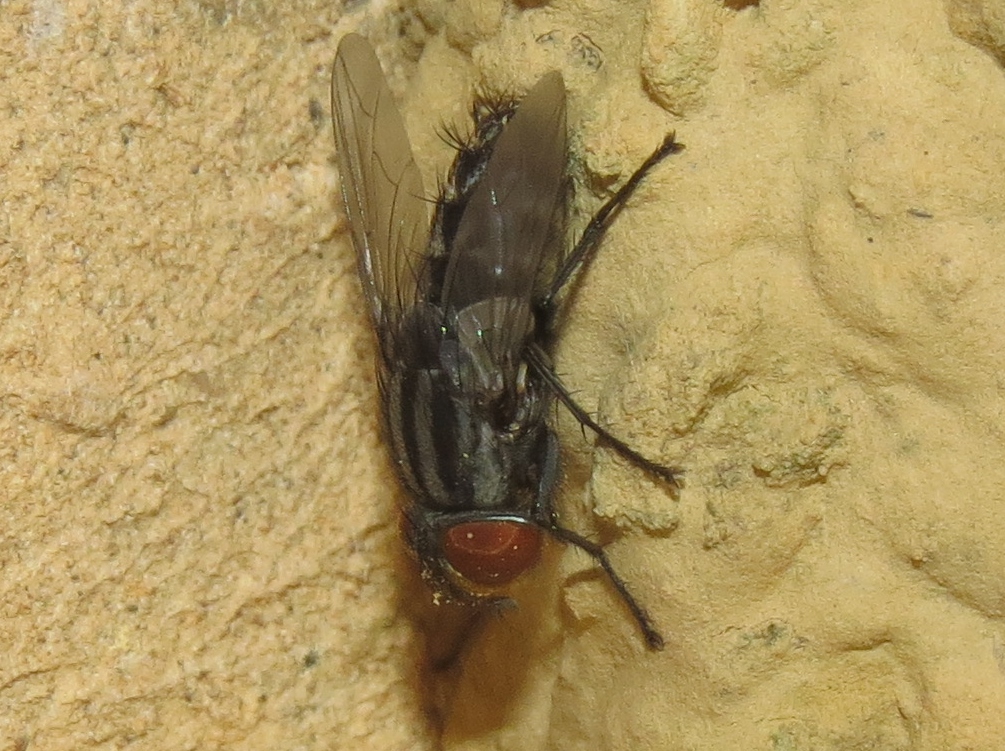
I was not the only one interested in this activity. A female Tachinid fly was stalking around the entrance to the nest, waiting for an opportunity to sneak in and leave one or two of its eggs inside the brood chamber. Gaining access was not an easy process. While the female wasp was away gathering more mud, the male wasp moved in to guard the nest entrance.

Eventually, as the female wasp put the finishing touches on the bottom seal of the brood chamber, the male wasp moved away and allowed the fly to slip in.

The video above shows the female wasp bringing in mud to seal the last brood chamber, the male wasp performing its guard duty and attending to the female, and the fly skirting around the entrance to the nest and finally seizing its opportunity to enter. A longer version of this video can be seen on YouTube by clicking HERE.

Yesterday I spotted this fly resting on the outside of the tube nest. It was obviously freshly emerged and its appearance was marred only by a few crumbs of dry soil matching the color of the nest.

Not far away from the fly was the hole through which it had escaped the wasp brood chamber.

I scraped a bit of soil away from the site of the exit hole and discovered the empty pupal case left behind by the fly.

Further excavation revealed what was left of several spider carcasses and what looked to be additional fly pupae.

Here’s what was inside the chamber. There was evidence of three Tachinid fly pupae.  The larvae had feasted on the spiders, leaving only empty husks behind.

Two pupae were intact, containing flies that would probably soon be emerging. A single empty case was left by the fly I had observed earlier.

Pipe Organ Mud Daubers frequently construct their nests on my porch. Some of the holes in this nest from last season were probably made by emerging wasps, but I know that several were made by foraging woodpeckers.


Closer examination of the old nest reveals smaller holes that are just the right size for an emerging fly. I imagine this fly and wasp a game is a common occurrence on my front porch.

Friday, July 20, 2018

Eastern Hognose Snake

I recently had an interesting encounter with an Eastern Hognose Snake. The snake had gotten itself caught in the mesh of a rat trap that had been set in my barn. My primary concern was releasing the snake from the grip of the wire before it injured itself, so I only took it couple of quick photos before beginning the rescue operation. By snipping and bending a single wire, I was able to quickly release the snake from the trap.

Hognose snakes have a wide repertoire of harmless defensive actions that they employ when they feel threatened. This individual went through the entire routine. It began by flattening of its head and neck in an attempt to look more threatening. As I snipped the cage wire, the snake hissed loudly and produced a guttural noise that sounded almost like a growl. It struck repeatedly at my hands and arms, but its mouth was not open, so all I felt were taps from its nose. As I slid the snake’s body out of the trap, it imitated a death spasm and released a highly pungent poop that splattered on everything nearby. It was an unfortunate circumstance that, due to an ongoing severe thunderstorm, I was performing the rescue operation on the covered front porch of the house.

The next stage in the snake’s act was to play dead. It hung limply from my hand as I took it out for release next to the barn.

Upon being set down, the snake rolled onto its back with mouth agape. 

The above video shows the snake repeatedly rolling over onto its back after being placed belly down.


I left the snake draped around a piece of wood, upright but still looking very much dead. When the thunderstorm abated a few minutes later, I went out to check and found that the snake had moved on. Hognose snakes feed on toads. It’s for this reason that I have been constructing breeding pools in hopes of increasing the toad population. More toads mean more Hognose Snakes, and that’s what I would like to see.

Thursday, July 12, 2018

Edwards' Hairstreak Butterfly Census 2018

Since I don’t actually count the butterflies or produce any type of tally, my annual observations of the Edwards’ Hairstreak Butterfly can’t really be called a census.  What I do is search appropriate habitat at Blue Jay Barrens to get an idea of current size and distribution of this uncommon butterfly.

Each year, I find butterflies in new locations and in concentrations larger than the year before.

Edwards’ Hairstreak Butterflies were quite rare when I first surveyed this property 33 years ago.  It took years before I found my first specimen.  Subsequent annual searches resulted in sightings of just a few individuals or, in some years, no sightings at all.  Now I can find that many or more sharing a single flower cluster.

One of my first management projects was to make the property more suitable to Edwards’ Hairstreaks.  I cleared Eastern Red Cedar from the fields to promote prairie like habitat, and encouraged the growth of Blackjack Oak, the Edwards’ Hairstreak preferred larval food. 

As habitat improved, the number of butterflies increased.  Nectar plants also responded to the management efforts and increased in number.  Butterfly Weed, a favorite of the hairstreaks, is now common in most areas containing butterfly colonies.

A few years ago it was uncommon to see more than a single Edwards’ Hairstreak on a clump of Butterfly Weed flowers.  Now the butterflies visit the blooms in masses.  There are 10 butterflies clearly visible nectaring on Butterfly Weed in the above photo.  There are still suitable areas not yet being utilized by the butterflies, so butterfly numbers have the potential to increase for many years yet.


The above video shows some Edwards’ Hairstreak nectaring action.  A few Honeybees are also trying grab some of the nectar.  Near the end of the video, one butterfly appears to headbutt another away from his flower cluster.  This video can be viewed on YouTube by clicking HERE.