Even though it is a most common butterfly throughout the
State of
Ohio,
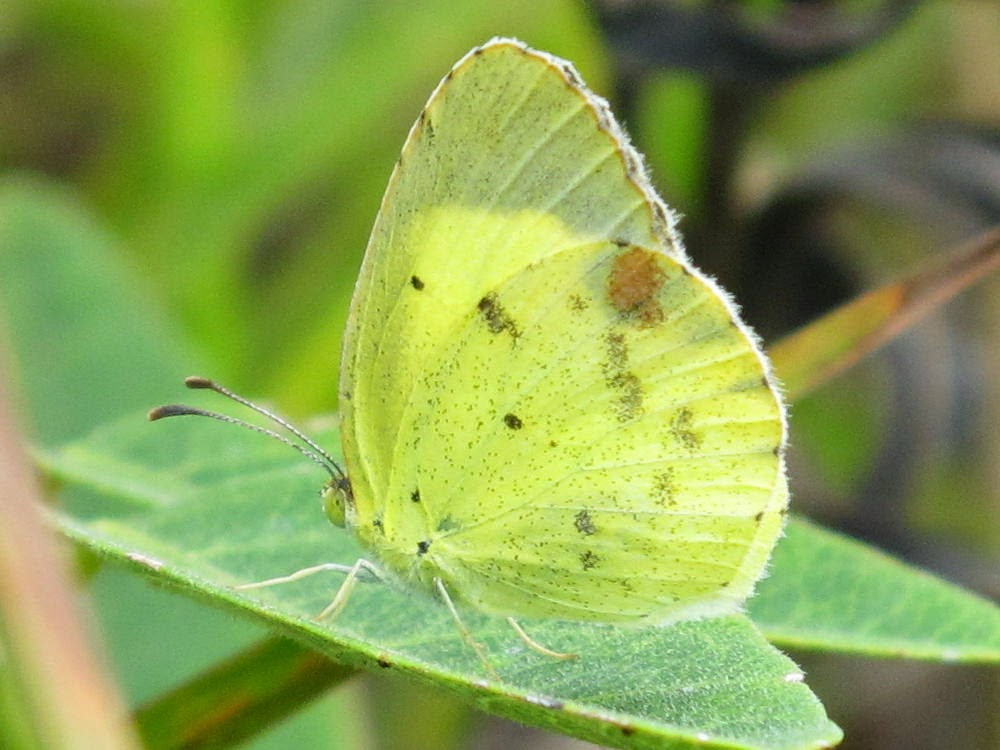
the Clouded Sulphur butterfly is an uncommon find at Blue Jay Barrens.
That is most likely because the Red and White
Clovers upon which the Clouded Sulphur caterpillars feed is practically absent
on this property.
During my childhood, Clouded Sulphurs were a particular
favorite of mine.
No matter where we
happened to be living, nearby agricultural fields abounded with Red Clover and
with that plant came the butterflies.
My
net captured hundreds of this species, which I would inspect closely and then
release.
Clouded Sulphurs are common puddlers and will often blanket
a small patch of mud.
I used to race
through mud holes, raising clouds of butterflies.
It is fortunate that these butterflies are so
quick to return to their mud.
As an
eight year old, I had little patience for waiting on butterflies to regroup for
my next run.
Mud holes are also uncommon in the well drained soils of
Blue Jay Barrens.
The pond bottom is
about the only decent place for puddling butterflies to gather.
Besides the resident Clouded Sulphur, Blue Jay Barrens has a
couple of migrant Sulphurs that show up each summer.
This is the Cloudless Sulphur, a species that
regularly shows up here in August.
The
largest of the Sulphurs, this butterfly presents a bright lime-green appearance
when in flight.
The large spots on the
wings identify this individual as a female.
It’s possible that she will deposit eggs on some of the abundant Wild Senna
growing in this field, but none of her offspring will survive the winter
weather experienced in this area.
Next
year’s Cloudless Sulphurs will come here from southern states with milder
winters.
Thistle flowers are a favorite of this species.
These butterflies fly much faster than the
average person can travel through the field, so chasing one down is problematic.
The easiest place to view them is on thistle
flowers.
The Little Sulphur is the smallest of the Sulphurs.
It flies close to the ground and weaves its
way through the tall vegetation.
Its
small size makes it appear quite moth-like as it moves from one location to the
next.
The best time to view this species is early in the morning,
before the dew dries and the butterflies warm up.
At that time, disturbed individuals will only
move a short distance before settling back down.
This is another migrant that moves in each
year from more southern states.
Perhaps
one day it will actually be a resident of this area.




 Despite the cold, dry weather and the lack of nectar sources, I’m still seeing several butterflies around Blue Jay Barrens. The most abundant is the Buckeye. This is a southern immigrant that won’t survive the winter in Ohio. I can’t remember a year where I’ve seen this many Buckeyes.
 The occasional Clouded Sulphur can still be found in the field. This is a common resident that is normally abundant every year.
 The Variegated Fritillary is another immigrant. I don’t see this species very often at Blue Jay Barrens. I’ve seen several during the past month.
 Meadow Fritillaries have been especially abundant this year. They prefer a moist habitat, so it’s interesting that I’m seeing so many in this super dry year. Maybe the abundant rainfall early in the year set the stage for a population explosion of this species.
 Checkered Skippers are still abundant, but they seem to have ceased their egg laying activities. Most of the individuals I see are just resting spread-winged in the sun.
 There must be a lot of butterflies around if they’re all trying to squeeze into the same picture. This year has had an extraordinary abundance of butterflies. I hope the butterfly bonanza continues on into next year.
 Clouded Sulphurs, Colias philodice, are one of the most common butterflies in Ohio and can be seen in practically any open area. They are also kind of jumpy when approached and I’ve had a lot of trouble getting a descent picture of this species. My luck changed yesterday when I got this shot of a Clouded Sulphur nectaring on Butterfly Weed.
 While I was viewing the first photo to see if it was at all in focus, a second individual landed on the same milkweed plant. This is a white color morph of the same species. It’s not uncommon for female Clouded Sulphurs to be very light yellow or completely white. How very fortunate to get identifiable shots of both colors.
 Then my luck got even better. Sulphurs rarely open their wings while sitting, so it’s really difficult to get shots of the upper wing. The yellow individual suddenly began a courtship display in front of the female. He hovered and she responded by opening her wings and raising her abdomen. Males of this species have a solid black border along the outside of the wings, while females have a series of spots within the black border of the front wing.
 Next came a bouncing display by the male. While hovering, he would rise several inches and then drop suddenly almost on top of the female’s head. The female produced several quivers and wing flaps during this part of the display.
 Suddenly, the male shot into the air. The female was quick to follow and they began performing a tight circling maneuver that made them appear as a load of laundry tumbling in the drier. As quickly as it began, it was over and the two broke apart and headed in separate directions.
 The male came back to the Butterfly Weed and resumed drinking nectar. I guess something just wasn’t right for the two to mate. Maybe the whole thing was performed just so I could get a few pictures.