Showing posts with label Water Garden. Show all posts

Wednesday, June 17, 2015

Blue Dasher Dragonfly

I love to sit on the front porch and watch the dragonflies chase around above the Water Garden.  The Blue Dasher is an abundant and entertaining member of the group.

Males of the species are most noticeable as they perch on vegetation near the water.  They will typically choose the highest point on a plant stalk from which to sit and observe, but when the rushes bend down the dragonflies will take a position on the highest point of the arc.  From this vantage point they will rush out to capture small flying insects or chase away rival males.  There are so many things that need chasing that the males are seldom still for very long.

The females are more secretive and less often seen.  They will perch to watch for suitable insect prey, but they don’t go in for the aerial acrobatics associated with protecting a territory.  That and their more drab coloration, tends to keep them from being noticed.

A female hovering close above the water usually indicates an individual searching for a suitable location to deposit eggs.  The downdraft from her wings produces a pattern of rough water similar to that below a hovering helicopter. 

Egg release occurs when the female dips down and touches the tip of her abdomen to the water.  Several hundred eggs can be released a few at a time in less than a minute.  Each egg will produce an aquatic nymph that will stalk the depths of the Water Garden in search of aquatic prey.

This short video shows the female depositing eggs into the water.  The white eggs can be seen falling through the water after each dip of the abdomen.  Click HERE for the higher quality YouTube version of the video.

Monday, June 15, 2015

Water Garden Predators

The Blue Jay Barrens Water Garden will be celebrating its 15 year anniversary this summer.  On August 4, 2000 I installed a liner into the completed excavation and diverted runoff from downspouts in the front of the house to the leak proof pool area.  Two days later, a light rain put an inch of water in the bottom of the pool, and that night, treefrogs deposited several egg clusters.  Since then life in the pool has been in a state of constant change.  Each year is a new experience with new players, both plant and animal, finding a place in this tiny pool.  Most conspicuous in the pool these last few years has been a growing number of predators that feed on the masses of small animals attracted to a permanent body of water.

All plants in the Water Garden are native to this area, with the exception of the Water Lilies.  I’ve had a desire for a pool of Water Lilies for most of my conscious life, so I bought some tubers, planted them in weighted tubs and put them into the Water Garden.  After a couple of years, the Water Lily root mass grew so large that it floated the pots to the surface.  My thought was to transplant the tubers into larger pots with heavier weights, but when I hauled the plants out of the water I found that the lily roots had completely enveloped the pots.  I settled for adding more weight by strapping bricks around the outside of the root mass.  This worked for a couple more years, then up came the root masses with all of my bricks neatly hidden inside.  At that point I decided to just leave the lilies alone.  Now the root masses rise to the surface each summer with the growth of new roots and then sink again in the fall as the roots die back.  Islands created by the root masses are becoming populated with a variety of aquatic plants that don’t mind a winter long emersion.

In last few days there has been a mass emergence of damselflies from the pool.  The shed skin of the aquatic nympth is left behind by the newly emerged adult form.

Both the aquatic and adult forms of damselfly are predators.  Adults capture and consume small flying insects, while the aquatic nymphs feed on insects, tadpoles, fish, worms and anything else small enough to be captured and held.

Adults seem to emerge most often under the cover of darkness.  In the morning, newly emerged individuals can be found resting on stable structures near the water.  It takes a while for the wings and exoskeleton to harden, and for the full coloration of the adult to develop.

Unlike most other damselflies, Spreadwing Damselflies hold their wings slightly apart.  These damselflies are slightly larger than the average.

This is one of the Bluet Damselflies.  This is a small, delicate Damselfly that is quite common here at Blue Jay Barrens.

Male and female bluets join in tandem for mating and egg laying.  This pair is insuring a supply of Damselflies will be around next year.

Aquatic plants growing in pots set on a shallow shelf at the edge of the Water Garden have long since escaped confinement and found their own anchorage.  A tangle of rush stalks and other dead vegetation give a foundation for an assortment of water loving vegetation.  Some were planted when the Water Garden was first filled, but most have arrived by more natural means.

The thick vegetation may be a place of safety for some, but it also harbors a healthy population of predators.  These young spiders have just recently emerged from heir silken egg sack.

Most of these will fall to larger predators or relocate far distant from here, but several will stay and grow to adulthood in the lush vegetation of the Water Garden.

Red-spotted Newts are the top of the line submerged predator.  They can detect the slightest movement and will investigate any creature their own size or smaller.  If they can fit it in their mouths, they will eat it.  I don’t believe you can stuff a newt so full that it would stop trying to eat more.  Males like this one are continually cruising the pool looking for food and for breeding opportunities.

Female newts typically remain more hidden, but they are still alert for anything that may be food.

When newly hatched, salamander larvae are heavily preyed upon by the newts.  As the salamanders  grow, they become a predator as efficient as the newt.  The difference between the two is that the salamander only spends a portion of its life in the pool.  It will soon mature into a land dwelling form and take off for a more terrestrial lifestyle.

Bullfrogs are probably the most aggressive above water predators in the Water Garden.  As long as he can avoid the notice of Minks, Raccoons and Herons, this guy should have no problems.  Anything smaller than this guy’s mouth is in danger of being eaten.  Bullfrogs are typically just temporary visitors and after a few weeks will move on to new hunting grounds.  If it ever rains here again, this frog will probably move on.

Adult Green Frogs have a chance of competing against a large Bullfrog, but those that have just recently transformed from the tadpole stage are just Bullfrog food.  This young frog has just lost the last of its tail stub and is watching for a flying insect to come within grabbing distance.

Gray Treefrogs have a tough time competing in a permanent pool.  Predators make quick work of the newly hatched tadpoles and the adult frogs are in danger of becoming a Bullfrog meal.

Northern Water Snakes will also make a meal of tadpoles and frogs.  There are at least two mature water snakes now living in the Water Garden.  They arrived here as youngsters several years ago and have been growing steadily since.

I’ve resigned myself to the fact that the Water Garden has become a home for top level predators.  That is why I’ve initiated other projects to provide temporary pools to those aquatic creatures that cannot deal with a high predator load.  I’ll just keep enjoying the Water Garden and see what comes next.

Friday, January 9, 2015

Open Water

The creek and its tributaries are the only natural source of open water at Blue Jay Barrens.  From Fall through Spring, the creek provides drinking and bathing water to a wide variety of birds and mammals.  Summer water is less dependable.  It is common for the creek to stop flowing for several weeks during August and early September.  Occasionally the dry season extends for months.

I have always enjoyed dabbling in water.  As a child, I could spend hours exploring a puddle in the yard. Finding mosquito larvae in the air conditioner drip pan was like discovering a gold mine.  My parents didn’t appreciate my efforts to increase water opportunities by enlarging potholes in the driveway or excavating beneath the downspouts.  My neighbors seemed to share this attitude.  So it’s only natural that once I reached a point where other people’s opinions had no bearing on my actions, I would create pools of water wherever I pleased.  The water garden, as artificial a body of water as you can get, proved quite effective at drawing animals as well as plants into position for my enjoyment.  It does freeze over easily though and doesn’t provide a reliable source of open water for the local wildlife in winter.

Even though my later attempts at developing open water are still artificial creations, they function more naturally than the water garden.  The established toad pool in the foreground and its under construction counterpart behind, are intended to provide a breeding environment for toads.  A declining toad population is coinciding with a decrease in Hognose Snake sightings.  The snakes feed on toads, so it seems logical that increasing the toad population will benefit the snakes.  It’s just a happy bonus that the pools also benefit a wide variety of other animals and give me more places to play in the water.

The new toad pool is still under construction.  The dam creating this pool is composed of topsoil that will eventually be used as topdressing over the permanent dam.  The center of the planned dam will be along the line of stakes sticking from the water.  Pooled water slowly seeps through this temporary dam and emerges clean on the downstream side.  This keeps sediment from actually leaving the construction site during the winter.

Seasonal springs emerge just above the planned water line.  The springs are almost keeping up with the seepage loss through the dam.  This makes me optimistic that the springs will easily keep the pool full of water well into early summer.  Deer visit the pool every night and seem to delight in running and jumping through the mud.

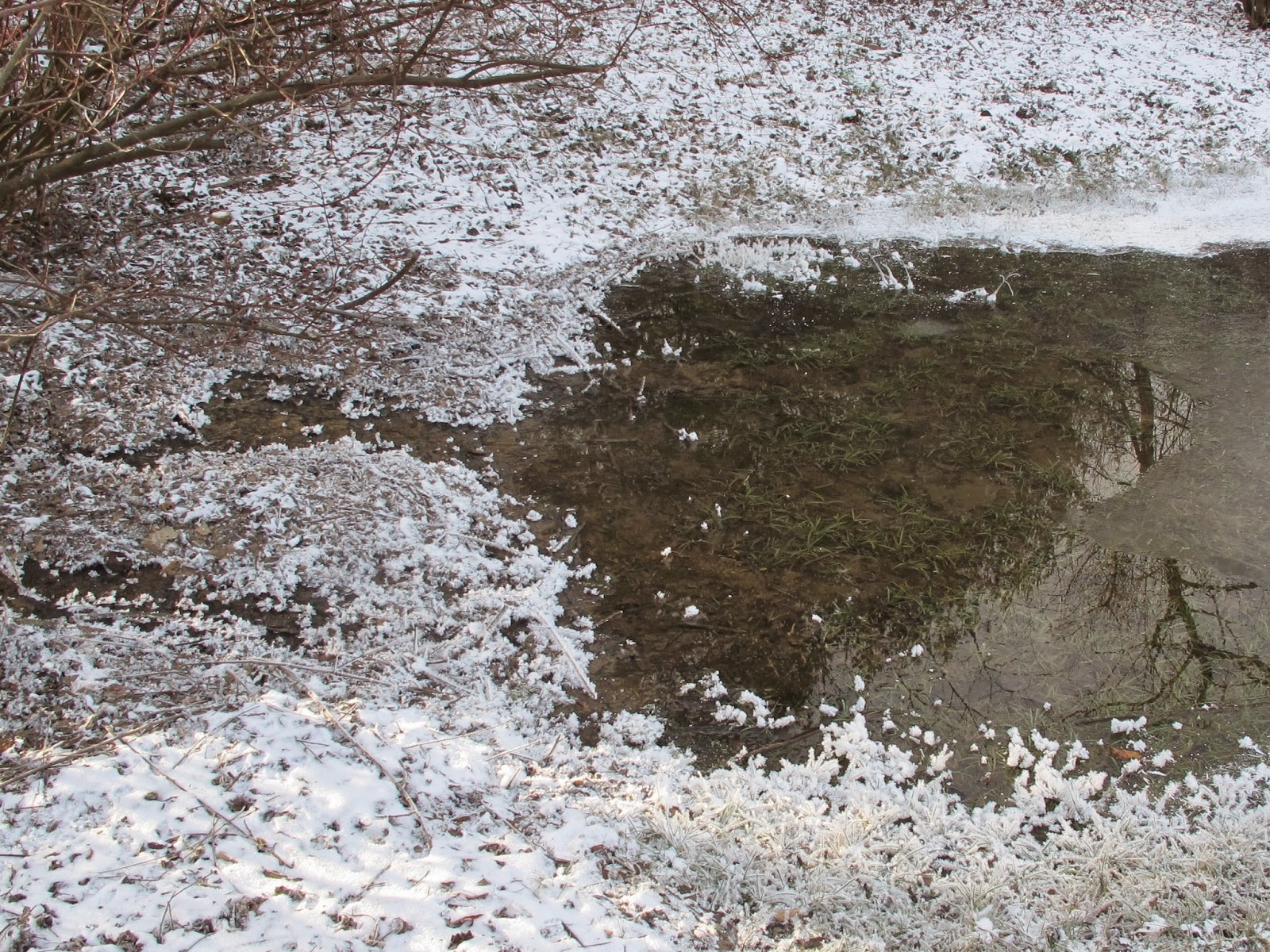
Cold weather caps the pools with ice.  The established pool is fed by a single small spring, but that is enough to keep a bit of water unfrozen.

The spring keeps a small area of open water available to visiting wildlife


The same conditions occur in the pond, an artificial water body that was created long before I purchased the property. 

A strong seasonal spring produces a continuous stream of water entering the pond throughout the winter.

The warm water from the spring maintains a large area of open water.  Even through the coldest winters, this portion of the pond remains unfrozen.  When other water sources freeze over, birds flock here to drink and bathe.

Water from the spring also helps maintain adequate water for the survival of the breeding salamanders.  The view may be blocked by snow, but the salamanders are busy with courtship and egg laying activities beneath the ice.  I would never threaten the native prairies of Blue Jay Barrens with a water development project.  I’m just glad there are a few areas of undesirable vegetation available for conversion to open water.

Monday, May 26, 2014

Water Garden

The Water Garden has now been in existence for 14 years.  In that time, the composition of flora and fauna has been constantly changing.  I’ve tried to guide that change to create what I believe would be the ideal situation, but the Water Garden has proven to be a dynamic force that will not be tamed.


Water Lilies are the only introduction I made of plant species not found on the property.  Even these lilies don’t follow my original intent.  Planted in weighted pots, their root systems become so massive during the summer that they rise to the surface to float about as islands.  The root masses have totally engulfed the pots along with several bricks that I tied on in an attempt to keep the roots on the bottom.  Several species of aquatic plants have colonized the islands and survive the winter immersion while waiting for the islands to pop back to the surface in summer.


Water Lily flowers always fascinated me as a child.  I would spend hours staring at them.  This year, you have to view these white flowers early in the day to catch their brilliance.  Tree pollen is falling so heavily that white quickly turns to yellow as the day goes on.  The bud to the left has collected several rings of pollen already.  The pollen forms a skin on the water’s surface that remains until a rain causes it to sink to the bottom of the pool.


I put in some pots of native aquatic plants when the water garden first filled.  Since then, a variety of seeds has arrived to add diversity to the pots.  The actual lip of the pot is about an inch below the water surface.  Accumulation of moss, roots and organic debris has raised the soil level above the water line and doubled the diameter of the original pot.


Common Milkweed arrived on the scene just a few years ago.  Although I have several stands of milkweed around the yard, the plants growing next to the Water Garden are most favored by the Monarch butterflies.  Even though the plants become quite unruly later in the year and lean out to threaten visitors to the house, I’ll leave them to grow here.  With all of the reports of possible Monarch extinction, I would hate to deprive even one individual the opportunity to deposit some eggs.


Field Horsetail has now formed an almost solid border between the driveway and the Water Garden.  Along the creek, where I originally collected this plant, the horsetail grows in tiny patches and seems to be struggling to maintain a presence.  I was hoping it would maintain this same pattern in its new location.  Instead, it has set out on a campaign to claim as much territory as it possibly can.  If I didn’t keep it in check with a little glyphosate application, it would have taken over the driveway and half the yard by now.


I collected some rushes from the pond and installed them in pots on the back side of the Water Garden.  They have formed a floating mat that bridges the pots and extends into deeper water.  The floating roots are unable to keep the tall plants upright and the tops soon fall over.  Other plants have colonized the rush mats, including the invasive Narrow Leaved Cattail.  The one in this photo will be cut and sprayed.


The cattail leaves do make a sturdy support for a dragonfly nymph making the transformation into an adult insect.  Several species of dragonflies deposit eggs in the Water Garden and the discarded exoskeletons of mature nymphs are a common sight.


Being a permanent water body, the Water Garden has provided conditions conducive to the establishment of aquatic predators.  I no longer see explosions of tadpoles, crustaceans or insects, because the various established predators keep those species at lower levels.  Dragonflies are one of those predators.  This dragonfly skin may be empty, but you can still see the labium, or lower mouth part, used by the dragonfly nymph to capture prey.  The nymph extends the labium like a long arm to reach out and snag any creature small enough to hold. 


At the end of the labium is a set of curved hooks that trap the prey and hold it while it is consumed.  A pool full of dragonfly nymphs can easily cut down the number of smaller organisms.


Another predator with a never-ending appetite is the Red Spotted Newt.  These guys will feed on any animal matter, dead or alive, that is small enough to swallow.


In time, larger predators arrived.  The Common Water Snake feeds on the larger pool inhabitants, including other predators.


Bullfrogs have massive mouths and will try to eat anything that moves.  When Bullfrogs move into a small pool, they quickly consume the smaller frog species.  I’ve tried removing predators in an attempt to keep the pool in an earlier stage of development, but have decided that type of activity is not practical.  The Water Garden will be left to those species adapted to living in a permanent pool environment.  I will construct new pools with the proper conditions for the other species I enjoy so much.


The Water Garden still holds Green Frog tadpoles from eggs laid last year, but there are no adult Green Frogs left.  The tadpoles feed algae and other plant debris.  More tadpoles mean clearer water.  This tadpole has been skimming pollen from the surface.  I guess next year’s tadpoles will be those of the Bullfrogs.


Water Boatmen colonized the Water Garden before it had completely filled with water and have maintained a continuous presence since then.  These are true bugs with the signature tube-like mouth parts.  They feed primarily on algae and decaying organic matter.


Air is carried by the Water Boatmen as a film covering the body surface.  This gives the bugs a shiny appearance and makes it difficult to view body details.  They stay submerged by anchoring to stationary objects and periodically come to the surface to exchange stale air for fresh.


Great Blue Herons have eaten all of the goldfish, so the 100 gallon tub has lost its top predators and algae eaters.  Algae is a quality food item and where food exists, something will come along to eat it.


Since a population of new predators has not yet had a chance to colonize the tub, the Gray Treefrogs have a safe place in which to lay their eggs.  New egg clusters are placed almost daily.


The tadpoles develop quickly and it won’t be long until they are growing fat on the algae.  I’m looking forward to seeing what other changes this year brings to my Water Garden complex.