Showing posts with label Tachinid Fly. Show all posts

Monday, August 27, 2018

Pipe Organ Mud Dauber Wasp and Parasitic Fly

About two weeks ago, while sitting on the front porch cleaning my boots, I heard the unmistakable buzz of a female Pipe Organ Mud Dauber, Trypoxylon politum, sealing up a brood chamber inside her nest. This species of wasp uses mud to construct a long tube which it divides into individual compartments, each of which will be loaded with a collection of venom paralyzed spiders to be used as a food source for a developing wasp larva. I looked over and saw that the female wasp was in the process of sealing off the bottom chamber of a long tube nest.

I was not the only one interested in this activity. A female Tachinid fly was stalking around the entrance to the nest, waiting for an opportunity to sneak in and leave one or two of its eggs inside the brood chamber. Gaining access was not an easy process. While the female wasp was away gathering more mud, the male wasp moved in to guard the nest entrance.

Eventually, as the female wasp put the finishing touches on the bottom seal of the brood chamber, the male wasp moved away and allowed the fly to slip in.

The video above shows the female wasp bringing in mud to seal the last brood chamber, the male wasp performing its guard duty and attending to the female, and the fly skirting around the entrance to the nest and finally seizing its opportunity to enter. A longer version of this video can be seen on YouTube by clicking HERE.
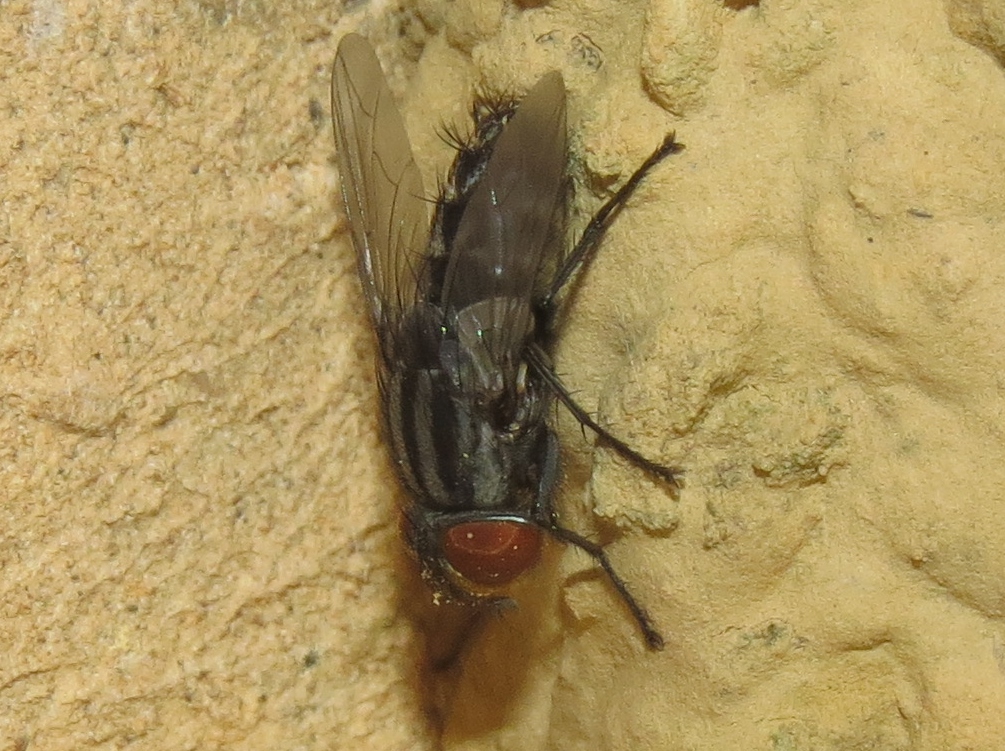
Yesterday I spotted this fly resting on the outside of the tube nest. It was obviously freshly emerged and its appearance was marred only by a few crumbs of dry soil matching the color of the nest.

Not far away from the fly was the hole through which it had escaped the wasp brood chamber.

I scraped a bit of soil away from the site of the exit hole and discovered the empty pupal case left behind by the fly.

Further excavation revealed what was left of several spider carcasses and what looked to be additional fly pupae.

Here’s what was inside the chamber. There was evidence of three Tachinid fly pupae.  The larvae had feasted on the spiders, leaving only empty husks behind.

Two pupae were intact, containing flies that would probably soon be emerging. A single empty case was left by the fly I had observed earlier.

Pipe Organ Mud Daubers frequently construct their nests on my porch. Some of the holes in this nest from last season were probably made by emerging wasps, but I know that several were made by foraging woodpeckers.


Closer examination of the old nest reveals smaller holes that are just the right size for an emerging fly. I imagine this fly and wasp a game is a common occurrence on my front porch.

Sunday, June 17, 2018

Unexpected Cycnia and Tachinid Flies

The Cycnia collaris larvae have disappeared, presumably to complete the next phase of their life cycle.  It was a lot of fun to have the opportunity to observe their behavior on a daily basis, even though some of the observations were rather disturbing.

The 70 or 80 larvae that began their lives crowded in a small clump of Common Milkweed plants, soon became mobile and began to disperse.  Larvae of a size approximating half of their potential full grown dimensions were found wandering as far as 50 feet from their birth plants.  In all cases there were milkweed plants in the direction of their travels.  It wasn’t long before all larvae were absent from the original plants.

Their dispersal pattern spread the larvae out, but instead of having a couple of larvae on each plant in the vicinity, they clustered into small groups.

Once they got settled into their new locations, I began seeing some ominous ornamentation on many of the larvae.  On closer examination, each white spot was identified as the egg of a predator.

This is the culprit, a Tachinid Fly, a species that lays its eggs on the bodies of other insects.  Observers of Monarch butterfly caterpillars are familiar with this species and its ability to decimate caterpillar populations on milkweed plants.  Fly larvae hatch from the eggs and immediately enter the body of the caterpillar, where they will feed until they are mature enough to pupate.  Caterpillars do not survive the experience. 

Most affected larvae displayed one or two eggs.

Rarely, I found larvae carrying three eggs.  About half of the larvae I inspected were carrying fly eggs.


The video shows a fly searching the leaf for larvae.  Although the fly investigates two of the three larvae found beneath the leaf, it laid no eggs.  When I later checked, these three larvae were already carrying eggs.  Perhaps the fly senses larvae that are already infested, and passes without leaving additional eggs.  In an earlier encounter I watched a fly chase a Cycnia larvae that was running across the surface of a leaf.  The fly was approaching from the right and the larva kept making quick directional changes to the left. When the fly was within range it leapt on the Cycnia larva’s head.  Almost immediately, the Cycnia larva snapped into a C shape and popped off the leaf.  It ended up in the water, so I scooped it out and gave it a close examination.  Two fly eggs were attached just behind the head.  I am assuming that one or both of these eggs had just been attached.

Friday, August 31, 2012

Orange Coneflower

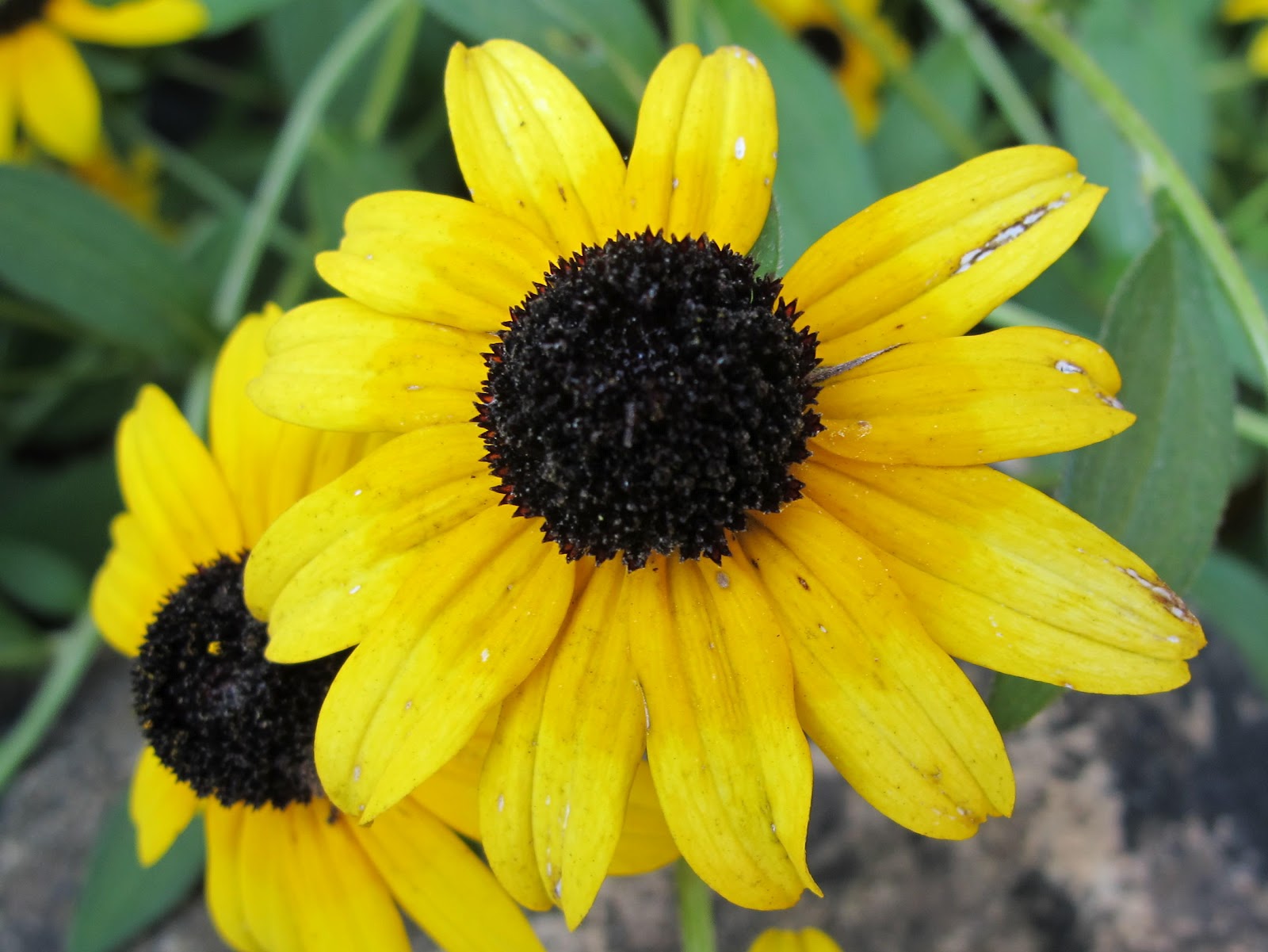
One plant that doesn’t seem much bothered by the drought is Orange Coneflower, Rudbeckia fulgida.  It may appear to be a bit worn, but that’s its normal condition at this stage.

The fertile flowers are found in the central disk.  The flowers mature in succession, beginning with the outer edge and moving toward the center of the disk.  As blooming progresses, the disk expands upward until the center sits well above the yellow rays.

Orange Coneflowers tend to grow in wetter conditions such as are found at the base of slopes or in natural drains through the field.  They also tolerate dry conditions.  I think these two characteristics account for the plant’s vigor during this year’s unusual weather conditions.

Orange Coneflowers are hardy perennials.  Flower stalks will die over winter.  Next year’s growth will come from basal rosettes that form from short stolons produced by the flowering plant.  These basal rosettes typically remain green through the winter and will develop rapidly as soon as it warms in the spring.

Several insect species find the Orange Coneflower of interest.  An unidentified moth larva boring up the center of the stalk produces this dusty material.  The timing of this activity doesn’t seem to affect the ability of the plant to complete flowering and produce viable seed.  Over half of the plants typically contain one or more larvae.

Small bees are the most numerous of the flower visitors.

A few Soldier Beetles are around, but I’m seeing fewer than normal for this time of year.

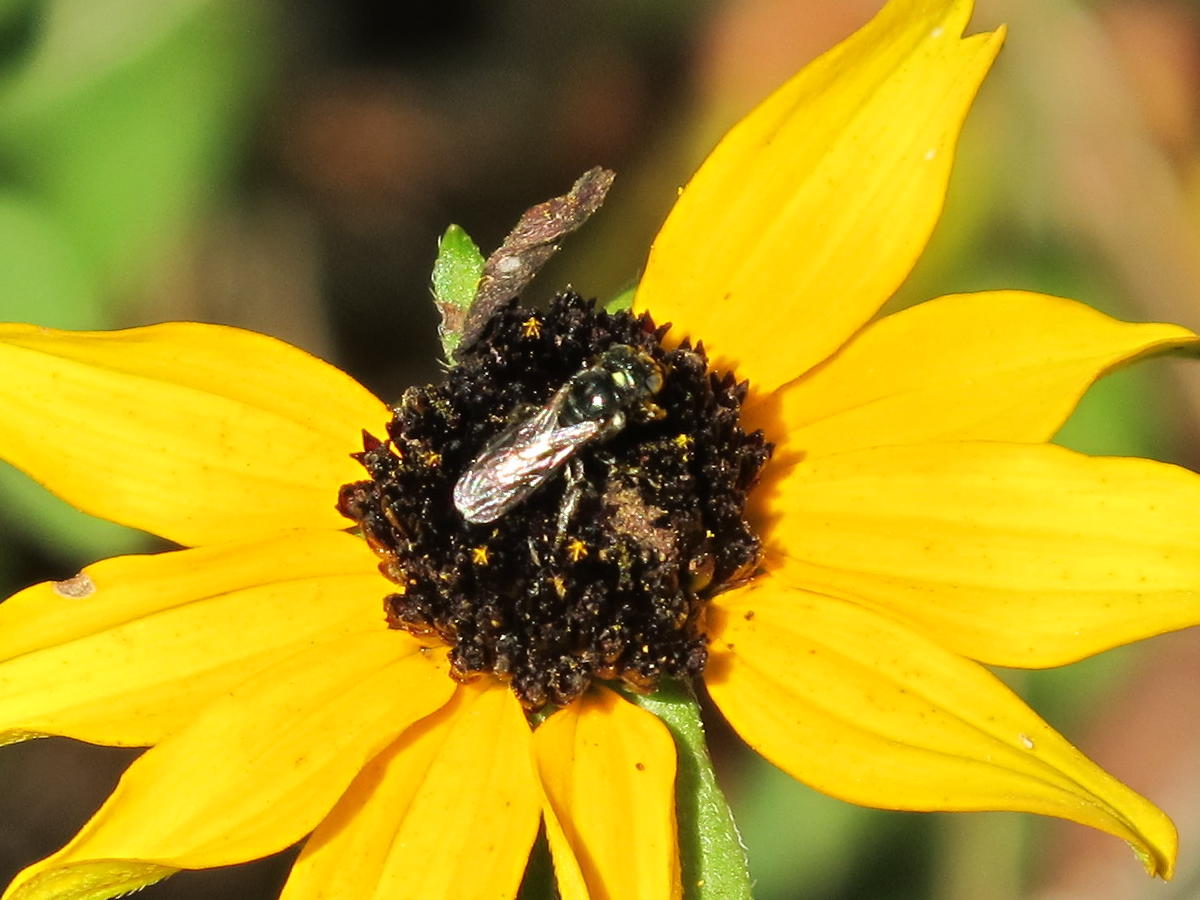
This neat little fly spent quite some time moving from flower to flower.  This is a member of the Tachinid Fly family, the larvae of which develop inside an insect host that ultimately does not survive the encounter.  Most in that family are big, hairy brutes.  This fellow is a species of Cylindromyia, a genus of wasp mimics.  I don’t see these guys very often and enjoyed observing this one for the few minutes it was around.

There appears to be some type of larva feeding down among the disk flowers and leaving a mass of excrement to mask its passage.  I dug into several of the affected flowers and found nothing but an empty tunnel.  One thing noticeably absent from the flower heads was Crab Spiders.  I can usually find dozens of these small yellow spiders perched on the flowers.  Here is one more regularly common animal species that has failed to appear this year.

Wednesday, June 27, 2012

Smooth Sumac Insects

Smooth Sumac, Rhus glabra, is just beginning to bloom.  I have an abundance of this plant along the trail leading up the hill behind the house.  It gets mowed about every three years and blooms heavily the second year after mowing.  The result is a massive display of blooms at just about eye level.  It’s just perfect for viewing visiting insects.

A flower head forms at the end of each branch.  Smooth Sumac is a common species that is recognized by its hairless stems.

The buzz of nectar eaters never ceases.  Bees, wasps, flies and beetles are frequent visitors of these flowers.  Hairstreak butterflies also make use of this nectar, but I have yet to see any of the hairstreak species this year.

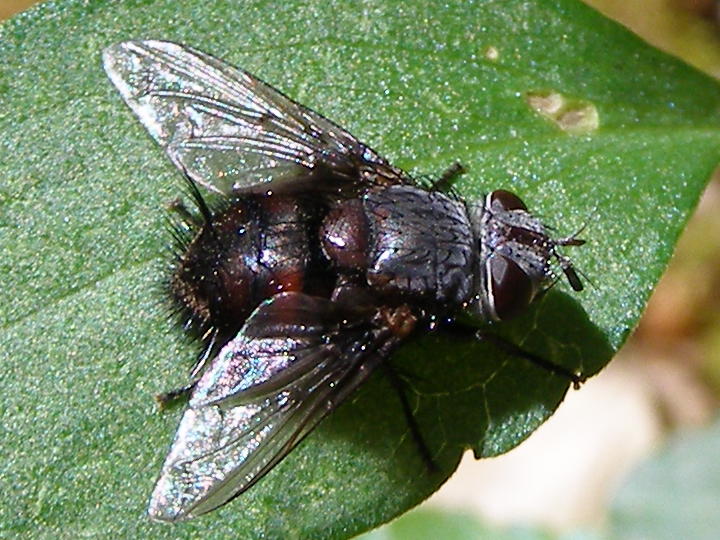
Tachinid Flies were the noisiest of the various visitors.  Tachinids come in a variety of sizes and colors, but my preference is for these large types.

Tachinid larvae develop inside a living host, usually a specific insect species.  The adult flies are so numerous it’s almost impossible not to see them when you’re in the field.  Despite seeing thousands of adults, I’ve never seen a host insect containing a Tachinid larva.

This is a Yellow-collared Scape Moth.  I see this day flier on many different flower species that produce large flower heads.  The moth tends to take advantage of the flower cluster to partially hide itself while feeding.
 
Beetles abound in the flower cluster.  Most try to remain hidden among the small flowers.

I think this is some type of Soft Winged Flower Beetle.  I couldn’t tell if it was actually feeding inside the flower or searching for something on the outside.

Of course the little green bees were there.  I have yet to find a flower that doesn’t attract these bees.

I think sumacs are one of the preferred flowers of Bumblebees.  I always find an abundance of Bumblebees on these blooms.  I like to watch flowers because of the wide assortment of insects that they attract.  When they are busy feeding, insects are easy to approach and observe.  I’ll be spending a lot of time around the sumacs for the next week or so in hopes of seeing something new and unusual.

Monday, April 26, 2010

Flies

If I were to choose a single group of organisms for intense study, it could easily be the flies. Flies are a group with an immense diversity of species that interact with an almost infinite number of plants, animals and habitats. These first couple species are Tachinid Flies, a family of flies that spend their larval period as an insect parasite. The Tachinid family represents a large selection of flies that may differ greatly in size, shape and color. It may be that all the photos in this post are Tachinids, but I’m not sure of that.

Many Tachinid Flies display very pronounced abdominal bristles. If I were a frog, I don’t know that I would want to sling my tongue onto something like this.

The pattern on the rear of the fly may look like a faded slow moving vehicle sign, but these guys can be quite speedy. Finding that the direct approach easily spooked the flies, I adopted the willow in the wind stalking method and swayed my way into range. Witnesses to my photographic methods might be convinced that the beer cans slung along the roadway had actually come from me.

Gray striped jacked and bulging red eyes attracted my attention here. I got the impression that this tiny Dracula was trying its best to hypnotize me. This reminds me of a type of fly that I helped raise in school while I was volunteering in the insect rearing lab, but that fly had a gray eye color and could fill a 30 gallon trash can with several pounds of wriggly maggots.

Another set of large red eyes, this time set in a white face. The willowy legs and shape of the face remind me of a butterfly. The legs look like the type that would be very useful in sneaking up to lay eggs on some suspicious insect host.

This individual is displaying some long abdominal spines. Makes me wonder if this is also one of the varied shapes of the Tachinids. I’ll be spending more time this year watching the flies. Let me know if you have any recommendations of good fly identification guides.