When you regularly walk the same trail, it’s pretty easy to notice a change. Some things are really obvious, like having a tree slap leaves in your face in a place that has always been clear trail. I didn’t actually get a face full of leaves, but the possibility was there when this formerly vertical tree changed to a more horizontal attitude.

The tree didn’t make the change of its own accord. A male member of the local White-tail Deer population chose this oak sapling as a prime place to release some aggression and place a scent marker identifying his territorial claim. An antlered buck can quickly debark a small tree.

This tree was doing a good job of competing with its neighbors for a piece of the rapidly closing tree canopy. Lost bark and broken branches are going to be quite a set-back.

You can tell by the healthy green leaves that this tree was successfully capturing a good share of the available sunlight. This is one of those oak hybrids,
Quercus bushii, that are so common at Blue Jay Barrens. Even though it’s common, I’d hate for it to be lost.

Even if it survives the loss of bark, this tree will never return to an upright posture. New growth will develop vertically, but there will be numerous leaders competing to be the new tree top. If a mature tree is eventually produced it will have some deformities that will limit its life expectancy. I’ll probably cut the tree off at the ground this winter and remove a couple of neighboring small cedars to produce a larger hole in the canopy. The established oak root system should produce a rapidly growing stump sprout that could easily make its way back into the canopy in a few years. Assuming a deer doesn’t trash it again, a healthy, mature tree could eventually develop.
 When you regularly walk the same trail, it’s pretty easy to notice a change. Some things are really obvious, like having a tree slap leaves in your face in a place that has always been clear trail. I didn’t actually get a face full of leaves, but the possibility was there when this formerly vertical tree changed to a more horizontal attitude.
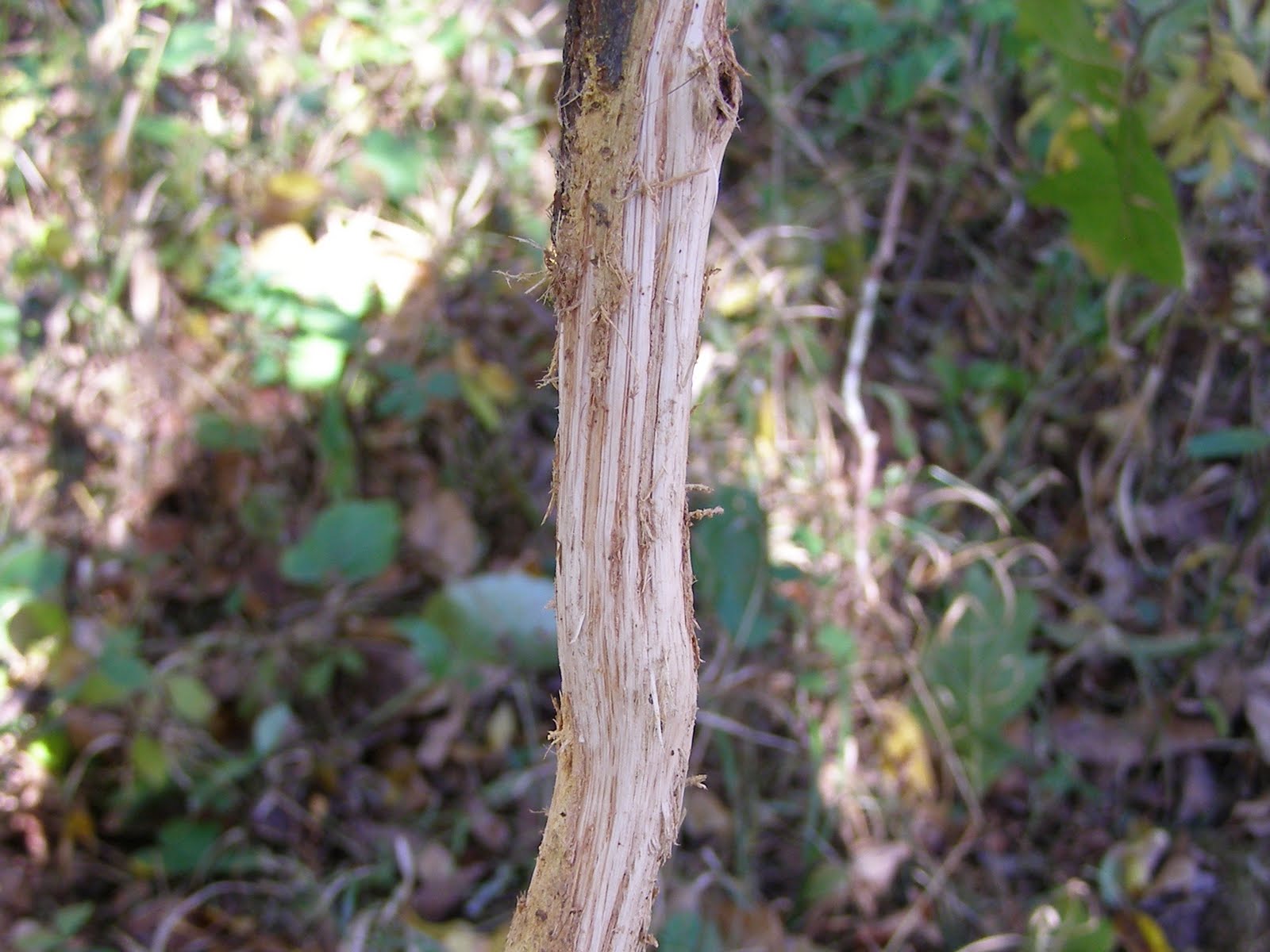 The tree didn’t make the change of its own accord. A male member of the local White-tail Deer population chose this oak sapling as a prime place to release some aggression and place a scent marker identifying his territorial claim. An antlered buck can quickly debark a small tree.
 This tree was doing a good job of competing with its neighbors for a piece of the rapidly closing tree canopy. Lost bark and broken branches are going to be quite a set-back.
  You can tell by the healthy green leaves that this tree was successfully capturing a good share of the available sunlight. This is one of those oak hybrids, Quercus bushii, that are so common at Blue Jay Barrens. Even though it’s common, I’d hate for it to be lost.
 Even if it survives the loss of bark, this tree will never return to an upright posture. New growth will develop vertically, but there will be numerous leaders competing to be the new tree top. If a mature tree is eventually produced it will have some deformities that will limit its life expectancy. I’ll probably cut the tree off at the ground this winter and remove a couple of neighboring small cedars to produce a larger hole in the canopy. The established oak root system should produce a rapidly growing stump sprout that could easily make its way back into the canopy in a few years. Assuming a deer doesn’t trash it again, a healthy, mature tree could eventually develop.