I’ve been interested in vegetable gardening for most of my
life and have had some type of garden every year since I was eight years
old.
Maintaining a vegetable garden is
an activity that my wife says makes me appear more normal in the eyes of the
general public.
It gives me a second
topic besides the weather of which I have an interest and which I might discuss
with others while creating idle conversation at social events.
I’ve learned that most people can only stand
a few minutes of weather talk and generally have no interest in my thoughts
about managing land for native ecosystems.
Talking about gardening gives me something to do besides reading a book
or standing alone glaring at anyone who comes near.
This pleases my wife and gives the illusion
that I’m having a good time.
My garden is located in the lower portion of a field
drain where eroded soil was trapped behind an elevated farm lane.
This was the only place I could find with
soil deep enough to securely anchor fence posts.
People sometimes question why I carved my
garden out of a nice prairie field.
In
this situation there was no prairie when I created the garden.
At that time, the field was all oat stubble,
remnants of the last grain crop to be grown there.
The garden was long established by the time
the prairie came in.
The garden is maintained in raised beds.
Through the summer I fill the trenches
between beds with whatever organic matter I have at hand, mostly mower
clippings.
Each fall I till the trenches
and scoop the half composted organic matter to the top of the beds.
Worms
and other organisms work on the organic matter over the winter and the beds are
ready to receive seed in the spring.
Onions, peas and potatoes are currently growing.
Row cover was placed over the peas to protect
them from some predicted cold temperatures.
They made it through a couple of 20 degree nights with no damage.
But there are other things going on in the garden that easily
take my attention away from the vegetables.
Several native prairie species are grown here for seed production.
The natives are not as well behaved as the
vegetables.
These Prairie Dock will not
stay confined to a bed and are continually increasing their territory.
The organic mix atop the beds seems ideal for germination of
Prairie Dock seed.
I’ve decided to limit
the Prairie Dock to one bed and they’ve just about taken that.
Clumps of False Gromwell last for three to five years before
dieing.
In that time they produce huge
quantities of seed.
Some of that seed
manages to germinate and initiate growth of another clump.
False Gromwell are always in the garden, but
their location is constantly changing.
Butterflyweed has claimed a three by three foot section at
the end of one bed.
It came in as a
volunteer and I let it stay.
That was
about fifteen years ago.
Since then it
has attracted swarms of interesting insects to the garden.
For the past three years it has hosted the
caterpillars of the Unexpected Tiger Moth, an
Ohio rarity.
The garden keeps losing ground to natives, but there’s still plenty of
space for vegetables.
The cedar fence posts around the garden continue to expand
their collection of interesting lichens.
It doesn’t take much for the lichens to distract me from my gardening
chores.
I have yet to take the time for
any serious lichen studies, but when I get around to it, there should be plenty
of lichens here to get me started.
I am serenaded constantly while in the garden.
This Song Sparrow nests in an ornamental juniper
that is kept in the garden just because birds nest in it.
It was planted there as a seedling 28 years
ago along with several others that were intended for landscaping in front of
the house, but it was not used.
Instead
of getting rid of it, I left it there in case one of the junipers in the yard
failed to grow.
By the time it became
obvious that it wasn’t needed for landscaping, it had become a favorite nesting
site of Song Sparrows, Catbirds and Cardinals.
Although not as melodious as the Song Sparrow, Henslow’s
Sparrows call out their territorial warnings from perches in the tall Indian
Grass surrounding the garden.
Since
these birds return here every year and I hear them calling well into summer,
I’m assuming that they are nesting.
It’s
hard enough to see these birds in the field.
It would just be dumb luck if I ever encountered one of their nests.
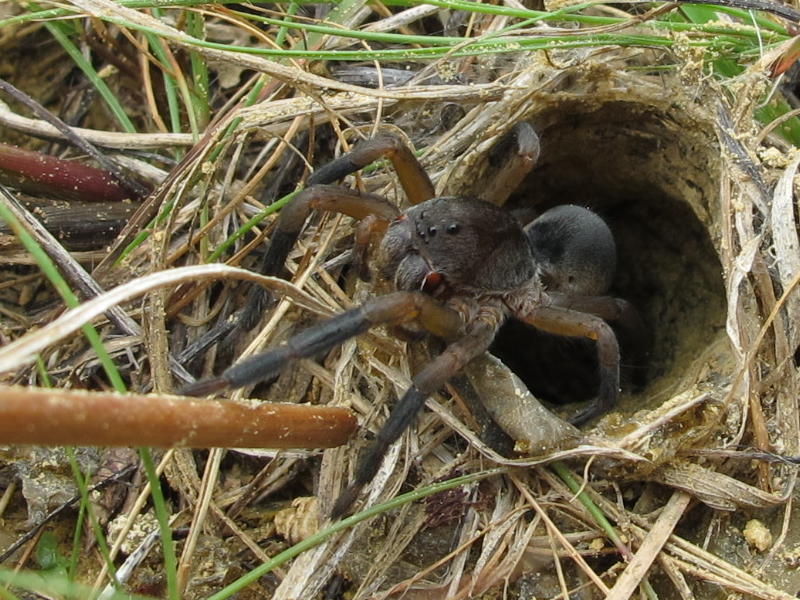
A Burrowing Wolf Spider has claimed a territory near the
Butterflyweed.
The burrow should be safe
from disturbance in this location, so I will have time to coax the spider out
for some photographs.
While on my knees looking at the spider hole, I glanced
beneath the Song Sparrow’s juniper and saw this garter snake.
I think the garden is an appropriate place
for this snake since, as a kid, I used to think their proper name was Gardener
Snake.
This one kept doing strange
gyrations with its tongue as though trying to convey a message in snake
semaphore.
Maybe the message came
through, because I suddenly thought of something I should be doing.
That’s how most of my garden forays progress;
distracted by the native plants, distracted by the birds, distracted by the
bugs and gone.