Showing posts with label Northern Fence Lizard. Show all posts

Wednesday, March 30, 2016

Northern Fence Lizard

Most of my encounters with adult Northern Fence Lizards occur in the early spring. At this time of year the lizards are fresh out of hibernation.  The cold ground and air temperatures cause the lizards to seek out sunlit basking areas where they can warm their bodies.
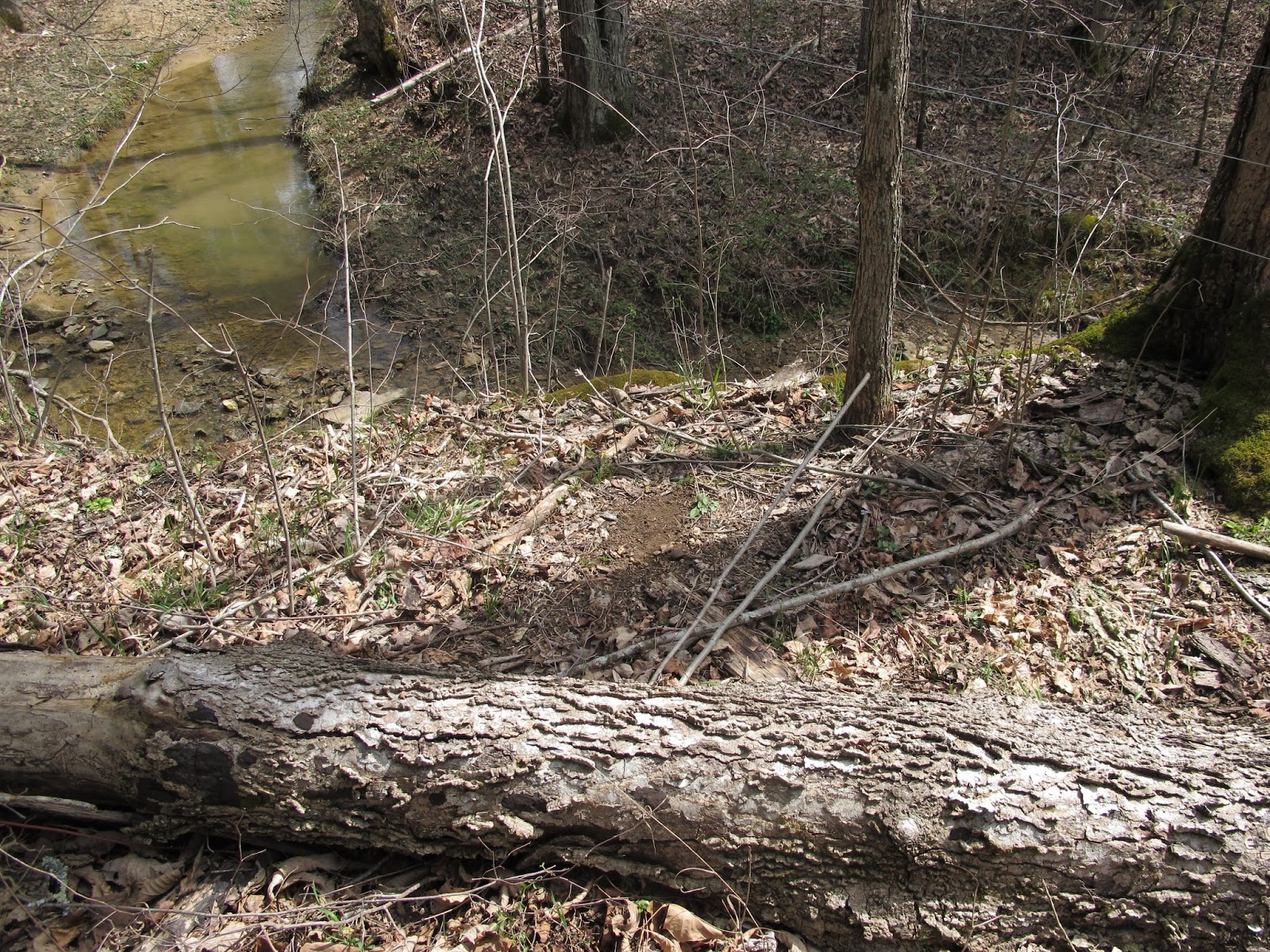
A fallen log, exposed to full sunlight, is an ideal place to find one of these lizards. Northern Fence Lizards spend much of their time on tree trunks, and they don’t seem to discriminate between trunks in the vertical versus the horizontal position. This log, situated on a dry, sunny bluff beside the creek, is an ideal place to watch for lizards.

As the sun warms the lizard, its face assumes an expression of contented enjoyment.  More likely, the closed eyes probably serve some physiological function that benefits the survival of this organism.

The lizard’s mottled brown coloration allows it to blend well with rough tree bark. Their existence is often unnoticed until they happen to move.

On the ground, the colors merge with those of the fallen sticks and leaves. It’s the sound of dry leaves being pushed aside that calls your attention to the presence of a startled lizard running for cover. The sound generally moves towards a nearby tree where the lizard suddenly appears on the trunk.
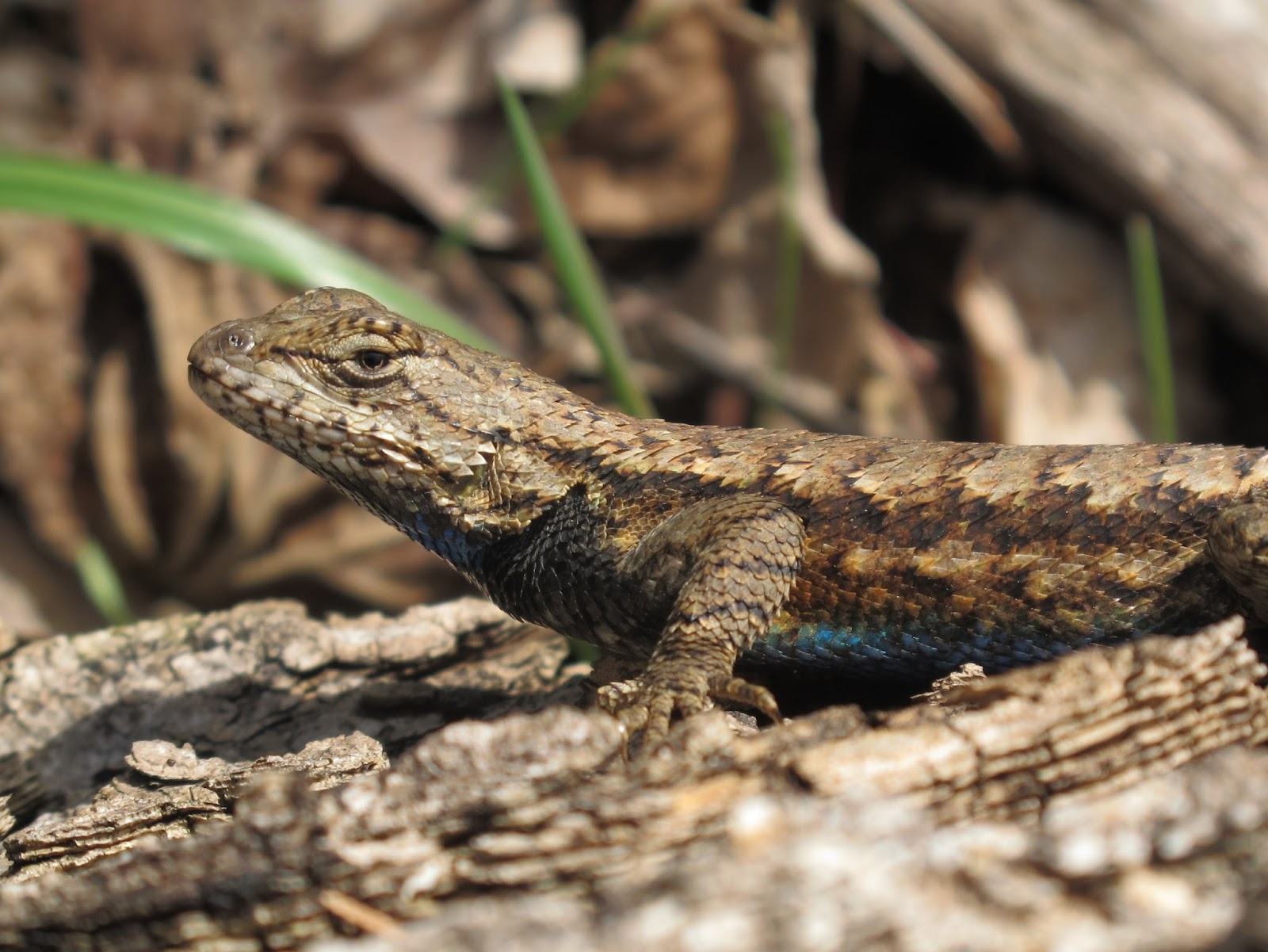
If you move slowly, most of these lizards will allow a close approach, although they often keep a watchful eye on your presence. Black and blue coloration on the throat and sides indicates a male Northern Fence Lizard.

By sitting quietly, you soon become just another object in the woods. The lizard then turns its attention to stalking insects that will provide a suitable meal.  Northern Fence Lizards will be active through the summer and into the fall, but they will become harder to see as growing vegetation begins to hide them away.

Monday, June 9, 2014

Fence Lizard on a Fence

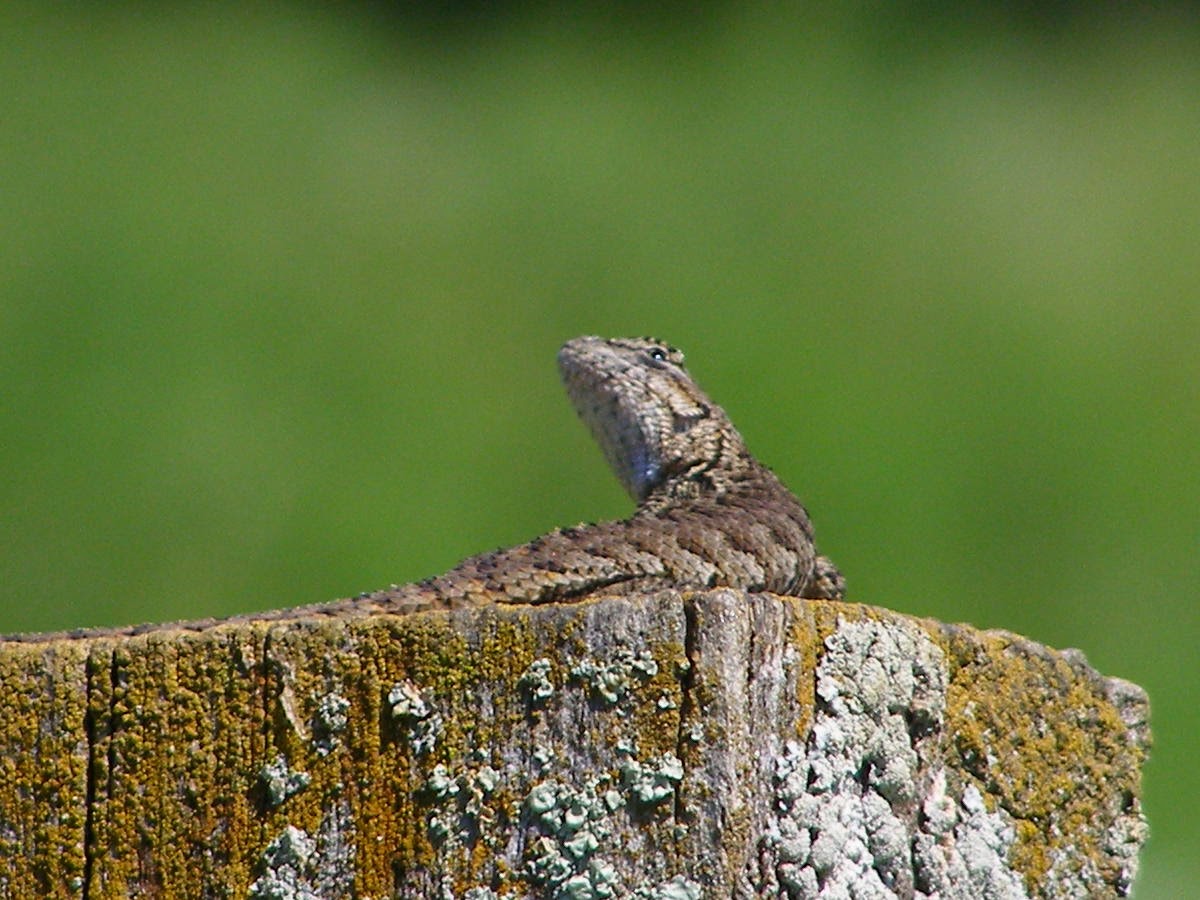
I’ve had hundreds of encounters with Northern Fence Lizards at Blue Jay Barrens.  My most recent encounter has the distinction of being the only time I’ve actually seen a fence lizard on a fence.


The lizard zipped up to the top of a fence post and gave a couple of head bobs, typical behavior for a male lizard.  Instead of the bright blue sides and throat normally associated with the male Northern Fence Lizard, this individual displayed only a blue blush in the throat area.  I recently read of research done by biology professor Tracy Langkilde of Pennsylvania State University in which she states that a high proportion of female Fence Lizards display some degree of blue coloration.  This fact effectively invalidates my previous assumption that lizards sporting blue coloration had to be males.  Limited head bobbing is also practiced by females of many lizard species, so I’m calling this one a female with weak male characters.


Any wild animal lounging in the open has to keep an eye to the sky in watch for avian predators.  The only things passing over this day were Tree Swallows.  The lizard glanced up each time one of these birds came near.


In between bird passes, a search was conducted for any insects that might make a suitable meal.


The fence posts are of native cedar locally grown and milled.  In the 25 years since they were installed, the posts have become a foundation for a variety of lichens and mosses.  I think this makes them more attractive to native wildlife such as the Northern Fence Lizard.


Even though this is the first time I’ve seen her on the fence, the lizard has been in the garden for several weeks running along the planting beds or scurrying across the mulched paths between.  She normally pays little attention to my activities.


If she doesn’t worry about me, it means that I have to worry about her.  Her coloration closely matches that of the garden soil and mulch.  I don’t want to discover that she has been trodden upon, so I’m careful to watch where I put my feet.


So far, she’s stayed close to the native planting part of the garden.  I see her most frequently darting in and out of the Ashy Sunflower and Prairie Dock thickets.


At other times I find her just lounging around.  Here she is taking in the morning sun.  She’s totally relaxed and not at all disturbed by my moving around nearby.  I’m looking forward to having her as a gardening companion through the summer.

Wednesday, September 12, 2012

Northern Fence Lizard Youngster

I’ve only seen a few adult Northern Fence Lizards this year, but hatchlings have been showing up on a regular basis.  They’re probably not really hatchlings since they didn’t just crawl from the egg.  Their size indicates they haven’t been long out of the shell, so I’m just using the term to describe a very young lizard.

I found this guy on the barn wall.  He’s probably the smallest specimen I’ve seen all summer.  I’m wondering what has caused the abundance of youngsters.  I’m leaning towards the theory that the early warm up in late winter allowed the lizards to emerge from hibernation much sooner than normal.  This would have allowed for earlier mating, earlier egg laying and earlier hatching.  The most important point being that older females would have had time to lay more than one clutch of eggs and this would account for the emergence of lizards over a period of months.  Since this is all based on casual observations, it’s also possible that I’ve just been in a position to notice more lizards this year.

I was trying to get a close look to see if the egg tooth was still attached.  The egg tooth is used to slice open the egg shell at hatching and is soon lost.  I think the tooth is gone, but the spot it occupied is still visible at the tip of the snout.

The natural pattern and colors of the lizard make superb camouflage when the lizard is running on the rocks, fallen trees and tree trunks which are its normal haunts.  The visual effect fails when the background is a solid color.

It’s easy to see why this species is referred to as a spiny lizard.  I love the spiky scales.  Upon close examination each scale seems to have its own unique shape and color pattern.  The whole effect gives the lizard the appearance of invulnerability.  Of course there’s a whole list of predators ready to prove that to be untrue.

Northern Fence Lizards are great climbers as long as the surface they are scaling is rough enough for a toe hold.  Long, sharp nails tip the toes and allow a firm grip.  I can’t be sure why I’m seeing so many lizards this year.  Whatever the reason, it’s been a lot of fun.

Saturday, August 25, 2012

Young Fence Lizards

Young Fence Lizards have suddenly begun showing up everywhere at Blue Jay Barrens.  I don’t know if the hatch has been that much greater than previous years or if the drought diminished plants have just left more prime lizard habitat exposed to easier viewing.

All of the lizards seemed to show up on the same day.  I noticed the first just off the front porch.  I looked through the window at the Water Garden and saw movement in the young violet plants. 

I snuck out the door and crawled toward the violets.  The lizard watched me the whole way and stuck around long enough for one photo.

After a quick run through the vegetation, the lizard zipped up the landscape timbers.  It gave me one last look before running the length of the timber and disappearing between two stones.

I headed on out to the barn to gather some tools for the day’s activities and scared a young Fence Lizard that was sunning on the concrete slab outside the barn door.  It scooted off the slab and crawled up the door jamb.  It really blends well with the weathered wood.

The lizard population around the barn keeps increasing, so I must be doing a good job of not harming the little guys.  I keep thinking that one of these days I’ll throw my back out twisting to avoid a small lizard that makes its break for safety right at my feet.  There must be times when they mistake me for some form of shelter.

Later that same day, I saw this youngster sunning on a dead cedar branch at the edge of one of the barrens.  I really love lizard encounters.  It’s nice to see so many additions to the population.

Sunday, June 10, 2012

A Spot of Sun

When a tree falls in the woods, a hole in the canopy is the usual result.  Suddenly, a shaft of sunlight invades a previously shadowed area.  The sun is a beacon for all things craving light and the illuminated area becomes a center of activity.  I like to approach these areas slowly in an effort to glimpse the creatures that thrive in the tiny sunny patch.

Rapid movement along the top of the fallen log assured me that there was something interesting going on.

A young Northern Fence Lizard hunting insects along the length of the log.  Flies appeared to be the only type of prey available and the lizard was having a hard time catching any of those.  Perhaps this guy hasn’t yet mastered the art of the sneaky ambush.

Even a young lizard has that wizened expression normally associated with age.  The look may have been one of wise adult, but the actions were more like an inexperienced youth.

This is only the second season that the tree has been on the ground.  The exposed log, tangle of dead branches and deep drift of dead leaves make this ideal lizard habitat.  This could remain as a prime lizard nursery for many years.  With luck, a large skink will take up residence here.

After a time of futilely chasing flies, the lizard moved down into the smaller branches nearer the ground.  His obviously good health is evidence that he does possess adequate hunting skills.  He just failed to demonstrate his prowess to me today.

Saturday, May 19, 2012

Lizard on the Rocks

This is my first 2012 lizard encounter.  I found this large Northern Fence Lizard in one of the bedrock exposures on a steep, south facing slope. 


In my opinion the rocks make a perfect shelter.  I would certainly choose to live here if I was some small, vulnerable creature.


I shifted my foot and the lizard instantly looked in the direction of the movement.  These guys have excellent eyesight and always seem to see me before I see them.


The blue coloration on the throat identifies this specimen as a male.  The blue is most visible when the lizard is engaged in territorial defense behavior or courtship activities.


It doesn’t look like there’s any shortage of food items in this jumble of rock.  I seldom see lizards that are as plump as this fellow.


After a while, the lizard headed away and disappeared beneath one of the rock slabs.  He looks as though he’s daring me to follow.


I always give the rocks a look when I’m in the area, on the off chance that some animal will be out moving about.  I think they usually see me coming and make themselves scarce. 

A Camera Critters submission. 

Monday, August 1, 2011

Rock Piles

On the upper slopes of an old cedar covered hillside, can be found piles of limestone slabs. The pieces were created when a meteor struck this site hundreds of millions of years ago. They were exposed by erosion resulting from improper land use experienced in the last couple of hundred years. Now they offer another specialized habitat for the creatures of Blue Jay Barrens.


The rock piles are found in a 100 foot wide band that follows the contour for about 900 feet across the south facing slope. The southern aspect allows the rocks to heat quickly on sunny days in late winter and spring. That makes these rock piles an excellent place to search for lizards and snakes coming out of hibernation.


Each pile produces a wide range of caves, cracks, crevices and shelves. Each location provides a variety of temperature and moisture conditions. Here we have a lizard absorbing the heat of a sunny ledge while a turtle squeezes into a cool, shady nook just below.


Each rock pile seems to have a resident Northern Fence Lizard, but I never see more than one lizard per pile. There is a hint of blue coloration at the base of the throat and on the exposed portion of the belly that indicates this individual is a male.


Temperatures in the high 90’s are a bit much for the turtles. This Eastern Box Turtle has squeezed beneath a thick rock overhang to escape the rising sun and benefit by the slightly cooler earth at the base of the rocks. Both the turtle and the lizard are carrying about bits of spider web, so I imagine there are a few spiders making their homes among the rocks. I put my hand beneath the ledge to feel the cool turtle getaway, but I didn’t go sticking my fingers where I couldn’t see.

Saturday, August 28, 2010

Northern Fence Lizards

During the last two summers, I had a large female Northern Fence Lizard living near my barn. Late last fall, her dried carcass showed up near a tree at the corner of the barn. I knew it was her because of a distinctive scar she had on her back. I hoped that she had successfully laid a clutch of eggs and earlier this year I began seeing many small lizards that I assumed were her offspring.

This little guy is about half the size of the female. I tried to get him to pose on a more natural background, but he wouldn’t leave the sheet of window screen that had previously been deployed to keep chipmunks out of one of my big flower pots. His coloring does make him hard to see against the screen, so I guess this is a fine place for him to hang out.

I’ve never seen a Fence Lizard that didn’t know it was being watched. If you’re close enough to see them, you can bet they’ve already seen you. There are four of these lizards that spend their time chasing bugs on the concrete apron in front of my barn door. I’m very careful not to step on them or squash them with a mower tire, but they’re so used to me that they’re not quick to get out of my way.

This is their favorite place to seek shelter. Hiding would really be more effective with the tail pulled in.

Here he is nice and snug in his hideaway. I’ve made piles of dead wood and flat rocks to serve as shelter for Fence Lizards. This spot is not in one of those.

The preferred hiding place is beneath the sliding door on my barn. It would be nice if you could explain to wildlife that you’ve created a nice, safe place for them to live and have them go there. Now, every time I open the barn door I have to check for lizards and then open the door very carefully to assure that none of the little guys get caught in any pinch points.