While out working yesterday, I noticed periodic clouds hanging
around a clump of Virginia Pines. It was
as though little wisps of fog were drifting from the branches.

Like many plants at this time of year, pines are in full bloom. The flowers aren’t showy, but they stand out
nicely against a background of green pine needles.

Pines produce separate male and female flowers that appear
at different locations on the tree.
These are male flowers, responsible for producing large quantities of
wind born pollen.

The slightest breeze carries clouds of pollen away from the
flowers.

Giving the branch a light tap releases an avalanche of
pollen. As a child, I learned that
tapping a pollen laden pine branch, beneath which my sister was standing, was a
sure way to get caught up on the current disciplinary doctrines being practiced
by my parents.

This is the female flower, the desired destination for all
of that pollen. It looks like plenty has
found this particular flower. Of course,
most of the pollen never reaches this point.
It’s wind carried pollen that is the bane of many allergy sufferers.

There is a small area that I have allowed to grow up into a
pine thicket. The thicket grew up around
a few large Virginia Pines that had managed to colonize the field several
decades ago. There are a few other
single large Virginia Pines scattered around the fields, but the small trees
surrounding them were all cleared away to make room for the prairie
vegetation. Since the Virginia Pine is a
native species that arrived here under its own power, I thought that a
miniature pine forest might be an interesting addition to the diversity of
ecosystems found at Blue Jay Barrens.

Other than some refreshing shade and a wealth of pine cones,
the pine thicket hasn’t produced anything of remarkable interest. Solid stands of young pines are notorious for
having an almost desert like floor. I’ll
give it a few more decades to see what develops.

In an area dominated by brown and green, this rough orange
growth encircling a pine branch was easy to notice.

This is a fungal disease know as Eastern Pine Gall Rust or
Pine-Oak Gall Rust. The infection starts
small, but in a few years can form a raised collar as seen here. The gall can remain active for up to ten
years. In the spring of the year, orange
spores are produced that travel by the wind to infect oak trees. Infected oak leaves produce hair-like galls
on their undersides which release spores that infect pines. This two host system means that spores
released by the gall on the pine cannot infect another pine and spores from the
oaks cannot infect other oaks. Without
pines and oaks in close proximity, the fungus cannot survive.
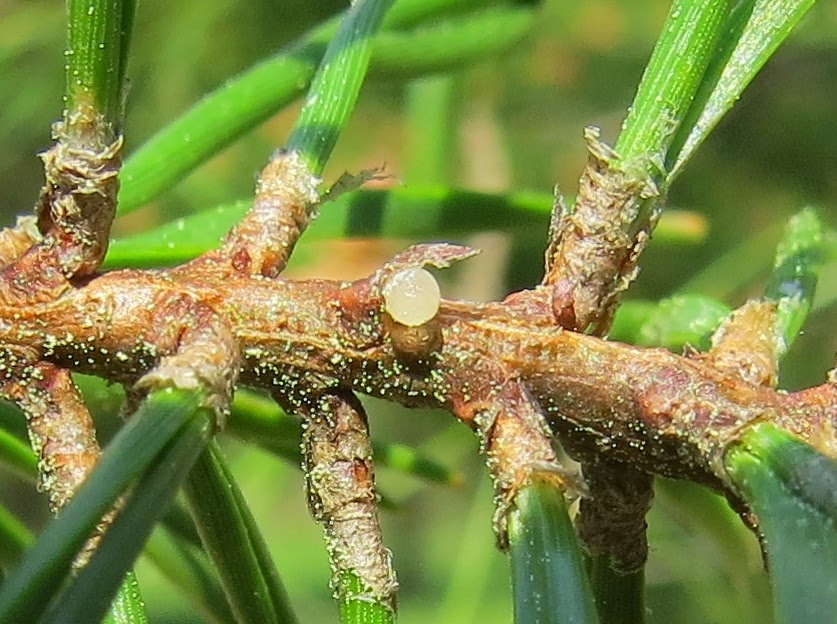
The pines are host to many types of interesting small
animals. Whatever hatches from this egg
will probably be a consumer of pine needles.

This exit hole was left by some insect that spent its larval
stage consuming the inside of a young pine cone. With its seed cavity cleaned out, the cone
died.

As with most plants at Blue Jay Barrens, Virginia Pine
serves as host to numerous aphid colonies.
Where there are aphids, there will be Allegheny Mound Ants. It is uncommon to find any aphid colonies here
that are tended by other ant species.

I found these large aphids to be particularly
interesting. When disturbed, the mature
aphids would break from the pack and run up the branch. Most aphids have a top speed that would be
described as a fast walk. These aphids
moved just as quickly as one of the scurrying ants. I believe these aphids are of the genus
Cinara, AKA Giant Conifer Aphids, but if I was charged with the task of
assigning an appropriate common name, I think I would to call them the Running
Aphid.