Showing posts with label Pulling Invasives. Show all posts

Friday, September 13, 2019

Pulling Wild Carrots

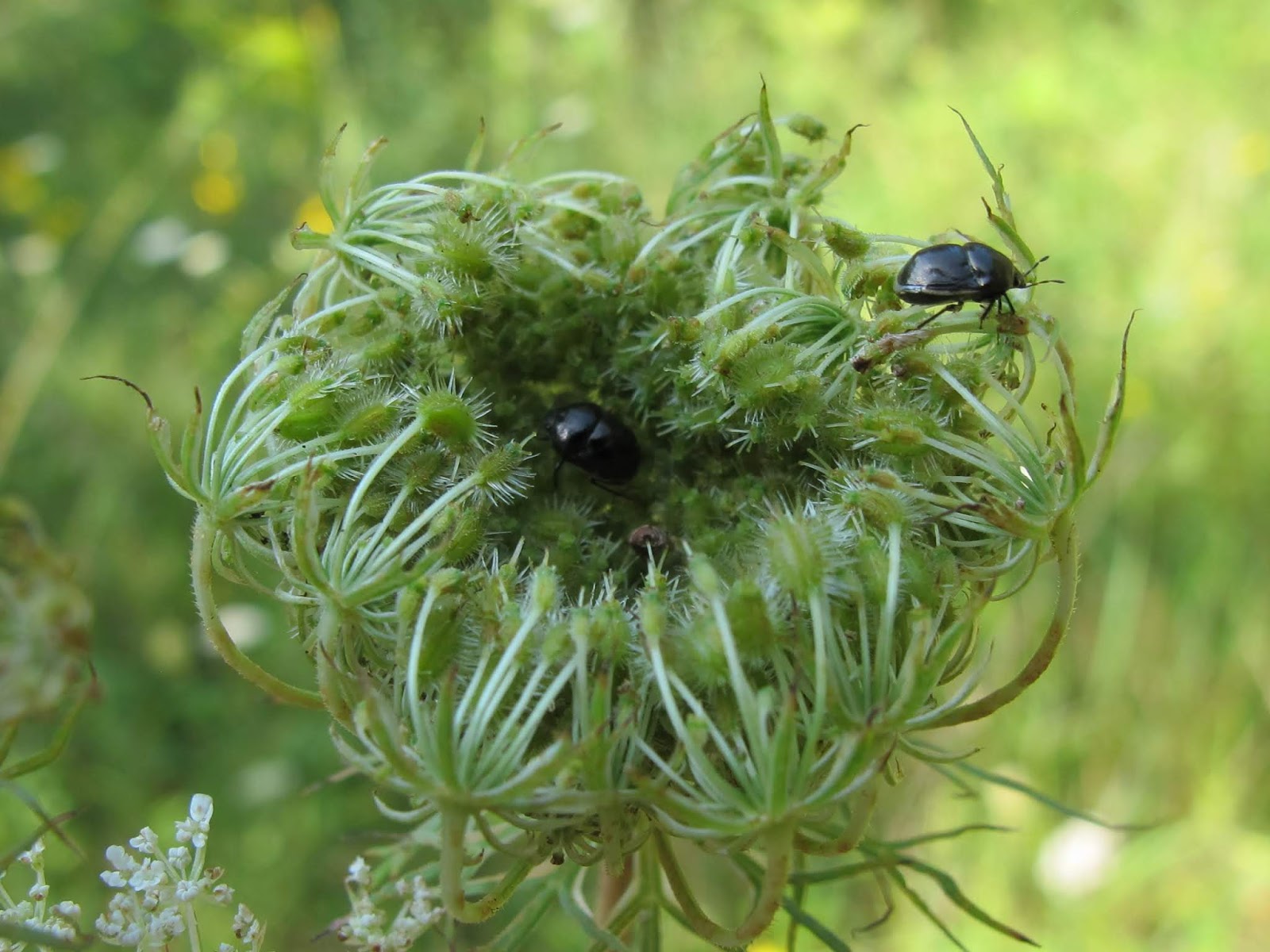
The flower head of the Wild Carrot, Daucus carota, is made up of myriad small individual flowers, each capable of yielding a single seed. Since each plant is capable of producing multiple flower heads, a single plant may produce hundreds or even thousands of viable seeds. This may be a lovely proposition for those wishing to expand their population of Wild Carrots, but it can be a headache for people trying to manage areas as native ecosystems. My management efforts aim towards creating conditions that favor the growth and spread of native species. While Wild Carrot may be attractive and a favorite of many people, it is not native to North America and can act to degrade areas into which it invades. In order to protect and improve the native integrity of Blue Jay Barrens, I remove non-native species from the property and that includes ridding the fields of Wild Carrot.

The Wild Carrot is not the only invasive species I work to eradicate during the summer months. Sweet Clover, Teasel and Oxeye Daisy are also on my list of invasive plants to be pulled during the summer months, but they mature at different times through the summer, so multiple visits must be made to each management site during the year.  The photo above shows a collection of plants pulled from a small Prairie area during the first week of June. Plants on the left are Sweet Clover, those in the middle are Oxeye Daisy, and the small pile on the right side is Wild Carrot. Wild Carrot is just becoming noticeable in June as its developing flower stalk begins to elongate.
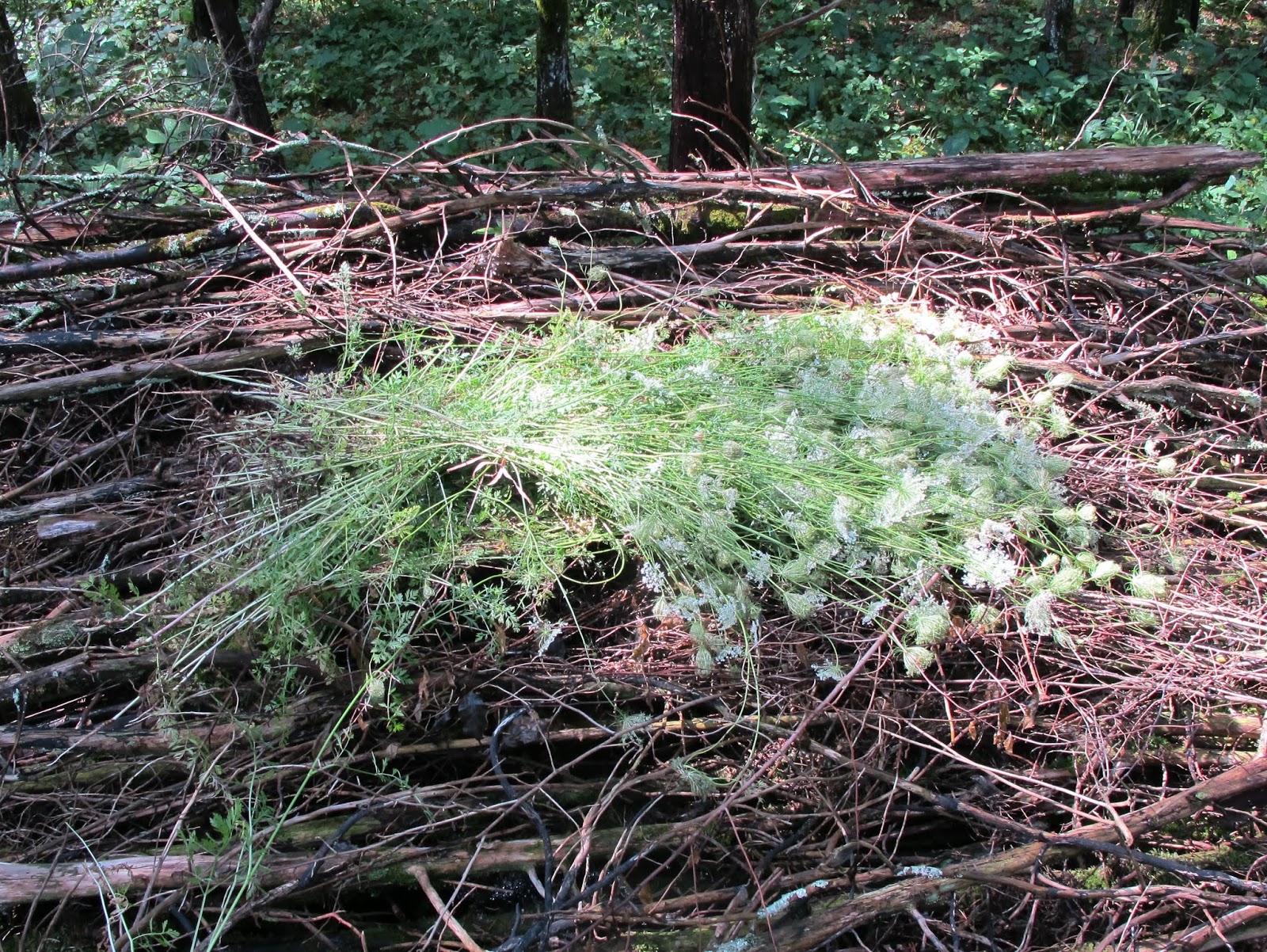
By the time August 1st arrives, Wild Carrot plants are a few feet tall and supporting a nice collection of white flowers. All pulled plants are gathered up and placed on an existing brush pile. It wouldn’t hurt anything to leave the plants in place to rot down naturally on the prairie, but doing that makes it difficult to see all of the plants that have not yet been pulled.  I don’t want to risk leaving plants in place that are going to produce seed for future generations. Besides, I enjoy finishing work on a site and then immediately viewing the area in its improved condition.

I always carry a camera with me while I’m working and try to get a few before and after shots. Often the camera doesn’t come out of its holster because I’m racing to finish an area before I run out of time, or I’m sweating so profusely that I’m afraid I’ll ruin the camera if I try to use it. I did make a special effort to take this shot on a fine August morning when the temperature reached 90° F by 10 AM. This is a small section of a 1 acre opening that had never before received any carrot pulling treatment. My success in eliminating invasive summer forbs means that each year I have time to add new areas into my work schedule.

This is the same area with carrots removed. Within a few years the area should pretty much look this way without my having to spend hours pulling carrots.

Wide area shots of these prairie openings rarely show the diversity of plant species present. Spiranthes orchids, such as this pair of Slender Ladies’ Tresses, Spiranthes lacera, were particularly abundant this year.  They are but one of many interesting little species hidden in the tall grass.

Pulling is an effective way of eliminating Wild Carrots because of the plant’s biennial growth habit. The lifespan of the plant is two years. During the first year the plant forms a cluster of basal leaves and establishes its taproot. The abundance of first year plants such as the one shown above gives a good idea of the expanse of plants to be expected in the next year.

A flower stalk develops in the second year. Following pollination, seeds begin to develop as the flower head closes in on itself. Pulling the plants eliminates seed production and reduces the number of flowering plants you will see two years later. Mature seeds that become incorporated into the soil may remain viable for five or six years. Seeds that remain on or near the surface of the soil generally parish if they do not germinate within a couple years. When you begin pulling plants on a new site it takes two years before you really begin to see the positive results of your actions.

Like many plant species that evolved in areas subject to grazing by herd animals, the Wild Carrot has a weak spot in its stem located roughly at the soil surface. If the stem is given a quick pull it breaks at this weak point instead of having its root pulled out of the ground. Just below this breakpoint is a cluster of buds ready to immediately begin producing new flower stalks if the top of the plant is lost. On most occasions, a steady pull will bring the plant up root and all. When you have a particularly tenacious plant or are working in ground that is extremely dry and hard, the carrot often breaks at its weak point. When this happens, I normally use my hand pruners to cut the plant off down into the root slightly below the ground level to avoid the rapid regrowth shown in the photo above.

Often it’s impossible to find the plant stump and regrowth is inevitable. This plant produced two flower heads within four weeks of the plant originally being pulled and broken off at its weak point. I try to make a run through my work areas at 4 to 5 week intervals to catch late developing plants or regrowth situations such as shown here.

Browsing animals, primarily Whitetail Deer, typically bite the plant off well above the soil surface. Browsed plants are particularly difficult to see when you make your first pass through an area, but quickly produce new flower stalks and often account for the majority of late-season flowers.

I found many mature plants that were lying flat on the ground instead of standing in an upright position, making them particularly hard to see. This was primarily a phenomenon of partially shaded areas near the field edges. In the above photo you can see two flower clusters almost at ground-level.  One plant stem comes from the lower right-hand corner the photo and arcs leftward to one of the flower heads and a second plant stem comes from the lower left-hand corner of the photo in a rightward arc to a second flower head. Despite their horizontal growth, both plants are still perfectly capable of producing viable seeds.
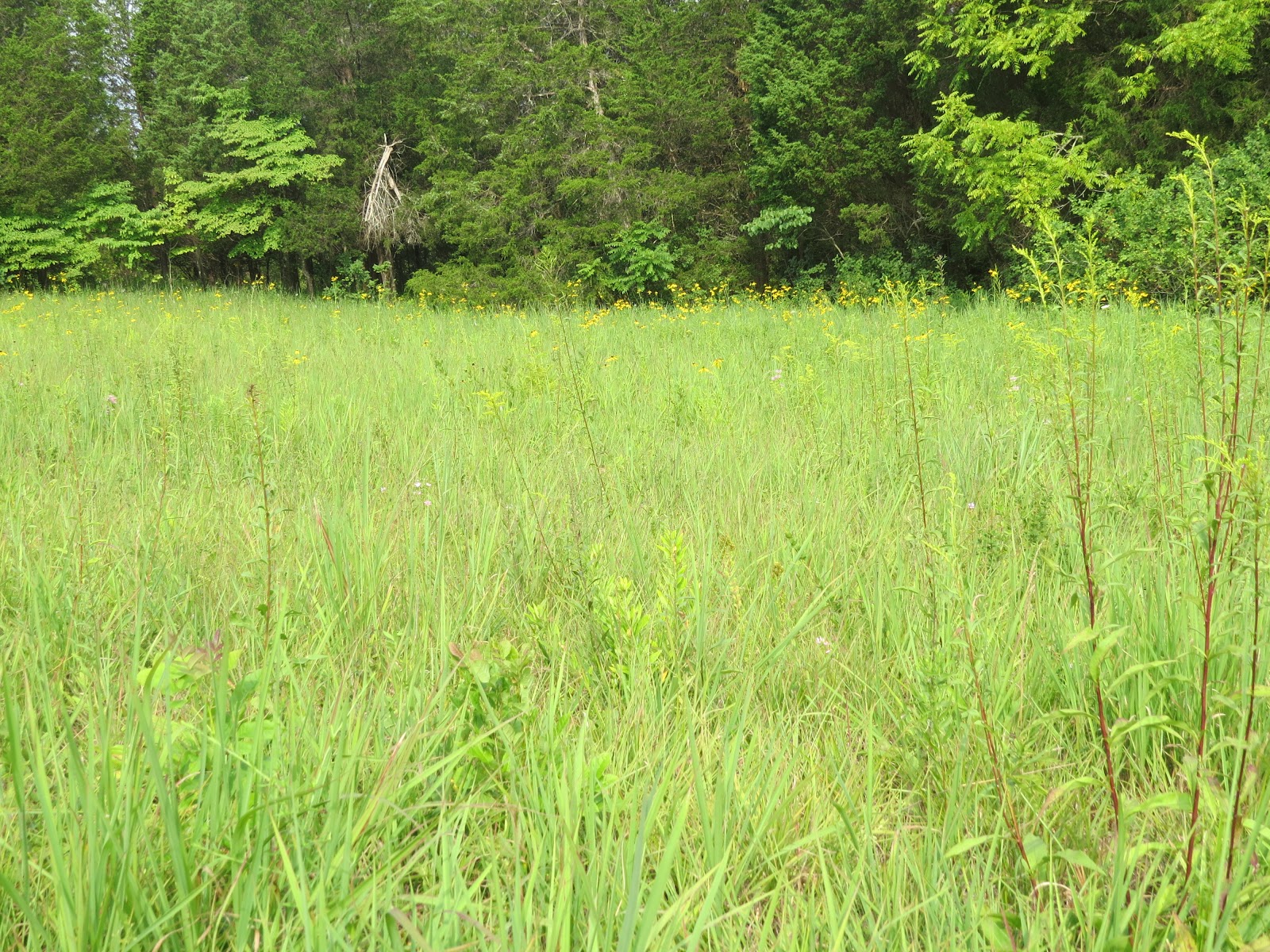
This particular area has received a lot of attention in the past few years. A mid-July photo shows no Sweet Clover, no Teasel, and no Wild Carrot. It shouldn’t be too many more years before all the areas have reached this level of control.

I always find a lot of interesting things while I am working and try to stop occasionally to take a few photos. One day I found a number of Poison Ivy Sawflies, Arge humeralis, feeding on the carrot flowers. They were impossible to miss with the sun shining off those bright red abdomens. I’m much more used to seeing the sawfly larvae, so I was pleased to get the opportunity to observe the adults.

The following day, I continued to see adult sawflies, but now I was seeing a different species. On this day it was the Sumac Sawfly, Arge coccinea, that seemed to have staked a claim to the local wild carrot flowers.


Every year I see a couple of Black Swallowtail butterfly larvae feeding on the wild carrots. I took this one and moved it onto a cluster of nearby first year basal leaves.  If they want to continue breeding at Blue Jay Barrens, they will have to select one of their few native host plants.

Tuesday, August 21, 2018

2018 Teasel Pulling Results

My Teasel removal activities took so little time this year that I can’t even describe the activity as an event.  I spent about four hours walking fields with a history of Teasel infestation and pulled all of the Teasel plants I found.  A total of about 12 acres was searched.

This is my second year of pulling Teasel plants.  Prior to that I collected ripe seed heads on an annual basis.  Last year’s effort occurred about a week prior to expected seed ripening.  This year I began pulling when most plants were just beginning to bloom.  Teasel plants stood above most other plants in the field and were easy to see.  The Teasels were widely distributed across the field as individual plants.  No clusters of plants were found.

This is last year’s harvest of Teasel plants.

This is what I collected this year from the same area, a significant reduction.  There are always a few plants that show up late in the season because they were slow to begin growth or are recovering from injury.  I’ll walk the fields again in the next week or two to search for those late developing plants, but I doubt if I’ll find many.


Pulling is now my preferred method of dealing with Teasel plants.  I can begin pulling when field vegetation is relatively short, so it’s easier to move around and find the plants.  Pulling the plant takes much less time than removing all of the seed heads.  Pulling before seeds are ripe eliminates the chance of spreading seed to other parts of the field.  I think I’ve reached the point where annual Teasel control is going to take very little of my time.  It’s nice to see the fields devoid of invasive Teasel plants.

Monday, September 18, 2017

Eliminating Invasive Plants – Summer Activities

As the seasons change, my management activities change.  Summer is a time to hunt and eliminate invasive forbs and grasses.  Sweet Clover was my initial target several years ago.  As Sweet Clover numbers dropped, I added other species that could be controlled by pulling prior to setting seed.  Now, Yellow and White Sweet Clover, Wild Carrot, Teasel, and Oxeye Daisy are all on my summer pulling schedule.  Not all invasive species can be controlled by pulling.  Sometimes, like in the case of Crown Vetch, the aid of a chemical herbicide is necessary to eliminate the plant.

This is my second year using the chemical Clopyralid in the treatment of Crown Vetch.  Clopyralid kills only broadleaf plants, and is particularly effective on legumes.  Grass is left unharmed, so no bare spots are left in the field after treatment.  The areas I treated this year were fewer in number and much smaller than what I dealt with last year.  Shown above is the largest patch of Crown Vetch I had to spray this year, and it covered only about 40 square feet.

Crown Vetch found its way into my fields as seed that was produced along the edges our township road.  I eliminated the roadside vetch last year, but some of the affected field areas are going to take a bit more work.  Crown Vetch growing beneath the canopy of tall Indian Grass is hard to spot.  The best time to search is when the plants begin to flower.

Unfortunately, peak flowering time for Crown Vetch coincides with flowering of other lavender bloomed plants such as Monarda.  Shown above is Crown Vetch on the left and Monarda on the right.  Colors are almost identical.

Monarda flowers are held above the Indian Grass leaves.  Good luck trying to spot a couple stalks of Crown Vetch hidden down in the grass.

Johnson Grass is another species that requires some herbicide assistance if it is to be eliminated.  I’ve been after this species for several years and only found seven small clumps growing this year.

When dealing with Johnson Grass, I first cut the stalks down to a manageable height and trim back any long, flowing leaves.  This allows me to spray the complete plant with glyphosate, without spraying a lot of neighboring plants.

Johnson Grass is another invasive species that can trace its origin back to the roadside.  Even though the roadside along my property is free of this invasive grass, seed produced along other sections of the road are easily caught and transported by vehicles traveling the roadway.  I expect passersby will replenish my seed supply on an annual basis.

Johnson Grass is hard to miss when it sends up a flower stalk.  This species puts on height in late July, long before the tall prairie grasses, so it doesn’t take much searching to identify new infestations.

When the plant is blooming, tops can be cut and just left in the field.  There is no chance that these flowers will produce viable seed if removed from the plant at this stage.  If treatment is done after seed has formed, it is best to remove the seed heads from the field to eliminate any viable seed being left behind.

I began pulling Wild Carrot six years ago.  I’ve had a lot of success in reducing the numbers of this plant.

Areas that once yielded hundreds of plants, are now producing only a few plants each year.

With fewer plants to pull, I can cover more area.  This is the last of the Wild Carrot infested barrens, an area that I have never had time to get to before.  I was able to finish off this field just as the pulling season came to a close.

Wild Carrot seeds were just beginning to darken during my last week of pulling.  Not knowing if these seeds were developed enough to finish ripening on a pulled plant, I removed the seed heads and bagged them for disposal somewhere other than the middle of my field.

A single Black Swallowtail caterpillar was found on one of the pulled carrots.  I transplanted it to a domesticated carrot variety in my vegetable garden.  It ate for several days and then disappeared.  I hope it went off to find a secure place to pupate. 


Monday, July 31, 2017

Pulling Teasel

In an effort to eliminate invasive Teasel from my fields, I have taken time each summer during the past several years to remove the ripe seed heads from the Teasel plant.  Results have been positive.  The Teasel population is notably diminished over what it was just three years ago.  Instead of large Teasel patches, I now just have individual plants scattered around the field.  The problem with this control method is that the timing for Teasel seed head removal is critical.  Ideally, the activity should begin when the most mature seed heads are just a couple of days away from dropping their seed.  Beginning too late allows mature Teasel seeds to be lost during the collection process, giving rise to another crop of mature plants in two years.  Beginning too early allows for the possibility that the plants will produce new flowers that will mature before the end of the season and scatter new seed in the field. 

I was determining the progress of Teasel seed production and found most plants to be about a week away from releasing mature seed.  As I looked at the plants, I began to wonder how easily a Teasel plant would pull from the ground.  If I pulled the plant, I would not have to worry about it producing any new flowers.  Pulling would also allow me to begin work earlier in the year and increase my collection window from a few days to a few weeks.  I figured that pulling was worth a try, so I headed for the barn for a pair of heavy work gloves, an absolute necessity if you are going to grapple with a spiny Teasel stalk.

Despite its impressive root system, Teasel turned out to be fairly easy to pull.  There were a few that held tight, so I cut these off at ground level.  I’m betting that the root system won’t be able to produce a new mature plant before cold weather sets in.

The work of plant pulling went much more rapidly than seed head collection ever did and piles of Teasel plants began to accumulate on the trail between two fields.  I spent eight hours at the task and searched an area of about 12 acres.  Only about five of those acres actually yielded any Teasel plants.  I just wanted to make sure there weren’t any infestations that I had not yet discovered.

I learned one trick that came in handy, especially in the tall grass areas.  I left one tall Teasel standing in the area that I worked and piled pulled plants at its base.  I then moved on to the next section and did the same thing.  The standing plant allowed me to easily find my cut pile when I was ready to haul the plants out of the field.

This group of ten plants represented a new infestation.  Just beyond the trees in the background is the township road.  A culvert crosses the road at this point and dumps runoff water into the field.  Along with the trash and debris from the road are often a few weed seeds.

All of the collected plants were consolidated into a single pile.  The pile is located at the field edge next to my vegetable garden and is used as a depository for any noxious plants that may drop viable seed.  I pass this pile several times a week and will destroy any undesirable plants that try to grow here.

Even the most developed seed was not near maturity.  The seed shown here has shriveled considerably since the plant was pulled two days ago and may not be viable.

Several of the plants had played host to some type of stem borer.  The borer doesn’t seem capable of killing the plant before seed matures, so it is not likely to be valuable as a control method.

Tiger Swallowtail butterflies were especially numerous in the field.  I scared dozens from the Teasel as I worked.  Fortunately, there are plenty of native wildflowers that the butterflies like just as well.  Pulling Teasel and removing the entire plant turned out to be much quicker and easier than collecting seed heads.  I’ll definitely continue this practice in the future.  At least until I run out of Teasel.