Showing posts with label Woodpecker. Show all posts

Friday, June 10, 2016

Red-headed Woodpeckers

Red-headed Woodpecker numbers continue to climb at Blue Jay Barrens.  There are at least five individuals that regularly visit the yard, and I frequently see others about the property.

Of course, the Red-headed Woodpecker has a ways to go before it displaces the Blue Jay as the most noticeable bird species here.

The birds are most easily observed at the feeder. 

Sunflower seeds are collected in quantity…

… and removed to nearby deadwood snags to be opened and consumed.

It’s generally just one woodpecker at a time at the feeder.  Others wait in the trees for their turn at the seed.

I’m becoming used to hearing the calls of these beautifully colored birds.  I hope the Blue Jay Barrens population continues to grow.

Friday, July 3, 2015

Red-headed Woodpecker Family

I saw my first Blue Jay Barrens Red-headed Woodpecker about ten years ago.  It was a juvenile that frequented the feeder for about three months in late summer.  Two years ago a single adult began visiting the feeder.  It was joined by another the next spring and the two became regular visitors to the feeder.  A few weeks ago, I noticed both birds making frequent feeder visits and leaving the area with a bill full of feed.  This was a distinct change from their previous habit of taking small amounts of feed to be consumed on the dead apple snag just beside the feeder.  I suspected they were collecting food for some youngsters.  Sometimes they left with a bill full of cracked corn.

Other times they loaded up with sunflower seeds.

A few days ago, some juveniles showed up with the parents.  I can hear them calling from the trees, but I haven’t been able to get an accurate count.

I know there are at least two, because I spotted two on the ground helping themselves to cracked corn.  The young woodpeckers are the birds in the photo that are not the Blue Jay.

The adults are now collecting feed and flying into the nearby trees.  Unfortunately, that hides them from my view.

This adult sometimes uses the top of an old utility pole as a feeding platform.

The utility pole is the only place I’ve been able to get a glimpse of the young birds being fed.  The parent lays its sunflower seeds on top of the pole and then opens them one at a time for the youngster.

I’ve included a short video of the young woodpecker being fed by its parent.  The start of the film is a bit shaky because I was shooting through a partially opened window and go tangled up in a potted plant on the windowsill.  I was trying to keep the pot from falling to the floor while I centered on my subject.  About seven seconds in to the video, a caterpillar on its silk thread drops into the right side of the frame and quickly swings out of the picture.  The video can also be seen on YouTube by clicking HERE.  A second, slightly longer, video of the same subject may be seen by clicking HERE.

Monday, October 27, 2014

Fall of the Woodpecker Tree

This is how the woodpecker tree appeared in May 2014, the last time it was photographed in an upright position.  The stout Silver Maple managed to remain standing for nine years following its death in 2005.
 
This is that same view as of today.  It’ll be a while before I stop doing a double-take as I pass by the window outside which this large tree trunk once stood.  I had the tree cut short enough, so it wouldn’t reach the house if it fell in that direction.  Fortunately, it went the other direction and landed in a spot where it can be left to continue its slow deterioration.

I had been looking at birds on the feeder just minutes before the tree lost its hold on the vertical and flung itself to the ground.  The impact tremor was felt throughout the house.  The sound was reminiscent of a quarry blast.  I would have thought nine years of decomposition would have softened the trunk up a bit.

The three large branches broke at the point where they forked from the stout base.  The tree has securely brought itself to rest and will not be doing any further shifting of position.

Despite nine years of weathering, the outside wood of both branches and trunk are still remarkably solid.  Even when the tree was alive, the point that branches diverge from the trunk was a weak spot.  It’s natural that the breaks would occur here.

The dead tree has had no shortage of insect residents.  The wood surface is covered with holes created by a variety of wood borers.

There were only a very few locations where insects had obviously concentrated their feeding activities on wood located directly beneath the bark.  The bark remained securely attached for several years following the death of the tree.  I expected to find a lot more signs of insects in this part of the wood.

This cavity, found near the top of the smallest diameter branch, fledged a batch of bluebirds this summer.  I’m glad the tree didn’t come down during nesting season.

Decomposition was more rapid at and below the ground, where fluctuation of temperature and moisture levels was minimized.  Had the trunk followed the same pace, there would probably be just a pile of crumbs here now.

Side roots disappeared long ago.  A small central core was all that kept the dead tree upright.

Loss of its vertical attitude has not dissuaded the woodpeckers from visiting the tree.  They still probe the cracks and crevices, but seem to have abandoned it as a regular feeding station.

Sunflower seeds taken from the feeder are now conveyed to a dead limb on the old apple tree for opening and consumption.  I’ll miss watching the adult birds teach their offspring the knack of placing a sunflower seed in just the right crevice so the husk can be easily removed.  The woodpecker tree may be down, but I’m sure it will still provide plenty of interest for me to observe.

Friday, May 2, 2014

Woodpecker Tree

Red-headed Woodpeckers have arrived at Blue Jay Barrens.  I saw a juvenile several years ago and I spotted a couple of adults in the area last year, but this year I’ve seen three at once and they seem to be staying around.  Now I have all six resident woodpecker species living on the property and all six are visitors to my feeding station.


A component of my feeding station is what I call the Woodpecker Tree.  This Silver Maple once had large, sprawling branches that reached completely across the house.  To prevent future roof damage, I had the upper part of the tree removed in 2005.  The lower portion I left as a place to hang feeders and as a source of dead wood for foraging woodpeckers.  For about two months after having it cut, I performed a weekly removal of sprouts growing from the cut stumps.  It only took a few minutes each week and without leaves, the tree quickly ran out of energy and died.  Insects soon colonized the dead wood and the woodpeckers went to work.


The root buttresses have just about disappeared, but the tree still seems very sound.  Woodpeckers and various mammals have spent a lot of time foraging in this part of the tree.


There are still a few patches of bark clinging to the stout branches.  Where the bark has long since fallen away, the exposed wood has taken on the weathered appearance of driftwood.


Each limb has a couple of woodpecker nest holes near its summit. 


There are plenty of small holes from woodpeckers searching out burrowing insects.


Larger excavations provide evidence of Pileated Woodpecker feeding frenzies.  The insect supply in the tree must be diminishing, because the woodpeckers now use the tree as more of a feeding platform to which they bring food. 


The Red-headed Woodpeckers have adopted a common feeding strategy.  First there is a visit to the feeder to get a sunflower seed.


The seed is taken into the tree and lodged into a crack of hole.


With the seed securely held, the woodpecker cracks the shell and removes the meat.  Sometimes there’s a line waiting for access to the best holes.


The Red-bellied Woodpeckers use the same strategy.  A single seed is removed from the feeder and taken to the tree.


Red-bellied Woodpeckers are responsible for most of the nest holes chiseled into the tree.


Downy Woodpeckers follow the accepted pattern.


Although, they prefer to open the seed in a more sheltered location.


Downy Woodpeckers leave more debris behind than do the larger species.  Chickadees often come in and clean up once the Downy has moved on.  I don’t know how much longer this tree will last, but I’ve thoroughly enjoyed having it outside the window.

Note:  The six resident woodpecker species at Blue Jay Barrens are: Red-headed, Red-bellied, Northern Flicker, Downy, Hairy and Pileated.

Saturday, June 16, 2012

Young Woodpecker

The Red-bellied Woodpecker pair that I’ve been seeing all spring has managed to produce at least one offspring.  This youngster has joined its male parent at the feeder for a lesson on consuming sunflower seeds.  It waits on the branch while its father fetches the food.

The parent begins by selecting a sunflower seed from the feeder.

The selected morsel is carried up to the dead tree trunk to be deposited into the male bird’s preferred seed shelling hole.  The woodpecker never fails to have a good look around before placing the seed into the hole.

The hole may be a way of safeguarding the secret to shelling sunflower seeds.  More likely, it just holds the seed in place while the bird breaks in to remove the meat.

As the parent works, the youngster moves closer in anticipation of being fed.

The parent is quite practiced at opening sunflower seeds and has a meal ready in seconds.  The young bird gets its food and the parent hops back down to the feeder to begin the process again.  After about a dozen seeds, the pair went to the ground for some cracked corn.  At last they headed off to the trees, hopefully to balance their diet with some more natural food items.

A Camera Critters submission.

Sunday, December 5, 2010

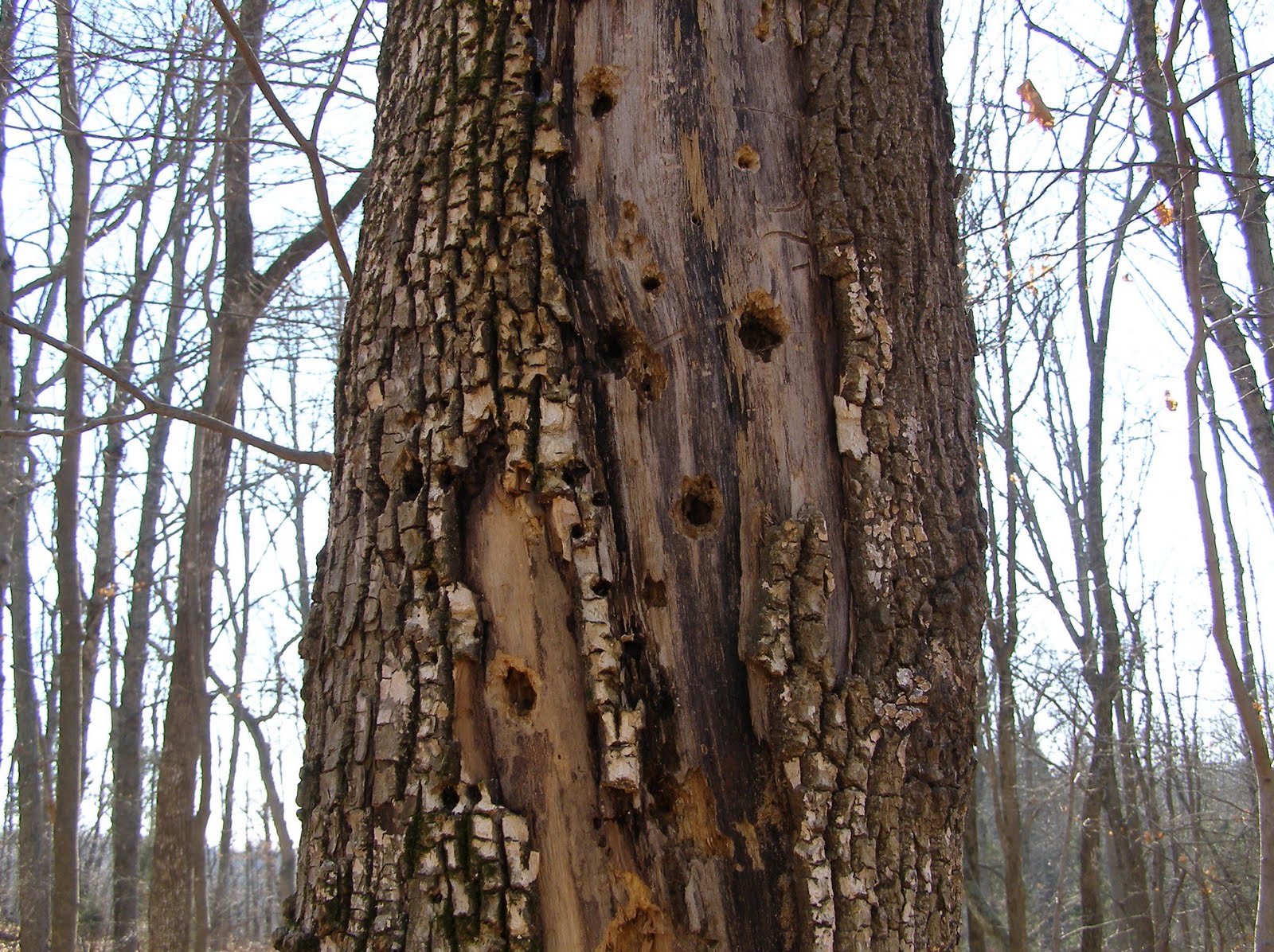
Woodpecker Holes

I mentioned a couple of weeks ago that trees hosting shelf fungi were attractive nest trees for woodpeckers. The white shelf fungi on this tree glowed in the sunlight like a beacon, causing me to change my course and come over to investigate. There between two growths of shelf fungi, I found a woodpecker hole.

The feeding of the fungi on the deadwood of the tree makes for easy digging. A bit lower on the trunk were these oval holes that were probably made by Pileated Woodpeckers. The holes were too high on the tree to determine if they were intended as nest holes or were the result of feeding activity. Pileated nest holes are typically more rounded than these, so I'm guessing this was just feeding activity.

The tree is fairly large and shows signs of woodpecker activity along the entire length of the trunk. I wouldn’t be surprised to see the tree down on the ground within the next couple of years. I guess then I’ll get a closer look at the holes and be able to tell what they were used for.

I’m sure a few of the holes higher on the trunk were entrances to nest cavities, but most of the activity was clearly pursuit of insects. Many areas had sections of bark removed and various small sized holes in close groups.

Some are older holes that show signs of new growth attempting to heal the wound. I don’t think this tree is going to be around long enough to do any real healing.

The heartwood shows signs of insect tunnels and galleries. Many animals utilize the holes in order to access the potential meals inside. I’ve seen mice, skinks, opossums and raccoons work use woodpecker holes for access and then work their way up through the center of a tree. It doesn’t take long for the tree to be hollowed and left to await its fall to the forest floor.