Showing posts with label Pileated Woodpecker. Show all posts

Monday, September 30, 2019

Pileated Woodpecker

Sometimes you don’t even have to search for an interesting photographic subject.  I was lounging beneath a large cedar tree, waiting out a light drizzle of rain, when I heard some activity in the vegetation almost directly in front of me.  About the time I got my camera set up, a Pileated Woodpecker stuck its head up and took a look at me.

This is the largest of our Ohio woodpeckers and is always a treat to encounter.  I thought my presence was going to drive it away.  I just kept still and waited.  Humans are much less threatening when their facial features are hidden behind a camera.

My presence apparently didn’t cause the bird any alarm, because it continued tearing into a rotten stump in search of insects.


I’ve been trying to shoot some video of my photo subjects when possible.  The video shows the woodpecker breaking into a nest of ants. It’s particularly interested in grabbing the white colored larvae.  It snaps up what is readily available and then uses its tongue to probe into crevices to haul out any hidden morsels.  I stopped filming when the bird shifted around to the back of the stump.  It stayed out of sight for a few minutes before flying off.

Thursday, April 7, 2011

Woodpecker Work

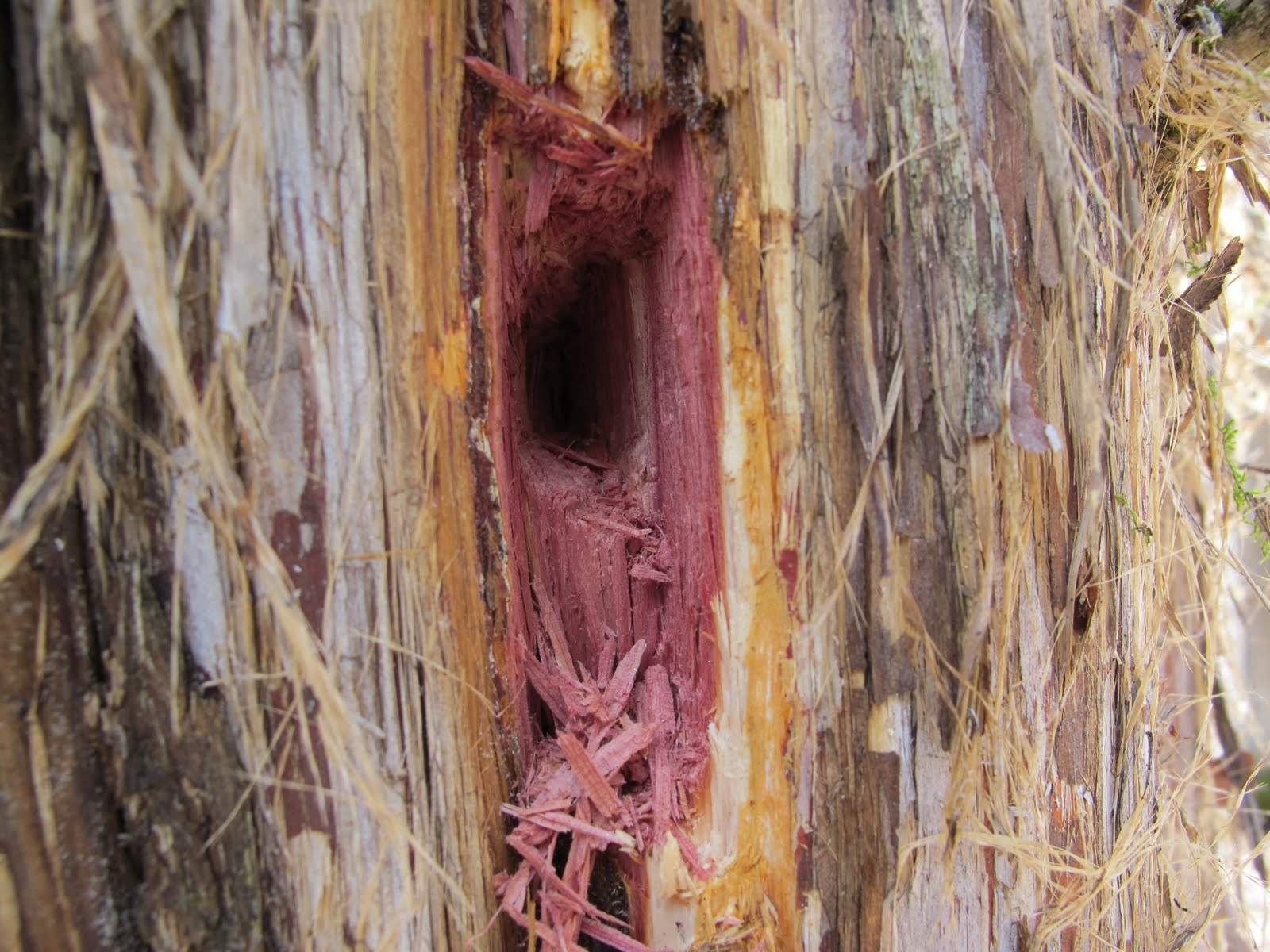
I was really surprised when I saw this hole chiseled into a large Eastern Red Cedar. The red interior wood of a cedar us quite hard and is rather difficult to chop into. It’s obviously the work of one of the Pileated Woodpeckers that frequent this woods. That red wood is full of the fragrant oils that do such a wonderful job of repelling wood boring insects, so it’s hard to imagine anything edible living in there. I’ve never seen woodpeckers attack a live cedar and this fact caused me to keep looking around to see if I could come up with some other explanation for the hole.
Cedars often develop deep furrows in the trunk that can grow closed to leave a vertical shaft isolated within the tree. That’s what seems to have happened here. The woodpecker removed enough of the outer wood to make the shaft accessible. The long, narrow chamber probably made an ideal overwintering site for some insect. At least it was ideal up until the time the insect was eaten by the woodpecker.


It looks like the woodpecker was first successful in accessing the lower portion of the shaft and then it shifted higher and tried to regain access. Either the shaft was more deeply imbedded in the trunk or it did not exist at this upper level, because the woodpecker could not reconnect with its intended foraging site.


My assumption about the sequence of events was based on the fact that most of the bright red chips from the upper site are sitting on top of the other material. I would also guess that the woodpecker revisited the lower area after its failed attempt above. However it happened, there was quite a mass of bark and chips left in evidence. I would certainly like to know what it was after.

Saturday, October 30, 2010

Some Birds and Things

Some people keep asking me why I don’t post more pictures of birds. First off, I have to say that I think I have had several bird posts. I can assure you that there’s no lack of birds at Blue Jay Barrens, but to post pictures of birds you first have to get the pictures and my camera is just not very bird friendly. Sometimes I get lucky, like with this Pileated Woodpecker. The bird was just sitting when I pushed the shutter button, but by the time the camera took the picture, the woodpecker was taking to the air.

I also have pretty good luck with yard birds. They’re out in the open and stay around long enough for me to take multiple shots.

When I’m in the woods, I specialize in two types of shots. The first is the silhouette. The birds always seem to be backlit, so I usually get little more than outlines. This shot of the Titmouse is much better than my average effort.

The second type of shot is the blur. I have quite a collection of blur shots.

I’m much better at getting shots of those creatures that stay still and don’t run at my approach. This is a Black-sided Pygmy Grasshopper, probably the cutest grasshopper around. They are common, but their habit of staying close to the ground makes them hard to notice. They are often found along small creeks and will escape threats by jumping into the water and swimming.

I’m also fairly good at capturing shots of large, slow moving mammals such as this member of the lawn maintenance crew. I’m not even enough of a threat for her to stop eating and look up at me.

My camera most likes the inanimate objects. It doesn’t look like I’ll be setting any balloon finding records this year. This is only number 2 for 2010. Maybe this is an economic indicator showing a decline in the number of birthday parties being held.