Showing posts with label Onosmodium molle var. hispidissimum. Show all posts

Wednesday, July 15, 2015

Prairie Garden Anniversary

Twenty years ago, I decided that I needed a place where I could grow some of the interesting plants found at Blue Jay Barrens that would allow me to view them daily and learn something about their growth patterns.  I gathered seed from various places around the property and in the summer of 1995, planted that seed in a front yard location with such poor soil that typical lawn grass had trouble growing.  I thought this would best simulate the stressful conditions found in the barrens from which the seed originated.  The Prairie Garden took off and is now about twice its original size.

In addition to planting seed directly onto the Prairie Garden site, I attempted to grow some of the uncommon species in pots for later transplant.  I had limited success, but managed to get a few plants.  Seed had been collected and stored, and then stratified or scarified as suggested by several texts I consulted.  I soon learned that most seed, such as that from this False Gromwell, Onosmodium molle var. hispidissimum, does best when planted in pots at the time it falls from the plant and then allowed to experience natural weather conditions until its natural germination time.

My original idea was to have each plant species growing in a certain location so it would be easy to find and observe.  This was the case for the first few years, but the plants soon began behaving as they do in the wild.  I had three of these American Aloes, Agave virginica, that survived transplanting and grew to flowering size.  Two are still persisting, but their offspring are scattered around the garden.   With many species, the initial planting has died, but younger plants have taken their place.

Even though my goal was to showcase uncommon species, I included several common species in the mix.  Gray-headed Coneflower, Ratibida pinnata, is a very common prairie species in this area. 

Gray-headed Coneflower was the first prairie species I found on this property after its purchase 30 years ago.  About a month after moving in, I was on my way home from work and passed a small plant growing out of the loose stone on the edge of the road just in front of the house.  At that time, I had not had an opportunity to explore any of my newly acquired property, so I didn’t know that in just a few weeks this species would be blooming everywhere.  Fearing that the plant was in danger of being destroyed by passing traffic, I grabbed a shovel and transplanted the coneflower to a spot near the edge of the yard.  It prospered in its new location and produced many new blooms through the summer.

I planted a single grass species, Side-oats Gramma, in the Prairie Garden.  Besides being a lovely plant, it only grows a few feet tall.  I thought the short stature of the grass would make it easier to keep track of the other plants.

The Side-oats Gramma can still be found in the garden, but it is no longer the only grass.  Indian Grass soon found its way here and now dominates about a third of the garden area.

Some of the wildflowers bloom early in the season while the Indian Grass is still short.  Others, like the Western Sunflower, Helianthus occidentalis, grow along with the grass and later produce tall flower stalks.  In August, these Western Sunflower plants will top out at over six feet.  Their flowers will be held up above the thick mass of grass leaves where they will attract a variety of pollinators.

Allegheny Mound Ants maintain a single residence in the center of the Prairie Garden.  Their appearance was the result of a colony migration, with a three foot diameter mound being created in just a few weeks.  Once the mound was established, the ants proceeded to eliminate selected nearby plant species that apparently posed a threat to the colony.  Spider Milkweed, Asclepias viridis, an uncommon species that I had planted here, was eliminated soon after the ants arrived.  Other species, such as this Round-podded St. Johnswort, Hypericum sphaerocarpum, are allowed to grow right up to the edge of the mound.

An extension to the garden was added a few years ago.  Since I know that grass will eventually colonize this area, no grass was planted in the addition.

Purple Coneflower, Echinacea purpurea, was represented by only a few plants when I first discovered it on the property 30 years ago.  Their numbers were so few when I first created the Prairie Garden that I didn’t take any of their seed for that initial planting.  Clearing away cedars and other woody growth allowed to plants to flourish, so there was an abundance of seed available for this recent planting.  The addition of colorful plants makes it more likely that passersby will consider this an intentional creation and not just a random patch of weeds.
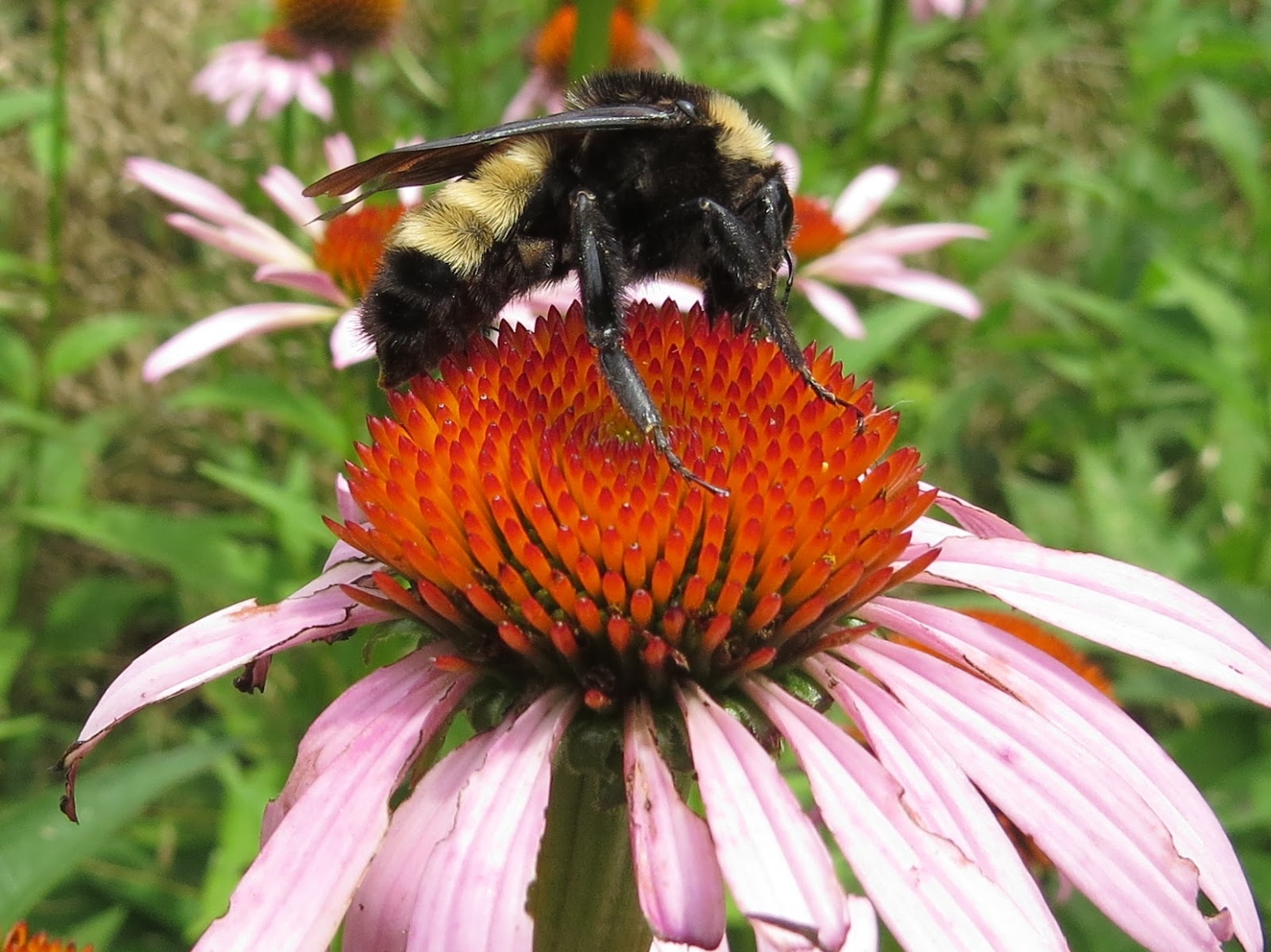
Purple Coneflower is also eagerly sought by many pollinator species.  In most years, butterflies are the dominant visitors of these plants.  So far, Bumblebees are outnumbering butterflies by several to one at all of the nectar sources.  Conditions this past winter must have been perfect for Bumblebee queen survival.

The Prairie Garden spawned this patch of prairie vegetation growing along the driveway.  I refer to this as the Prairie Garden Annex.  I am thinking of expanding the garden to tie in with this area.

The Annex grew up around this patch of Northern Fogfruit, Phyla lanceolata.  I found the Fogfruit growing at the edge of the driveway several years ago.  I was curious about its origin, whether it was already on the property or if the seed had been carried in on some visiting vehicle.  I decided to let it grow to see what developed, but people kept running over it.  When the Indian Grass began to grow here, people must have gotten the idea that I wanted those plants to stay, because they stopped driving there.  I allowed the Indian Grass to spread as a further deterrent to vehicular traffic.

My original intent for this project has been realized.  Developing the Prairie Garden has allowed me to observe the growth of plants in a way that was not possible in their natural sites far from the house.  I hope to continue increasing the size of the garden and to establish additional uncommon species to the mix.

Monday, June 18, 2012

Onosmodium Insects

The larvae I was monitoring in the False Gromwell flowers have disappeared.  This doesn’t surprise me, because it is the normal conclusion whenever I try to follow caterpillar development in the wild.  Larvae often move to new parts of the plant as they grow and some even move to new plants, so there’s a chance they are alive and well in a different location.  They may have represented some small species and have already pupated.  I suspect they may have been eaten.  If I was able to find them, they should have been easy to discover by some caterpillar predator.
Those larvae may be gone, but something has deposited a bunch of new eggs in the flower whorls.  Maybe these are from the Onosmodium moth I’ve been looking for.

The Onosmodium plants are performing exceptionally well this year.  Many may top four feet once their flower stalks have completely extended.  While searching for my missing larvae, I took the time to examine a few other residents of the Onosmodium plant.

Some insects are found on a plant because of developmental requirements that can only be satisfied by a particular plant species.  Other insects are there just because the plant is a convenient resting place.  The host plant for this Elegant Grass-Veneer moth is grass, which is found in abundance in the prairie areas in which the Onosmodium grows.  To be fair, I have to admit that these moths were so abundant that they were probably resting on every plant in the area.  I couldn’t move without causing a few to take flight.

Small, black beetles were on all of the Onosmodium plants.  Most were doing like this fellow and struggling to negotiate the hairy stalks. 

Fireflies are another insect that just use the plant as a convenient resting structure.  Here is a Photinus species displaying one of the more comical insect faces.  This is a common species responsible for much of the low level flashing seen on summer evenings.

Bumblebees are common visitors to Onosmodium flowers.  Most were carrying impressive masses of pollen.  I often see bumblebees spend the night on nectar plants, so I’m not sure how often they actually return to the nest or how long it has taken to accumulate all of that pollen.

Southern Cloudy Wings were frequent visitors to the Onosmodium flowers.  Most nectar gathering insects tend to concentrate on a single plant species that offers an abundance of flowers.  When blooms fade on that plant species, the insect will begin visiting the next most abundant nectar source.  This habit benefits the plant by increasing the odds that flower visitors will be carrying the right pollen for that plant. The Southern Cloudy Wings consistently passed by other nectar producing species in order to reach the next patch of Onosmodium.

I found many insects in early developmental stages.  The best I could do in identifying this fellow was to determine it to be some type of Hemiptera that is not an aphid.  It was fairly fast moving and continued to evade my observation.

Small flies were particularly abundant on the Onosmodium.  This Rivellia species systematically traveled the plant leaf-by-leaf until I inadvertently scared it off.  It rarely paused and I have no idea what the object of the search may have been.

These two flies were doing a dance on the flower’s exerted style.  One fly would shift its body to one side and the other would match the maneuver.  The body shifts continued for a while and then one fly took off.  As with so many things I observe, I can’t explain the why behind the behavior, but that doesn’t make it any less fun to watch.

Friday, May 25, 2012

Onosmodium and Larva

There are certain caterpillars that I see each year, but by the time they become noticeable, they’re of a fairly large size.  I’m making an effort to see some of these at their earliest stage of development, so I can get an idea of their life history.  A good example is the caterpillar I find on the False Gromwell, Onosmodium molle var. hispidissimum, in late summer.  I’ve never seen the earlier larval stages.  I don’t even know its species.  I just call it the Onosmodium moth.  I have run into people who know this moth and they call it the "Oh yeah.  I know that, but I can't think of the name."

I’ve been watching the Onosmodium since it emerged and have recently noticed some signs of leaf feeding.  The damage was concentrated in the area of new leaves at the top of the plant.

By folding back the developing leaves, I was able to trace the evidence of feeding right down to the emerging flower buds at the center of leaf formation.  Damage on the old leaves matched that of the newer leaves, so the feeding probably happened when the leaves were young and closely wrapped.

As I folded back the final leaf, I discovered this small larva at the heart of the new growth.  This part of the plant will soon unfurl into a long stalk of flowers.  I’ve noticed in the past that the larvae begin feeding on the flower stalk and later move down to the stem leaves.

I don’t know yet if this is the same species of larva that I’ve seen in the past.  I’ll keep watching its progress.  No matter what it is, I’m sure that I’ll learn something of interest through frequent observation.

Onosmodium was an uncommon plant at Blue Jay Barrens when I began my management activities.  It forms a large seed that is easily stripped from the plant, so I began collecting the seed and scattering it around the immediate area of the plants.  Areas along trails got the most attention and this Onosmodium patch near the trail head has grown from a few plants to several hundred.  There’s plenty of food here for the Onosmodium moth.

Thursday, October 21, 2010

Onosmodium Seeds

The drought has certainly stripped the color from the prairie landscape at Blue Jay Barrens. We’ve only had the one light frost, so I would normally expect to see masses of asters and the tall grass glowing a bright golden color. What I see is a total lack of flowers and the grass looking more like dirty straw. There is one plant, a favorite that I’ve talked about before, that is still showing green and adding interest to the prairie landscape. That plant is False Gromwell, Onosmodium molle var. hispidissimum.

These plants don’t even look like they’re aware of the ongoing drought. Maybe all those hairs do help minimize water loss from the leaves. The leaves are still full and green. The veins sit in deep furrows that add an interesting depth and texture to the leaf. I always enjoy looking at this plant.

Another plus is the bounty of seed produced. I’m increasingly discouraged by the number of plants that didn’t produce any viable seed this year. The Onosmodium produced a bountiful crop of showy seeds.

The seeds are like hard little nuts. I’ve known them to stay on the plant for the entire winter, so I’m not sure whether or not anything finds them edible. They’re extremely easy to germinate if planted shallowly in the fall. They need to experience the full effects of winter before breaking dormancy. Even if nothing eats the seeds, the foliage is favored by a wide variety of insect species.

Shape and texture of the seeds are a defining character is the genus. This species has a smooth surface covered by randomly spaced pits. The flared out collar is also an identifying trait. These seeds are such attractive little things that I can forgive their apparent inedibility.

Sunday, August 1, 2010

Onosmodium Insects

At this time of year, I become most curious about the identity of this particular insect. I’ve mentioned this larva before. It feeds on the False Gromwell, Onosmodium molle var. hispidissimum, and travels through web tubes that it constructs on the plant. I’ve never found anything laying eggs on the plant. The larva apparently leaves the plant to pupate, since I’ve never found pupae or pupal skins in the web tunnels. Larvae raised indoors will pupate on the plant, but I’ve had no luck producing adults from the pupae. Netting the wild plants has only resulted in dead larvae in the bottom of the net. I suspect the wild larvae may pupate on or in the ground. I’ve raised False Gromwell in pots with the thought that I could cage the entire pot once larvae appeared on the plant, but none of my potted plants has ever hosted larvae. I’d really like to see an adult.

Whatever this thing is, it must be fairly common. Typically 60 to 70 percent of the plants are infested with larvae. A single plant may contain a half dozen larvae. I’ve cut a flower pot in half and plan to enclose the base of a plant containing larvae. With the pot filled with soil and the plant completely netted, I may capture a pupa. We’ll see what happens.

The frass from feeding larvae covers the lower leaves. Lower leaves are not consumed by larvae, but they never seem to remain healthy. While examining this plant, I found another neat little insect.

I believe this to be a nymph of the Spiny Assassin Bug, Sinea spinipes. There are a couple of similar species that can be readily separated as adults, but the nymphal descriptions made it difficult to be certain. There’s no doubt of it being an interesting little creature.

This clump of Gromwell was consumed by larvae the past two years. This year the leaves are blemish free. Feeding damage occurs late in the season and the loss of leaves doesn’t appear to hurt the plant or reduce seed production. Finding the adult form of this larva may be one of those things that’s going to have to wait until I have time to stay with the plant and catalogue visitors.

Monday, August 10, 2009

Onosmodium Moth Larva

There is a larva that feeds on the False Gromwell, Onosmodium molle var. hispidissimum. It’s an attractive larva, with a golden head and four gold bands around a black velvet body. I don’t know what it becomes.

Normally the larva will stay within a network of web tunnels built on the stem and leaves of the plant. Within these tunnels it can feed and is protected from many predators. I don’t know why this individual has decided to run about.

The plant takes on a ragged appearance after awhile, but it doesn’t seem to suffer any life threatening damage. I’ve tried rearing a couple of these larvae in caged conditions, but have never had any luck getting an adult. A pupa was developed once and it looked very much like you could expect a moth to emerge. I have searched through this webbing in the fall and have found neither pupae nor their skins. I wonder if the larvae leave the plant and pupate elsewhere. This particular larva may be preparing for that journey.

You can keep track of feeding activity by cleaning the leaves and then watching for new droppings.

This larva didn’t seem to be moving inside its web tunnel. It may be molting or pupating or dead. I’ll try to check later and see what has happened.

The seeds develop satisfactorily even when covered by webbing. The webbing does seem to hinder seed dispersal somewhat. You’ll often see the entire top of the plant fall off as one unit neatly bound by webbing.