Even though it is a most common butterfly throughout the
State of
Ohio,
the Clouded Sulphur butterfly is an uncommon find at Blue Jay Barrens.
That is most likely because the Red and White
Clovers upon which the Clouded Sulphur caterpillars feed is practically absent
on this property.
During my childhood, Clouded Sulphurs were a particular
favorite of mine.
No matter where we
happened to be living, nearby agricultural fields abounded with Red Clover and
with that plant came the butterflies.
My
net captured hundreds of this species, which I would inspect closely and then
release.
Clouded Sulphurs are common puddlers and will often blanket
a small patch of mud.
I used to race
through mud holes, raising clouds of butterflies.
It is fortunate that these butterflies are so
quick to return to their mud.
As an
eight year old, I had little patience for waiting on butterflies to regroup for
my next run.
Mud holes are also uncommon in the well drained soils of
Blue Jay Barrens.
The pond bottom is
about the only decent place for puddling butterflies to gather.
Besides the resident Clouded Sulphur, Blue Jay Barrens has a
couple of migrant Sulphurs that show up each summer.
This is the Cloudless Sulphur, a species that
regularly shows up here in August.
The
largest of the Sulphurs, this butterfly presents a bright lime-green appearance
when in flight.
The large spots on the
wings identify this individual as a female.
It’s possible that she will deposit eggs on some of the abundant Wild Senna
growing in this field, but none of her offspring will survive the winter
weather experienced in this area.
Next
year’s Cloudless Sulphurs will come here from southern states with milder
winters.
Thistle flowers are a favorite of this species.
These butterflies fly much faster than the
average person can travel through the field, so chasing one down is problematic.
The easiest place to view them is on thistle
flowers.
The Little Sulphur is the smallest of the Sulphurs.
It flies close to the ground and weaves its
way through the tall vegetation.
Its
small size makes it appear quite moth-like as it moves from one location to the
next.
The best time to view this species is early in the morning,
before the dew dries and the butterflies warm up.
At that time, disturbed individuals will only
move a short distance before settling back down.
This is another migrant that moves in each
year from more southern states.
Perhaps
one day it will actually be a resident of this area.


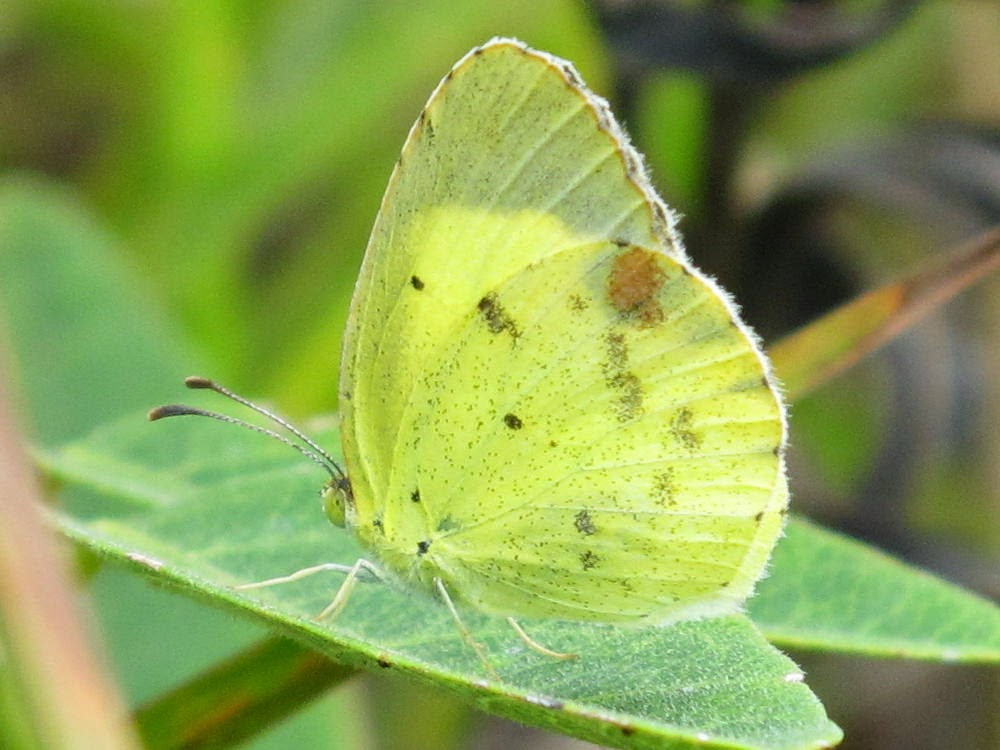

 This has been a great year for butterflies and now is the time to be watching for southern species that extend their populations into Ohio during the late summer. This is a Little Sulphur, a regular immigrant species found at Blue Jay Barrens. It’s a very flashy butterfly that I may see once or twice each season. This northward expansion is a risky business for species such as the Little Sulphur. These temporary populations are killed by cold winter temperatures and this behavior can appear to do nothing but destroy a lot of butterflies. Species increase their chances of survival by occupying every acceptable habitat they can find and aggressive immigration guarantees that every possible opportunity is taken to improve the long term chances for survival.
 As has been the case with many other species this year, the area is thick with Little Sulphurs. These three are probing for the last of the moisture from the drying pond. It’s interesting that the above normal rainfall we were having earlier in the year ended abruptly in mid July and we’ve been in drought mode since then.
 I talked earlier about the butterfly’s habit of taking mineral laden moisture from the damp earth. This puddling behavior provides a great opportunity to observe large numbers of butterflies. Each day without rain brings more butterflies into this last bit of moisture left by the disappearing pond.
 The pond sediments have shrunk during the drying process, causing cracks to form in the pond bottom. The moisture no longer wicks to the surface as it did when water was more plentiful. These Eastern Tailed Blues have to probe deep to find any moisture.
 Many of the Pearl Crescents have taken to probing around the base of plant debris. Apparently the mulching effect of the plant material makes it easier to find moisture near the surface.
 The grouping behavior of the different species reminds me of herds of grazing animals moving across the African veldt. Each butterfly species searches for moisture in a slightly different manner and location. So, like those grazing herds, the different species utilize the same resource, but in a manner that eliminates competition. It would be interesting to make enough observations to know whether this separation of species is a normal thing or if it’s just what’s been happening here during the past couple of weeks.