Showing posts with label Mowing. Show all posts

Wednesday, February 22, 2017

Random Mowing

It has been a couple of years since I’ve done any large-scale field mowing with the brush mowers. For about 12 years I followed a planned three year rotation that had me mowing five to seven acres each year. The sole reason for the mowing was to locate and eliminate trees and shrubs invading the field. I purchased my first DR field and brush mower in 1992. That mower, which I refer to as the DR or The Doctor, followed the old Bachtold Brothers design. The DR was lightweight and would mow practically anywhere, but only had one speed, moderately slow, and with age its performance began to decline. In 2009 I purchased the newer model shown above, which I generally referred to as JR or Junior. JR took over the duties of field mowing while the DR retired to more lightweight duties.

When I first began mowing fields, I would mow over the invasive plant and mark the location of the stump using a 4”x5” red plastic flag mounted atop a 3 foot wire shaft. In the early years I was averaging about 750 flags per acre. Mowing was done in November and December, and I would return to the fields in April or May to apply glyphosate herbicide to the developing stump sprouts. This strategy worked extremely well in fields that were experiencing a heavy infestation of invasive woody plants. In recent years, most areas of the fields are experiencing invasion rates low enough to allow me to individually treat the invaders without a wholesale mowing of the field. Most of my current mowing is done in small isolated areas that still require a more heavy-handed management approach.

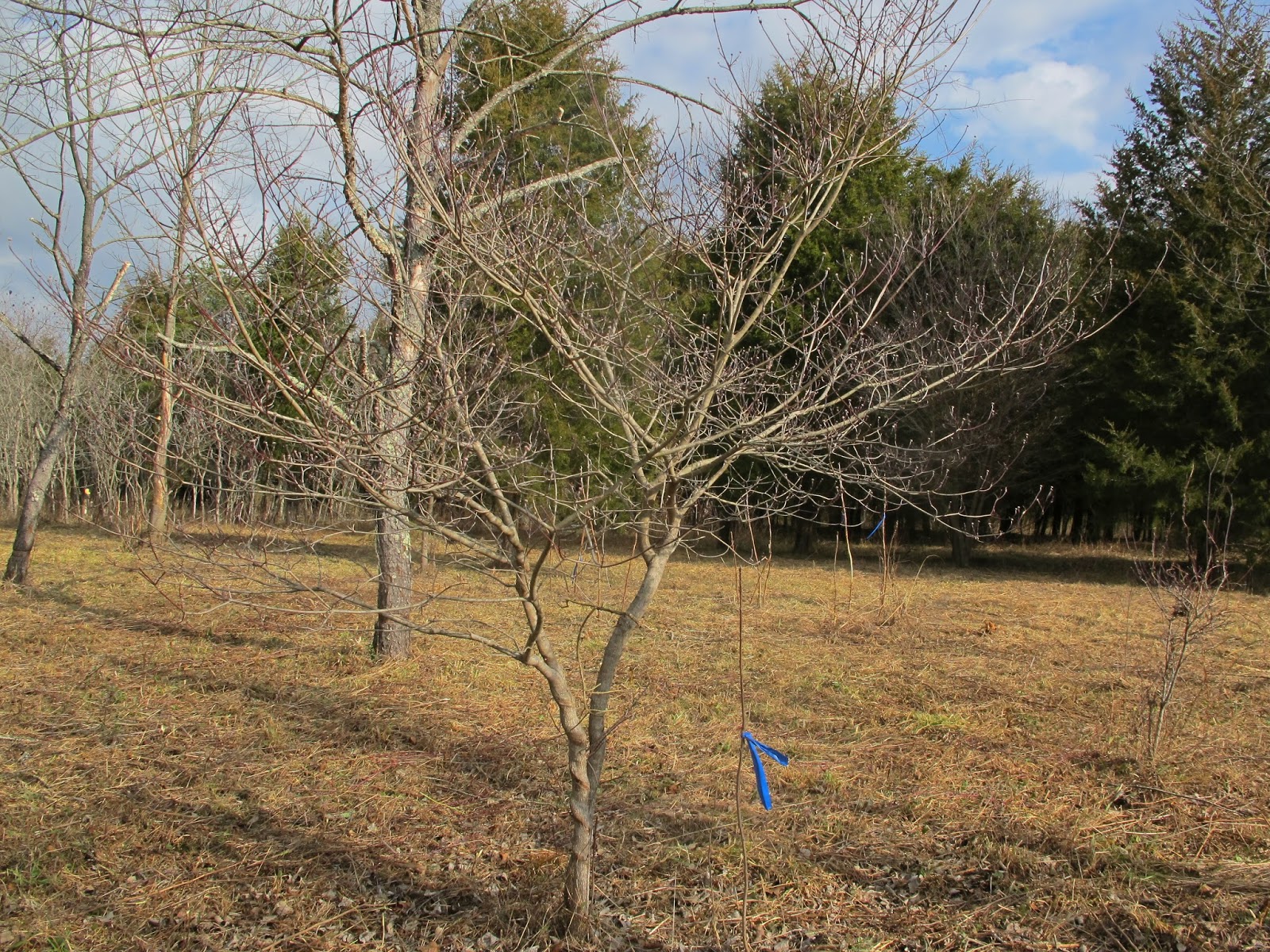
Here is a good example of a small area requiring some special attention. This long triangular area wedged between an old fence row and an intermittent Creek has some special needs that are best met by mowing. This end of the field is crowded with Dwarf Sumac. If left unchallenged, it would eventually create an impenetrable thicket. The far end of the field was once a multiflora rose jungle. I use blue flags to call attention to special features such as holes, rocks, old fence wire, or plants that should be left untouched. In this case the blue flag identifies a small oak that is to remain in this field.

The finished product. The mowing does not kill the sumacs. After two or three mowing seasons they will once again reach the point where they will need to be knocked back. Managed in this way the sumacs pose no threat to the tallgrass or other prairie vegetation, but they are still able to produce food for the various leaf and seed eaters that seem to prefer this species.

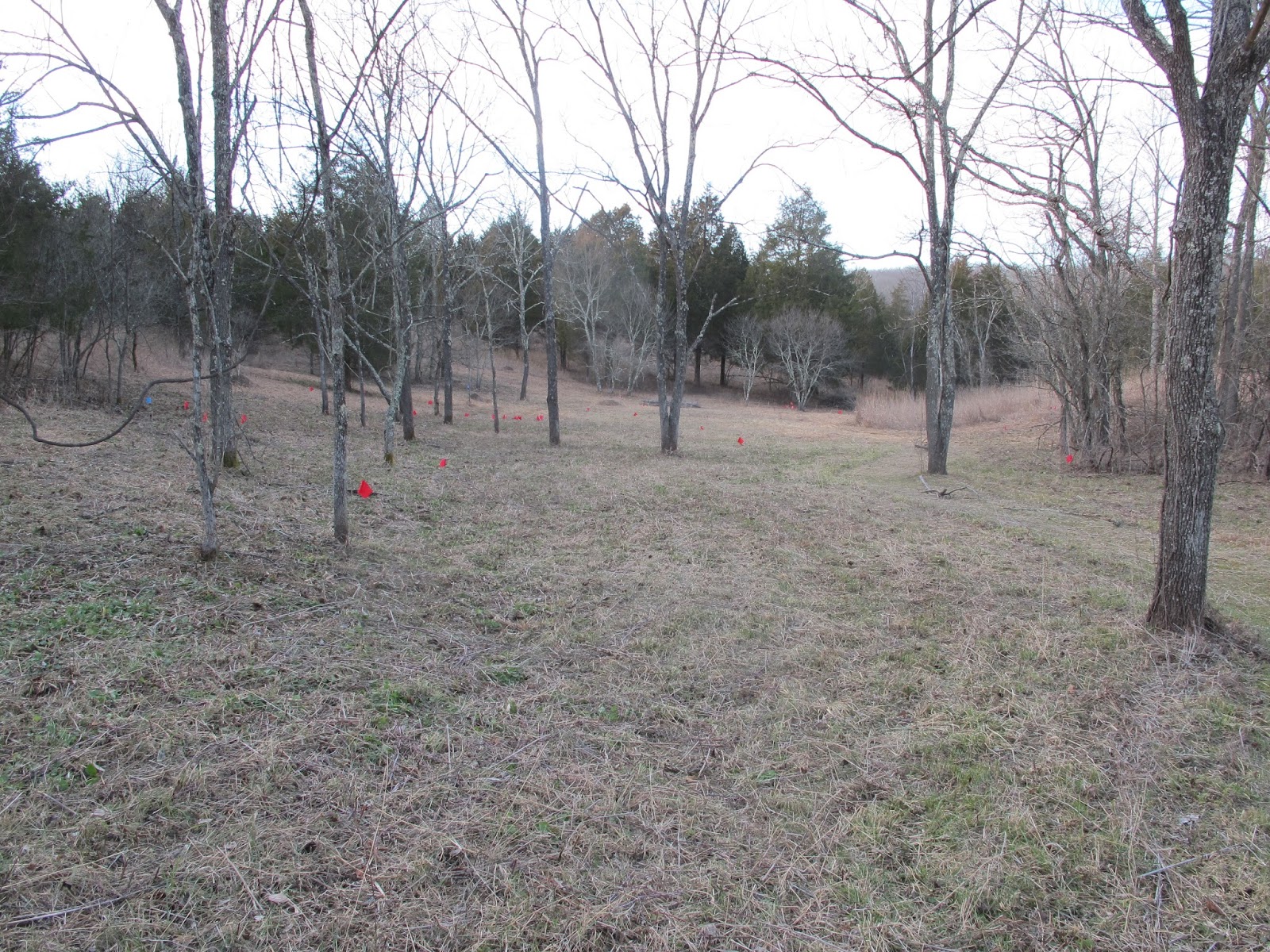
A photo taken from this angle 10 years ago would have shown nothing but a solid wall of multiflora rose inches from your face. I have many photos of that type, but they are virtually useless as helpful before photos for documentation purposes. The massive roses went up to the point where the light-colored grass begins. Since old seeds continue to sprout to produce new plants in this location, I mow it at least every other year to help locate the new multiflora rose plants. The red flags identify young multiflora rose plants that need to be treated with herbicide. Only eight rose plants were found in this one third acre field this year. The blue ribbon marks one of several native rose plants that I am trying to encourage.

The area around the main trailhead is mowed each year. This is one of only two areas that get such attention on an annual basis.

A mixed bag of invasive shrubs once grew here, but now I only have to deal with the occasional new recruit. My primary reason for continuing to mow this small patch is to get rid of the scattered tallgrass and plant stalks that interfere with enjoying the wildflower displays occurring here during spring and early summer. The Monarda bloom is especially attractive. The floral display along with its attendant butterflies should not be sullied by a mass of year-old stalks and stems.

It’s nice to have reached a point where large-scale mowing is no longer necessary to achieve my management objectives, but I kind of miss the activity. It was good exercise and I found it relaxing to spend the day just walking round and round and round the field. Fortunately, I have plenty of other work to fill up those hours no longer needed for mowing activities.

Wednesday, February 1, 2017

Removing Fallen Trees

January has been a rough month for getting any heavy work done in the field. Warm temperatures and frequent rains left the soil highly vulnerable to compaction and other damage resulting from inappropriate management activities. It has only been in the last few days that I’ve been able to perform any intensive work, and that has been limited to hilltop areas that drain and dry out quickly. I removed the girdled trees that had fallen in my planned grassland area. A few stumps, some scattered twigs and flattened areas of grass were all that was left after I finished picking things up.

Following the removal of the downed trees, I brought in JR, the brush mower, and mowed the entire work area. Removing the trees and mowing the field were not necessarily required activities in my plans to convert the area to a grassland condition. The fallen trees would quickly decompose and the tall prairie grasses would eventually take over the site. My actions here were in response to the need to easily access the area to locate and eliminate invasive shrubs. Keep in mind that it’s only been a few years since this particular patch of ground was a thicket of Multiflora Rose and Autumn Olive. The site still harbors viable seed and is producing several new seedlings that must be found and killed each year. Anything that interferes with my ability to travel freely through the area in search of these invaders must be removed.

The area is planned to be grassland, but it will not be completely free of trees. This Blackjack Oak, Quercus marilandica, currently surrounded by the standing dead, will one day be surrounded by tall native grasses.

This double trunked Flowering Dogwood will also be left alive. An anthracnose outbreak nearly three decades ago eliminated this species from the woodland understory at Blue Jay Barrens. It has still not returned to the woods, but a few survivors along the field’s edge became the progenitors of flowering Dogwood trees growing in the open fields. I allowed this species to remain in certain designated areas of the fields, and now have dozens of nice sized specimens producing copious amounts of fruit and seed each year. This individual is doing quite nicely despite one of its trunks being disfigured by the choking embrace of a Japanese Honeysuckle vine, yet another invasive species needing to be controlled here.

After mowing the area, I noticed a leaning tree poised to land directly atop the Flowering Dogwood, and a pair of grape and honeysuckle festooned trunks similarly aiming towards the lovely oak. Not wishing the oak or dogwood to be damaged by their menacing neighbors, I removed the threats myself in a safe and controlled manner.

In order to facilitate invasive shrub control, I also removed some fallen branches from the sumac patch.

The patch of Dwarf Sumac was left intact and standing dead stems were not touched. These sumac thickets harbor their own suite of boring beetles, leaf eaters, lichen colonies and other organisms drawn to this type of habitat. I tried to disturb it as little as possible.

The removed wood roughly tripled the size of the brush pile at the edge of the field. Logs were placed on the east facing side of the pile. Skinks and fence lizards are particularly drawn to logs situated in this manner.

Tree branches were dismantled down to individual stems which were then piled as densely as possible. This fosters rapid decomposition, so the pile quickly reduces in volume. The logs are stacked so that they will fall back into the pile as the small branches decompose. It has been pointed out to me numerous times that my brush piles do not follow the classic wildlife management design, which has the goal of providing escape cover to game mammals. My piles serve a broader interest and are utilized by a wide range of reptiles, birds and mammals.

The dead trees will continue to fall for the next couple of years. During that time, the tall prairie grasses will move in and become established. By then the incidence of invasive shrubs should be limited to new arrivals carried by birds as seeds from neighboring properties. For now, I’m pleased with the way things are progressing on the site and hope that all continues favorably.

Friday, February 5, 2016

Finishing Up the Mowing

Last night, I heard the first calls of courting Woodcocks from the prairies of Blue Jay Barrens.  This was a reminder to me that I had to complete my winter mowing before the female Woodcock began selecting nesting sites.  I only planned on mowing about two acres this winter and should have completed that back in November.  However, frequent rains and warm temperatures kept some of the areas too wet and soft to mow without making a mess.  I found myself with about an acre left to mow as we entered February.  This is one of the larger areas, the valley though which one of the main trails begins.

At one time, this valley was choked with Smooth Sumac and a hefty dose of Multiflora Rose.  Removal of the shrubs allowed prairie vegetation to move into the area.

The deep soil of the valley supports a healthy population of Monarda.  The flowers attract a wide range of butterfly and moth species during the summer.  Soil depth decreases rapidly as you leave the valley.  The slope in the background has less than a foot of soil over the bedrock.

Indian Grass crowds this section of trail.  As it grows, it leans into the open area.  The leaning grass was trimmed back several times during the late summer to keep the trail open.  Heavy snow sometimes bends the grass towards the trail, but our precipitation this year has been primarily rain, so the Indian Grass has remained upright.

The contours of the valley are easy to see following a mowing.  The steep hillsides terminate suddenly into the flat valley floor.  Underlying limestone bedrock follows the grade of the hillsides and continues that same angle to a point beneath the valley center.  Soil eroded from the hillsides has been trapped in the valley, gradually changing the shape from a sharp V to a gentle bowl.

A strange feature of this valley is the fact that a large portion of the storm runoff water travels through channels below the ground.  Under certain conditions you can hear the water rushing beneath your feet.  The water all emerges at the head of a stream farther down the valley.  Seasonal springs also discharge through this same system, but at a much lower volume.  The springs normally flow from January to July.

The sumacs cleared from this valley produced several large brush piles.  The remains of one can still be seen just right of center in the photo.  This pile remains because it contained several rot resistant Eastern Red Cedars along with the sumac.  Piles of all sumac, one of which was in the center of the photo behind the crooked Ash and another just downhill from the cedar on the left, decomposed quickly and disappeared back into the soil.

I don’t mow the fields every year, but I always take at least one pass along the trail edges.  This keeps the dead grass stalks, which will eventually fall, from dropping out into the trail.  A couple of years ago, I began blowing the cut grass onto the trail in an attempt to increase organic matter and nutrient cycling.  After 25 years of maintaining this trail with a lawn mower, I had unintentionally subjected it to a type of management known as soil impoverishment.  This is where you continue to remove vegetation and the nutrients it contains, without replacing the loss with soil additives.  Over time, this activity diminishes the supply of essential elements required for plant growth and plants grow poorly.  Each time I mowed, the cut grass was blown into the edge of the field.  Eventually, the grass on the trail began to thin out and the grass at the field edge prospered.  Trail grass seems to be responding well to my new strategy.

With the mowing comes the flags marking woody invaders that need to be removed in order to protect the desired mix of plant species.  Control of woody vegetation is the reason these areas get mowed.  Red flags mark small trees that need to be killed.  Most of these flags are marking Black Walnut seedlings that grew from nuts produced by those Black Walnut trees showing in the foreground.

Only one patch of nasty invasives in this mowing.  A clump of young Multiflora Rose.  I suspect the seeds came from a bird that rested in this tree.  My encounters with non-native invasives become more rare each year.  It’s a nice thing to see happening.  I should finish my mowing tomorrow and hope to see just as few non-native invasives then.

Friday, March 20, 2015

Prairie Garden Mowing

The tall grass in the Prairie Garden looks a bit battered from the heavy snows it endured this winter.  The combination of strong west winds, heavy snow, and no support outside the garden boundary, caused much of the grass to be laid on its side.  Even though there are acres of similar habitat very close by, birds and other animals spend a lot of time foraging and hiding in this small plot.  This is one of the reasons I leave the garden untouched through the winter.

The new portion of the Prairie Garden has little prairie grass, so the dead stalks of various wild flowers are easy to see.  Birds have pretty much picked the area clean of seeds.

In the spring, I remove the dead top growth.  The process begins by cutting with the brush mower and raking the cut material from the garden.

The clearing away of dead material is done primarily to give me an unobstructed view of the developing plant life.  I intentionally crowded a large number of species into this small space.  They all grow naturally at Blue Jay Barrens, but it takes a bit of a walk to visit all of the areas where the different species occur.  The Prairie Garden specimens make it possible to easily visit the plants every day and follow the various stages of their development.  The recent heavy snow cover has slowed the emergence of many of the common plants.  Some species, such as this Orange Coneflower, Rudbeckia fulgida, were already green and growing prior to the onset of snow.

Monarda has produced this growth in just the week or so since the snow melted.

The invasive Oxeye Daisy, Chrysanthemum leucanthemum, legally designated as a noxious weed in Ohio, maintains a cluster of green basal leaves through the winter.  This is the only specimen found in the garden this spring.  

I’ve been pulling Oxeye Daisy from the Prairie Garden to evaluate the effectiveness of this method in controlling the weed.  I’ve found that the pulled plant can be killed if all segments of the spreading rhizome are removed from the ground.  Fibrous roots don’t seem capable of regrowing the plant, but any small segment of rhizome will quickly reestablish the infestation.  Pulling isn’t a practical method of dealing with fields already filled with Oxeye Daisy, but it can be effective in dealing with new incursions into previously uninfested areas.

After raking, I go over the garden with a push mower equipped with a grass catching bag.  It’s at this stage in my management efforts that some people get the impression that I’m finally getting rid of the weed patch in my yard in favor of a cleanly mowed look.

It is now easy to see anything growing in the garden area.

The material removed from the Prairie Garden is hauled back to the vegetable garden and used as mulch between the raised growing beds.  By next fall, the material will be well composted and will be incorporated on top of the beds.

Friday, February 6, 2015

Final Field Mowing of the Season

This field was on the schedule to be mowed in November, but the mowing was postponed until I could remove the small army of tiny cedars that had sprung up in the tall grass.  Cedar removal was completed on January 31, just ahead of an approaching storm front.  Four days later, the temperatures climbed above 40F and the last trace of snow melted away.  I hurried out to mow the field before the next storm, forecast for that night, could recover the field with snow.

I had several reasons for wanting to mow the field this year.  One reason was to knock back several small stands of sumac.  These are Winged Sumac, Rhus copallinum, and may get as tall as 20 feet if left to grow.  I maintain a couple of stands of the tall specimens, but most of the sumac is periodically cut to maintain it in a younger growth stage.  Two or three years after being cut, the plants flower profusely and develop a generous load of fruit.  The fruit remains uneaten during most winters, but during severe weather the fruit stands high above the snow and becomes an excellent survival food for the birds.  These plants have not yet reached that stage, but I’m trying to set up a rotation where there are always a few stands of sumac bearing fruit during the years when other sumacs are recovering from being cut.  Maintaining the sumac in an early stage of growth also allows them to grow as part of the open field environment without negatively impacting the tall grasses.

Several clumps of invasive Johnson Grass in this field were treated with herbicide last spring.  Having the field mowed will allow me to identify any other Johnson Grass infestations and treat them early next year.

This shallow four foot diameter crater was once the site of a thriving ant colony.  The mound peaked at 18 inches until Wild Turkeys selected it as a prime dust bath site.  During the course of three summer months, the turkeys turned the mound into a pit and then stopped using the site.  That was two years ago and vegetation has yet to reclaim the bare ground.

The site after mowing.  Mowing with JR is easiest when you are dealing with long, relatively straight runs.  Under those conditions you can shift into high speed and move along at a fast walk.  Unfortunately, this field doesn’t have any straight sections.  Most of the time I was weaving in and out of small corners and pockets or slowing down to maneuver around large cedars, small trees, ant hills and a number of other obstacles to my progress.  This will be the last mowing I do this year.  Besides having already mowed everything that was planned for this winter, I always stop mowing when the Woodcocks begin calling in the field.  I’m betting that will be in the next couple of days.

There is no shortage of ant mounds in this field.  In the acre and a half that I mowed, there were close to 20 large mounds.

The tall grass tends to shade the lower branches of the Eastern Red Cedars and those branches die.  This allows enough sunlight to get beneath the tree to maintain the grass that grows there.  If excess shade threatens the survival of the grass beneath the trees, manually trimming the lower branches should open things up enough for the grass to survive right up to the base of the tree.

There were only a few unwelcome woody invaders that had to be marked for cutting and herbicide treatment in the spring.  Most were Tuliptree seedlings, a species that is easily killed by a cut stump treatment of glyphosate.

A half dozen large Flowering Dogwoods survive along the lower slope of this field.  The trees thrive in this open, but sheltered area.

It appears that the dogwoods are set to put on a magnificent flower show this spring.  Each one of those large buds will open to produce a flower cluster surrounded by four brilliant white bracts.  Severe winter weather conditions commonly damage those buds and diminish the quality of the spring show.  Hopefully, this will be a year where each bud flowers to its full potential.

Wednesday, December 3, 2014

Previously Mowed Field

Mowing does not leave a permanent, easily recognizable signature on the land.  Plants grow back and the area once again takes on a natural appearance.  Those familiar with the stages of natural succession that occur within a field, would suspect that there was a reason for the absence of woody species growing above the grasses, but the tracks of the mower have disappeared.  Last year at this time, the field to the left of the trail was in a condition identical to the recently mowed field on the right.  By next year, both fields should be displaying a similar appearance.

Indian Grass dominates during the autumn and winter seasons.  The seed heads of the early summer wildflowers have long since been overtaken by the stalks of tall prairie grass.

Despite the outward appearance of being a solid stand of Indian Grass, there are pockets of short grasses such as Little Bluestem and Side Oats Gramma scattered about the field.  From a distance, the tall grass effectively blocks these small openings from view.

In many areas, other grass species grow stem to stem with the Indian Grass, but lack the visual impact to be noticeable at a distance.  Here Little Bluestem and Prairie Dropseed occupy the spaces between the Indian Grass stalks.

A narrow valley running through the field provides perfect growing conditions for a stand of Canada Goldenrod. 

At one point in its transition from grain crops to prairie, the field was a monoculture of Goldenrod.  On the hillsides, where the soil was shallow and dry, prairie species gradually outcompeted the Goldenrod.  Now Goldenrod is confined to the deeper soils of the valley.

On November 17, three inches of wet snow brought the Indian Grass nearly to the ground.  Fortunately, the snow melted quickly and the grass stalks returned to an upright condition.  Rain just prior to the snow hydrated the stalks so they were able to bend without breaking.  Had the stalks been dry and brittle, they would have broken under the weight of the snow and stayed down permanently.

Not long after the snow, a storm front with wind gusts of 50 miles per hour whipped the stalks around for nearly a full day.  Stalks remained upright, but most seeds fell to the ground.

Whitetail deer commonly bed down in the thick stands of Indian Grass.  Judging by the number of beds I’ve seen in the field, the deer must frequently build new beds for their use.  Either that or I have seriously underestimated the size of the deer population.  Maybe they are like rats and every visible deer means there are a hundred you don’t see.

Of course, despite all of my efforts to eliminate them, there are some small cedars taking hold down in the grass.  Still, it will be several years before I will need to once again cut little cedars from this field.  Until that time, I can just enjoy the sight of an open grass field at least visibly free of woody invaders.