Showing posts with label Apple Cedar Rust Gall. Show all posts

Friday, May 6, 2016

Apple Cedar Rust Gall

This spring’s frequent rains may be messing up my planned outdoor work schedule, but they have been a boon to many forms of life.  Apple Cedar Rust Fungus depends upon high moisture conditions to properly complete the reproductive portion of its life cycle.  The fungus has a two host life cycle, shuttling back and forth between apple trees and cedars.  Each spring, the cedar bound fungus sheds spores that will make their way to apple trees.  In its spore producing form, the fungus resembles some weird sea creature that has washed up onto a tree branch.

Many people are put off by the appearance of this fungus, but I find it to be quite attractive, as well as fascinating.  From a distance, the cedars appear to have sprouted large orange blooms.  I’ve heard some ascribe Blob-like characteristics to these fungal masses, but I’ve never seen one reach out and engulf passers-by.

The fungus reaches the cedar by way of airborne spores produced by the fungus during the summer while in its apple host phase.  Spores that successfully colonize the cedar will form a small, hard nodule on the new cedar leaves.  The nodule, called a gall, will grow in size until it matures approximately 18 months later.  When spring rains and temperatures produce the proper conditions, filaments called telia emerge from dimple-like structures on the gall’s surface.  Fully hydrated telia produce the spores that will be released to colonize an apple tree.  Spores produced by galls on the cedar cannot establish themselves on cedar.  They can only colonize on apple, and spores from the apple can only colonize cedar.  In order for the fungus to survive, both apple and cedar must be present in the vicinity.
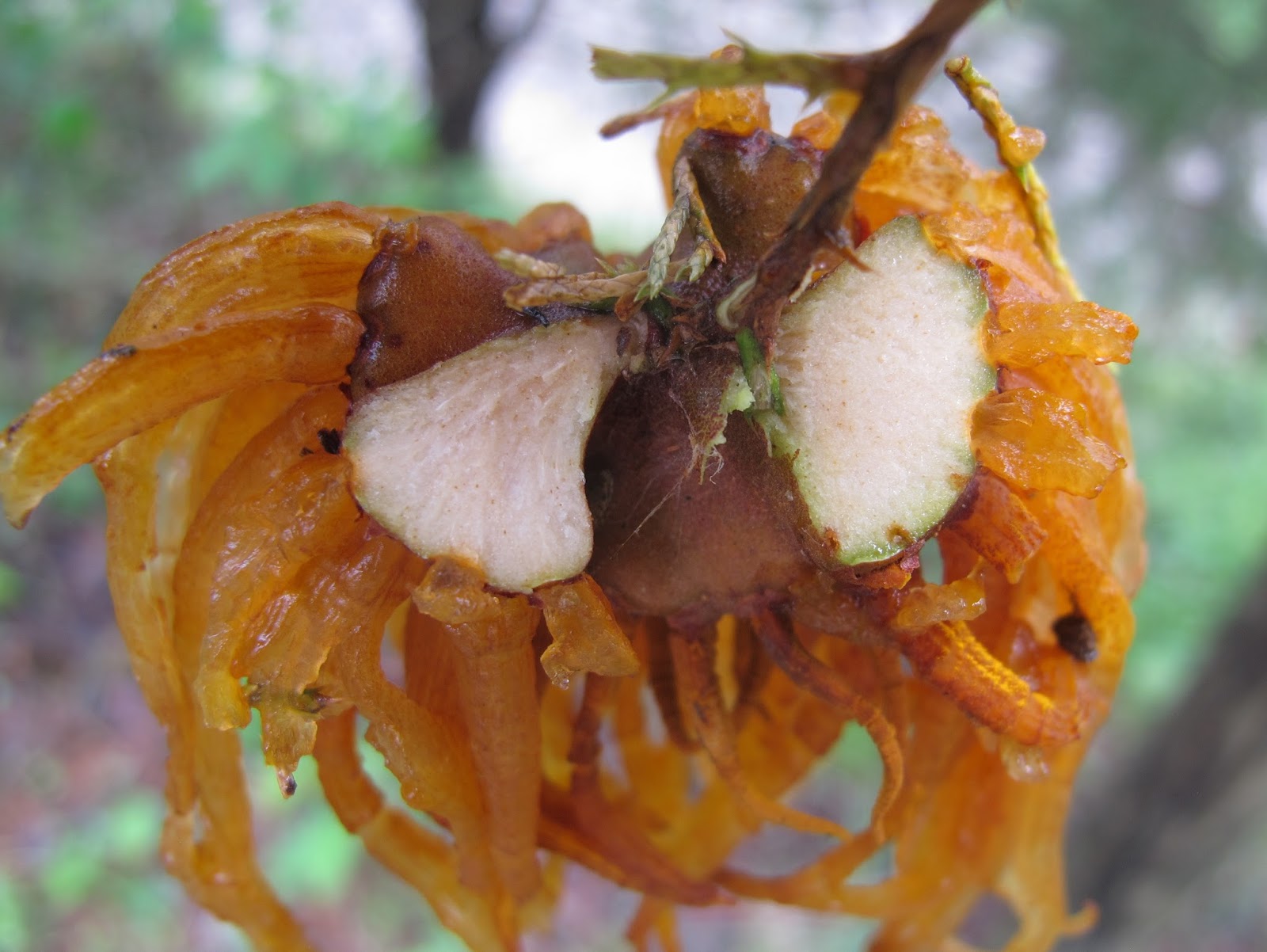
In most fungi, what we notice most are the reproductive structures that must be exposed to successfully spread spores to the wind.  This gall has been halved to reveal the body of the fungus from which the spore producing telia emerge.

After the rain has passed, the telia begin to dry.

The telia will dry back to short stalks, but will swell again when the next suitable rain occurs.  This process can recur several times during the spring season.  So far, this has been an exceptional season for the Apple Cedar Rust Galls.  Judging by the weather forecasts, the cedars may bloom several more times before the season ends.

Monday, May 3, 2010

Apple Cedar Rust Gall

If you’re making a list of bizarre organisms, you need to add Apple Cedar Rust Gall. This formation is produced by Gymnosporangium juniperi-virginianae, a fungus that alternately lives on Eastern Red Cedar and various species of apple. The fungus spends the winter as an acorn sized mass attached to the cedar branches. The masses usually go unnoticed until spring rains cause them to explode with these fleshy orange spikes.

Who’s not going to notice the sudden appearance of something like this on their tree? This seems to be an off year for the fungus. These masses have been extremely rare this spring.

The galls affect the cedars very little. At most you may notice some die back of the needles or branch tips. It’s when the fungus transfers to apple trees that damage occurs. Blemishes to the apple fruit can severely reduce the market value of a crop. Leaf damage is sometimes severe enough to weaken the tree and make it susceptible to die back or infection by other diseases or insects.

Dimples on the surface of the gall open to allow extension of the filaments that will be the source of spores. Spores released from the gall must come into contact with an apple tree in order to survive and produce more fungus. Mature fungus on the apple tree will produce spores that will again infect cedars. In some ways it seems a somewhat risky survival strategy, but I guess it would be a fairly effective way of ensuring that the host plant was not overwhelmed and killed by the fungus.

It only takes a light rain to cause the dry projections to blossom into full spore producing appendages. Depending on the weather, the spore producing portion of the fungus may remain for as long as a couple of weeks. My apple trees sometimes play summer host to the fungus, but the blemished apples taste just as good.