Showing posts with label Creek. Show all posts

Friday, April 10, 2015

Rain and Flooding

Blue Jay Barrens is about as wet as it can get.  A long sequence of storms moving through during the past week has dropped nearly six inches of rain over the area.  Storm clouds moved through once or twice every day.

The soil, already fully hydrated by over six inches of rain in March, quickly became saturated and the output of each storm had nowhere to go but to run overland to the creek.  A storm yesterday afternoon produced 0.8 inches of rain in 15 minutes.  The result was a flash flood, the third this week.

Water from the township road carried red clay particles to the pond.  It looks like a bowl full of mud, but the water clarity is not as bad as it appears.

A closer examination shows the water to still be fairly clear.  The clay tint makes the dark Wood Frog tadpoles easy to see. 

The tadpoles have just recently taken on the traditional tadpole shape and become free swimming.  If these rains persist, there will be no problem of the pond drying up before the tadpoles transform into little hoppers.

The diversions around the vegetable garden have been working overtime this spring.  The garden sits in a level area that was formed by eroded soil being trapped by an elevated roadway.  Without the diversions, water would inundate the garden after every rain.

After each storm, I check to see that the female Carolina Wolf Spider is alive and well.  So far, she seems to have been unaffected by even the heaviest of rains.
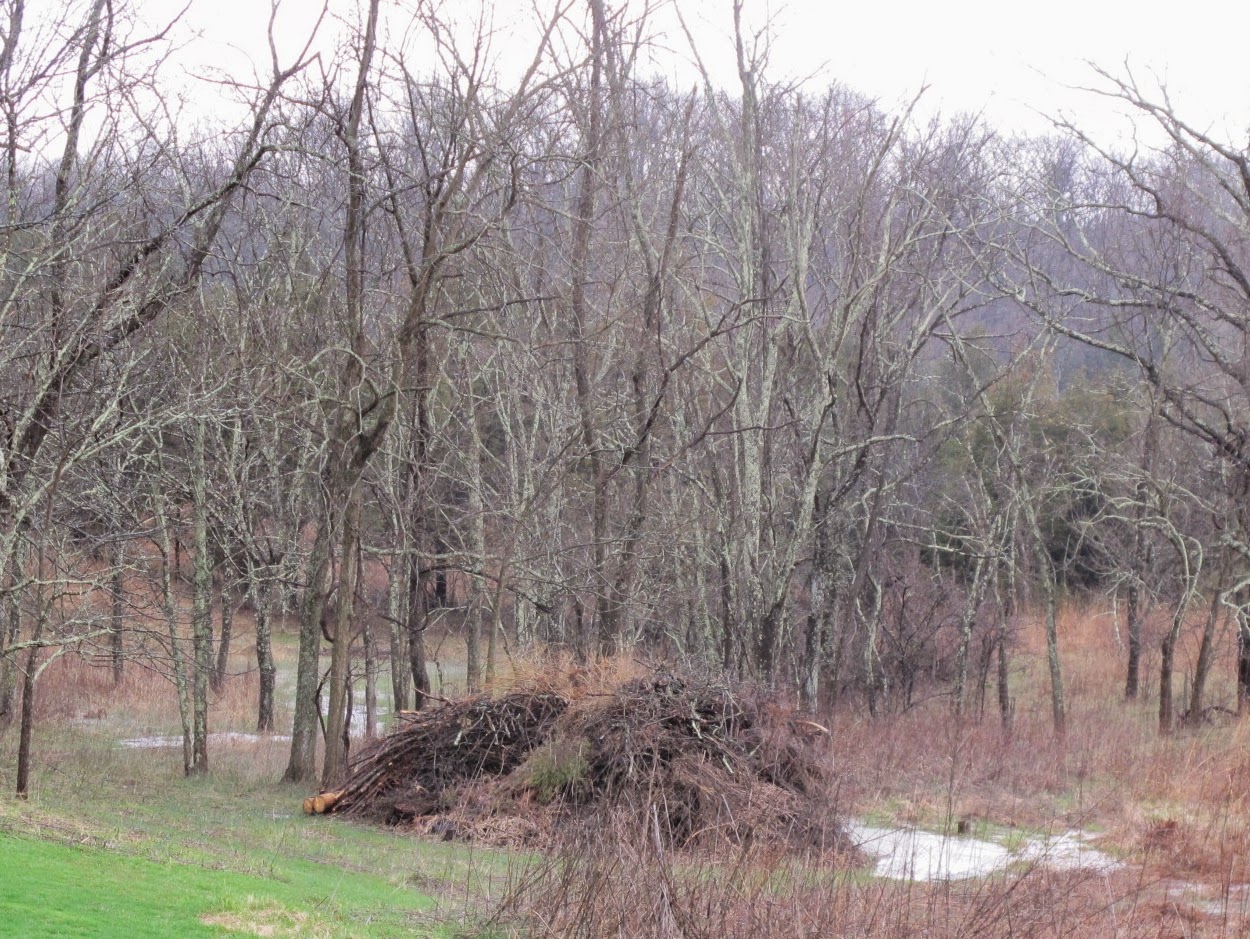
Small upland waterways swell to wide streams as the water quickly rushes downhill.  After each rain event, I try to get down to the creek to see how the increased water flow moves through the channel.

The quickest way to the creek is over the hill.  Even in the driest, most well drained locations, water still stands on the surface.

Five minutes after the rain has stopped, concentrated water flow is still pouring from small woodland watersheds along the creek. 

Water running from these woodland areas is generally clear, but it carries a heavy load of leaves.  The result is a mosaic of bare ground and thick piles of leaves.  This will influence the pattern of plant growth through the rest of the year.

I’m always relieved when I see the bridges still intact.  All but one of the bridges have been replaced to an elevation above the record flood level.  If we do get a flood capable of tearing out this bridge, I hope I’m here to see it, because it will be a truly rare and terrifying event.

Calm and scenic features, such as a small waterfall, are covered over by the flood.  It’s always a surprise when the water drops and the creek resumes its earlier appearance. 

Water pools in the flood plains as it waits for a chance to seep into the ground.  This soil is very well drained and normally allows rapid water infiltration.  Its appearance now makes you think of vernal pools and amphibian breeding, but given a day without more rain, it will pass all of this water into the creek.

This is the last bridge needing to be repaired and elevated.  It has been moved and battered by flood water many times over the years.

Downstream of the bridge is the area blocked by a log jam a couple of years ago.  Since the removal of the jam, water now flows freely through the channel.

Since I wait for the lightning to clear the area before venturing out after a storm, I usually miss seeing the water at its highest level.  At the peak of the flood, water left the creek channel and moved overland.  This area was scoured clean when the water was suddenly blocked by the formation of a log jam and forced out here.  It’s likely that a new channel will be formed here someday.  I could have left the log jam in place and let the new channel form, but this little area has a nice collection of woodland flowers that I would like to enjoy for a while longer.

The third of three large bridges is now well above flood level.  This bridge was repaired using sections of decking from two older bridges.  I think this one is elevated and anchored well enough to withstand any flood.

I find still photos of rapidly moving water to be lacking in impact, so I have included a short video that captures the movement and sound of the angry creek.  It is also available for viewing on YouTube by clicking HERE.

Wednesday, February 11, 2015

Freeze and Thaw

Blue Jay Barrens has been riding the temperature rollercoaster because of a seemingly never ending parade of small storm systems out of Canada that pass through about every three or four days.  Temperatures soar in advance of each storm and plummet following each departure.  That translates into a pattern of freezing and thawing of any exposed water.  Even the hilltop barrens, known for their extremely hot and dry conditions, are not immune to these actions.

Soil does not freeze, but the water within the soil does.  Under certain conditions, the freezing water causes a phenomenon known as Frost Heave, which transforms the smooth soil surface into a rough terrain of sharp peaks and valleys.  The effects are most dramatic when moist, unfrozen soil with high silt content is subjected to sudden below freezing temperatures.  We have had several occasions this winter where daytime temperatures were above 50oF and the following nighttime temperatures went to 20oF or lower.

As temperatures drop to the freezing point or below, surface moisture begins to freeze.  As water freezes in the soil, the soil becomes drier and the water lost to freezing is replaced by water rising from below through capillary action.  Upon reaching the base of the previously formed ice crystals, the water freezes and pushes the ice upward.  Soil trapped in the ice is also moved upward, forming tall pillars.  Plants caught by this action are often lifted right out of the ground.  The soil falls back into place when it thaws, but the plants are often left exposed on the surface.

Soil pillars can sometimes get several inches high.  This mixing action is a common way for seeds to get buried to a suitable depth for germination. 

When moisture is abundant and the freezing point is near the surface of the soil, you can get ice columns that contain very little soil.  This is commonly referred to as Needle Ice.

At this site, the surface froze quickly.  Ice columns began forming beneath that frozen layer and lifted the entire mass as a single unit.  Stones were not affected by this action and remained in their original positions.  The stones had the initial advantage of not cooling as quickly as the surrounding soil.  Then they were able to channel heat from the warmer soil they rested upon.  If the cold lasted long enough, the freeze point would drop lower into the soil and the stones could then be lifted.  In this instance the freezing lasted for only one night and the morning sunlight quickly thawed the soil.

The freezing and thawing is also having a disruptive impact on exposed rock layers. 

The Blue Jay Barrens bedrock was previously fractured by a prehistoric meteor impact.  These tiny cracks allow water to enter the rock slabs.  The water expands as it freezes and separates the rock layers.

When the ice thaws, the loosened rock falls down the slope.

The creek water freezes, but that generally occurs with no negative impacts.

The actions of freezing and thawing in the creek are more conducive to works of art than to damage.  Thin layers of ice form and are left suspended above a slowly dropping water level.

Periods of freezing temperatures add long, sharp crystals to the existing ice.

Warmer temperatures soften the crystals by blunting points and rounding edges.

The result can be a wild collection of varied forms.

One interesting phenomenon could not be adequately captured in a still image.  Then I remembered that my camera had video capability, so I proceeded to make my first ever video creation.  As water moves beneath the overhanging ice, surges in the creek flow cause it to periodically make contact with the ice.  The cohesive qualities of water allow it to keep its contact with the ice while maintaining a short column connecting the ice and the creek.  This contact is maintained as the water scoots on downstream, producing the dark image seen from above.  The violet color is the result of my inability to change the video settings on the camera.  I guess I’ll have to read the manual before making any more videos.  The video actually looks better when viewed on YouTube.  You can check it out there by clicking on http://youtu.be/DJA1EtSIcE8.

Friday, January 9, 2015

Open Water

The creek and its tributaries are the only natural source of open water at Blue Jay Barrens.  From Fall through Spring, the creek provides drinking and bathing water to a wide variety of birds and mammals.  Summer water is less dependable.  It is common for the creek to stop flowing for several weeks during August and early September.  Occasionally the dry season extends for months.

I have always enjoyed dabbling in water.  As a child, I could spend hours exploring a puddle in the yard. Finding mosquito larvae in the air conditioner drip pan was like discovering a gold mine.  My parents didn’t appreciate my efforts to increase water opportunities by enlarging potholes in the driveway or excavating beneath the downspouts.  My neighbors seemed to share this attitude.  So it’s only natural that once I reached a point where other people’s opinions had no bearing on my actions, I would create pools of water wherever I pleased.  The water garden, as artificial a body of water as you can get, proved quite effective at drawing animals as well as plants into position for my enjoyment.  It does freeze over easily though and doesn’t provide a reliable source of open water for the local wildlife in winter.

Even though my later attempts at developing open water are still artificial creations, they function more naturally than the water garden.  The established toad pool in the foreground and its under construction counterpart behind, are intended to provide a breeding environment for toads.  A declining toad population is coinciding with a decrease in Hognose Snake sightings.  The snakes feed on toads, so it seems logical that increasing the toad population will benefit the snakes.  It’s just a happy bonus that the pools also benefit a wide variety of other animals and give me more places to play in the water.

The new toad pool is still under construction.  The dam creating this pool is composed of topsoil that will eventually be used as topdressing over the permanent dam.  The center of the planned dam will be along the line of stakes sticking from the water.  Pooled water slowly seeps through this temporary dam and emerges clean on the downstream side.  This keeps sediment from actually leaving the construction site during the winter.

Seasonal springs emerge just above the planned water line.  The springs are almost keeping up with the seepage loss through the dam.  This makes me optimistic that the springs will easily keep the pool full of water well into early summer.  Deer visit the pool every night and seem to delight in running and jumping through the mud.

Cold weather caps the pools with ice.  The established pool is fed by a single small spring, but that is enough to keep a bit of water unfrozen.

The spring keeps a small area of open water available to visiting wildlife


The same conditions occur in the pond, an artificial water body that was created long before I purchased the property. 

A strong seasonal spring produces a continuous stream of water entering the pond throughout the winter.

The warm water from the spring maintains a large area of open water.  Even through the coldest winters, this portion of the pond remains unfrozen.  When other water sources freeze over, birds flock here to drink and bathe.

Water from the spring also helps maintain adequate water for the survival of the breeding salamanders.  The view may be blocked by snow, but the salamanders are busy with courtship and egg laying activities beneath the ice.  I would never threaten the native prairies of Blue Jay Barrens with a water development project.  I’m just glad there are a few areas of undesirable vegetation available for conversion to open water.

Friday, October 24, 2014

Water Returns to the Creek

Following a three month absence, water has returned to the creek.  Gentle precipitation spread over a two week period resulted in a total of five inches of rain falling on Blue Jay Barrens.  This recharged the ground water enough to cause a rise in the well level and to allow water flow through the creek channel.

Most of the aquatic life has yet to become active, but the pools are full and shallow riffles sparkle in the sunlight.  It won’t be long before the creek animals reclaim their domain.

The water flow is still below its wet weather norm.  The rate of flow suggests that the ground water has been recharged sufficiently to maintain a stream flow until the wet weather does arrive.

The rain fell at a slow enough rate to allow practically all of the water to penetrate the ground rather than run overland to the creek.  Leaves in the channel lay undisturbed except in the lowest part of the channel where the water flow originated.

The upper portion of the creek channel is more entrenched and has a steeper grade than the wider channel downstream.  This generally results in a more rapid water flow.  Even in these reaches, the water flow was so slow that leaves in the water were not carried away.

Decomposing leaves are a prime source of energy for organisms living in headwater streams.  The longer the leaves remain in place, the more benefit they are to the stream ecosystem.  In years where the leaves are not washed away by flood waters, there is a noticeable increase in stream insects and other organisms.

Reflections of sky and trees on large bodies of water usually result in an attractive image.  Reflections on a small creek are often less appealing.  The green and yellow leaves reflecting on the water make this creek appear to have acid mine drainage or similar contaminant fouling the water.

A colony of Coltsfoot, Tussilaga farfara, has become established on the toe of this bank.  Coltsfoot is a non-native that can form dense colonies on gravel bars and creek edges.  I always remove it when I find it, but seed from upstream continues to bring me new colonies.
Flood water hasn’t yet come close to reaching the bottom of the new bridge.  The support beams sit just above the record flood level for this stretch of creek, so it’s going to take a flood of disaster proportions to cause any damage here.

Water Striders were quick to reclaim the surface of the newly filled pools.  When the creek is dry, the Water Striders shelter beneath flat creek rock in the channel or beneath vegetation on a moist bank.  They emerge from hiding as soon as water appears.

The only fish left in the creek in early summer are the recent hatchlings from the spring spawn.  Most of those perish when the creek pools dry up in July or August.  A lucky few manage to end up in the one pool that holds water in all but the driest of years.  Now considerably larger than they were a few months ago, they will begin to spread out along that section of creek.  It’s always a good feeling to have the water return to the creek.