Showing posts with label Caterpillars. Show all posts

Sunday, July 8, 2018

Cycnia collaris Brood 2

Another batch of Cycnia collaris, formerly Cycnia inopinatus, is munching its way through the clump of Common Milkweed beside my front porch.  I’m assuming these larvae to be the offspring of the brood that showed up in May and went into pupation a few weeks ago.  That would make these larvae brood two .

More than a few of the brood one Cycnia larvae must have avoided playing host to Tachinid fly offspring and survived to adulthood.  I counted 69 larvae of this State Endangered moth species feeding on a single milkweed plant.  Additional larvae were present on many other milkweed plants close by.  As with the previous brood, it appears that the adults emerged from the leaf litter at the base of the plants and deposited a nice batch of eggs on plants readily accessible.

Larvae just recently moved onto the leaf on the left side of the photo.  They made the move after reducing the leaf on the right to a bare skeleton.

There’s not much tender young growth on the milkweed plants right now.  This doesn’t seem to slow down the Cycnia larvae at all.  The smallest larvae appear to have no trouble dining on the oldest and toughest of leaves.  The thick leaves allow the larvae to eat a lot without moving very far.  This sometimes results in a frass chain forming behind the larva.

Several severe storms have knocked down the milkweeds during the last few weeks.  Some plants have given up trying to right themselves.


The Cycnia females found the horizontal milkweeds to be just as desirable as those in a vertical position.  The larvae are quickly stripping the edible material from these leaves.  Having this action occurring right outside my front door has provided an ideal opportunity to learn something about the habits of this rare species.

Monday, May 21, 2018

Common Milkweed Hosting Larvae of Unexpected Tiger Moth

My first encounter with the Blue Jay Barrens population of the Ohio endangered Unexpected Tiger Moth, Cycnia collaris, formerly Cycnia inopinatus, was seven years ago.  My encounters with this species have increased each year since then, and this year is no exception.

Unexpected Tiger Moths are a milkweed dependent species.  Last fall, a few larvae were found on Common Milkweed, Asclepias syriaca, growing in the narrow strip between my driveway and Water Garden.  When larvae of this species are ready to pupate, they move into the plant litter at the base of the host plant and pupate near the soil surface.  I am assuming that this is exactly what occurred last September.  This spring, the adults emerged and apparently laid masses of eggs on the young milkweed plants emerging at the time.

The larvae are present in numbers many times greater than what I saw last year.    The amount of plant damage occurring from feeding larvae is readily apparent.

Most of the feeding is occurring on the young leaves at the growing tip of the plant.  There are about 10 larvae working on the particular plant.

Plants with more larvae show more leaf damage.

There are at least 20 larvae working on this plant.  The milkweed can’t grow quickly enough to stay ahead of these ravenous caterpillars.

Many of the larvae are moving out to begin feeding on the older leaves.  This intensive feeding won’t harm the milkweed.  This batch of larvae, the first of two yearly broods, will soon mature and leave the plant to pupate.  The plant will recover and be ready to hopefully host another batch of larvae in August.


The video shows feeding activity in one of the areas of highest larvae concentration.  Click HERE to view the video on YouTube, which usually provides a clearer image.  Click HERE to view earlier posts concerning this species.

Friday, September 15, 2017

Cycnia inopinatus Caterpillars

I’m always pleased when an uncommon plant or animal species shows up in unusually large numbers. This year, I am finding the caterpillars of the Unexpected Tiger Moth, Cycnia inopinatus, to be several times more abundant than they have ever been in any past year. Having a bright orange body decorated with tufts of black hairs, this species is hard to miss when it’s around.

The Unexpected Tiger moth is listed as an endangered species in the state of Ohio. Its caterpillars feed exclusively on milkweeds, with Butterflyweed, Asclepias tuberosa, probably being the most common host plant. So far this year, I’ve found caterpillars on Butterflyweeds scattered over about a 30 acre area.

In late spring and early summer I’ve seen the caterpillars feeding on Spider Milkweed, Asclepias viridis. Recently, I’ve found several caterpillars feeding on the leaves of Common Milkweed, Asclepias syriaca.

A five-year-old clump of Butterflyweed growing next to my driveway is currently hosting a half dozen caterpillars. Later this year the caterpillars will move into the leaf litter at the base of the plant and pupate. They will remain there through the winter and emerge as adults next spring.

The Common Milkweed being used as a host plant is growing at the edge of my water garden. So far, this is the only Common Milkweed plant that I have found hosting any Unexpected Tiger Moth caterpillars.

Oleander Aphids have been abundant on all of the milkweeds this year. Caterpillars seem to avoid leaves that are excessively covered with aphids and honeydew, but there are enough clean leaves that the caterpillars do not seem to be lacking an adequate food supply. I hope this abundance of caterpillars results in record numbers of adult moths next spring.


The above video shows some of the typical caterpillar activities.

Tuesday, August 15, 2017

Camouflaged Loopers

This is a perennial favorite of mine, Camouflaged Looper, the larva stage of the Wavy-Lined Emerald Moth.  There are two caterpillars in the photo, one to each side of the central disk.  Camouflaged Loopers commonly feed on the disk flowers of species in the Aster family, so spend much time exposed to view.  In order to look less like a tasty morsel to passing predators, this caterpillar adorns its body with bits of the plant on which it is feeding.  To the casual eye, it looks just like a part of the plant.

At Blue Jay Barrens, Orange Coneflower, Rudbeckia fulgida, seems to be the plant of choice for this species.  I encourage a large patch of Orange Coneflower to grow outside the front door of my house, so I can enjoy the Camouflaged Loopers through their entire season.

This looper was cleaning its mouth or doing some similar facial area grooming.  I gave it high marks for doing what I thought was a superb Godzilla impersonation.

The above video shows some typical Camouflaged Looper behavior.  If you turn your sound on, you will notice the chatter and buzz of Hummingbirds passing over my head.  My Hummingbird feeders are only about eight feet from me.  I posted a longer version of this film to YouTube which you can view by clicking HERE.

Wednesday, September 16, 2015

What's Eating the Redbuds?

When people ask me what ornamental tree I would recommend for home landscaping, Redbud is generally my instant response.  My reason for this response typically causes my inquisitors to lose interest in my opinions.  They are expecting me to make some point about the beauty of the tree or the rapid rate at which it grows or the fact that it doesn’t get large enough to fall over and smash your house, but I like Redbud because it is a preferred food of so many animals.  From the time the first flower bud begins to open in the spring until the last leaf drops in the fall, something is consuming the Redbud.  About 20 years ago, I planted two Redbuds at the corner of my garage, so I could more easily follow the season long parade of Redbud predators.  These trees have since grown tall and lost most of their lower branches.  From below, I can see the chewed leaves and know that something interesting is living above.

Fortunately, the trees I planted have spread many seeds.  I’ve let some of the resulting seedlings grow along the side of the garage, so I can have a few Redbud branches at my eye level.  Many different types of animals feed on the tree through the year, but in September it’s the caterpillars that dominate.  I took a few minutes to photograph some of the current residents.

First off, I should probably mention the species that actually targets the Redbud over other plant species.  The Redbud Leaf Roller can likely be found on any Redbud Tree.  Because of its habit of folding over a leaf edge and webbing it in place to form a sanctuary in which to feed, the Redbud Leaf Roller is not seen by many people.

You have to unfold the leaf to reveal the creator.  These caterpillars are known as skeletonizers because of their habit of leaving the leaf veins and a thin layer of tissue behind as they feed.  Inside the fold of the leaf, the caterpillar eats and leaves its droppings.  A nice little package that hides most evidence of the caterpillar.

Hanging by lengths of silk, these small green caterpillars disperse themselves around the tree.  It doesn’t make sense to me that they are all just accidently falling off of their leaves.   It seems like poor survival skills to be unable to keep hold of your food supply.  Some of the caterpillars keep lowering themselves until they arrive at another leaf.  Others sway in the breeze and grab onto leaves or branches.  Still others climb back up their thread, apparently arriving at the end of their tethers with nowhere to go.  I think much of their activity is in an effort to scatter themselves around the area.

I believe these thread travelers are early instars of the Redbud Leaf Roller.  I’ve found many living in refuges made by webbing together the edges of two neighboring leaves.  Perhaps the younger caterpillars do not have the strength to fold a leaf edge over on itself and take advantage of an already occurring situation.

Colorful caterpillars are always more colorful when they come in a group.  These are early instars of the Red-humped caterpillar.  Like most of the caterpillar species found on the Redbud, these caterpillars feed on a variety of woody plant species.  A few end up on the Redbuds each year.

The final instar of the Red-humped caterpillar.  Having groups of different ages suggests that more than one female planted her eggs on this tree.

Fall Webworms are also generalist feeders, but they never miss laying eggs on the Redbud. 

A mass of webbing is generally the first indication of Fall Webworms.  The group stays together until its final instar.

The last stage caterpillars head off on their own, sometimes staying on the original host tree and other times wandering to a new location.

The caterpillar of the American Dagger Moth.  I personally think of this as the English Sheepdog caterpillar, because of the mass of hairs hanging down over the face.

Here’s a caterpillar that’s often overlooked as a bit of fluff.  This is the early instar of the Black-waved Flannel Caterpillar.

Final instar of the Black-waved Flannel Caterpillar looks quite different from its earlier edition.


Skiff Moth caterpillars don’t look at all like living animals.  They look more to me like galls or other plant deformities.

Their coloration can vary.  This one carries an image on its back that looks more like a birds face than do many actual bird’s faces.  This should certainly startle any predators approaching from the rear.

The Yellow-shouldered slug.  This is one of many caterpillars collectively called slug caterpillars.  It’s easy to see why they were given that designation.  Most in the group are slow moving and look like an oblong blob.

You may not guess it from the name, but many of the slug caterpillars are the showiest caterpillars around.  This is the Saddleback Caterpillar.  Those spines are far from being just ornamental.  I’ve received five stings from this species this year: Two shoulder, One arm, One neck, One ear.  It takes my body about 30 minutes to deal with the toxin and get back to normal.  This caterpillar routinely sits near the edge of the lower side of the leaf with the tips of the spines sticking out.  That makes it very easy to accidently brush against the spines.

The Spiny-oak Slug is another stinger, but it generally doesn’t spend so much time at the edge of the leaf.  This is a variable species that can display a wide range of color patterns.

A real winner in the color category is the Stinging Rose Caterpillar.  The warning here is included in the name.  It may have the appearance of a fancy piece of hard candy, but this is one morsel you don’t want to touch.

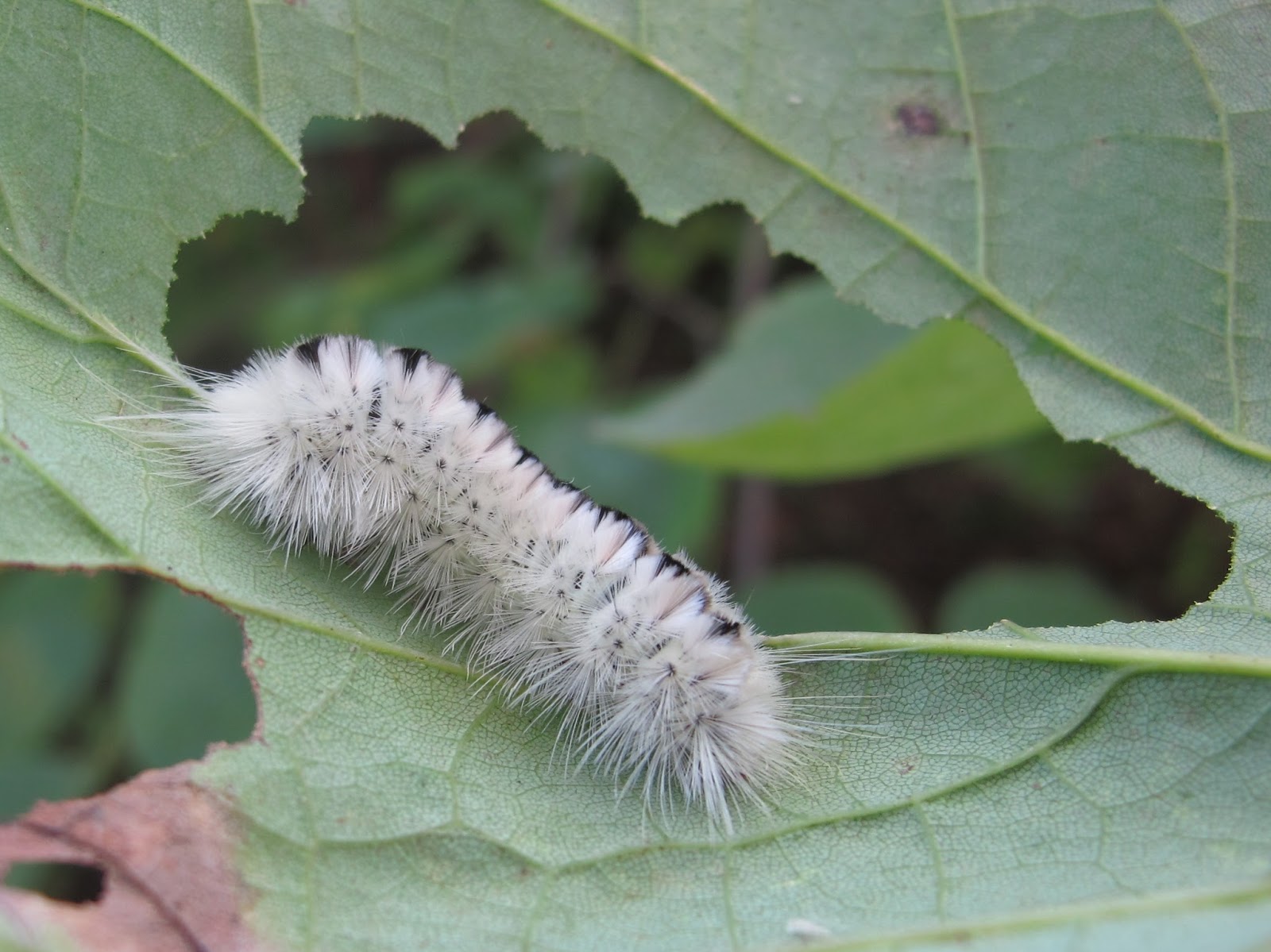
The black and white pattern of the Hickory Tussock Moth caterpillar reminds me of white Bengal Tigers.  This specimen seems to be shedding.

I found many of this species on the Redbud, but wasn’t finding much evidence that they were feeding.  There was a chance that they were just migrating over from some nearby Black Walnuts, a favorite food plant.  Then I found this guy carving a large hole in the middle of a Redbud leaf and decided that they must also eat Redbud.

There are also several caterpillars that I can’t put a name to.  This little guy had three parasitoid larvae riding its back.  I found this curious because the caterpillar was trudging along as though nothing was wrong.  Typically, the parasitoid larvae would feed and grow inside the caterpillar and then emerge to spin cocoons and pupate on the caterpillar’s skin.  As large as these larvae are, it seems there would have been little left if they had been feeding inside that small caterpillar.  The caterpillar should have at least moved sluggishly or remained stationary as I’ve seen so many other caterpillars do in similar situations.

Finally, this European Hornet, which is not a caterpillar of any kind, searched leaf after leaf and appeared to be following me as I examined the Redbud.  I thought it might be hunting caterpillars, or some other creature on the tree, but it never seemed to find anything.  I’ll just add its behavior to my enormous list of things I would one day like to understand.

Monday, September 29, 2014

Green Snake

I have a feeling that even people who aren’t fond of snakes can’t help feeling kindly towards a cute little snake of green.  I found this Rough Green Snake when I revisited the Sycamore that yielded so many caterpillars a couple of weeks ago.

It was caterpillars that I was actually looking for.  At the time of the snake discovery, I was taking a close look at this Drab Prominent caterpillar.

I lifted my eyes from the caterpillar and on a branch just a few feet away was the snake.  Green Snakes are insect eaters and hairless caterpillars are readily consumed.  The snake and I may have been looking in this tree for the same reason.

The Rough Green Snake is the only species of green snake likely to be in this area.  Even so, on the rare occasions that I find one of these snakes, I like to verify the ID by checking the scales on the snake’s back.  The scales of the Rough Green Snake are divided by a slight ridge.  The ridges align to form faint stripes running the length of the snake.  They also give the snake its rough feel that earned it its name.

This snake is typically found in the trees and is remarkably adept at moving about through the branches.  It must have remarkable balance and muscle control.

It moves along a narrow branch as if it were traversing level ground.

If it desires a higher elevation, it just lifts its head and goes up.

It’s like a snake mime hitting an invisible wall.

The head just continues to ascend.

Finally the snake connects with the petiole of a grape leaf and begins to slide its body along the narrow stem.

The diameter of the grape vine is smaller than that of the snake, but the snake proceeds along this new avenue without complication.

Up and away, the snake climbs out of my range.