Showing posts with label Brush Pile. Show all posts

Wednesday, February 1, 2017

Removing Fallen Trees

January has been a rough month for getting any heavy work done in the field. Warm temperatures and frequent rains left the soil highly vulnerable to compaction and other damage resulting from inappropriate management activities. It has only been in the last few days that I’ve been able to perform any intensive work, and that has been limited to hilltop areas that drain and dry out quickly. I removed the girdled trees that had fallen in my planned grassland area. A few stumps, some scattered twigs and flattened areas of grass were all that was left after I finished picking things up.

Following the removal of the downed trees, I brought in JR, the brush mower, and mowed the entire work area. Removing the trees and mowing the field were not necessarily required activities in my plans to convert the area to a grassland condition. The fallen trees would quickly decompose and the tall prairie grasses would eventually take over the site. My actions here were in response to the need to easily access the area to locate and eliminate invasive shrubs. Keep in mind that it’s only been a few years since this particular patch of ground was a thicket of Multiflora Rose and Autumn Olive. The site still harbors viable seed and is producing several new seedlings that must be found and killed each year. Anything that interferes with my ability to travel freely through the area in search of these invaders must be removed.

The area is planned to be grassland, but it will not be completely free of trees. This Blackjack Oak, Quercus marilandica, currently surrounded by the standing dead, will one day be surrounded by tall native grasses.
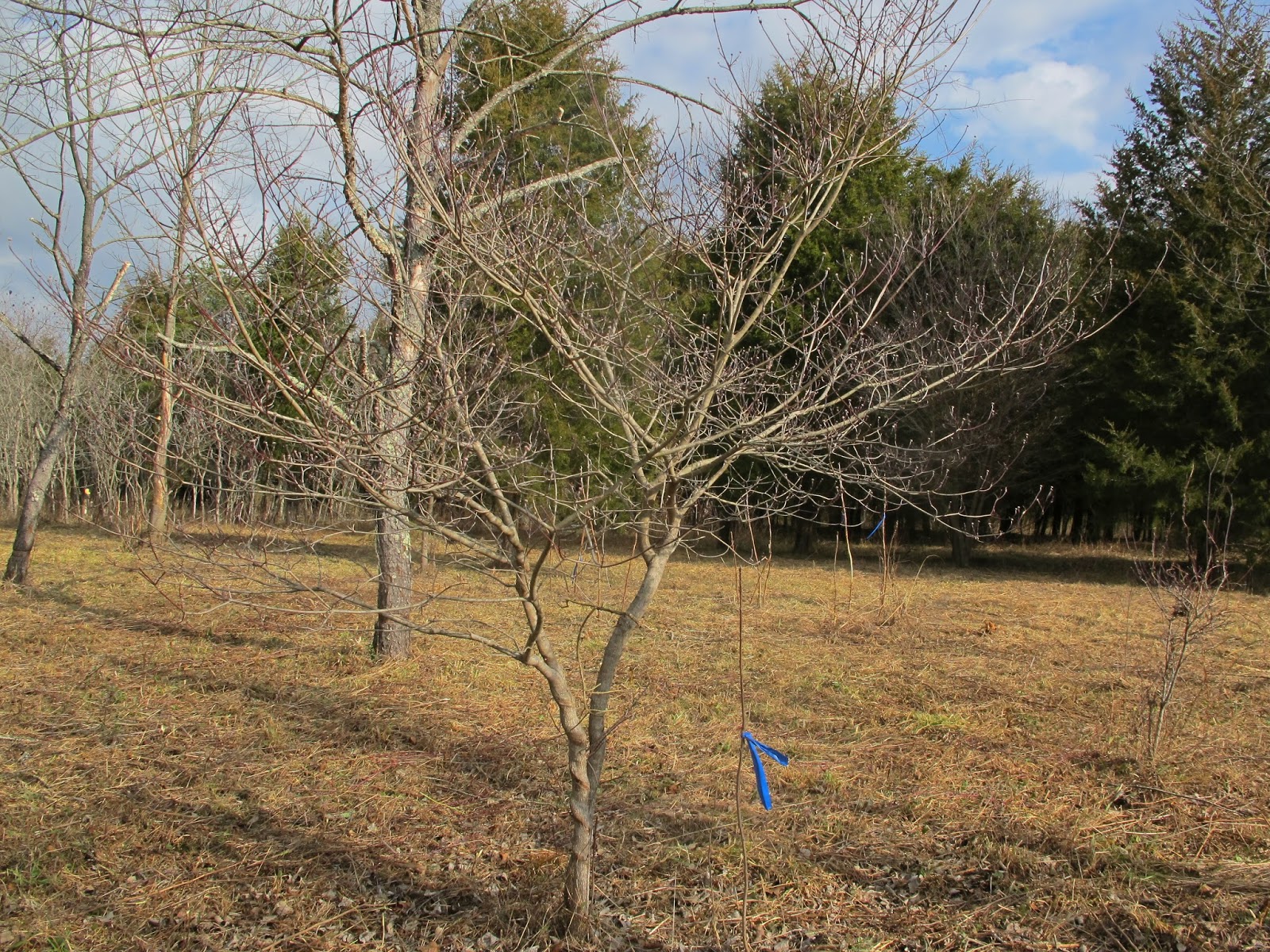
This double trunked Flowering Dogwood will also be left alive. An anthracnose outbreak nearly three decades ago eliminated this species from the woodland understory at Blue Jay Barrens. It has still not returned to the woods, but a few survivors along the field’s edge became the progenitors of flowering Dogwood trees growing in the open fields. I allowed this species to remain in certain designated areas of the fields, and now have dozens of nice sized specimens producing copious amounts of fruit and seed each year. This individual is doing quite nicely despite one of its trunks being disfigured by the choking embrace of a Japanese Honeysuckle vine, yet another invasive species needing to be controlled here.

After mowing the area, I noticed a leaning tree poised to land directly atop the Flowering Dogwood, and a pair of grape and honeysuckle festooned trunks similarly aiming towards the lovely oak. Not wishing the oak or dogwood to be damaged by their menacing neighbors, I removed the threats myself in a safe and controlled manner.

In order to facilitate invasive shrub control, I also removed some fallen branches from the sumac patch.

The patch of Dwarf Sumac was left intact and standing dead stems were not touched. These sumac thickets harbor their own suite of boring beetles, leaf eaters, lichen colonies and other organisms drawn to this type of habitat. I tried to disturb it as little as possible.

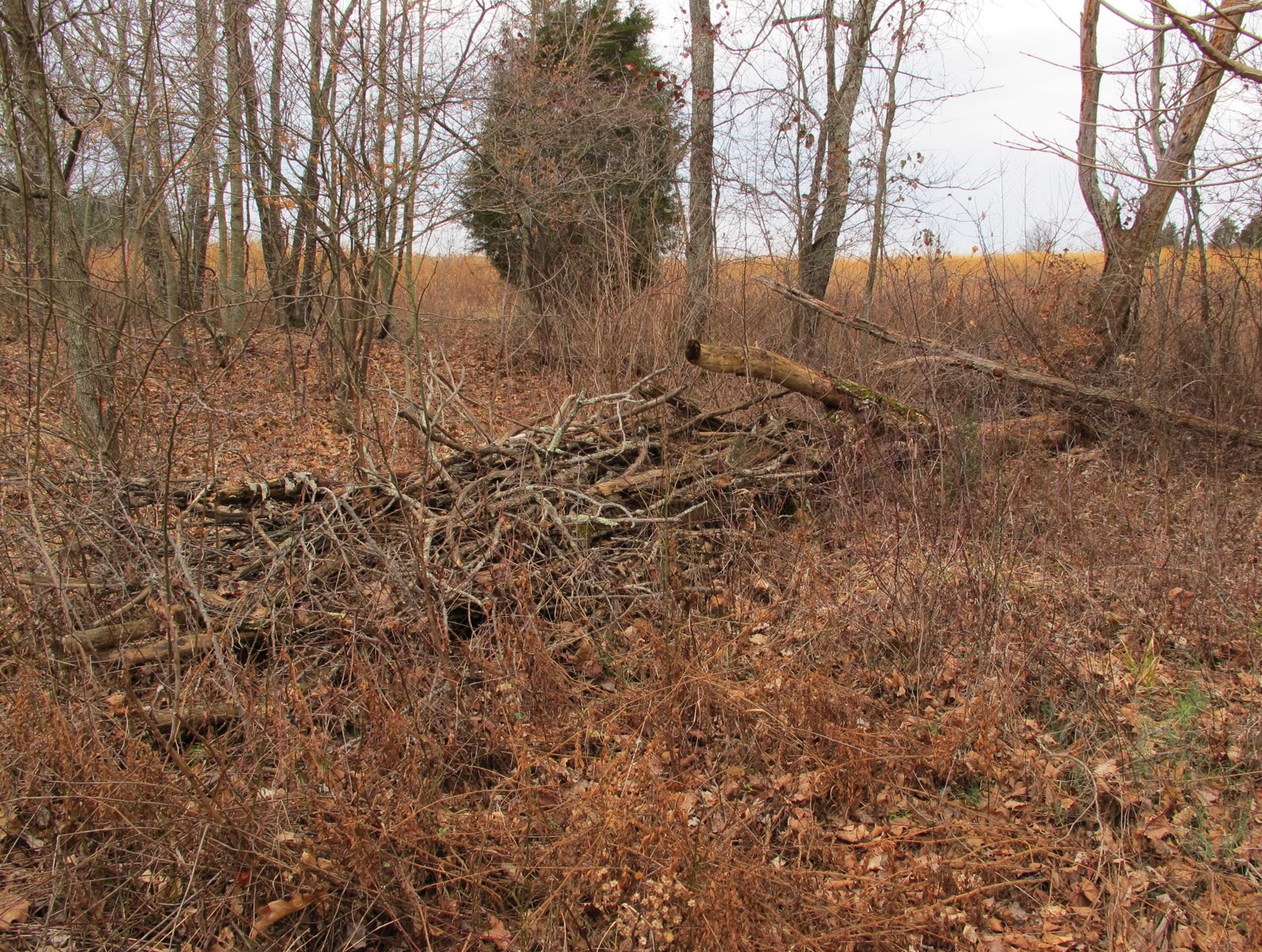
The removed wood roughly tripled the size of the brush pile at the edge of the field. Logs were placed on the east facing side of the pile. Skinks and fence lizards are particularly drawn to logs situated in this manner.

Tree branches were dismantled down to individual stems which were then piled as densely as possible. This fosters rapid decomposition, so the pile quickly reduces in volume. The logs are stacked so that they will fall back into the pile as the small branches decompose. It has been pointed out to me numerous times that my brush piles do not follow the classic wildlife management design, which has the goal of providing escape cover to game mammals. My piles serve a broader interest and are utilized by a wide range of reptiles, birds and mammals.

The dead trees will continue to fall for the next couple of years. During that time, the tall prairie grasses will move in and become established. By then the incidence of invasive shrubs should be limited to new arrivals carried by birds as seeds from neighboring properties. For now, I’m pleased with the way things are progressing on the site and hope that all continues favorably.

Wednesday, September 26, 2012

Steep Hill Clearing Site

I’m still evaluating the old clearing sites to see which ones need some additional work.  I need to get an estimate of how many days it will take to complete the work and how much brush can be added to the existing piles.  Steep topography sometimes adds an extra challenge to cedar clearing.  Measured on the down hill side, this brush pile originally reached a height of 12 feet.  That’s mainly because the ground dropped three feet from the front to the back of the pile, so by the time I had the top of the pile level with the ground in front, the back of the pile had already received three feet of brush. 

This is the area directly uphill from the brush pile.  The slope certainly made it easy to drag the cedars.  The only problem I had was weather related.  The ground was frozen and we kept getting dustings of snow at night.  Temperatures warmed enough during the day to turn the snow to slush and coming down the hill was like trying to walk down a water slide.  Some of the larger cedars were just thrown down the hill and they managed to slide all the way to the bottom.

I quit working if it got warm enough to thaw the soil surface.  I didn’t want to create ruts that could start an erosion problem.  It’s definitely easier to drag brush down hill, but a slope can be a problem under certain conditions.

It took several years before the vegetation finally covered the cleared area.  Now that this area has developed so nicely, it’s time to open up the neighboring section.

The stand of cedars is not very thick, but it’s enough to inhibit plant growth.  This is what the other section looked like before being cleared.  In the background is that previously cleared area.  Completion of this next section will about double the size of the opening. I’ll keep clearing until the brush pile is back up to its record height.  I’m hoping to accomplish the task without ice this time.

There is a good diversity of plant species beneath the cedars, but lack of sunlight inhibits their growth.  One of the fun things about clearing is watching these small plants respond to the increased light and grow to their full potential.

Even with plenty of sunlight, growing conditions are not good on this hillside.  Rock is here in all sizes from gravel to bedrock slabs.  Rain water runs off quickly and that sunlight so desperately needed by the plants, bakes the ground hard each summer.  Like the first section, the plants will be slow to rebound, but I’m confident that I’ll see improvement every year.

Friday, September 14, 2012

Clearing Plans

Cedar removal is going to be a top priority work activity this winter.  In preparation, I’ve been going around to assess the condition of the brush piles and determine the area necessary to allow the cut cedars to bring the piles back up to their original eight foot height.  I’ve built enough brush piles that there is now one within dragging distance of all potential cedar clearing areas.  This particular pile was built in February 2004 and contained mostly medium sized cedars of 10 to 12 feet.  Cedars of that size take a while to decompose, so this pile is still about a third of its original height.

Here’s the cedar that stands above that brush pile.  Using a large cedar to give stability to the pile allows me to build a higher pile and reduce the ground area actually covered by brush.  Supporting a large pile of brush doesn’t seem to have any negative impacts on the health of the cedar.

The piles support a wide variety of wildlife species.  Each has been penetrated by at least one burrowing animal.  There are only a couple of species that actually excavate, but there are many more that are ready to take over a burrow after the builder has moved on.

My 2004 clearing activities were concentrated on the upper slopes of the hill.  I knew that I would eventually be working to clear more of the hillside, so I established the brush pile all the way at the bottom of the hill.  After nine growing seasons, my cedar dragging corridor from work area to brush pile is just as open as the day it was created.

The upper slopes show a good mix of vegetation despite being stunted by lack of rainfall.  The biggest surprise here was the number of Spiranthes magnicamporum orchids that bloomed within a few years of clearing.

In a couple of places I just created openings so I could see how the vegetation responded to increased sunlight.  There was nothing unusual in most places, but the diversity of species increased dramatically.

Several large slabs of limestone bedrock project from the hillside.  An area of vigorously growing tall grass develops down hill from each slab.  Rain water falling on the slabs runs off, giving a small area an increased amount of water.  Plants growing near the rock benefit by this added moisture.  It’s the same effect you get at the edge of a driveway or sidewalk where water flows off into the lawn.

Uncleared areas show very little ground cover.  Shade and dry soil make it tough for much of anything to grow here.  Removing the medium sized cedars should increase sunlight penetration by 30 to 50 percent.  That should be enough to make a difference in the plant composition on the ground.


Monday, August 6, 2012

Recent Cedar Clearing

I took some time to check on the area I cleared of cedars back in January.  The weather hasn’t provided the best of growing conditions this year, but the plants are still showing a good response to increased sunlight. 

The brush pile has compacted to about half of its original height.  Cedar brush piles are always glaringly obvious during their first year.  When first constructed, their bright green stands out against the winter browns.  As plants green up for the summer, the needles of the cut cedars turn reddish brown.  The needles will drop before next summer and the brush pile will blend more into its surroundings.  That is unless I add more to it this winter.

Shade from the cedars created a sparse ground cover.  Now that there’s some light, small plants are racing to fill in the voids.   A couple of good growing years should see this area covered by plants.

Increased sunlight was a real help to these Rose Pink plants.  They will bloom in the shade, but the number of flowers is reduced.  The few plants that are here now should produce enough seed to cover the entire clearing.

Many plants that were surviving in the shade in a much diminished condition, have produced some vigorous growth.  This False Gromwell should be able to store enough energy to produce a flower next year.

Wild Petunia does poorly in the shade, but can persist for many years as a small, non-flowering plant.  Increased sunlight allows that small plant to quickly expand its size and produce flowers.

I found several small Monarda plants growing in this location.  These plants are several hundred feet from the nearest Monarda patch.  I like seeing this area get some species that serve well as nectar sources for butterflies and other insects.  When these plants bloom next year, it will give me another tool to use when assessing the butterfly population in the area.

Stunted Butterflyweed plants received enough sunlight to produce a few blooms this year.  They should be able to create a much larger flower head next year.  This plant will also help in drawing in the butterflies.

Gray-headed Coneflower has been here for several years, but has never bloomed well.  It should now begin to spread and put on a better floral display.  None of these species are rare or new to Blue Jay Barrens.  Some rarities may show up as the plants respond to the new conditions in the clearing.

Indian Grass on the lower slopes is much thicker than it has been in previous years.  A few of the plants look like they’ll produce seed heads this year.

Soft ground conditions kept me from clearing as much as I had hoped to last winter.  If weather conditions permit, I’ll be out next winter continuing with this clearing project.  Last year’s effort showed positive results, so I’m anxious to continue with the work.

Monday, January 30, 2012

Wrangling Roses

I decided to drag the material from my invasive cutting over to this brush pile.  When first constructed, the pile of cedars would have reached nearly to the top of the picture frame.  That was seven years ago.  Those cedars have since decomposed and the mass of the pile has diminished considerably.  It receives a few branches each year, but not enough to make up for the rate of decomposition.

Some Multiflora Rose bushes growing near the pile were cut earlier in the year.  Since I was going to be working in the area, I thought I might as well gather up the cut roses and add them to the pile.

I’ve got some thick leather gloves that I wear when working with roses.  It’s sometimes possible to move the entire bush by gathering the thorny canes by the base and dragging the mess to its new location.

This specimen proved to be one of the more difficult to move.  As sometimes happens with fence row roses, this bush had canes in excess of 25 feet long that had gotten tangled up in the tree.  I managed to get some of the bush on the brush pile, but the canes still trailed back to a mass left hanging from the tree.

I was fortunate to shed only a little blood while wrestling the bush down out of the tree.  Multiflora Rose canes tend to grow in a curve.  A long cane will be stretched straight out while it’s being pulled, but once free from the tree, the inherent curve causes it to whip around and encircle the person doing the pulling.  It’s no fun to be suddenly hugged by a thorny rose cane.

I finally got the bush sort of rounded up and on top of the brush pile.  Tips of canes are still waving around, so it remains a challenge to keep from being scratched.  The next task is to consolidate the coils of canes into a controlled collection.

I used the cut brush to collect the canes and force them in and down on top of the pile.  Each branch contained a few more canes until the rose bush was confined to the boundaries of the pile.

The final step was to add heavier material on top to further compress the rose.  Rose canes decompose quickly, so they’ll disappear by next fall.  I would normally climb on top of the pile at this point and push everything down further.  I skipped that step because most of the brush on top was Autumn Olive and crabapple, both of which were covered with short spear-like branches.  I had no desire to end my day with puncture wounds in my ankles and legs.

Saturday, January 28, 2012

Fallen Tree Brush Piles

Not all of the brush piles I construct are the result of cedar clearing.  Occasionally a tree will fall or lose a large load of branches and I will gather them up into a small pile on the site where they fell.  I usually do this when the branches have fallen into an area that I am managing as an open field.

The result is a small pile that has a rather short life span.  While it exists, the combination of large loosely arranged branches attracts a variety of wildlife species.

Many bird species hang around the piles and leave behind the seeds contained within fruits upon which they’ve been feeding.  An eater of Multiflora Rose fruits obviously spent time here.  A shallow pile of brush provides an ideal environment for the germination of seeds and the growth of young plants.  Some very healthy rose bushes sprout from these piles.

I keep finding more roses with fresh growth.  I hope this out-of-season growth is putting some stress on the rose plant.

The roses have been removed and their remains added to the top of the pile.

Many other woody plants have taken advantage of the exceptional growing conditions within the boundaries of the brush pile.  Winged Sumac, Fragrant Sumac, Sassafras and Wild Black Cherry are sharing this pile.  These are all species that are readily spread by birds.

The Fragrant Sumac is heavily loaded with flower buds, so it should be a prime source of early spring nectar.  This will be a good place to search for some of the rarer early season butterflies.

The pile was built from the branches of this dead tree.  Woodpeckers and other cavity nesting birds made good use of the tree before it fell.  Unless there’s a safety issue involved, I’ll leave dead trees to fall naturally.  I also like to leave the trees to decompose where they fall.  While it grew, the tree took its needs from the soil on that site and I think it’s proper for the soil to receive back what it earlier gave up.