Showing posts with label Redbud. Show all posts

Wednesday, April 13, 2016

Redbuds and Butterflies

Blooming of the Redbuds coincides with the emergence of two of my favorite butterflies.  Unfortunately, this is also the season for windy days, so each year my efforts to photograph these species is thwarted by gusty winds.  Today, about two hours before sunset, the wind stopped.  I took advantage of this uncommon calm to make a search for the elusive Henry’s Elfin and Olive Hairstreak butterflies.

I soon found Henry’s Elfins, but the position of the Redbuds allowed only backlit views.

I took my search to the east side of the field where I found a group of Redbuds receiving sunlight from just the right angle. 

Several Henry’s Elfins were in the trees, but they were keeping to the tree tops.  Besides that, most seemed to have buried themselves in the clusters of Redbud blooms.

Finally, I found some that offered a clearer view.  Their numbers are already higher than usual, and their season has not yet peaked.

Larvae of the Henry’s Elfin feed on Redbud.  Early season eggs are commonly laid on the Redbud flower.  Young larvae will consume flower parts and developing seed pods.  Older larvae typically move on to consume young leaves.

The bright green of the Olive Hairstreak is easy to spot among the pink Redbud blooms. 

Olive Hairstreaks visit Redbud flowers strictly for the nectar.  Their larvae feed on Eastern Red Cedar, which is extremely common here.  Looking for these butterflies on the Redbuds is the easiest way to assess their numbers.

Saturday, March 31, 2012

Looking for Henry's Elfin - Finding Olive Hairstreak

I was looking for something and I found something, so I guess I was somewhat successful.  My search was for an uncommon small brown butterfly known as Henry’s Elfin.  Henry’s Elfin lays its eggs among the blooms of the Redbud, so the best time to see them is at the peak of the Redbud blooming season which happens to be right now.  I managed to see several small butterflies on the Redbud flowers, but they were all Olive Hairstreaks as shown in the photo.  Olive Hairstreaks are also an uncommon species, so even though they weren’t my desired find, I was happy to see them.

Several factors increased the difficulty of my search.  One was the sheer volume of Redbud blooms.  Every branch of every Redbud tree is crowded with flowers, so the butterflies could be anywhere.  This abundance may result in a larger than average Henry’s Elfin population next year. 

Most of that profusion of Redbud blooms is above my head.  I’ve seen several small butterflies moving in the tree tops.  Unfortunately, I can’t confirm any of those as being Henry’s Elfin.  The Olive Hairstreak may display some bright colors on its lower wing surface, but the upper surface is brown.  In flight, especially when viewed against a bright sky, the Olive Hairstreak looks brown, so I may have been seeing more of that species.

Butterflies were far outnumbered by foraging Bumblebees.  It’s easy for a small butterfly to go unnoticed among the ever moving Bumblebee traffic.

The other consideration is the fact that I’ve never before seen a Henry’s Elfin adult on a Redbud.  I know adults have been there, because I’ve found larvae on Redbuds.  Every Henry’s Elfin I’ve ever found has been resting on the dead stalks of tall Prairie Grasses. In an effort to help the Henry’s Elfin population, I favor Redbuds in my management efforts and maintain that tree in large sections of the field edges.

I can’t help thinking that there’s some connection between the Henry’s Elfin and the Xeric Limestone Prairie found at Blue Jay Barrens.  For that reason, I maintain some Redbuds out in the Indian Grass fields.  I don’t know if that helps, but the Henry’s Elfins are very plentiful in some years.

I’ll keep looking for the Henry’s Elfin.  It may be that they have not yet emerged.  In the mean time, I’ll enjoy the Olive Hairstreaks.  If you believe my search is doomed to failure, you can go back to an earlier post to get a look at a Henry’s Elfin.

Monday, March 26, 2012

More Blooming Shrubs

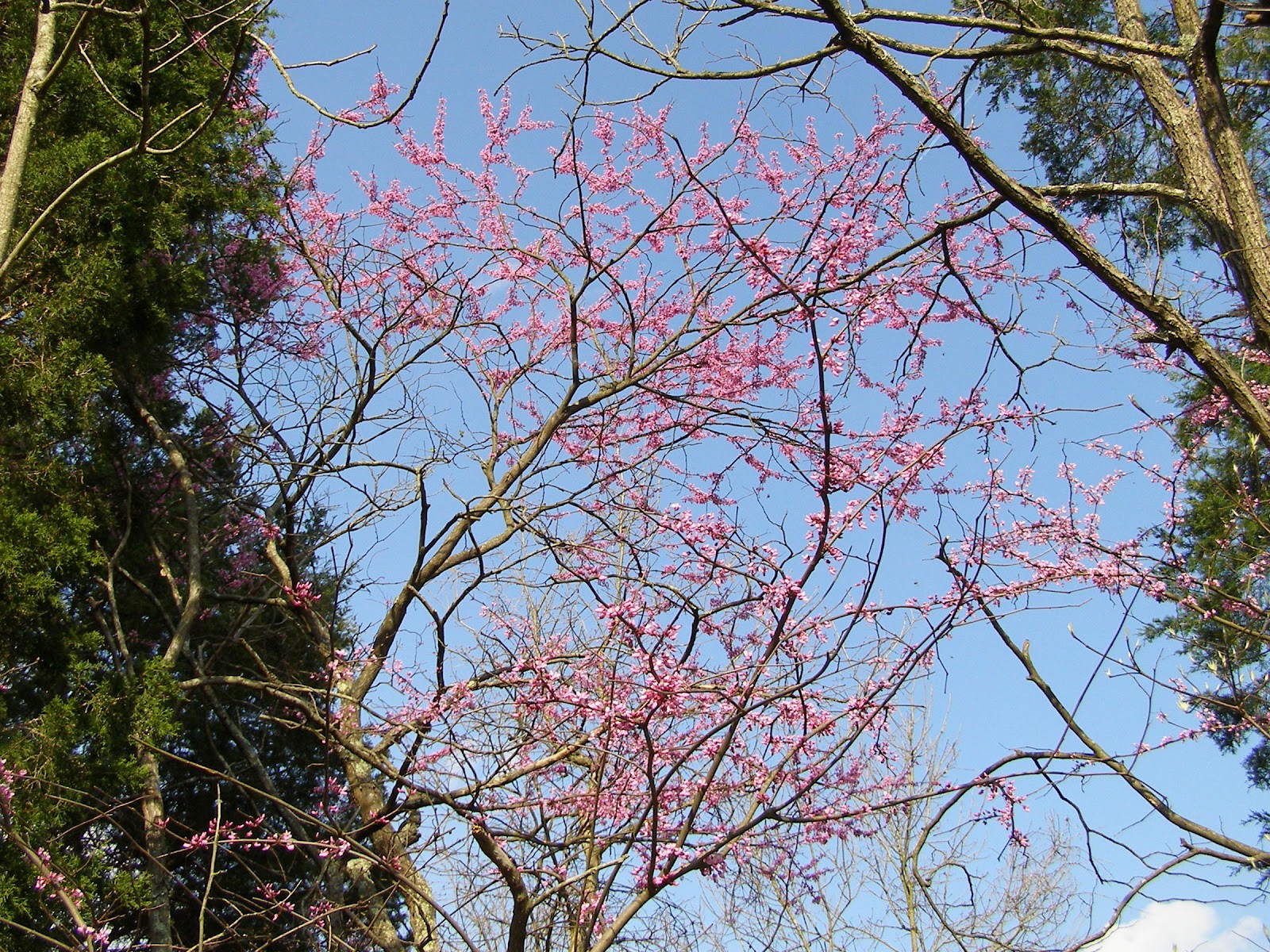
The shrubs at Blue Jay Barrens really took advantage of the week of warm weather we just had.  Redbud flower buds were just beginning to color and swell a week ago.  Now they’re in full bloom.

Redbuds are the most colorful of the spring blooming shrubs and are a valuable nectar source for some butterflies and larger bees.  The flower shape makes it difficult for many of the smaller insects to access the nectar.

Fragrant Sumac flowers are normally available at the same time as the Redbuds and are much more insect friendly.  I see a greater diversity of insects visiting these flowers than any other spring blooming plant.

Serviceberry is known for its early blooms, but it’s blooming a full month earlier than it did last year.  I’m wondering what will happen to some of these shrubs if we manage to get a hard freeze this spring.  Freeze warnings have been posted for Tuesday morning, so I guess we’ll be having the first test really soon.

These are Prickly Ash flowers in full bloom.  If you get close enough to the bush to see these flowers, you’ll most likely get snagged on one of the many thorns that give Prickly Ash its name.

Other shrubs are making rapid progress, but have not yet reached the bloom stage.  The bracts have folded away from the Flowering Dogwood flower buds.  These flowers should be blooming by next week.

The bracts will continue to enlarge and lighten in color until they create a brilliant white frame to the cluster of small flowers.  The showy bracts are what create the impressive display.

Black Haw is producing clusters of flower buds and won’t be far behind the dogwoods in blooming.  It seems that spring is rushing past too quickly to enjoy everything. Last year at this time we had only been snowless for a couple of weeks and were enjoying the arrival of more moderate temperatures.  This year it feels like we’re already pushing into summer. 

Friday, March 16, 2012

Blooming Shrubs

A look at some common Blue Jay Barrens shrubs showed only one species to be in full bloom.  The Hazelnut, Corylus americana, is covered with flowers, but the small size of the bloom makes it nearly impossible to notice.

Hazelnut is one of those plants that produces separate male and female flowers.  The long male flowers, called catkins, are produced in the fall, but don’t mature until early spring.  When the scales of the catkin pull back and the color lightens to a pale green, the female flowers should be present.

Like many of our native shrubs, Hazelnut grows in the forest understory and effectively blends with its surroundings.

Buds of the Fragrant Sumac, Rhus aromatica, have not yet begun to enlarge.  It would not be surprising to see some of these flowers emerge within the next week.

Fragrant Sumac commonly grows at the edges of small openings or fields.  The blooms produce an abundant supply of nectar and are visited by a wide variety of insects.

Buds of the Flowering Dogwood, Cornus florida, are just beginning to swell.  The buds look to have suffered very little winter damage this year.  Hopefully, weather conditions will continue to support a good flower show.

All of the Flowering Dogwood branches are loaded with flower buds.  It’s been quite a while since I’ve seen such a good prelude to the flowering season.

Redbuds are pushing out from beneath their protective scales.  Blooming of the Redbuds coincides with the emergence of the Henry’s Elfin butterflies.  The tiny butterflies will mate and then lay their eggs on the young Redbud blooms.  The size of the Blue Jay Barrens population of this uncommon butterfly tends to fluctuate along with the success of the Redbud flowers.

Flowers of the Spicebush, Lindera benzoin, are not far from emergence.  That’s a leaf bud tucked in between the developing flowers.  I’ll be back later in the year to examine the leaves for larvae of the Spicebush Swallowtail butterfly.

Wednesday, March 3, 2010

Redbud Pods

Temperatures are beginning to moderate and the snow will soon be gone. This can be a critical period for wildlife searching for enough food to carry them through this last little bit of winter. Last year’s crop of seeds and fruits is not as abundant as it was a few months ago, but there still seems to be some around. Something has been tearing into these Redbud pods and pulling out the seeds.

Most of the Redbuds are still carrying a load of seed pods. Redbud produces a nutritious seed that is eaten by many species of birds. Each one of these pods holds about a half dozen seeds.

There are still plenty of pods filled with seeds. Removing the seeds from the dried pod can be a bit of work and may explain why these seeds are still around. I imagine that birds take the easiest to get meals first.

It won’t be long before these pods drop and the Redbud develops flowers. Once on the ground the seeds will be made available to a new cast of consumers.