Showing posts with label Wood Frog. Show all posts

Tuesday, April 3, 2018

Split Season Wood Frog Breeding

During roughly the third week of February, the Wood Frogs of Blue Jay Barrens swarmed into the pond for their annual mating event. The behavior is typical for that time of year; however, weather conditions and the intensity of the mating activities were not what I have come to expect.


February 17 – Six inches of snow falls. February 18 – Temperatures struggle to reach the low 40s. Snow melts slowly and is nearly gone by evening. Wood Frogs begin to enter the pond. February 19 – High temperature reaches 75°F. Wood Frogs continue courtship activities through the day and into the night. February 20 – High temperature reaches 80°F. Wood Frog courtship activities can almost be described as frantic and continue through the day. February 21 – high temperature around 35°F. Three inches of snow falls. Wood Frogs have disappeared.

On March 28 Wood Frogs returned to the pond and were heard calling for the next three nights.  Weather was rainy and cool through the period.  This is the first time Wood Frog breeding activities divided in this manner.


The swimming frogs seem to pull in their eyeballs when swimming with head submerged.

In order to project the sound of their calls, the Wood Frogs inflate air sacs located on each side of the body.  The sacs act as resonating chambers for the call. In the above photo the frog is seen from behind, showing the twin air sacs in the foreground and the two bulging eyes behind.

Surface tension causes the water to curve and ride up the frog’s body. The water then reflects the sky and the surrounding landscape, making it difficult to see the frog itself. I wonder if this might afford the frog a degree of camouflage and protection from water level predators.


The short video above offers a view of a calling Wood Frog and a broader view of activity in the pond. The video can also be seen on YouTube by clicking HERE.

Monday, March 30, 2015

Amphibian Egg Progress

The bulk of salamander and Wood Frog egg laying at Blue Jay Barrens occurred between March 13 and March 17.  In the two weeks since egg laying began, air temperatures have ranged from a low of 10oF to 75oF.  Water temperature has not suffered such wild fluctuations, due to the constant inflow of relatively warm spring water.  Despite these varying conditions, development of salamander eggs is progressing at a rapid pace.

Several of the Jefferson Salamander egg clusters show eggs with white colored centers.  This usually indicates the presence of fungus feeding on unfertilized and damaged eggs.

There are still plenty of live embryos in these masses, so there should be no shortage of larvae hatching into the pond.

Jefferson Salamanders concentrated their egg laying efforts on sticks floating in the pond.  Several large sticks are completely covered with Jefferson egg masses.  Streamside Salamanders made heavy use of the hard surface structure I placed in the pond for their use.

The structure was composed of a mixture of clay drainage tiles, bricks, rocks, and boards.  My thought was to see if the salamanders preferred one substrate over another.

Substrate type didn’t seem to matter.  There were eggs everywhere.

Once the lower surfaces were covered with eggs, the salamanders began attaching eggs wherever they could find a hard surface.  Next year I will try placing the material so there are more spaces between the various components.

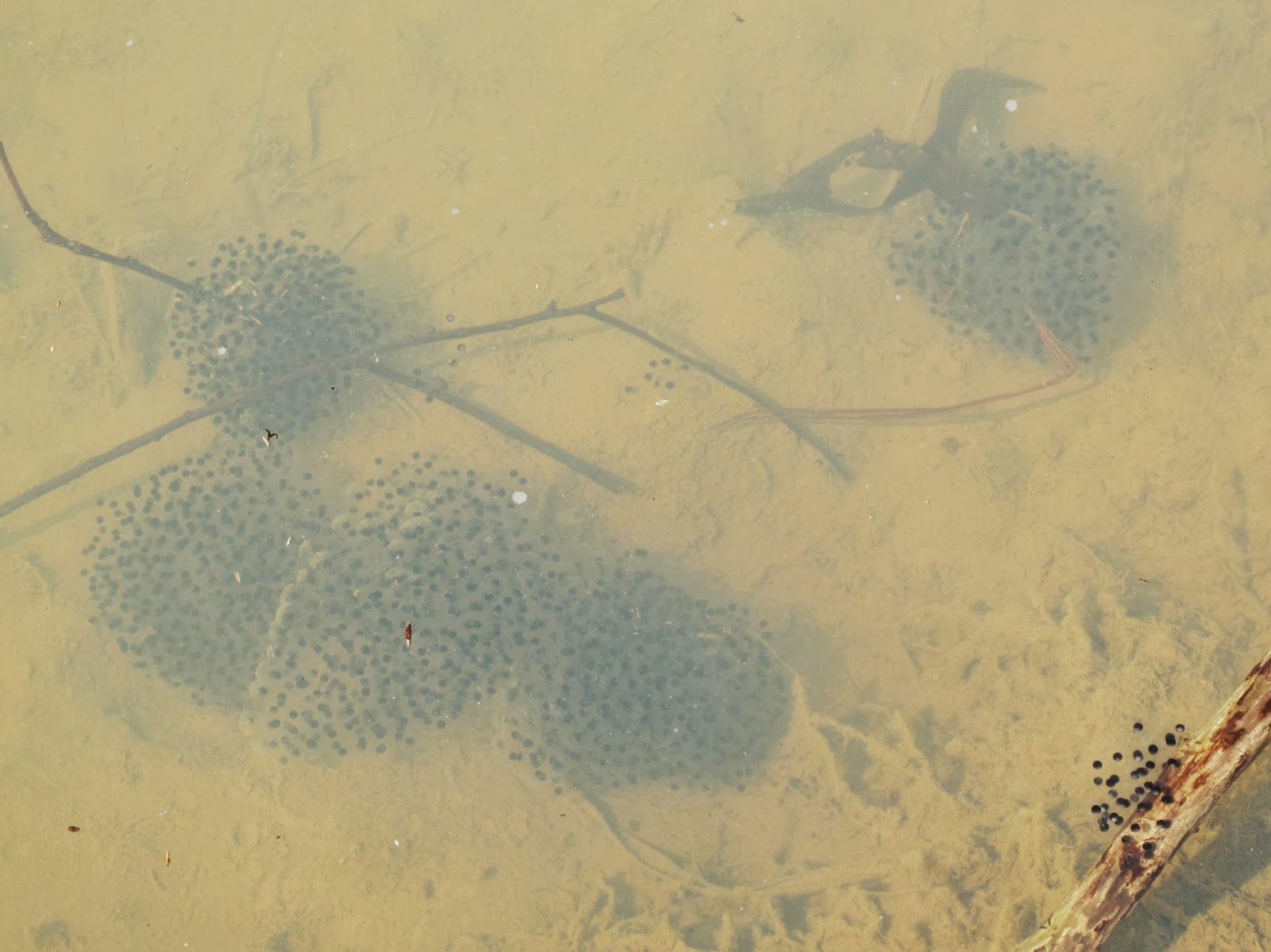
Wood Frog egg masses are beginning to lose their cohesiveness and spread across the water surface.

Frog tadpoles are becoming free swimming and detaching from the egg masses.

Development of the eggs on the outside of this mass seems to be several days behind those eggs in the center.

Eggs in the top of the mass are most susceptible to damage from weather conditions.  Ice formed over the top of these eggs several times during the past two weeks.  Several embryos seem to have been killed from freeze damage.  Larvae hatching from that top layer of eggs also seem to have a tough time working their way out to open water.  Even so, plenty of live tadpoles will result from this hatching.

Attracted by the movement of hatching tadpoles, one of the breeding pond’s super predators moves in to investigate this newly available food source.  Red-spotted Newts will take their toll on the young salamander and frog larvae.  They can’t eat them all, even though they will try.  Plenty of young salamanders and frogs will live to add their efforts to future annual breeding activities.

Wednesday, March 18, 2015

2015 Salamander Breeding - Third Wave

Salamanders have once again been stimulated into a flurry of egg laying activity at Blue Jay Barrens.  This has been an odd weather year that presented the salamanders with limited opportunities to safely travel overland to their breeding pools.  A light rain on January 3 brought in the first of the Jefferson Salamanders, but no egglaying activity was noticed.  A storm on February 1 gave us a third of an inch of rain and Streamside Salamanders joined Jeffersons in the pond.  Water level was still very low and only a few egg clusters were produced.  The pond quickly iced over.  Snow then covered the ice and the pond remained hidden from view for nearly a month. 

Finally, over two inches of rain fell during a 24 hour event beginning March 3 and ending March 4.   The pond filled and salamander breeding resumed.

Following the rain, fresh Jefferson Salamander eggs appeared on twigs throughout the pond.

The rain fell on soil that was already saturated by snow meltwater, so nearly the entire two inches moved overland to the creeks.  This carried numerous sticks and other debris that entered the pond and was used by the salamanders as an anchor for their egg masses.  Now these loose batches of eggs are being driven by the wind and are in danger of being left high on the shore as the pond water level slowly drops.  I make periodic circuits of the pond to relocate eggs in danger.

I found a couple of Jefferson Salamanders out of the water and heading away from the pond.  Some of these guys have been in the pond for over ten weeks, so I guess it’s about time for them to be getting back to their underground burrows.

The Streamside Salamanders also got busy laying their eggs.   Streamsides attach their eggs on the underside of submerged objects such as rocks and boards.

Instead of being contained as a group within a mass of jelly, Streamside Salamander eggs are individually attached. 

Wood Frogs also emerged with the warm rain.  They have spent the past several days producing large egg masses.

A few frogs and salamanders took advantage of the branches hanging below my floating jug and attached their eggs to this safe location.  Weather conditions made it impossible for me to float the branches prior to the arrival of the breeding amphibians, so my success in keeping the eggs safe from fluctuating water level was not nearly as successful as last year.

Many of the eggs were laid near the shoreline where a falling water level could leave them hanging in the air.  If our spring rainfall is less than normal, I’ll just have to relocate all of these egg clusters to deeper water.

Friday, April 4, 2014

Wood Frog Eggs Hatching

Wood Frog egg masses are falling apart and the developing larvae are breaking through the egg membrane into open water.  Even though they have left the egg, the larvae are not yet free swimming.  Most just flutter to the pond bottom where they will rest for the next couple of days.  During this time they will use up the remaining yolk in their egg sack as they develop into a more typical tadpole shape.


Some egg clusters lost their globular shape and floated about on the water’s surface.  This did not seem to affect hatching at all.  Even so, there were several larvae that emerged on the upper surface of the raft and seemed in danger not making it down into the water.


Other egg clusters fell to the pond bottom.  No matter where they ended up, all of the egg masses produced healthy larvae.


Egg masses laid a little later in the season were still in the early stages of development.  The pond was ice covered on many mornings during the past two weeks.  I imagine the cold temperatures played a part in the delayed development.

The floating tree branch did an outstanding job of keeping the frog and salamander eggs from being exposed during times of falling water level.  A shortage of rainfall during March caused the pond water level to drop to record low levels for this time of year.  I was able to maneuver the tree branch into the deepest part of the pond and the eggs on the branch were spared exposure to the air.


Jelly masses that once protected salamander eggs broke lose and floated freely about the pond.


Almost all of the jellies were empty.  Most successfully produced salamander larvae, but a few contained unfertilized eggs that were consumed by fungus.


There were just a few larvae that had not left the egg.  Now I just have to wait a few weeks for the larvae to grow large enough for me to see them in the pond.  Water won’t be a problem for a while.  Thunder storms earlier today dropped 1.2 inches of rainfall and the pond is now near its full level.  More storm clouds are hurrying in from the west and I’m rushing to type this and get it posted before the heavy rain once again blocks my internet satellite link.

Wednesday, March 19, 2014

Pond Breeding Streamside Salamanders Confirmed

Wood Frogs had a brief breeding frenzy just a few days following the salamanders.  In some years the Wood Frogs spend as much as two weeks in the pond.  This year they’ve been active for a night or two and then absent for a couple of nights before returning.  I try to keep twigs and branches away from the shoreline so the frogs and salamanders are forced to deposit their eggs in deeper water, but winter ice storms broke some branches from the shore hugging dogwoods and these ended up getting covered with eggs.  Fluctuating water level can easily leave these eggs hanging in the air.  Part of my daily routine is to check the eggs to see if a rescue operation is in order.


My floating branch, staked out in the deepest part of the pond, successfully attracted the majority of breeding frogs.


The Wood Frog egg masses have effectively camouflaged those of the salamanders.  This branch rises and falls with the water level, so the eggs are safe from desiccation.


A few egg clusters were attached to dead twigs floating in the water.  Those that I’ve found at the edge of the pond have been relocated to the toad pool.


While gathering up some Wood Frog eggs, I noticed this patch of moss that had come loose from the pond bottom.  On the underside of the moss was a collection of eggs that had to have come from a Streamside Salamander.  I want to make it clear that the moss I am referring to is the terrestrial type that established itself in the pond bottom during the dry season.  This is not algae, which many people refer to as pond moss.


Streamside Salamanders, which normally lay their eggs beneath flat creek rocks, have utilized the moss mats as an alternate substrate.  I imagine that the activity of the breeding salamanders detached a large area of the moss mat from the pond bottom and that is the reason so many patches of egg bearing moss are now floating free in the pond.


Embryo development is well underway.  The pond water temperature fluctuates and tends to stay warmer than that in the stream.  I suspect that this accelerates development of the pond reared Streamside Salamanders over that of their creek bound relatives.


There are dozens of moss chunks floating about the pond.  Oxygen produced by the moss causes the mats to float green side up.  Most of those I checked carried a load of eggs beneath.


Eggs could also be seen around the edges of moss mats still maintaining contact with the pond bottom.  I imagine that the bottoms of these mats are also egg laden.  Now I know that the Streamside Salamanders are definitely breeding in the pond.  I’m happy to have this confirmation, but presence of the Streamsides in the pond also makes it less likely that I actually have the look-alike Smallmouth Salamander living at Blue Jay Barrens.

Sunday, January 19, 2014

Projects 2013 - Toad Pool

In October 2012, I began a project designed to increase the toad population at Blue Jay Barrens.  Toads were once common visitors to the pond during the spring breeding season.  I still hear their mating calls at a distance, but it has been several years since they have been on this property.  Besides missing the toads, I am concerned about the population local Hognose Snakes which feed heavily on toads.  I believe that additional suitable breeding sites will help the toad population to rebound, so I am constructing a series of small temporary pools to serve that purpose.  This is the start of the first pool.

My working tools are a roto-tiller and a scoop shovel.  Tilled soil is scooped up and moved to its new location.  In this pool, excavation stopped just atop the bedrock.

I finished work minutes ahead of the rain and the pool quickly filled.  The local White-tail Deer population was quick to claim this as a preferred watering site.  Soil that was used to form a shallow dam at the low end of the pool suffered severe trampling.  The deer had the area looking much like a confined livestock area. 

The pool was constructed in an area primarily consisting of Tall Fescue, a non-native grass considered to be invasive in areas of native vegetation.  Elimination of the fescue was a primary consideration in choosing this particular site. 

The second consideration was the presence of this seasonal spring located just above the pool site.  My hope was that this spring would produce a strong enough flow to keep the pool full of water.

In January 2013, Jefferson Salamanders returned to the pond for their annual breeding activities.  I had hopes that the toad pool would also support the local salamander population, but knew it was unlikely that any salamanders would appear there the first year.  I was right.  The pool remained empty.

Salamander breeding in the pond was highly successful.  Dozens of egg clusters clung to the submerged tree branches.

Mild temperatures in February brought out several species of aquatic insects that filled the toad pool with eggs.  Since I was going to be making frequent visits to the toad pool through the coming year, I wanted to make sure there would be some interesting things to see.  I thought the insect larvae developing in the pool might support salamander larvae, so I moved a couple of salamander egg clusters from pond to pool.

These five week old eggs are showing well developed salamander larvae.

The stick holding the egg clusters was secured to the pool side so the eggs were suspended in the mid level of the water column.  I was curious to see if the newly constructed pool would be able to satisfy the needs of the developing larvae.

Wood Frogs were actively breeding in the pond, so I moved a few of their egg clusters into the pool. 

Salamander larvae wriggled free of their jelly-like egg masses in late March.

Wood Frog tadpoles, looking more like small leeches than amphibians, fell from their eggs on April 1 and spent several days lying on the pool bottom before becoming free swimming.  I witnessed one salamander larva making a meal of a newly hatched tadpole.

The Wood Frog tadpoles developed quickly and within two weeks were aggressively consuming algae in the pool.

Below normal rainfall in May was cause for concern.  This shot on May 23 shows the pool still full of water.  Had the spring not stopped flowing a week earlier, I would have been confident of the pool’s ability to hold water long enough for the salamanders and frogs to complete their metamorphosis and move away from the water.

A check of the salamander larvae on May 24 showed them to be in good health and vigor.  This individual illustrates the average stage of development and is about two weeks from leaving the water.  A few more rapidly developing larvae had already moved out of the water to hide beneath wet vegetation at the pool’s edge.

Wood Frogs were also well advanced and would be leaving the water soon.  Several had already moved away from the pool.

By May 30 the pool was in danger of disappearing.  Had there been a normal precipitation pattern, the pool would have remained full plenty long enough for the amphibian larvae to leave the water before it left them.

Even though there was still enough water to support life, predator tracks in the mud told me that the young salamanders and frogs could no longer survive in the pool. 

I netted the surviving pool larvae and moved them back to the pond.  The dozen or so remaining salamander larvae would be independent of the water within a few days.  Knowing that salamander larvae survival is often quite low in typical breeding pools, I was happy with the number of pool raised individuals that made it to the land dwelling stage.

The pool as of January 16, 2014.  Vegetation has closed in around the banks and things are looking more hospitable for local aquatic creatures.  So, why have I not mentioned the toads?  Because there were none in 2013.  I see toads occasionally through the summer, but I don’t know where they are breeding.  If I don’t get toad eggs this spring, I may have to corral those I find in the summer and make sure they meet at the right time next year.