Showing posts with label Streamside Salamanders. Show all posts

Sunday, May 12, 2019

Salamanders in the Drain

My house in Southern Ohio sits atop a small cellar that was part of an old farm house constructed in 1875.  A drain pipe runs from the cellar to a point near a seasonal pond in front of the house.  During the wet season, a seasonal spring emerges from the brick in one corner of the cellar and flows across the floor to the drain.  For some reason, beginning just a couple of years ago, salamanders have been coming up the drain and making themselves at home in the cellar.  Here are a few species that wandered in this past winter and spring.

Jefferson Salamander – This species is the first to arrive at the pond during the breeding season.  They sometimes lay their eggs as early as December.

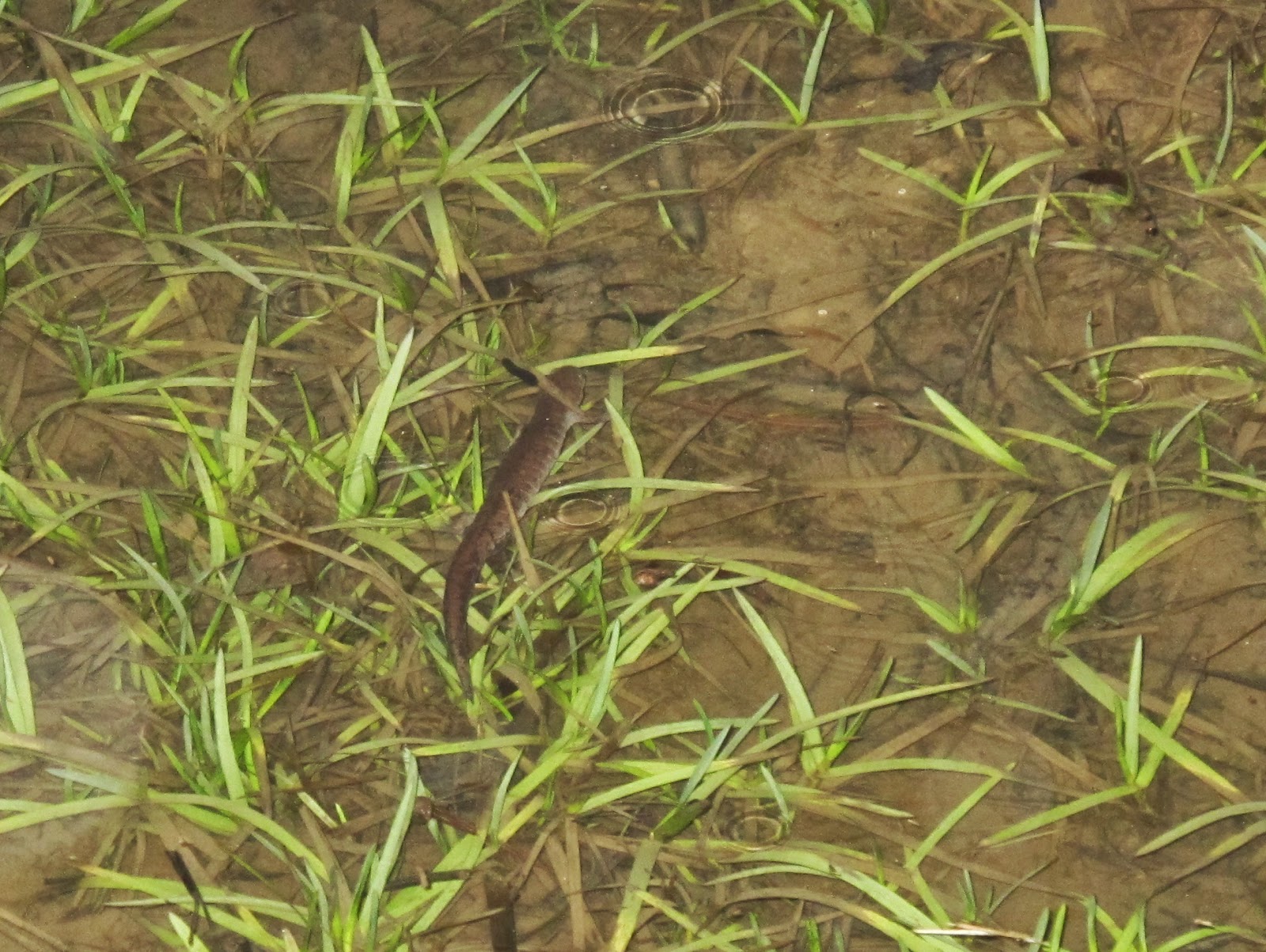
Streamside Salamander – This uncommon salamander is almost identical in appearance to the Smallmouth Salamander.  The main difference between the two species is in the location and method of laying eggs.  Smallmouth Salamanders breed in still pools and deposit multiple eggs in a jelly-like mass.  Streamside Salamanders breed in small headwater streams or pools and deposit their eggs singly, but in close proximity so as to form a grouping of several eggs, beneath rocks, logs, leaves or other flat bottomed debris. Streamside Salamanders begin their breeding activities very soon after the Jeffersons.

Red-Spotted Newt – Adults of this species are typically found in permanent bodies of water, but they are also able to survive in seasonal pools that are dry during the summer and early fall.

Southern Two-Lined Salamander – I don’t normally find this species far from rocky creeks.  The instinct to disperse is present to some degree in all animals.  When conditions are right, the animal just takes off and travels.  Some die and some colonize new areas.  This individual may have been in dispersal mode.

Marbled Salamander – This species lays its eggs in the fall in locations that will contain water when the end of year rains begin.  Once inundated, the eggs hatch.  Adults commonly wander during late winter and spring rains.  I’ve lived here for 34 years, but it was just two years ago that I saw my first Marbled Salamander.  That individual was found in my cellar.  Even though I’ve seen this species each year since, all individuals have been found in my cellar.  I’ve yet to encounter one outdoors.


On warm days, I gather up the visitors and release them outdoors.  There is an old brush pile just upstream of the pond that seems to me to be an ideal release point.

Monday, January 23, 2017

Salamander Eggs

So far this month we’ve had 5.8 inches of rain, with rain falling more days than not since January 1.  Temperatures have remained above average.  High temperatures in the 50’s and 60’s Fahrenheit have been the norm so far this year.  It’s been a tough year for pinpointing when salamanders began showing up in the pond for their annual breeding frenzy.  All I can say for certain is that the pond was free of salamanders three weeks ago, and now the pond is full of salamander eggs. 

The frequent rains have kept the water level high and visibility slightly clouded, but it’s easy to see the masses of egg clusters clinging to plant stems scattered across the bottom of the pond.

I found this Jefferson Salamander during a break in the rain a couple of nights ago. 

This is the most common pond breeding salamander at Blue Jay Barrens, and the only one here that produces egg masses this early in the year.  In a month or two, Spottted Salamanders will enter the pond and leave their own egg masses.

Attached to the underside of a floating plank were these eggs of the Streamside Salamander.  This species typically places its eggs on the undersides of flat rocks in small headwater streams.  In situations where they utilize temporary pools, the eggs are placed on the undersides of any available surface.  Once it became apparent that Streamside salamanders were breeding in this pond, I adorned the deepest part of the pond with a variety of items suitable for receiving eggs.    I am assuming that these items are now sporting a nice covering of Streamside Salamander eggs. I’ll find out for sure when the water clears enough for me to see though to the pond bottom.

The Streamside Salamander eggs seem to be developing rapidly.  I suspect that warmer water temperatures have increased the rate of egg development.  This may increase the chances of the salamander larvae reaching their land dwelling stage before the pond water disappears for the summer.

Friday, March 4, 2016

Streamside Salamanders in the Pond

Water depth, glare, and wind ripples have made it impossible for me to see whether or not the sunken tiles, rocks and boards, intended to receive the eggs of the Streamside Salamander, have actually been used this season. Streamside Salamanders typically lay their eggs on the undersides of flat rocks in small flowing streams. Absence of flowing water and large flat rocks will not necessarily make these salamanders abandon their breeding efforts. I added a breeding structure to the pond at Blue Jay Barrens in an attempt to provide a population of pond breeding Streamside Salamanders with a suitable structure to receive their eggs. In the past, this breeding aid has been readily used, but even in its absence Streamside Salamanders find a way to anchor their eggs and ensure breeding success.

When the water level drops in early summer, I use this board as a way to cross the mud between the dry bank and open water. During the winter and early spring months, I allow the board to float freely in the pond.

I used to remove the board during the winter and put it in a dry location for storage. One year the pond filled quickly from a late autumn rainstorm followed by a quick freeze that trapped the board in the ice in the center the pond. The board stayed out of reach until early spring. When I finally went to pull it in, I found the bottom surface covered with Streamside Salamander eggs. Now I just let the board stay in the pond as an alternate breeding site for the Streamside Salamanders.

The Streamside Salamanders also utilize as an egg laying site, pads of terrestrial moss that grow on the bottom of pond during the dry season. The activity of the egg laying salamanders causes the moss to lose contact with the muddy pond bottom and begin to float free.

Some of the moss pads containing egg clusters are held in place by surrounding vegetation. Others break loose and float about the pond. The eggs seem to develop properly and hatch in either condition.

The Jefferson Salamander eggs have picked up a covering of silt washed in from the nearby Township road. This covering may actually provide a beneficial screen against excessive UV radiation.

The embryos in the cluster are well-developed and probably within a week of hatching.

Many empty jellies are also floating around the pond, a sign that a successful hatching has been completed.

Wood Frogs have been calling from the pond for the past week. New egg clusters appear every night.

Most of the Wood Frog tadpoles will end up as salamander food. All of the tadpoles, both frog and salamander, will be racing to complete their metamorphosis before the water of the temporary pond disappears later this summer.

Monday, March 30, 2015

Amphibian Egg Progress

The bulk of salamander and Wood Frog egg laying at Blue Jay Barrens occurred between March 13 and March 17.  In the two weeks since egg laying began, air temperatures have ranged from a low of 10oF to 75oF.  Water temperature has not suffered such wild fluctuations, due to the constant inflow of relatively warm spring water.  Despite these varying conditions, development of salamander eggs is progressing at a rapid pace.

Several of the Jefferson Salamander egg clusters show eggs with white colored centers.  This usually indicates the presence of fungus feeding on unfertilized and damaged eggs.

There are still plenty of live embryos in these masses, so there should be no shortage of larvae hatching into the pond.

Jefferson Salamanders concentrated their egg laying efforts on sticks floating in the pond.  Several large sticks are completely covered with Jefferson egg masses.  Streamside Salamanders made heavy use of the hard surface structure I placed in the pond for their use.

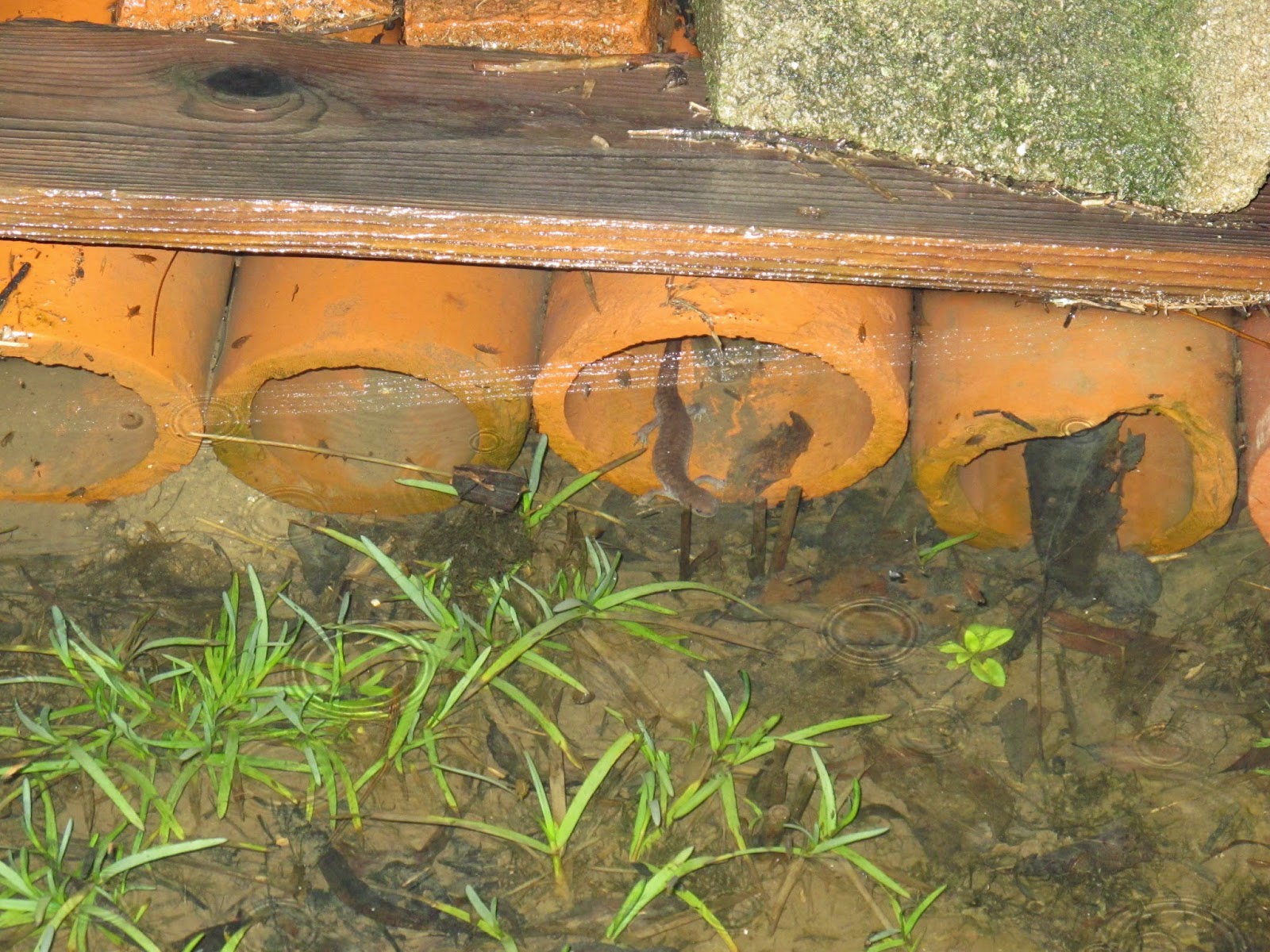
The structure was composed of a mixture of clay drainage tiles, bricks, rocks, and boards.  My thought was to see if the salamanders preferred one substrate over another.

Substrate type didn’t seem to matter.  There were eggs everywhere.

Once the lower surfaces were covered with eggs, the salamanders began attaching eggs wherever they could find a hard surface.  Next year I will try placing the material so there are more spaces between the various components.

Wood Frog egg masses are beginning to lose their cohesiveness and spread across the water surface.

Frog tadpoles are becoming free swimming and detaching from the egg masses.

Development of the eggs on the outside of this mass seems to be several days behind those eggs in the center.

Eggs in the top of the mass are most susceptible to damage from weather conditions.  Ice formed over the top of these eggs several times during the past two weeks.  Several embryos seem to have been killed from freeze damage.  Larvae hatching from that top layer of eggs also seem to have a tough time working their way out to open water.  Even so, plenty of live tadpoles will result from this hatching.

Attracted by the movement of hatching tadpoles, one of the breeding pond’s super predators moves in to investigate this newly available food source.  Red-spotted Newts will take their toll on the young salamander and frog larvae.  They can’t eat them all, even though they will try.  Plenty of young salamanders and frogs will live to add their efforts to future annual breeding activities.

Wednesday, March 18, 2015

2015 Salamander Breeding - Third Wave

Salamanders have once again been stimulated into a flurry of egg laying activity at Blue Jay Barrens.  This has been an odd weather year that presented the salamanders with limited opportunities to safely travel overland to their breeding pools.  A light rain on January 3 brought in the first of the Jefferson Salamanders, but no egglaying activity was noticed.  A storm on February 1 gave us a third of an inch of rain and Streamside Salamanders joined Jeffersons in the pond.  Water level was still very low and only a few egg clusters were produced.  The pond quickly iced over.  Snow then covered the ice and the pond remained hidden from view for nearly a month. 

Finally, over two inches of rain fell during a 24 hour event beginning March 3 and ending March 4.   The pond filled and salamander breeding resumed.

Following the rain, fresh Jefferson Salamander eggs appeared on twigs throughout the pond.

The rain fell on soil that was already saturated by snow meltwater, so nearly the entire two inches moved overland to the creeks.  This carried numerous sticks and other debris that entered the pond and was used by the salamanders as an anchor for their egg masses.  Now these loose batches of eggs are being driven by the wind and are in danger of being left high on the shore as the pond water level slowly drops.  I make periodic circuits of the pond to relocate eggs in danger.

I found a couple of Jefferson Salamanders out of the water and heading away from the pond.  Some of these guys have been in the pond for over ten weeks, so I guess it’s about time for them to be getting back to their underground burrows.

The Streamside Salamanders also got busy laying their eggs.   Streamsides attach their eggs on the underside of submerged objects such as rocks and boards.

Instead of being contained as a group within a mass of jelly, Streamside Salamander eggs are individually attached. 

Wood Frogs also emerged with the warm rain.  They have spent the past several days producing large egg masses.

A few frogs and salamanders took advantage of the branches hanging below my floating jug and attached their eggs to this safe location.  Weather conditions made it impossible for me to float the branches prior to the arrival of the breeding amphibians, so my success in keeping the eggs safe from fluctuating water level was not nearly as successful as last year.

Many of the eggs were laid near the shoreline where a falling water level could leave them hanging in the air.  If our spring rainfall is less than normal, I’ll just have to relocate all of these egg clusters to deeper water.

Wednesday, February 4, 2015

2015 Salamander Breeding - Second Wave

Winter storm Linus came through this area Sunday as mostly a rain event before changing over to snow on Monday morning.  Light rain began early Sunday afternoon and continued until almost midnight.  Rainfall total was only 0.35 inches, but that was enough to bring more salamanders to the breeding pond.  In my hand is one of the many Streamside Salamanders I saw Sunday evening.

The first Streamside Salamander encountered was already in the water, making me think I may once again have missed seeing any traveling overland to the pond.

I began searching the shoreline and soon discovered this fellow.  It was traveling along the path of shallow water flowing from the seasonal spring farther up the pond bank.

In reaction to my light, it began to seek refuge beneath a patch of moss.  The base color of this species varies from brown to various shades of gray.  The markings resemble lichen colonies and are also quite variable between individuals.  I think the brown color and golden markings on this one are particularly attractive.

I pulled the salamander’s head from beneath the moss and sent it on its way.  It soon plunged into the pond and disappeared from sight.

Streamside salamanders deposit their eggs on the undersides of flat objects such as rocks.  Since the pond is devoid of such objects, I created a breeding area composed of flat rocks, clay tile, bricks, boards and concrete blocks.  I’ll see which the salamanders prefer.  Last year their eggs were laid beneath mats of moss on the pond bottom.  This worked, but several of the mats detached from the bottom and began floating about the pond where they could easily be left dry along the shoreline as the water level dropped.

Several Streamside Salamanders were checking out the artificial structure.

Nothing in this collection is going to go floating off, so any eggs left here should be safe.

Jefferson Salamanders were also active.  Several Jeffersons entered the pond a month ago, but no egg masses appeared.

I’m wondering if the early arrivals were all males.  The January rain that brought the first of the Jeffersons was of short duration and a low amount.  This was possibly not enough rain to motivate the females to move to the pond.  We went until Sunday without having another rain, so this is the first time in a month that the females had a chance to make their journey.

The Jeffersons were quite interested in one another.  There were several groupings of two or more individuals around the pond.

When the rain once again picked up, the rough surface of the water made it impossible to clearly view the underwater activity, so I headed back to the house.

On Monday morning, clusters of Jefferson Salamander egg masses were clearly visible in the pond.  I guess a couple of females did make it to the pond Sunday night.

The pond is the lowest it has ever been for salamander breeding season.  When each rainfall measures just a few tenths of an inch, the pond doesn’t fill very fast.  As long as the spring water entering the pond equals or exceeds that leaking out, the salamanders should be in no danger.  The next species to move to the breeding pond will be the Spotted Salamander.  Depending on weather, the next wave could be anytime between now and the end of April.