Showing posts with label Giant Swallowtail. Show all posts

Monday, July 27, 2015

Monarda Returns

It’s been a few years since Monarda fistulosa has bloomed so prolifically in this opening at Blue Jay Barrens.  Something about the environmental conditions during the winter or spring of 2011 caused a massive die-off of Monarda plants in this patch. 

During the past few years, Monarda has returned and is now approaching its earlier abundance.  With the return of the plants comes a return of the butterflies.   Monarda attracts a variety of pollinator species, with large butterflies being the most notable.

At the small end of the size scale is the Silver-spotted Skipper.  Smaller butterflies, which includes the other skippers and many butterfly species, seem to find the Monarda flower head difficult to handle.  As if in celebration of the return of the Monarda, Silver-spotted Skippers are around in record numbers this year.

The showiest of the butterfly visitors are the Swallowtail species.  This is the Spicebush Swallowtail.  Its habit of constantly fluttering its wings while feeding makes it difficult to photograph.

Blooming of Monarda seems to coincide with the emergence of the summer brood of Tiger Swallowtails.  Summer brood individuals are typically larger than those found earlier in the year and they are quite showy as they glide between Monarda blooms.  There are those that exhibit the typical yellow coloration and …

… others that are colored a silky black.  Despite their black coloration, the tiger stripes still show through.
I found it interesting that the swallowtails all seemed to feed while hanging from the side of the flower head.
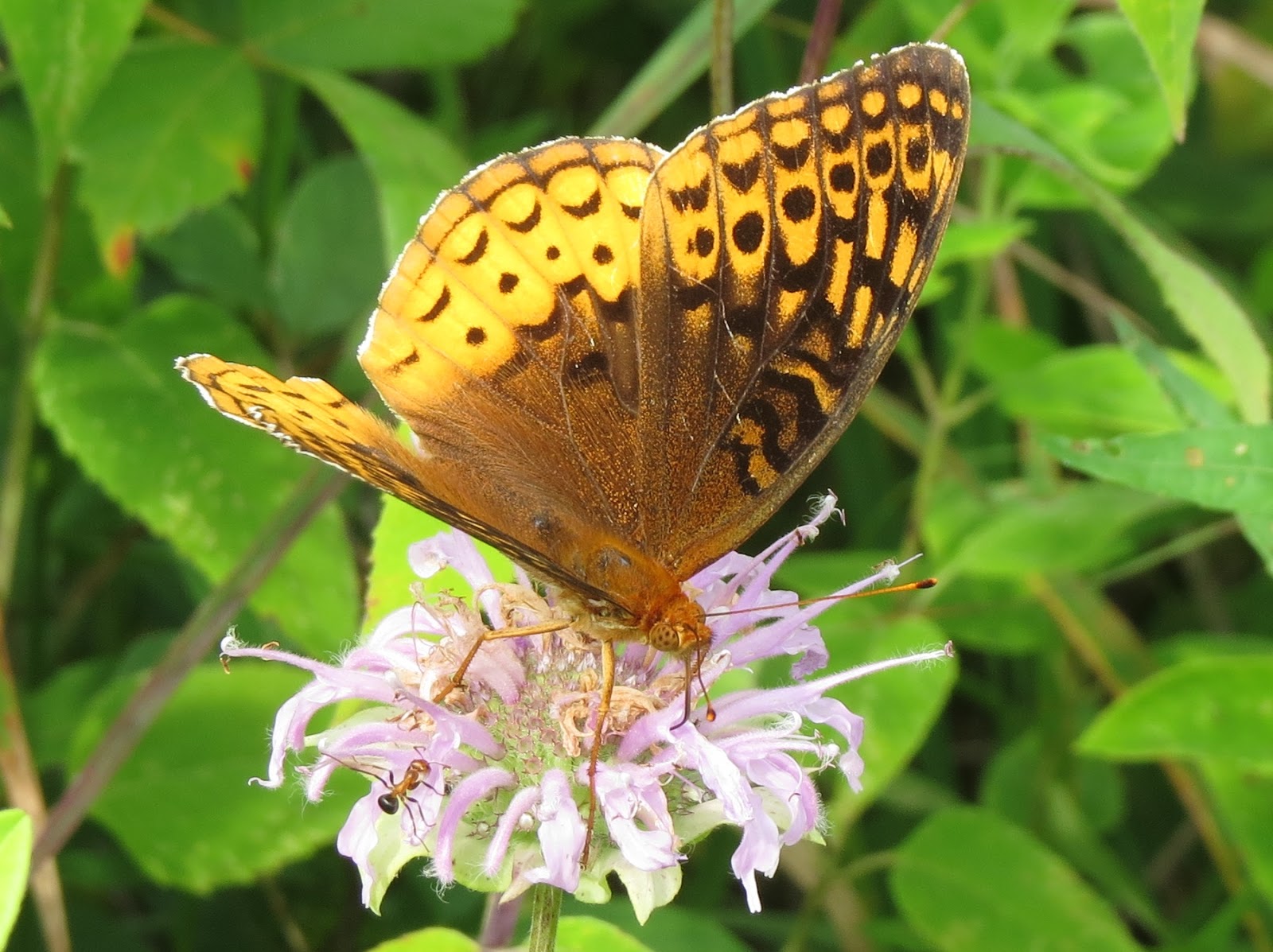
Great Spangled Fritillaries, however, tended to do their feeding while perched atop the flowers. 

The Monardas have even attracted a few Giant Swallowtails.  The Giant Swallowtails quickly move from flower to flower, spending so little time nectaring that I sometimes wonder if the act is even beneficial.  Finding them at flowers is about the only way to get a decent look at these fast fliers.

The Monarda is most famous as an attractor of Clearwing Sphinx Moths.  Using their front legs as anchors, Hummingbird Clearwings hover next to the flower as they draw nectar.  This species is currently outnumbering butterflies in the Monarda patch.

A few Snowberry Clearwings are also present this year.  Slightly smaller than the Hummingbird Clearwings, the Snowberries feed in a similar manner.  This is a species that I don’t often see here.

The Monarda’s attractiveness is not diminished by darkness.  A variety of moth species visit the flowers through the night.  The lack of multiple examples of nocturnal visitors more accurately reflects the photographer’s skills than it does the true number of night-time pollinators.

Wednesday, August 3, 2011

Dry Pond Butterflies

The tadpole stew that was left behind after the pond went dry is attracting a wide range of butterfly species. A Giant Swallowtail spent over an hour sucking up the nutritious goo. This is the first time I’ve ever seen one of these super sized butterflies sit still.


The Buckeye is an immigrant species that can’t survive Ohio winters and must reestablish itself from southern populations each year. I typically see this species in September as it suns itself in open areas. It’s not a normal pond bottom feeder.


Spicebush Swallowtails are regular visitors to mud puddles. Spicebush, the host plant of this particular butterfly, is not very common at Blue Jay Barrens. Fortunately, the butterfly also utilizes Sassafras as a larva food source and Sassafras grows here in abundance.


Pearl Crescents are always common visitors to the damp pond bottom. Sometimes found with the Pearl Crescents is the similar, but slightly larger Silvery Checkerspot. That’s the Silvery Checkerspot with its wings partially opened. Silvery Checkerspots tend to standout in a crowd of Pearl Crescents because of the sharp detail of the pattern on the underside of the hind wing. They are also slightly larger and display a flight pattern that seems more under control than that of the Pearl Crescents.


Pearl Crescents and Eastern Tailed Blues are the most dependable pond bottom visitors. They’ll visit every year even when the mud hasn’t been enhanced by a mass of decomposing amphibian larvae. Butterflies haven’t been overly abundant this year, so I have to think that the presence of the tadpoles has been a factor in attracting the more uncommon species to the pond bottom.


Several Skipper species have also swarmed into the mud flats. Peck’s Skippers numbered in the dozens. I like the skippers that show a little bit of recognizable patterning. It helps a lot with the identification.


There were also several unadorned skippers flitting about. This type and another with a more golden coloration were quite abundant. I’ve not yet mastered all of these skippers, so this one will remain unnamed today. Skipper ID is just another interesting thing I can look forward to pursuing in the future.

Tuesday, August 31, 2010

Giant Swallowtail Larva

Some people find it hard to believe that a face like this can be found on an animal in Ohio. It looks to me like something you would see on the Outer Limits. This is the front end of a Giant Swallowtail Larva and the face is just a decoration that’s part of its defensive arsenal. The actual head is located below that mouth-like slit.

Earlier this year I showed the young larvae that depended on their resemblance to bird droppings to avoid being eaten. Larger specimens still bear a bird dropping appearance, but they are much more noticeable and have gained a few additional tricks to avoid being something’s meal. At the slightest disturbance, the enlarged thoracic region of the caterpillar raises to display its mask to a potential predator. A show of eyespots is often an effective way to scare off birds.

A more aggressive disturbance causes the caterpillar to draw its weapon, a projectable organ known as an osmeterium. The osmeterium exudes an unappealing substance that combines touch and smell to deter predators. In cases like this, I usually attack using a stick so as to avoid carrying the odor with me on my fingers.

If the attacker comes from the front, the osmeterium takes on the appearance of a snake’s tongue, another visual deterrent to attack by birds.

This larva is about an inch and a half long. It won’t be long before it moves off to find a suitable place to form a chrysalis, the form in which it will spend the winter. Maybe I’ll see this guy in adult form next spring.

I found several suitable photographic subjects. There are many fluorescent blue spots and streaks that make the caterpillar appear to be throwing electrical sparks. I wonder if those might serve as another warning to potential predators.

A single clump of Prickly Ash contained half a dozen larvae. Most were resting quietly on the stems, but this one was busily consuming a last leaflet.

There’s quite a defoliation effort going on here. Fortunately, there are only one or two larvae per shrub. If these can all make it through the winter, next year may surpass our current record butterfly numbers.

Wednesday, July 21, 2010

Some Insect Fliers

Last year I saw an extra abundance of Robber Flies. These large, hairy predators lined the walking paths, waiting to dart out and seize some small flying prey. So far this year, they’ve been rather scarce. This mating pair is working hard to see that the population increases.

Crane flies are beginning to become more abundant. This one was acting even more ungraceful than your average Crane Fly and landed on this leaf after falling off the one above. Judging by the light color, I’m going to attribute its bumbling flight to the possibility that it just recently emerged as an adult.

Giant Swallowtail butterflies are having a super year. I’ve been seeing three or four at a time around the Monarda patch. Unfortunately, I have yet to get a shot of one of these gorgeous creatures that’s in focus. They keep their wings in constant motion and tend to hover rather than settle on the flower. As abundant as they are now, I should have several opportunities to get that elusive focused shot.

Bee Flies are great. They look threatening, but don’t bite or even bother to investigate humans. Many have coloration along the wing veins that makes them more attractive than a lot of the small, brown skippers. In fact, they often resemble butterflies when seen perched on a flower, their primary food source. The larvae are parasitic, but fortunately for us, they parasitize insects.

Well, it’s not flying yet, but it will be before long. This Monarch caterpillar is at rest beneath a milkweed leaf. Signs of feeding were quite evident at the top of the plant. It wasn’t until I got my face almost to the ground that I could see what had been doing the feeding. Despite the abundance of milkweeds at Blue Jay Barrens, I rarely see Monarch caterpillars. It’s always a joy when I do.

Thursday, June 3, 2010

Giant Swallowtail Larva

This could be a fresh bird dropping, but it’s not. This is the larva of a Giant Swallowtail Butterfly. Bird dropping mimicry is one trick used to avoid being eaten by hungry birds.

That blurry, winged thing in the middle of the picture is a female Giant Swallowtail looking like she’s trying to deposit an egg. I’ve never seen a live Giant Swallowtail that was not moving. This one was no exception. She bounced across a couple of leaves and then shot out through the woods. These butterflies are fast.

This prickly Ash is what attracted her. This is the primary host plant for Giant Swallowtails in this area. It’s normally found scattered through the woods as an understory shrub.

Instead of eggs, I found a young larva. Larva of many species avoid feeding in an irregular pattern such as this, because it is likely to attract predators. That’s apparently not an issue when you look like bird poop.

The easiest way to find Giant Swallowtail Larvae is to view the leaves from below and look for their silhouette. Of course, lots of other things also sit on the leaf, so not every shadow is a larva.

The larva I found was not in an easy to photograph location, so I had to do a little work to get him properly positioned. First I used my walking stick to lower the branch and then I hung dead branches along its length to get the larva in just the right position. The larva is on the leaf in the bottom center of the picture.

Giant Swallowtail larvae have a special irritant producing gland that they bring into play to repel predators. This larva is not yet old enough to produce the irritant, but I was able to make it show the rudiments of the developing gland.

Tuesday, August 4, 2009

Giant Swallowtail

I’ve been disappointed by the lack of swallowtail butterflies this summer. Swallowtail numbers are still almost nonexistent, but I did have a brief encounter with one of my favorites. This is the Giant Swallowtail, Papilio cresphontes, the largest of our Ohio swallowtails.

This is an active, fast flying butterfly. It’s a lot of fun to watch as it zooms over a field of flowers, dropping here and there to take some nectar. It’s a frustrating butterfly if you’re trying to get a picture.

It flutters its forewings constantly. I’ve got a large collection of shots that look like the butterfly tied its wings up in a hair ribbon. The hind wings are relatively motionless and are not as difficult to capture.

Same thing from the side. Despite the inadequacies of the photographer, the model is still gorgeous.

I see several of these butterflies each year, but they’re always on the move and it’s usually a here it comes, there it goes type of encounter. I was really happy to have one stick around for this many shots.

The host plant of the Giant Swallowtail is the Prickly Ash, Zanthoxylum americanum. Prickly Ash is related to the citrus and the tiny fruits have a definite fragrance of oranges.

I found this cluster of eggs on the leaf stem of a Prickly Ash and thought it might be eggs of the Giant Swallowtail. The literature says that Giant Swallowtails lay eggs singly on the top of the leaflets, so these are probably something else. I’ll try to get back and see what these become.