Showing posts with label Draba cuneifolia. Show all posts

Sunday, February 21, 2021

Harvester Ants

In late October I came across an industrious group of Harvester Ants.  These ants of the genus Pheidole exhibit dimorphism, having two different sizes of workers; a smaller size dedicated to food gathering and general nest chores along with a larger version that uses its extremely large head in defense of the colony. They are primarily seed gatherers and were busy moving spent flowers into their nest.  I assume there were some edible seeds included with the flowers.


The ants had located their nest in a shallow mound of bare soil.  The plants in the upper right of the photo are Draba cuneifolia, a rare winter annual.  I’ll be checking this plant population later in the year, so I’ll take some time then to see if I can identify these ants to species.


As usual, I was behind on the amount of work I had hoped to accomplish for the day, so I only took the time to get a couple of still shots and a short video.  The huge headed individuals seemed to be constantly on the move.  My presence may have disturbed their normal behavior, but I didn’t notice them until I was almost on top of the nest, so I don’t know what they were up to a few seconds earlier.

Saturday, April 28, 2018

The Barrens Garden

Eighteen years ago, as the first act of creating a water garden, I dug a large hole near my front porch. Approximately 55 cubic yards of material was removed from the hole and placed in a pile here, near the east side of my barn.  First came slabs of sod a couple of inches thick that were placed in the upper left-hand corner the above photo. Next came the removal of a half foot of clay subsoil that found a permanent residence in the upper center of the photo. Following that, I chiseled through 2 feet of fractured limestone bedrock and added that to my spoil pile. Over the years the material has settled down to become a solid fixture in the landscape.

After several years, the gravel area began to closely resemble the gravelly barrens found tucked away in some of the steeper hillside prairies of Blue Jay Barrens. I then began considering the idea of introducing into this gravel pile seed from some of the rarer winter annuals found growing in the gravelly barrens. My last year’s crop of captive Leavenworthia uniflora and Draba cuneifolia produced such an abundance of seed that I had plenty to invest in this new project that I am calling the Barrens Garden.

In July 2017, I scattered seed over the entire spoil pile.  The results did not disappoint. Shown above are some of the hundreds of rare Draba cuneifolia that resulted from that seeding.

Drabas and Leavenworthia are both members of the mustard family and their flowers show the standard four petal arrangement. These plants are annuals and will not survive past Midsummer. All of the plant’s energy goes into the production of flowers and seeds. Seeds that fall to the ground in June will begin to germinate in October or November. Rosettes of basal leaves will form and grow through the winter. Flower stalks and blooms typically arrive in April.

Leavenworthia uniflora usually follows the same growth pattern of the Draba, although a greater proportion of the seeds tend to wait until February to germinate.

In other wildflower gardens I’ve created, my primary problem is the habit of plants developing much more robustly than they do in their natural setting. It appears that I’ve managed to provide conditions in this Barrens Garden that closely mimic the natural conditions. Above are three Leavenworthia uniflora bracketing a standard dime. The basal rosettes are hardly much larger than that ten cent piece.


Here’s that same dime beside two Leavenworthia uniflora growing in the natural barrens. The size of the plants is almost identical to that found in my Barrens Garden. I have high hopes that this project is going to prove to be a long term success.

Friday, April 14, 2017

Draba Pollinators

The Draba cuneifolia have been in bloom for over six weeks now.  They went unscathed through a week long bout of cold weather that included single digit low temperatures, heavy frost and a covering of snow.  They baked through several sunny afternoons of temperatures above 80°F, stood beneath the pounding of two inch downpours, and some even spent a few hours submerged during an uncommon upland flooding event.  Despite all this, the plants have continued to produce blooms and in turn, seed pods have been forming.

Draba cuneifolia is an annual species that depends on its seed crop to produce the next generation of plants.  The flowers are capable of self-fertilization, so seeds will be produced even without pollen being moved between flowers.  However, sharing pollen is essential for the maintenance of a genetically diverse plant population, and the number one mover of pollen for these little Drabas is insects.  I recently spent some time sitting in the Draba patch, photographing the many pollinators visiting the flowers.  The rapidity at which the insects moved from flower to flower, along with it being a typical windy March afternoon, made it difficult to get many clear photos. The video above shows what conditions were like, but even though I only captured a few good images, the variety of pollinator species that I saw was amazing.

Draba flowers are tiny, but they must be good nectar producers.  Most flower visitors behaved just like this small native bee, only stop moving when you are drinking.

Another small native bee.  Small bees were the most common insect found on the flowers.

A Paper Wasp.  

Paper Wasps were the only insects large enough to move from plant to plant without flying.

Several species of flies were present.

Flower Flies were the most common of the fly species.

Plant Bugs were the only insects that spent any length of time at a single flower.  This one fed here for several minutes.  When it finally moved on, it went no further than the next open bloom.

I saw two of these day flying moths.

Not a pollinator, but this Carolina Wolf Spider is definitely interested in all of the activity only inches above its burrow.  Some of the flower visiting insects came by low to the ground, but none ever came within reach of the spider.

Friday, March 3, 2017

Blooming Draba cuneifolia

The Blue Jay Barrens Draba cuneifolia have set a new record for early blooming.  First full blooms appeared on February 26, more than two weeks ahead of the prior record.

In some places the Draba almost completely carpet the ground.  Not a bad showing for a plant considered to be Threatened in Ohio.  Lack of snow cover and above average temperatures allowed these plants to put on some impressive growth over the winter.  A couple of really cold nights resulted in a discoloration in some of the leaves, but that hasn’t slowed them down any.

This looks like an aerial shot of a forest landscape, but the photo was taken with the bottom of the camera sitting on the ground.  All of the plants are Draba cuneifolia.  With nothing in the shot for scale, it’s hard to realize that the largest plant in the bunch stands less than an inch tall.

Only a few plants currently have open flowers, but there will soon be more.  The majority of the plants have at least one bud opened far enough to show the white petals inside.

There are also plants that are at a stage typical for this time of year.  These buds will most likely open around the middle of March, a more normal time to expect the first flowers to appear.  A little frost or snow won’t slow these plants down now.  I’m expecting an impressive seed crop this year.

Wednesday, December 21, 2016

Draba cuneifolia

Is it too early in the season to begin talking about Draba cuneifolia?  I didn’t think so.  We are into the third growing season for Draba planted in one of my garden beds.  Classified as a winter annual, this plant grows through the winter and produces flowers and seed the following spring.  The plant then dies, leaving a scattering of seeds to produce the next generation. 

Draba cuneifolia plants remained alive in this bed until mid-June 2016.  Seedlings began to appear in late July.  The profusion of plants now growing in the bed points out the inefficiency of my seed collection methods.  Plants cover the top and sides of the bed, are growing in the walkway between beds and have shown up in neighboring beds.

New plants emerged from the end of July through October.  There are probably still new plants appearing, but they are hard to notice among the mass of plants that are already there.

In order to survive the winter, these plants must quickly get a root down below the frost line.  Since they grow primarily in areas of bare soil, they are in danger of being pushed from the ground through the process of frost heave, which occurs when soil alternately freezes during cold nights and thaws during the day.  Having their roots penetrate stable soil anchors the plant and keeps it in its proper place.  These small plants can produce some extra long roots.  I once saw some plants that had their roots exposed when heavy deer traffic caused part of a bank to break away.  One plant had 15 inches of root showing.

Those plants that began growing in July have reached an impressive size.  These are the plants that will produce masses of flower stalks next April.

Remnants of last year’s plants are still evident.  These spindly stalks, along with the dried Draba leaves, did a good job of protecting the site from erosion through the summer.  I once perceived the appearance of Draba cuneifolia to be an annual event that passed so quickly, it could easily be missed.  Two decades of observation has caused me to alter my perceptions.  I’ll admit that the blooming season can sometimes be short, but I have seen years where blooming plants could be found over a two month period.  It seems that the living plants can be found during a ten month period each year, and their skeletal remains are around during that two month break.  Now that I know what to look for, I can check on my little friends at any time of the year.

Friday, May 27, 2016

Spider Milkweed Project

Two years ago, I planted seeds of the Spider Milkweed, Asclepias viridis, in one of the garden beds, with the intent that the plants would host the larvae of the Unexpected Tiger Moth, Cycnia inopinatus.  That State endangered moth is primarily known for using Butterflyweed, Asclepias tuberosa, as a host plant, laying its eggs in the milkweed flowers.  I noticed that the Unexpected Tiger Moth had two broods at Blue Jay Barrens.  The early brood appeared prior to the blooming of Butterflyweed and was using Spider Milkweed as a host.  Adults emerging from that brood then layed their eggs on Butterflyweed flowers.  Populations of these two species of milkweeds were located in different areas of the property.  I thought that having the two species growing in close proximity might improve the breeding success of the moth.  Since I already had Unexpected Tiger Moths utilizing Butterflyweed in my garden, I decided to add a population of Spider Milkweed and see what happened.  This is their first year to bloom.

Spider Milkweed is the earliest milkweed to bloom at Blue Jay Barrens.  Shoots were breaking ground on April 18.

This is the same plant nine days later.  Multiple stems radiate from a common root system. 

Barely more than a week out of the ground and a cluster of flower buds has formed.

Plants are currently actively blooming.  I’ve been watching for both moths and larvae, but have seen neither yet.  These plants should produce enough seed for me to plant the rest of this bed to milkweeds and to scatter seeds back into the field where the original seeds were collected.

Sharing the bed with the Spider Milkweeds are Draba cuneifolia, which produced an abundance of seed, and …

Leavenworthia uniflora, which may have set a record for the greatest number of seed pods on one plant.

Wednesday, April 6, 2016

Draba & Leavenworthia Blooms

Here we are again with two of my favorite plants, Leavenworthia uniflora and Draba cuneifolia. These particular plants are some that are growing in one of the beds of my vegetable garden. I get to see them every day, and every day I am more impressed with the size and vigor of these pampered specimens. What a difference good soil and lack of competition make in the development of these species.

These two Leavenworthia uniflora plants have grown together to form one. Leaf and flower production has been compromised where the two plants collide, but even when considering that impediment it’s fair to say that each plant has produced a remarkable number of flowers. At some points there are so many flower stalks that they almost obstruct the view of the leaves below.

Each one of those flowers will produce a pod containing 10 to 12 seeds. These two plants alone will produce hundreds of seeds.

The Draba cuneifolia hardly bears any resemblance at all to the much smaller plants found growing in their typical habitat on the barrens. Flower stalks come out of the main plant from all directions.

The typical wild plants generally have a single flower stalk that rises vertically from the cluster of basal leaves. These garden specimens produce a few vertical stalks, but far more of the flower stalks grow horizontally from the bulk of the plant.

Each stalk has no shortage of blooms.

Hidden by the wreath of open flowers are clusters of new buds, some ready to open and others just beginning to form.

Each flower leaves behind a small flat pod.  Each of these pods could easily hold over 100 seeds. The flowers remain clustered at the top stock, but once a seed pod begins to develop, the stock elongates so that there is a gap between each pod.

Most of the Draba cuneifolia plants already have a dozen or more active flower stalks, but that is only the beginning for this season. Dozens more stalks are already beginning to push their way upwards. My harvest of seed from these plants should be phenomenal. That seed will go a long way in helping to expand the populations now growing on the barrens. I’m just hoping that the 20°F temperatures and possible snow forecast for this weekend doesn’t have an adverse effect on the yield.


I would offer an apology to that individual who is tired of seeing me blog about the Leavenworthia uniflora and Draba cuneifolia, but I am certain that he would never have read down to this point.

Monday, March 21, 2016

Some Rarities and Weedities

Blue Jay Barrens has never had an abundance of early spring wildflowers, and as the deer population increases, those that were here years ago have decreased in number. As a result, my perception of the early spring blooming season is that of a sprinkling of small white blooms. All come from tiny members of the mustard family. Some are quite rare, while others are prolific weeds. The first to show itself is generally Michaux’s Leavenworthia, Leavenworthia uniflora, a species that is listed as threatened in Ohio. I’ve been told that I feature this species, along with a couple of other similar subjects, far too often in this blog. Fortunately, the person providing that information is quite mistaken, so I will continue to discuss these plants at whatever times I deem appropriate.

The Leavenworthia is an annual plant and races along in its attempt to provide seeds for future generations. The blooms, held only a couple of inches above the soil surface, are hard enough to see. Add to that the rapidity with which the bloom withers around a quickly growing seed pod, and a person is lucky to catch a glimpse of these flowers at all.

The smallest of the early bloomers barely reaches an inch in height from the ground up to the top of the flower stalk. This is Carolina Whitlow-grass, Draba reptans, another state threatened species. Carolina Whitlow-grass is not a species that you will casually observe while out walking on an early spring day. You have to get down close to the ground and actively seek out these plants.  One identifying characteristic of this plant is the relatively smooth stalk supporting the cluster of flowers.

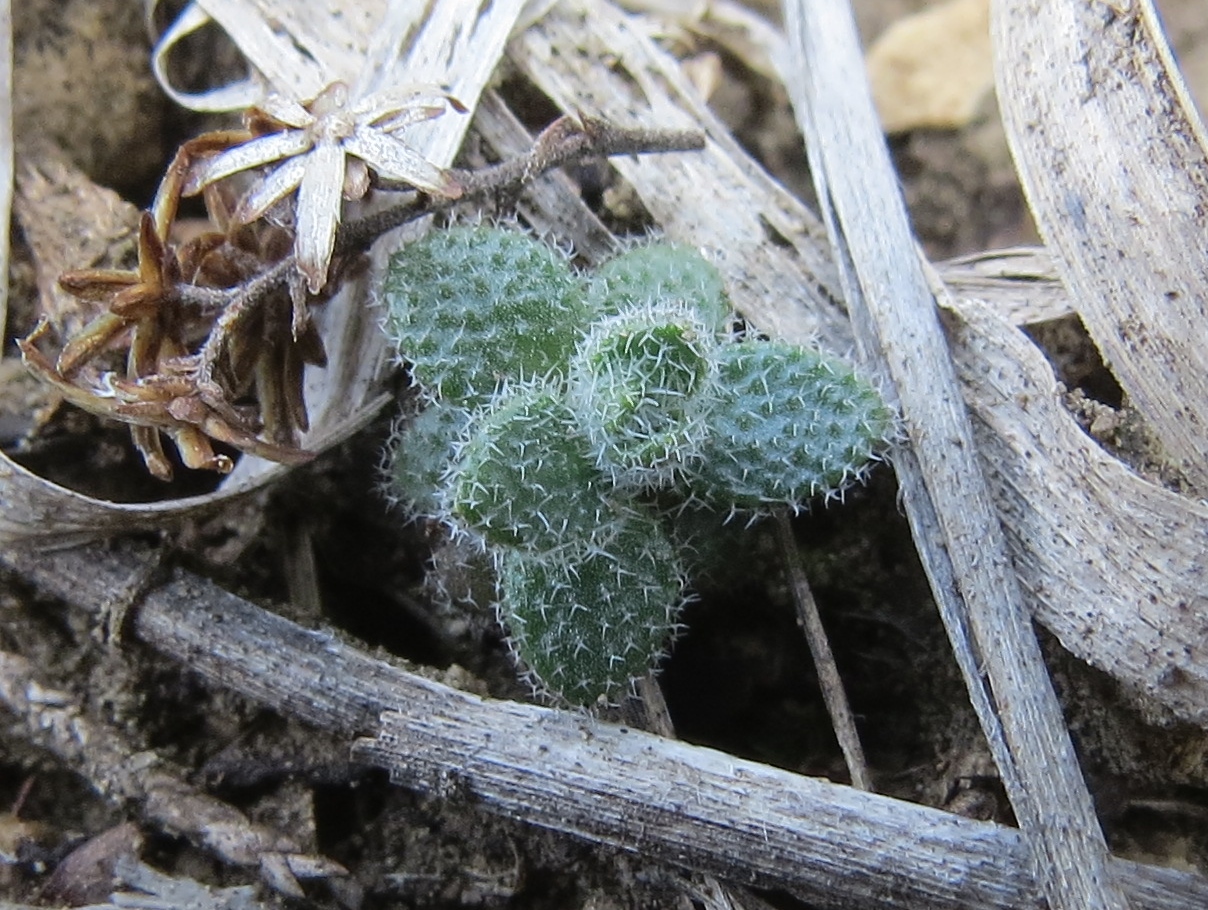
Prior to flowering, it’s best to have some type of magnification when trying to view the plant. At this stage, the plant always reminds me of a tiny cactus, but there’s no fear of being stuck by spines here.

Wedge-leaved Whitlow-grass, Draba cuneifolia, is the third early spring rarity that I regularly see. The leaves of this species have shallow pointed lobes along the margins, but this leaf feature may not be noticeable in very small plants.  The surest way to separate Wedge-leaved Whitlow-grass from the preceding the species is by comparing the flower stalks. The flower stock here is densely hairy.

Wedge-leaved Whitlow-grass has the typical four petaled flower of the mustard family. Each petal has a shallow indentation at the tip.

Several non-native species add their bits of whiteness to the spring blooming season. These are weedy species that are commonly found in most lawns and gardens. Whitlow Grass, Draba verna, although related to our native rarities, is an extremely common non-native weedy plant. One reason that these plants are so successful in human disturbed habitats is the fact that they flower and distribute their seed before most people become active with their gardening and weeding activities. The seed from these plants sits quietly in the soil through the summer and fall months, and is ready to spring forth the following winter.

The four petals of the Whitlow Grass are so deeply split down the center that they are often mistaken as having eight petals. This feature quickly distinguishes these alien plants from our native species.

Becoming ever more common in the urban landscape is the Hairy Bittercress, Cardamine hirsuta.  Blooms of this plant quickly disappear in favor of elongated pods that rapidly fill with ripe seed.  Once the seed is mature, the pods will violently open at the slightest touch and scatter seeds in a wide area around the plant.  The seeds are easily carried away on people’s shoes and gardening tools, to colonize fresh areas.

Field Pennycress, Thlaspi arvense, is a non-native quick to invade into bare or disturbed ground. In most situations it forms thick patches of plants.

The Field Pennycress seedpods seem to develop as quickly as the flowers can form. In just a few days a tall spike of developing seedpods replaces the initial flower cluster. These non-native species are interesting, but my goal is to manage for native populations and that generally means that the non-natives are considered weeds and must go.