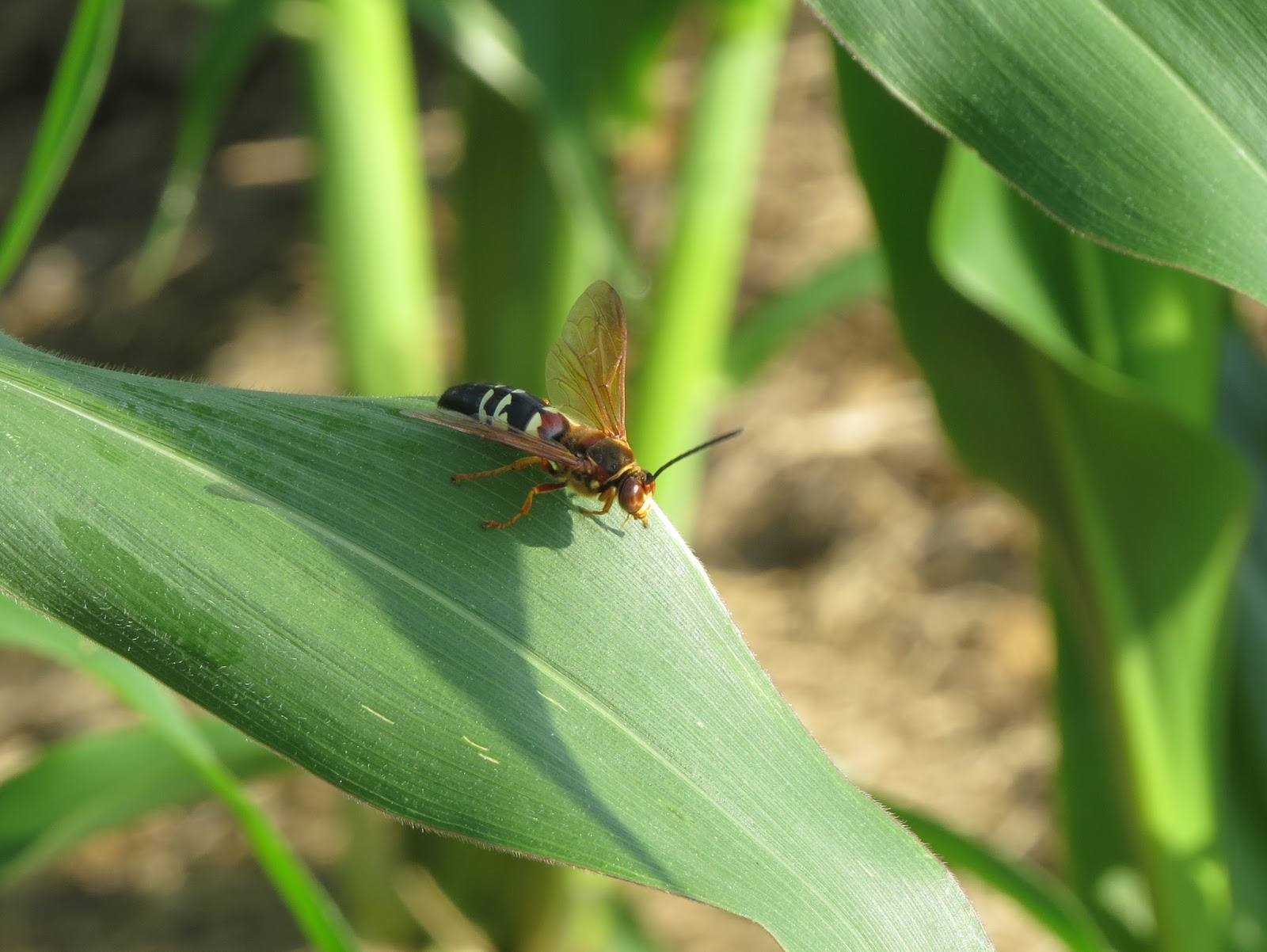
Showing posts with label Wasps. Show all posts

Monday, August 27, 2018

Pipe Organ Mud Dauber Wasp and Parasitic Fly

About two weeks ago, while sitting on the front porch cleaning my boots, I heard the unmistakable buzz of a female Pipe Organ Mud Dauber, Trypoxylon politum, sealing up a brood chamber inside her nest. This species of wasp uses mud to construct a long tube which it divides into individual compartments, each of which will be loaded with a collection of venom paralyzed spiders to be used as a food source for a developing wasp larva. I looked over and saw that the female wasp was in the process of sealing off the bottom chamber of a long tube nest.

I was not the only one interested in this activity. A female Tachinid fly was stalking around the entrance to the nest, waiting for an opportunity to sneak in and leave one or two of its eggs inside the brood chamber. Gaining access was not an easy process. While the female wasp was away gathering more mud, the male wasp moved in to guard the nest entrance.

Eventually, as the female wasp put the finishing touches on the bottom seal of the brood chamber, the male wasp moved away and allowed the fly to slip in.

The video above shows the female wasp bringing in mud to seal the last brood chamber, the male wasp performing its guard duty and attending to the female, and the fly skirting around the entrance to the nest and finally seizing its opportunity to enter. A longer version of this video can be seen on YouTube by clicking HERE.
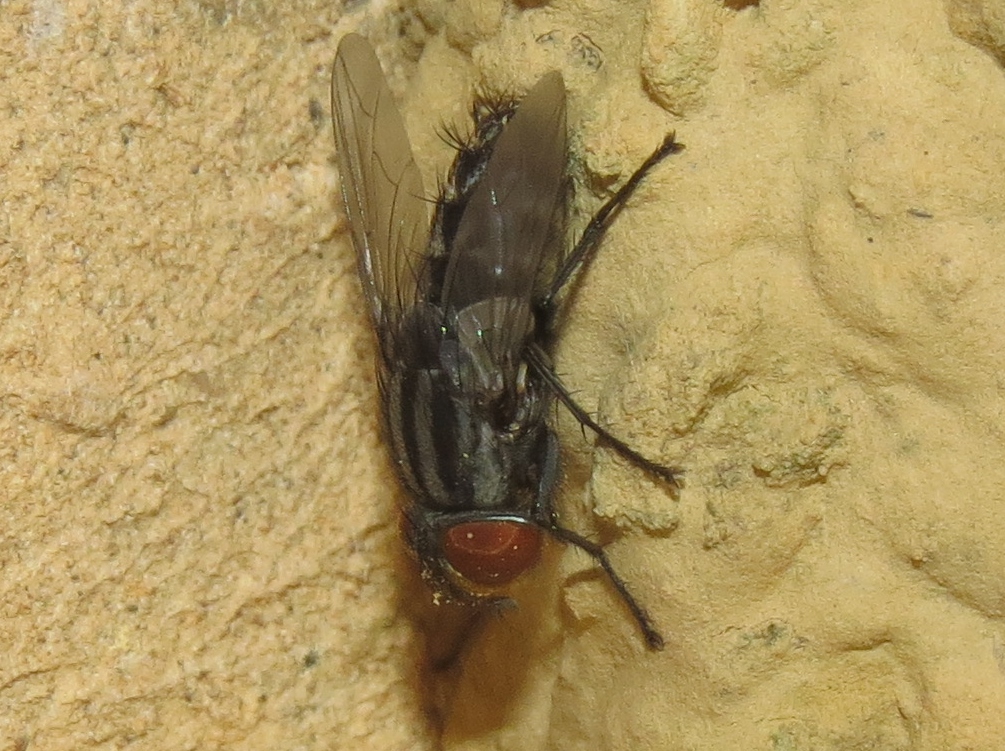
Yesterday I spotted this fly resting on the outside of the tube nest. It was obviously freshly emerged and its appearance was marred only by a few crumbs of dry soil matching the color of the nest.

Not far away from the fly was the hole through which it had escaped the wasp brood chamber.

I scraped a bit of soil away from the site of the exit hole and discovered the empty pupal case left behind by the fly.

Further excavation revealed what was left of several spider carcasses and what looked to be additional fly pupae.

Here’s what was inside the chamber. There was evidence of three Tachinid fly pupae.  The larvae had feasted on the spiders, leaving only empty husks behind.

Two pupae were intact, containing flies that would probably soon be emerging. A single empty case was left by the fly I had observed earlier.

Pipe Organ Mud Daubers frequently construct their nests on my porch. Some of the holes in this nest from last season were probably made by emerging wasps, but I know that several were made by foraging woodpeckers.


Closer examination of the old nest reveals smaller holes that are just the right size for an emerging fly. I imagine this fly and wasp a game is a common occurrence on my front porch.

Wednesday, June 21, 2017

Wasps and Other Mud Puddle Visitors

During early afternoon on the day before the Toad Pool went dry, I spent a couple of hours photographing visitors to the rapidly shrinking puddle. During this session I concentrated more on short videos than on stills.

A single, newly morphed toad is a couple weeks behind the hoard that emerged from the pool a few weeks ago. This little guy has only been a land dweller for a short time, but it already displays the mannerisms of an adult.  Click HERE for YouTube version.

The most noticeable visitors to the pool were wasps loading up on water. The wasps were light enough to ride the surface tension of the water as they drank.

Several species of paper wasps took advantage of this dwindling water supply. A few mud wasps also flew in, but they all left with only water.  Click HERE for YouTube version.

The paper wasp in this video doesn’t seem to be intimidated by the beetle larva attacking it from the rear. It’s probably a good thing the larva couldn’t get hold of the wasp, or it might’ve been pulled right out of the water.  Click HERE for YouTube version.

A small wolf spider stalked the mud flats.  It was particularly interested in the movement of what appeared to be a small insect near the edge of the pool. What wasn’t immediately obvious was the fact that the small insect was held in the jaws of a much larger aquatic beetle larva.

The spider finally attempts an attack on the small insect, but is driven back when the beetle larva begins to thrash its head. Immediately after the head thrashing, the beetle larva scoops a small bit of mud into his breathing snorkel, located just to the right of the thrashing head, and shoots a mud ball at the place the spider had just been.  An interesting defense mechanism.  Click HERE for YouTube version.

Several butterflies took advantage of the wet mud to imbibe some mineral laden water. The most persistent of these was a common Buckeye.

The temperature at the time this video was made was 93°F and there was a strong wind blowing. You can see the puddling butterfly occasionally buffeted by the wind. I was pretty much baked all the way through by the time I called an end to this photography session.  Click HERE for YouTube version.

Wednesday, July 27, 2016

Cicada Killer Wasp

I recently had an entertaining encounter with a Cicada Killer, Sphecius speciosus, our largest native wasp.  The females of this species construct burrows in the soil into which they place a cicada to act as a food source for their developing larvae.  I typically begin to see signs of burrowing activity around the first of August.

This individual provided me with some fine photo opportunities.  Using both corn leaves and the ground as perches, a watchful male spent the morning in the garden on the lookout for female Cicada Killers.  Several chases ensued, with one resulting in a pair of wasps in a love embrace spiraling into the sky.

The video shows the wasp constantly scanning its surroundings.  Body twitches and wing fluttering show its readiness to instantly take off after any passing female.

The Cicada Killer presents a fearsome image, but it is actually not at all aggressive.  Males are incapable of stinging, so this guy is completely harmless.  Females, which are capable of stinging, save that sting for their preferred prey.  A person would have to work hard to make one of these wasps sting, and that sting would be classified as justifiable self defense.

Female Cicada Killers build their burrows in areas of exposed soil.  Around here, they seem to prefer my shallow soiled, south facing front lawn, which typically shows bare ground in August as the lawn grasses enter summer dormancy. 

This is my favorite wasp species.  Many people have asked me how to get rid of these wasps.  I usually respond that the wasps are not a problem, so people should enjoy them.  When people say the wasp burrows are ruining their lawns, I reply that it must have been a poor lawn to begin with, otherwise the wasps would never have been attracted there.  When they accuse the wasps of attacking, I point out that a close fly-by does not constitute an attack.  I’ve never had to respond to any comments beyond that, because by that point, people have given up hope of getting any really practical advice from me.

In this video, the wasp has just had a close encounter with a passing Cicada Killer.  His body movements seem to display a heightened level of excitement.

Monday, September 22, 2014

Outcast Wasps

This is a male Polistes fuscatus, the Northern Paper Wasp.  It is part of the group of wasps that creates the paper nests commonly found beneath the eves of houses, on porch ceilings and above door jambs and window openings.  I encounter more nests of Polistes species than of all other wasp species combined.

I find Northern Paper Wasp nests in many locations.  Each nest is active for only one summer season.  The nest begins in spring with initial construction by the founding queen and dies in the fall when newly produced queens leave to mate and find a place to spend the winter.  For the past several years, wasps have constructed their nests inside the hollow spaces in the blocks used to create my barn walls.  Access to the interior of the blocks is through these two holes that, at some pre Blue Jay Barrens time, held mounts for some type of apparatus secured to the side of the barn.  I’ve never seen the actual nests inside the blocks, but I’ve become accustomed to the cycle of wasp activity around the holes.

The nest is approaching the end of its life.  The queen has stopped laying eggs.  She and her squad of workers are dead or dieing.  The bulk of nest occupants are males and unfertilized queens.  As the number of workers decreases, the flow of food to the nest is interrupted.  When the food supply diminishes, the female wasps respond by driving the males away from the nest.  The first light of day reveals male wasps being given the boot.  They struggle to remain inside, but the relentless females use as much force as necessary to push the males out.

Male wasps, identified by their curled antennae and light colored faces, loiter in the area around the hole.  The faces of the next group to be turned out can be seen at the entrance to the hole.

The wasps don’t go far from the nest.  They will spend most of the day lounging on the wall.  Occasional forays are made to a nearby water source.
The males spend considerable time socializing.  Some of the activity appears to be an attempt to solicit food from each other.  While in the nest they would have been fed by worker females who spent much of their life foraging.

The function of a male wasp is to mate with a female.  At this time of year they will attempt to mate with any wasp, male or female, that comes by.  A wasp flying to the wall arouses an instant mob of males.  Males are attracted to concentrations of females.  As long as the young females are still present in the nest, the males will stay close.  The females will soon leave to find suitable hibernation sites.  The males will follow and at that time will interact and mate with females from other nests.  Males will not survive the coming cold weather.

As temperatures drop with the setting of the sun, the males are allowed back into the nest.  The time is rapidly approaching when the wasps will be absent and the buzzing inside the wall will cease.  I expect next summer to again see the familiar flight of wasps flying to and from these holes.  

Saturday, September 8, 2012

Wasps

The Wingstem flowers are just about spent, so insects in search of pollen have been concentrated onto the few plants that are still blooming.  One of my favorite wasp species, the Double Banded Scoliid, Scolia bicincta, was out in force to gather pollen and nectar.  The name comes from the two bands of white clearly visible on the abdomen.

I’m a fan of animals with black and white patterns.  This one is particularly attractive.

A covering of hairs makes this wasp a pollen magnet.  This species leads a solitary life style with no permanent nest, so the pollen is not collected and stored.  Females lay their eggs on grub type beetle larvae in which the wasp larvae will feed until emerging to pupate.

I rarely see this species anywhere but on flowers.  Since it doesn’t store any of the flower material, everything it eats goes to maintaining a healthy body for mating and laying eggs.

I was sitting on the porch a few hours after taking photos of the wasps on flowers and a black and white wasp buzzed in and nearly hit me in the face.  As she went past I could see that she was holding something in her jaws.  She disappeared with her burden into an abandoned Carpenter Bee nest.  This wasp was a Four-toothed Mason Wasp, Monobia quadridens, a species that creates brood chambers inside available tunnels like those made by Carpenter Bees.  Each chamber is packed with caterpillars and one wasp egg.  Young from this nest probably won’t hatch until next spring.

It’s interesting that Carpenter Bees are not tunneling out new nests on the porch this year, but their old tunnels are being fully utilized by other species.  Grass plugging the entrance to this old tunnel indicates it has been used by a Grass Carrier Wasp.  Similar in habit to other tunnel nesting wasps, the Grass Carrier created a series of tree cricket filled chambers in which its young will develop. 

Tuesday, September 4, 2012

Pipe Organ Wasp Nest

Most people have seen mud nests of the Pipe Organ Wasp, AKA Mud Dauber.  Around the home, the nests are most commonly constructed on a vertical wall or beam.  A location favored by female wasps at my house is on the front porch.  The porch provides plenty of wall surface for nest construction and a roof to keep the nests dry.

Nests are constructed by the female wasp, a shiny steel-blue creature with a long thin waist.  She makes hundreds of trips to haul in balls of mud to form into the tube shaped nests.  Once a tube is completed, the female carries in paralyzed spiders and stuffs them into the tube.  Periodically she’ll lay one egg among the spiders and seal that section of the tube shut with additional mud.  Inside each of these sealed chambers, a single wasp larva will feed on spiders until it is time to pupate.  They will overwinter in this fashion and emerge as adults next spring.

The tube is constructed as a long arched structure, similar to the design of a Quonset hut.  The house forms the flat floor and the nest walls are built by adding mud fingers running from the central line of the tube to the house.  Placement of the fingers progresses in an alternating fashion from side to side.  Color differences in the fingers show that the wasp may visit several different mud sources during the period of nest construction.

While doing some work to the barn roof, I dislodged several mud nests from the barn rafters.  I checked out the debris later to see if anything of interest could be found in the debris.  Most of the fallen nests were old.  The few fresh nests all contained the lozenge shaped cocoons in which the larvae will eventually pupate.  I set undamaged cocoons in a safe place where they have a chance of surviving the winter and hatching new wasps next spring.

This cocoon was damaged in the fall.  Inside was a wasp larva.  The larvae eat just about every bit of the spiders in their cells.  Debris left in the cell is just a bit of dust.

Some cocoons were very light weight, so I cracked them open to see what was inside.  Most were filled with debris with no signs of the larva.

Several were full of the shed skins of Carpet Beetle larvae.  Judging by the number of skins in each cocoon, the beetles must have flourished here.

There are always a few old mud nests on the porch, usually in the corners.  I’ll remove them when they reach the stage where they begin to crumble on their own, but it usually takes them a couple of years to reach that stage.  I think they’re kind of neat to look at.  They remind me of the Mesa Verde Cliff Dwellings.  They’re just smaller and easier to access. 

Wednesday, August 1, 2012

Ichneumon Wasp

During most of the year, no matter where you are, there are insects quietly going about their business.  Unless they bite or are large enough to intrude upon our senses, they go unnoticed.  I try to take the time to observe some of these tiny wonders and have strained my eyes attempting to see some small, but fascinating creatures.  Occasionally, the fantastic arrives in a larger package. 

This is a female Ichneumon Wasp.  I believe this is Megarhyssa greenei, but I don’t have any reference that identifies all of the know species of this genus, so I don’t know if there are any look-alike species that could complicate the identification.  Regardless of the species, this genus has a remarkable life history.  The larva of this wasp begins life feeding on the inside of a Wood Wasp larva boring its way through the deep wood of a tree.  The female Ichneumon Wasp plants the egg by way of a long egg laying apparatus, AKA ovipositor.  That tail-like projection is the sheath that protects the ovipositor.  The sheath peels back as the ovipositor penetrates the wood.  The egg is actually larger in diameter than the ovipositor and squeezes through in an elongated shape that reforms into a more typical egg shape once it reaches the target.

I met my first female Ichneumon Wasp when it landed on the bread basket in the center of the table at our annual family picnic.  I was ten years old at the time.  I was never around anyone who had any interest or knowledge of natural history, so my knowledge came from a few books I was able to acquire along with speculation and a highly developed imagination.  The other dozen or so people at my table began to take notice when I pushed my food aside and did a sort of belly slide in the direction of the bread basket.  Someone was revving up to unleash a little discipline when I shouted something like “Man, look at the size of that stinger.”  Discipline was forgotten as everyone scrambled to get untangled from the attached bench seats and put distance between themselves and the wasp.  I later learned that the ovipositor did not function as a stinger and was no cause for alarm.

The hosts for the Ichneumon Wasp larvae are most often found in ailing or recently dead trees.  I’m not sure how the female senses the larvae of the Wood Wasp.  I watched for about ten minutes, thinking that the wasp might begin hunting on one of these recently fallen trees, but she eventually just took off and kept on going.

Bright colors often serve as a warning that an insect is dangerous and ought to be left alone.  Bright orange and yellow certainly stands out on green foliage or brown tree bark.  She may be defenseless, but anything that avoids wasps would certainly stay away from this lady.

Sunday, August 23, 2009

Wasps in the Barn

I found this nice paper wasp nest built by some Polistes species in the barn. Here it is, attached to the roof sheathing just beside a rafter. The scene here is typical of what you might find in any wasp nest.

This is what struck me as interesting. Scattered along the rafter, sometimes several feet from the nest, are these groups of wasps that are associated with the nest, but seem to have no work duties to perform. When I think of social insects such as ants, bees and wasps, I picture each individual hard at work doing some task that ultimately benefits the colony. I never imagined sitting around napping as one of those beneficial functions.

I thought at first that these wasps might be males waiting until they were needed to mate with the females that would overwinter to produce next year’s wasp colonies. A closer look showed the group to contain both male and female wasps. The male, with curled antennae and a yellow face, is shown on the left. On the right is the slightly larger, darker colored female.

Raised wings and head turned in your direction is a warning that you have invaded the wasp’s personal space and may receive more direct action if you don’t back off. This is a warning you should heed. Especially when you’re on the top a ladder with your head and shoulders stuck up through the ceiling joists.

A look down into some of the nest cells shows eggs and newly hatched larvae. The difference between an egg and a hatchling is the little black spot of a mouth on the upper end of the young larva. As more eggs hatch, those idle females will be needed to forage and care for the growing larvae. The males aren’t much for helping around the nest and will most likely maintain their lives of leisure.