Showing posts with label Tadpoles. Show all posts

Wednesday, September 9, 2015

Treefrog Tadpole Rescue

This has been a year of flood and drought at Blue Jay Barrens.  There have been several heavy rain events that dropped inches of water in a short amount of time.  Each rain was then followed by several weeks of dry weather.  Temporary pools have been appearing and disappearing all summer.  A two inch rain in mid-August produced an eight inch deep pool in the dry pond bottom.  Gray Treefrogs took advantage of this event to fill the pool with eggs.  

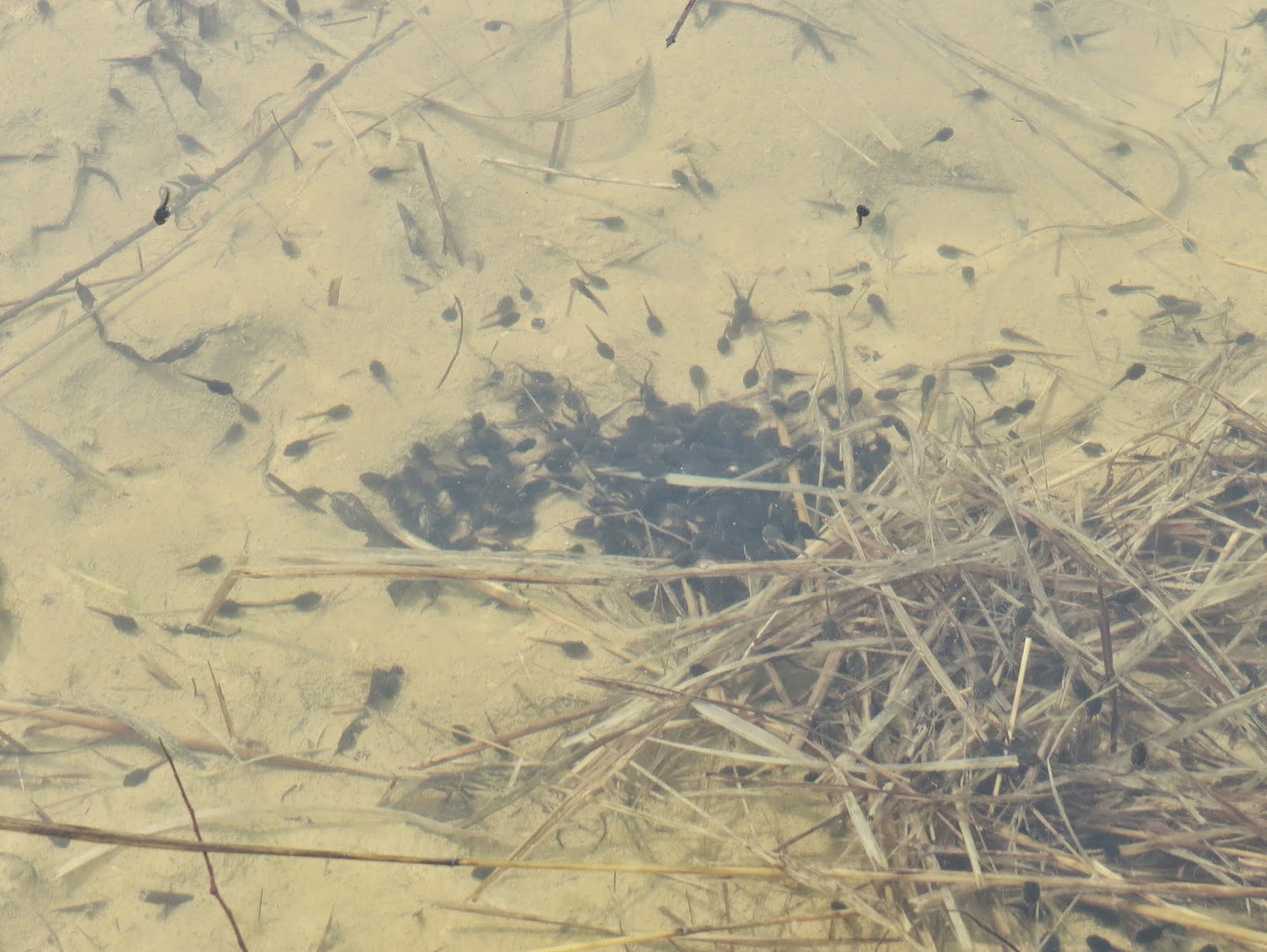
This week, a small puddle was all that remained of that pool.  During the last few days, hundreds of young treefrogs managed to reach the four legged stage and migrate from the pool to the surrounding vegetation.  This photo shows the puddle with just one day of life left.  The following day, the area went dry.

Because the original breeding event spanned more than a week, the young from the later eggs were not developed enough to leave the water.  Without intervention, they would all perish.

By the time I arrived with net and bucket, the mass of tadpole bodies seemed greater than the water they were in.  I like to make the classic rescue just as the clock ticks down to its final second.  When the shrinking pool crowds the tadpoles together nose-to-tail, it’s easy to herd them all into a waiting net.

The first of many nets full make it into the bucket.  A few aquatic insects and snails managed to sneak in with the tadpoles.

An expanding sediment cloud marks the release of a bucket full of tadpoles into the water garden.  Further releases were made into any tub I had that contained enough water to sustain tadpole life.

Many of the tadpoles were at the four leg stage and needed only a few more days of aquatic life.

Two days following the rescue, I found many young frogs making the transition to a terrestrial life style.  Most still displayed a remnant of their tail.

It has been many years since the Gray Treefrogs have had such a successful breeding season.  During the past six weeks, I have encountered one or two young frogs every day.  I’m glad I was able to assist in adding several hundred more frogs to this year’s output.

Friday, June 5, 2015

Salamander Larva Rescue

Rainfall patterns have been decidedly odd so far this year.  January and February both had below average precipitation.  March had 6.6 inches of rain, but six inches of that fell in the first two weeks of the month.  By the end of March, it was beginning to look like we were definitely experiencing a drought.  April totaled 7.4 inches of rain, but over six inches of that fell in the first two weeks.  Over the next few weeks, things slipped back into drought conditions.  May totaled only 1.5 inches of rain.  Combine that with a week of temperatures topping out in the 90’s and the drought soon became serious.  The seasonal spring that feeds the toad pool stopped flowing in mid-May.  By Memorial Day it was obvious that the pool would only survive for a few more days.

I went out with net and tub to begin removing tadpoles from the pool for relocation to the pond.  The pool began the season with a healthy population of Jefferson Salamander and Wood Frog tadpoles.   The surviving salamanders were now hiding in deep hoof prints left by the deer.  I soon became adept at using a stick to scare tadpoles from the hoof prints and into a waiting net.  After a while the water would become muddy enough to hide the tadpoles, so I would have to wait for things to settle down before continuing.  I scooped tadpoles twice a day for three days.  By day four there was no water left, but I think I had removed most of the tadpoles by then.

The pool water would have lasted longer if the deer didn’t have such a fascination for that big puddle.  Sometimes in the evenings as many as a dozen deer will gather at the pool.  Acting just like a bunch of children, the deer run back-and-forth through the pool.  Sometimes they just stand on the edge and make a series of jumps in and out of the water.  Some tadpoles probably get trampled and others may suffer from the muddy water left by the deer.  The most damaging thing the deer accomplish is to push soil from the banks into the center of the pool.  In this photo, the pool has only half of its constructed depth because of the deer activity.  It would have helped considerably to have that extra depth filled with water instead of soil.

This was the first batch of refugees to move into the pond.  Some of these are already losing their gills and preparing for a life out of the water.  The final rescue count was about 60 salamanders and an equal number of Wood Frogs.

The pond should last plenty long enough for the salamanders to complete their development.

While I had them, I put a few tadpoles into an aquarium for observation.  All looked healthy.

The Wood Frog tadpoles also looked to be in good shape.

To compensate for their ordeal of spending a day in the aquarium, I filled the salamander’s with earthworms and fed the Wood Frogs some algae wafers.  I thought full bellies might keep the salamanders from dining on their tankmates.

I was wrong.  Despite a healthy meal of worms, this guy still had room for a Wood Frog tadpole.  It only took him a couple more gulps to suck that tail inside its mouth.  For several weeks I had been noticing a decline in the frog tadpole population.  I guess this explains both the salamander’s rapid growth rates and the steady loss of frog tadpoles.

Friday, May 1, 2015

Tadpole Feeding Frenzy

The Wood Frog tadpoles have been growing rapidly and have just about eliminated algae and soft plant material from the pond.  In a typical year, the waste produced by the tadpoles acts as a fertilizer to stimulate the growth of algae which the tadpoles then eat.  As the tadpoles grow, they produce a greater quantity of waste which makes even more algae grow.  The excess rainfall we have had during the past few weeks has diluted the concentration of nutrients in the pond and slowed the algae growth.

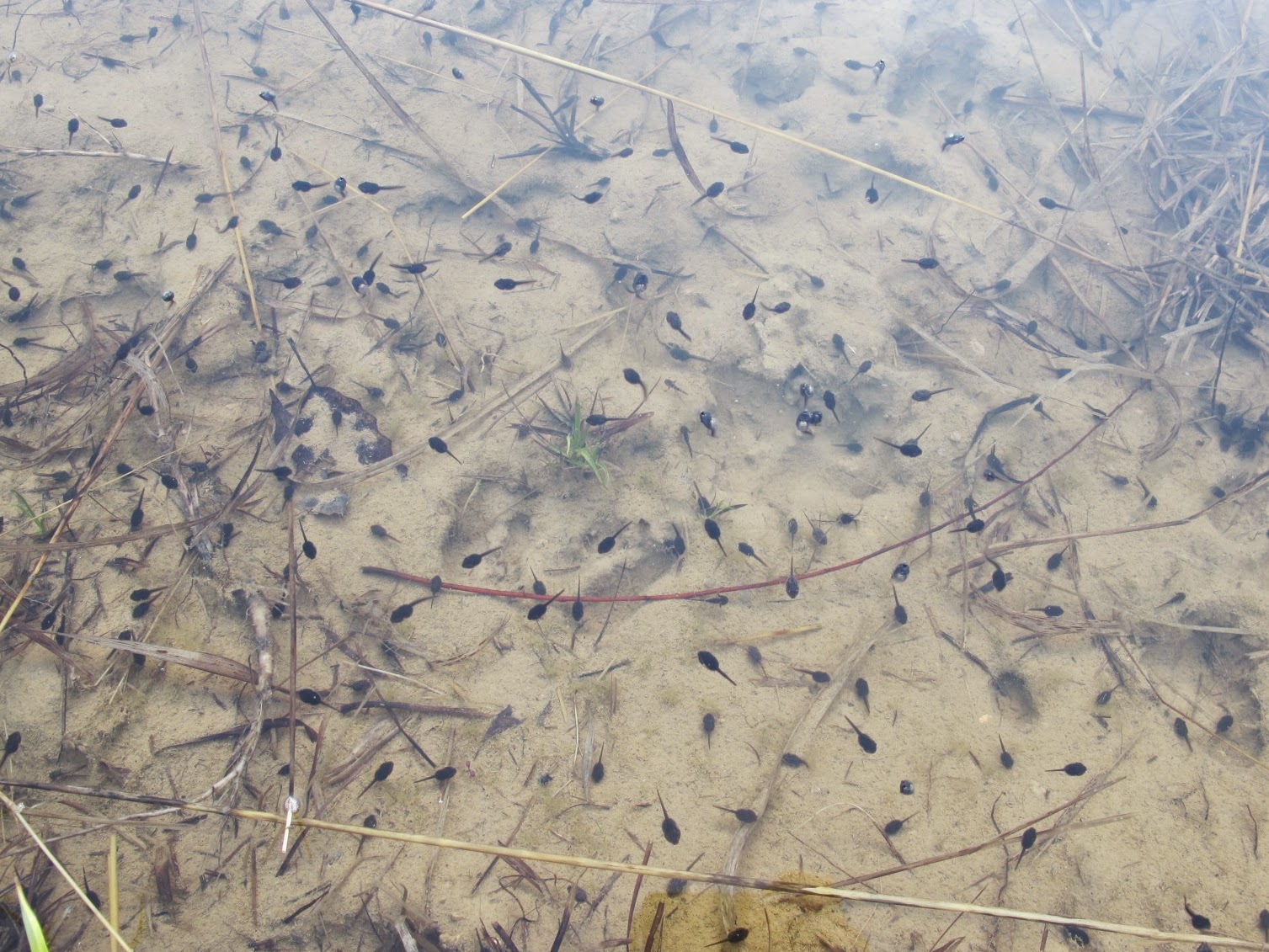
This is a typical Wood Frog tadpole dispersal pattern.  Each tadpole is engaged in a random search for food.  They nibble their way across the pond bottom, check every surface of submerged plant material, and even turn belly up to skim the film of pollen grains from the water’s surface. 

Occasionally, an especially appealing food source will cause a pile-up of tadpoles.

These tadpoles are all competing for some tasty morsel hidden from view by the mass of tadpole bodies.

This short video reveals the source of their excitement.  A chance to nibble on a drowned worm is the prize in this competition.  At this point the worm seems to have been broken into several sections.  One section of worm becomes visible when it is drug to the top of the heap and pulled out of the picture at the top of the frame.  As the tadpole runs off with the leading edge of the worm, three other tadpoles get pulled along for the ride.  The lead tadpole is only out of the picture for a second before it comes right back in and dives into the same confusion it had just escaped.  Its three followers are still trying hard to get some of the worm for themselves.  I’ve witnessed this same type of behavior directed towards a variety of partially decomposed small animals.  Tadpoles thrive on algae, but they love a bit of meat in their diet.  The video can also be seen on YouTube by clicking HERE.

Saturday, April 28, 2012

Tadpoles

Tadpoles distorted by curved glass.  This is a vision right out of my pre-school days.  I believed that a jar was wasted if it didn’t contain water and some type of aquatic creature.  Tadpoles were always one of my favorites.

A storm dropped nearly two inches of rain and brought the pond back to life.  In just a few hours the pond went from a shallow puddle to this healthy pool. 

Tadpoles that had been crowded together in the last bit of water were suddenly released to travel the open water.  Algae in the puddle made it impossible to estimate the number of tadpoles present, but judging by the masses of tadpoles in the open water, they must have been very tightly packed into the last remnants of the pond water.

These are Wood Frog tadpoles.  They’ve had their problems this season, but it now looks as though they’ll make it to metamorphosis.  First the eggs were almost left hanging in the dogwood branches because of high flood water followed by rapidly falling water levels and now they just came within days of having their water disappear completely.

Wood Frogs breed within a short time span, so the entire population of tadpoles grows together with little variation in size of developmental stage.

Rows of rasping teeth around the mouth are used to scrape algae and other material from submerged surfaces. 

An iridescent membrane hides the tadpole’s internal organs, but the spiral of intestines is still clearly visible.  As a child, my favorites were species that had a transparent abdomen that allowed clear observation of the working intestines. 

A tadpole’s function is to eat.  Material is constantly moving through the intestines and out.  These tadpoles were confined for less than two minutes, but they were filling the water with poop.  Their nutrient rich droppings sustain new populations of bacteria and algae which the tadpoles then consume.  It’s a cycle that helps maintain a diverse population of species in the temporary water body.  I’m now looking forward to watching the little froglets leave the water.
A Camera Critters submission.

Camera Critters

Tuesday, April 17, 2012

Water Shortage

Six weeks ago, Blue Jay Barrens was experiencing a record flood event.  The rain creating that flood was the last significant rainfall for this area and the pond has shrunk to almost nothing. 

Ground water levels are still plenty high, so some water is entering the pond from the intermittent spring.  This is not nearly enough to replace what is lost through leakage and evaporation.

Leafless dogwood branches clearly show the level of high water.  During the flood, Wood Frogs laid clusters of eggs in the now exposed branches. 

The pond is low enough that the rush stubble left to receive salamander eggs is now sticking above the water.  Fortunately, the eggs have long since hatched and are not in danger of being left airborne.  If the water level falls a couple more inches it will be shallow enough for the Raccoons to wade through the middle hunting for food.  That usually means the end of most tadpoles and other small pond creatures.

This year’s crop of rushes is already up and going.  These plants actually do their best when the water is shallow.

The Whitetail Deer are obviously spending a lot of time around the pond.  The winter herds are breaking apart and I’m seeing the deer individually or in small groups.  It won’t be long before the tracks of fawns begin showing up with the others.

As the water level drops, crawfish deepen their burrows to keep in contact with the water.  The excavated material forms small mounds on the exposed pond bottom.  The pond leaks because the soil does not contain enough clay to stop the water from seeping through.  The water wouldn’t drop so rapidly if there weren’t so many crawfish burrows giving unobstructed channels through which the water can quickly escape.

Amphibian larvae must hurry through their metamorphosis and become land dwelling creatures before their watery home disappears.  External gills make it easy to separate salamander tadpoles from those of frogs.  In order to survive, this guy must develop legs and lose the gills before the pond goes dry.

Wood Frog tadpoles have done well so far.  If we get some rain to boost the water level, these tadpoles should have time to make the change to little frogs.  Unfortunately, the long range forecast doesn’t look favorable for precipitation.  April is just not living up to its reputation of being a month of showers.

Wednesday, October 5, 2011

Blue Heron Green

I call this color Blue Heron Green because its development in the water garden is always preceded by the visit of a Great Blue Heron. This is only the third time in the history of the water garden that this phenomenon has manifested itself. It’s nothing to get concerned about, but it is rather startling to have the tiny pond flare up into a fluorescent pool.


The green color is the result of a bloom of planktonic algae. The development of this condition usually signifies a change in the ecological balance in the aquatic system. In this case, the change was the addition of one Great Blue Heron to the water garden ecosystem.


The water in the small overflow pool still exhibits the water quality that was found in the water garden three days ago. Algae eating tadpoles keep the water in the overflow clear. The same was happening in the big pool until the heron came by and effectively eliminated all tadpoles from the pool. I happened to come around the house and scare him off, but by that time he had already finished his meal.


Tadpoles are very adept at filtering floating material out of the water. The waste generated by the tadpoles acts as fertilizer that spurs the growth of more algae which is then eaten by the tadpoles. It’s like a self perpetuating system.


With the tadpoles gone, the algae is free to expand to the limits of its food supply. It won’t take long for another aquatic algae consumer to take advantage of this bounty. Last time this happened it was the daphnia that cleaned up the algae. By the time the weather turned cold, daphnia clouds filled the pool. They remained through the winter, but rapidly disappeared in the spring as predator populations expanded to consume the tiny crustaceans. I’m sure something has already begun to eat the algae and will soon emerge as the new master of the water garden.

Thursday, July 28, 2011

Pond Goes Dry

This is what the pond looked like on Tuesday morning. During the spring it seemed to rain every other day and the pond never lacked for water. In mid June the rain stopped and we’ve managed to miss most of the storms that have come through this area. The pond usually goes dry around the first of July, so this is not an unusual situation. In fact, it went dry on July 10 of this year and then a rain on July 11 created a one foot deep pool.


As the pond began to refill, Gray Treefrogs filled the shallow pool with eggs. Thousands of tadpoles resulted from that mating spree. They put on a lot of growth in just two weeks.


In situations like this, the raccoons fill their bellies with tadpoles. I get the impression that the raccoon’s dinner is spiced with mud.


A string of hundred degree days can make the pond dry up in a hurry. This is what it looked like on Wednesday evening. It’s always sad to see the water disappear, but that’s what’s necessary in order to keep the pond such a great place for springtime breeding frogs and salamanders. When the pond water goes, so do all of those aquatic predators that do such a good job of consuming tadpoles.


Tracks of raccoons, opossums and skunks show that many species were benefiting by the plight of the stranded tadpoles. I sometimes rescue some of the tadpoles before everything is completely dry, but that wasn’t possible this year because everything I have that holds water is already full of treefrog tadpoles. Treefrogs manage to get eggs into any available body of water and they know where all of my water supplies are located. If we get rain that puts water back into the pond, I can guarantee that the treefrogs will once again fill it with eggs.


Many species of butterflies like to feed on the decomposing tadpoles. Their numbers will increase each day until the mud dries completely.


Even the exposed mud benefits some species. Several wasps were busy carrying off balls of mud to use in the construction of their nests. Many insect species will utilize the exposed soil of the pond bottom during the dry time. I suppose there are some of those that depend on the dry pond conditions just as much as others depend on the periods of inundation.