Showing posts with label Goldenrod. Show all posts

Monday, December 19, 2011

Goldenrod Forest

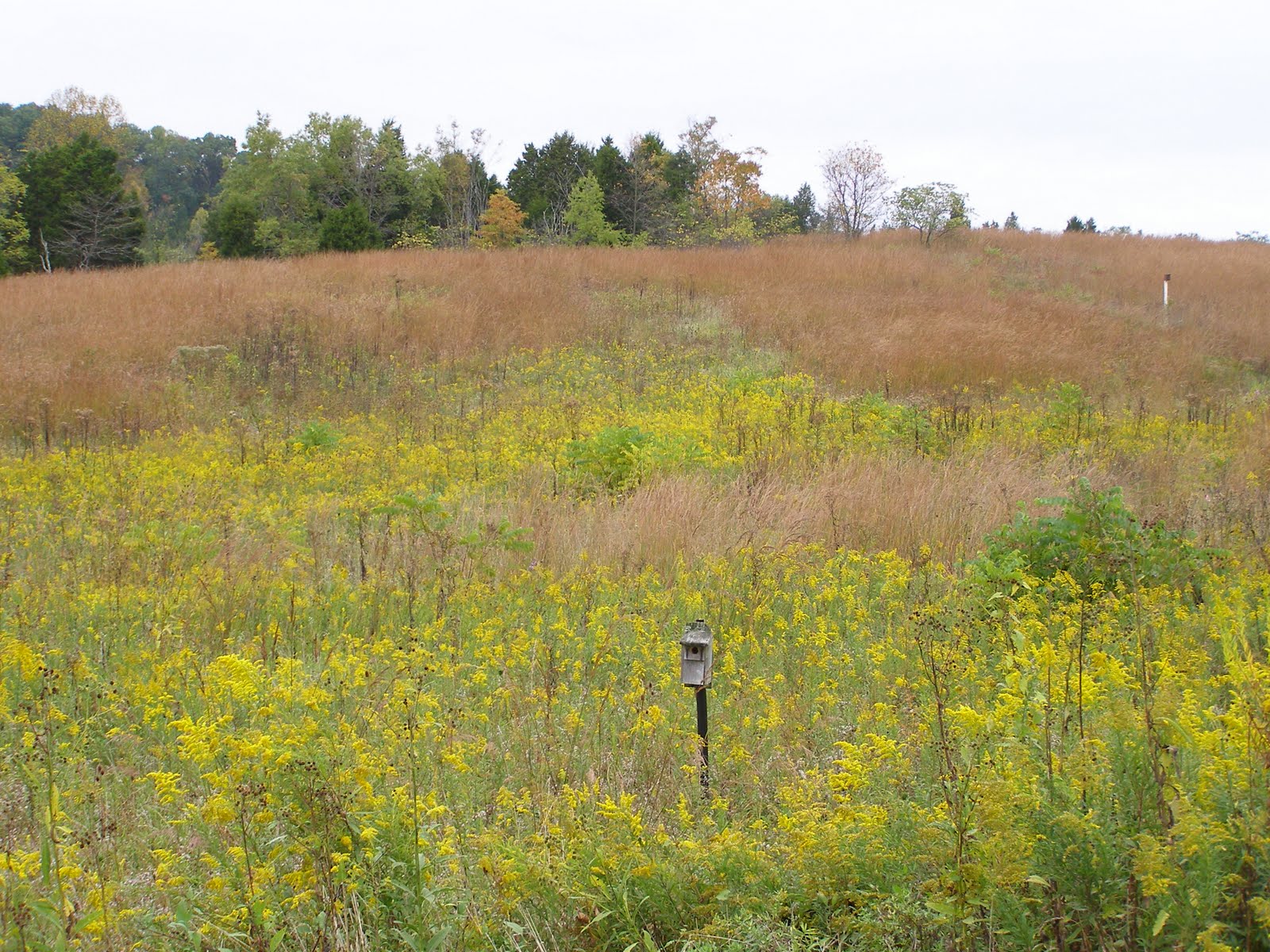
Too many people treat Goldenrod as a weed.  I’ll admit that it will quickly take over an abandoned field and can create acres of a seeming monoculture.  You really can’t fault it for that since it’s a native plant just taking advantage of conditions we’ve created.  I’ve always thought of Goldenrod patches as four foot tall forests.  Life in the Goldenrod Forest exists in distinct layers.  At the top are organisms living among the flowers, below this are those that interact with the leafy part of the plant, next come stem borers and gall makers followed by life on the forest floor.

It’s during the winter that ground level life flourishes in the sunlight.  Goldenrods produce a chemical agent that inhibits the growth of other plants.  The plants that do grow alongside the Goldenrods are those that are resistant or tolerant of the chemical inhibitor.  It’s not surprising that most of these resistant species are not likely to cause undue competition for the Goldenrods.

Ferns grow in abundance on the floor of the Goldenrod Forest.  Spleenworts in particular produce some luxuriant growth.  I see this same species growing in the deciduous woodland and the cedar thickets, but those populations don’t come close to producing the density of plants found among the Goldenrods.

Thick carpets of moss cover the ground in some areas.  The moss beds are identical to those found in the standard woodlands.
Other low growing species have also found a home among the Goldenrod stalks.  Blue-green Sedge is common in the field, but the most vigorous plants seem to be those surrounded by Goldenrods.  The sedge is probably benefiting by the absence of competitive plants that grow in areas not affected by the Goldenrod’s chemical growth control.

Despite its aggressive nature, Goldenrods are only a transitory population in the field ecosystem.  They are eventually replaced by other species capable of resisting the chemical growth inhibitors.  At Blue Jay Barrens, Indian Grass has been rapidly encroaching on the Goldenrod Forests.  Where once the Goldenrods covered many acres, only scattered patches remain.  A couple of these patches seem difficult for the Indian Grass to infiltrate, so the Goldenrod Forests should remain for many years to come.

Sunday, October 2, 2011

Farewell to Summer

With frost warnings being posted for the first night of October, I thought I should get out and say goodbye to some of those things that still link me back to warm summer months. The bright yellow Goldenrod flowers won’t stand up to a heavy frost. Even a light frost could take the vibrancy from the blossoms and leave them with a dusty brown cast.


I went to my favorite spot at the top of The Hill to get a general overview of the landscape. With temperatures in the mid 40’s, weather conditions bore no resemblance to summer. A light mist of rain fell all day. Not enough rain to register in the rain gauge, but enough to continually coat the camera lens with vision distorting beads. The strong north wind made it impossible to protect the camera, so it was a choice of constantly cleaning the lens or taking slightly distorted photos. I did a little of both. Heavy clouds made light conditions about equal to five minutes after sundown, so most of my shots weren’t going to look crystal clear anyway.


The hilltop prairie is full of Gray Goldenrod. The grasses are looking a little bit brown, but the yellow of the Goldenrod makes it a very cheery scene. If the clouds stick around over night, we’ll avoid a frost and the Goldenrod will continue blooming for another week of so. The meteorologists seem to have us in a perpetual Annie forecast, meaning that it’s always raining today but “The Sun’ll Come Out Tomorrow”.


Some of the trees are beginning to put on their colors. Weather definitely influences the progression of the seasonal change, but many species take their cues from day length and can be counted on to begin their transition to winter at the same time each year. Lack of any severe drought conditions through the summer should mean an especially colorful fall.


The Eastern Red Cedars are looking very green and full. I’m expecting them to carry that bright green color right into January.


The Indian Grass flowered a little bit later than normal this year, but each seed head is now full of ripening seed. I hope that translates into flocks of sparrows feeding on the seeds through the winter. There have been years in the past when sparrows have spent the entire winter feeding on Indian Grass seed. Even through heavy snow and ice storms there always seemed to be some seed accessible to the birds. I’ll miss the warm days of summer, but I’ll make up for it by enjoying the days of fall and winter.

Monday, August 15, 2011

Goldenrod Insects

It’s the time of year when fields begin to turn yellow with Goldenrod blossoms. I love to check out the Goldenrods to see what types of creatures have been attracted to this magnificent plant. Goldenrods have been described as being an ecosystem unto themselves because of the diversity of animal life that meets and interacts on these plants.


It’s primarily the old crop fields that support the large stands of Goldenrod at Blue Jay Barrens. Each year the stands are slightly smaller as the native prairie plants crowd in to claim the field as their own. Goldenrod produces a chemical deterrent that makes it difficult for many plants to infiltrate the Goldenrod stands. Many of the native prairie plants are not deterred and actually seem to thrive growing among the Goldenrods. Indian Grass is probably the most aggressive and can eradicate large Goldenrod stands in a matter of five to ten years. There may come a time when I’ll have to take action to save a few remaining Goldenrod blocks.


Goldenrod produces both pollen and nectar that attracts a wide variety of insects. Ctenucha virginica is a common Goldenrod visitor. Its larval food plants are grasses and sedges, but Goldenrod nectar seems to be a favorite of the adults.


Many of these small white moths took flight as I waded through the Goldenrods. At rest they resembled bird droppings.


Of course, there are several species of small bees present. All were filling up on nectar while their bodies collected heavy amounts of pollen.


Flies were by far the most numerous group of insects visiting the flowers. All seemed to be after nectar.


The presence of so many species of flies may be due to an apparent absence of predators hiding in the Goldenrod flowers. I closely examined many flower heads in an attempt to find some spiders or predaceous bugs commonly associated with Goldenrods. I found none. A similar search in September should yield an abundance of predatory species.


There were many of these little Bee Flies visiting the flowers.


This is a small Cylindromyia species of Tachinid fly using a bit of mimicry to look like a wasp. The larvae are parasitic on some type of insect, but the adults are frequent visitors of nectar bearing flowers. I scared it from a flower and thought I wouldn’t be able to use it for a Goldenrod based post until it landed on some Goldenrod leaves.