Showing posts with label Cottontail. Show all posts

Monday, June 11, 2012

Going to the Barn for a Pair of Pliers

I am sometimes easily distracted.  While working on a project in the garage, I had to stop to get a pair of pliers from the barn.  I got just one step out of the garage before I had to stop.

You can’t walk by a beautiful Black Rat Snake without pausing for a moment of admiration.  This is one of several snakes that periodically migrate between the house and barn, keeping both mouse free.

A yard stick was just inside the garage door, so placed it beside the snake.  Laid out straight, the snake would probably measure in at about four feet.

Beside the door was a lovely Crane Fly.  These big flies are quite common at Blue Jay Barrens and are one of my favorites.

Their large size makes it easy to see some of the characteristics unique to flies.  Unlike most other flying insects, flies have only one pair of wings instead of two.  Their hind wings have modified into knobbed stick-like structures called halteres which are used to balance the fly in flight.  You can see halteres on all flies, but on none as easily as the Crane Fly.

This colorful larva was hidden on the mortar between bricks on the house.  The yellow-green color almost glowed like that of a firefly.

A few steps later, a light colored moth shot from the grass and lit beneath a leaf beside the house.  I’ve been hoping to see an adult of the rare Unexpected Tiger Moth, so I tend to chase every whitish moth that goes by.  No luck here.  This is a common moth known as The Beggar.

Above the moth, an orb weaving spider has spun its web.  I believe this is called the Orchard Orbweaver.  It had the look of a small jewel.

The feeding station is in a direct line from house to barn, so the animals must move aside as I pass.  Most are so used to my comings and goings that they don’t move very far or fast at my approach.

A female Raccoon is nursing a litter, so she’s been visiting the feeder during the day to get enough food to sustain her through this difficult time.  I suppose it won’t be long before the little guys are out and about.

I cleared the house just in time to catch the Red-shouldered hawk dropping from the electric line.

It managed to land with a branch between us, so I’m not sure what it caught.  The prey must have been something small, because it went down in one gulp.

A bit closer to the barn I was attracted to a rustling in the tall grass around some old tractor parts.  A mother skunk had her young out of their den.  The little ones never stopped moving and never left contact with their mother.  I didn’t get an accurate count, but there are three baby faces and the mother’s tail in this shot.  At my approach they all retreated into an old Groundhog hole beneath the tractor motor.

I opened the barn door to find a young Cottontail.  This must have been the perfect spring for successful nestings.  I think I’ve seen babies of just about every mammal we have here.

Up in the barn loft was a young Blue Jay that couldn’t seem to find its way out.  I opened the big door at one end of the barn, but the bird wouldn’t fly down through the rafters to that exit.  Its calls kept getting more frantic and a parent bird outside the barn kept responding.  I finally climbed the ladder and opened the loft door so the youngster could escape.
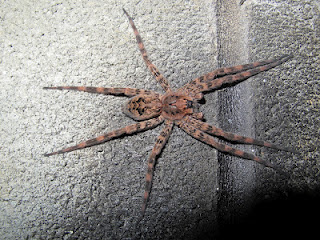
As I was coming down the ladder, I came eye-to-eye with a female Fishing Spider.  I enjoy finding big spiders and this one is about as big and beautiful as they get around here.

There aren’t many animals with a coat as beautifully colored and marked as this girl. 

Atop one barn wall was a fresh shed from a Black Rat Snake.  This is a common find when the snakes are hunting in the barn.  If a week goes by without a new shed appearing, I figure the snakes are in the house.

On the way back to the house I found this walnut shell left by a squirrel.  It must have known how much I like faces.  Sometimes you don’t have to go far to have an exciting walk.  It wasn’t until I walked back into the garage that I noticed I had forgotten to get the pliers.

Wednesday, May 16, 2012

Mayapple Feast

I returned to a place I had just visited the previous day to find that something had eaten a substantial meal of Mayapple plants.  I know that all of the plants were untouched the night before, so this was the result of a single night’s activity.

Other than loss of the fruit, I rarely see any damage done to Mayapples.  I was curious as to the identity of the culprit.  Three notorious plant eaters came instantly to mind:  Cottontails, Groundhogs, Whitetail Deer.  The feast consisted of several plants.  The heights of the remaining stalks suggest that in some cases, very little of the plant was actually consumed.  This doesn’t seem consistent with the feeding behavior of the Cottontail.  Cottontails bite a stalked plant off at the base and then sit upright while eating their way up the stalk.  They rarely eat from the top down to the ground.  I imagine their feeding method allows them to watch for predators while feeding. 

Groundhogs have a feeding pattern that’s similar to that of Cottontails.  If they were not going to consume the leaf, they would eat the stalk right up to the base of the leaf and leave little or no stub.  With an almost machine like proficiency, a Groundhog would have left each leaf with the same amount of stem attached.

The partially cut, partially torn stub makes me lean towards deer.  Deer are the most likely animal to leave varying lengths of stem both on the leaves and standing from the ground.  I’ve also watched deer leave this same type of bite signature on many different types of plants.

I still don’t know why an animal with constant access to Mayapples would suddenly make this one time assault on the plants.  Maybe the plant corrected some dietary deficiency present in the animal.  The single meal may have brought the deer back into normal balance.  I’ll probably never know for sure.  Many discoveries just leave me with a lot of unanswered questions.

Just up the hill from the Mayapples and in plain sight of my location, a group of Wild Turkeys engaged in courtship activities.  I saw them look in my direction, but they never stopped what they were doing or attempted to move away.  This bunch includes four Toms who are regular visitors to my yard.  They move out of the yard when I’m around, but come right back when I leave.  Now they seem to be getting used to my presence where ever we happen to meet.  I guess they don’t realize that there are a few more days left of Turkey season and they should be a little more wary of anything wandering around on two legs.

Tuesday, February 23, 2010

Cottontail Activity

The clearing I do results in a lot of brush piles that are used as cover by various types of wildlife. Snowy conditions are perfect for assessing the popularity if the various piles. This particular pile is being used by Eastern Cottontail rabbits.

The area around the brush pile is covered with rabbit sign. Tracks, scat and cuttings are everywhere around the pile. It makes me wonder how many rabbits might be using this one brush pile.

The rabbits have been feeding on Fragrant Sumac that has formed a thick stand on one side of the brush pile. Fragrant Sumac is known for the strong aroma it imparts when the stems are damaged. It certainly doesn’t smell like something that should be eaten.

This stem is showing drops of sap around the typical angled cut made by the rabbit. A little pruning doesn’t hurt these shrubs at all. Cutting seems to make them regrow with even more vigor.

The brush pile was also surrounded by the tracks of a dog or coyote. I haven’t heard the coyotes for over a month, so these may be dog tracks.

After the canine circled the pile, checking access routes used by the rabbits, it climbed up on top to see if it could access rabbits from there. This brush pile had a few large cedar trunks used in its base and the rest of the material was small and packed as tight as I could get it. There’s no way anything could ever dig through that mass of branches.