Showing posts with label Blue Jay. Show all posts

Wednesday, January 11, 2017

2017 Blue Jay Status

January weather typically includes a bout of cold temperatures and snow cover. These conditions bring an increase in activity at the Blue Jay Barrens birdfeeders and give me an opportunity to assess the local Blue Jay population.

Blue Jay numbers are running at about their normal level this year. Except for one or two birds that have a distinctive marking or unique behavioral trait, I can’t tell the individual birds apart, so I don’t know for certain how many are year-round residents of Blue Jay Barrens and how many have just moved in for the winter. The general behavior of the flock makes me think that the majority of individuals are here all 12 months of the year. In particular, I don’t believe that a new arrival would automatically know to sit in the apple tree and yell when the feeder goes empty.

As always, the almost constant movement between the feeding area and the nearby trees makes it nearly impossible to get an accurate count. I spotted 29 Blue Jays in the previous photo, including the one in the air. I know there were at least 47 here at one time, but at that same time I could see several more moving in the trees at the edge of the field a few hundred feet away.

The feeder on the post contains black oil sunflower seed. The area at the base of the tree in the upper right-hand corner of the photo gets a few cups of cracked corn scattered out each morning.

Second to the Blue Jays in producing consistently high numbers in the feeder area are the Cardinals. In between trips to the feeder, the Cardinals tend to hang out in the dry stalks of Giant Ragweed and Wingstem adjacent to the feeder.  The smaller feeder visitors also seem to prefer this area for feeding and loafing. The large crop of seeds produced by these plants has now been nearly consumed.

The tall plant stalks have been battered by rain, wind, and snow, but they continue to remain upright.

It’s not uncommon to count 30 or 40 Cardinals in the feeder area at one time. Most take their seed from the ground instead of directly from the feeder.

Mourning Doves typically arrive a couple hours after sunrise. There are usually 25 or 30 individuals in this flock.

Most of the doves in the area spend the winter gleaning seed from nearby harvested crop fields. A deep snow can make that source of food inaccessible, and the result is a substantial increase in Mourning Doves at the feeder.

These two Blue Jays demonstrate how so much sunflower seed gets on the ground beneath the feeder. They scrape seed up and over the edge of the feeder tray until they find just the seed they want. This also explains why my feeder sometimes so rapidly runs out of feed. I thought for a while that they were searching for the few shelled seeds that could be found in the mix, but that didn’t turn out to be the case. When they start to load up with seed, it’s just the standard seed in a shell. Maybe they just want to be sure that their friends down below have plenty to eat.

Friday, March 13, 2015

The Almost Final Last of the Season Cedar Maintenance

This aerial map shows the roughly three acre field in which I am currently completing cedar maintenance.  Red outlines indicate the areas of the field that have so far been completed.  A small area to the right is yet to be done.  The portions labeled B-2 and C were completed back in early February.  Work was then halted when a series of storms buried the field in snow.  Snow exited the field a couple of days ago, but it wasn’t until yesterday that the soil dried out enough for me to resume work.  Section D was completed yesterday afternoon and E is what I could get done this morning before heavy rain moved in.  I would not normally be doing this type of work in March, but I just couldn’t leave the field partially completed.  If the rain ends tomorrow as predicted, it will probably be the middle of next week before the soil will be dry enough for me to finish the last bit of this field.

The aerial view makes it appear that this field is heavily occupied by large Eastern Red Cedars.  The view from ground level shows that the cedars are spaced widely enough apart to allow plenty of sunlight to reach the ground.  Where soil conditions allow, a thick grass cover is present.
The slope steepens rapidly at the south end of the field.  The last 15 feet are an almost vertical plunge into the creek.  The last of the snow is still holding on along the top of the creek bank.

Field blends with woods at the steep north end of the field.  One October, about 20 years ago, I mowed a path through the tall grass.  The deer, which always seem to take the easiest option while walking, immediately began following the mowed path.  They still follow the same path and are responsible for it becoming a muddy trail.  As deer numbers increased through the years, they developed paths in other directions through the field and now this is just one in an expanding network of deer highways.

This is considered to be a south facing field.  Unlike the previous field I discussed, this one is dissected by a network of surface depressions that drain water in many different directions.  While the field is still generally south facing, there is a wide variation in slope steepness and direction.  This gives the field an interesting collection of microclimates within its boundary.

Saturated soil is still releasing water into the center of the drains.  The presence of water on the surface is short lived, but a gradual movement of subsurface water along this same route may persist for a couple more months.

Small cedars thrive in these areas of increased water availability.  This eroded area was practically bare when I bought this property.  Prairie grasses are slowly stabilizing the soil.

Between each drain is a ridge.  There is a drastic difference in the amount of water available to plants on the ridges as opposed to the drains.

This section of the field suffered soil slips that resulted in a stair step arrangement of bare patches on the slope.  The slipping stopped long ago, but the poor quality of soil exposed in each step is making it difficult for vegetation to become established.

Lichens are the pioneer species in these bare areas.  In time, grasses take root in the soil stabilized by the lichens.

Lichens become established on any stable surface.  Here they have encrusted an old cedar stump left from my initial clearing of the field.

The deep snow mashed down the fine grasses, making it more difficult to find the small cedars.  Even in the best of conditions I miss a few, but there were probably many more like this that escaped my search this time.

I found several patches of the uncommon Purple Triple-awned Grass, Aristida purpurascens, scattered about the field.  This grass was represented by only a few small clumps at the time this field was originally cleared.

The grass gets its name from the three long filaments, known as awns, projecting from the end of the seed.

I found collections of Blue Jay feathers beneath three different cedars, evidently the work of a Blue Jay predator.  I couldn’t tell if the feather piles represented three different birds, of if the predator moved the bird a couple of times while dining.  This batch included a section of leg bone.  I’m guessing this was the work of a Cooper’s Hawk.  The Cooper’s Hawks around here seem partial to Blue Jays and Mourning Doves.  It’s not unusual to find piles of feathers from these two species.  Even with the hawk whittling down their numbers, the Blue Jays seem just as abundant as ever.

Monday, February 23, 2015

Blue Jays

I think a Blue Jay may have been the first bird to visit my bird feeder when I moved to this property 30 years ago.  It was certainly the most commonly encountered species during that first summer.  I could not step out of the house or walk anywhere on the property without seeing or hearing Blue Jays.  It’s not hard to understand why I chose to name my property Blue Jay Barrens.

Since that first day, the number of Blue Jays at Blue Jay Barrens has grown.  It’s now rare to encounter a lone bird.  If a Blue Jay scolds me as I wander around the property, there are always several more ready to back him up.

The perch on the feeder is not nearly wide enough to accommodate the daily throng of Blue Jays that come in to feed.  Many of these are from this summer’s crop of youngsters.  A swarm of young birds join the flock each summer, but I have yet to find a Blue Jay nest.

Tree roots exposed by the digging actions of deer and turkey act as perches on which the Blue Jays can open their sunflower seeds.  After eating their fill, the birds usually take a few seeds off to cache for later.  I’ll find many of these caches in early summer when clumps of sunflower seedlings sprout from all sorts of unlikely places.

Counting the total number of Blue Jays visiting the feeder is just about an impossible task.  Those on the ground are constantly leaving to perch in the trees while others come in to take their place.

There are a couple of doves in the tree, but the majority of perching birds are Blue Jays.  This photo shows about a third of the tree area and the rest of the tree is just as crowded.  Add to that the Blue Jays in two other nearby trees, those spread over a considerable ground area, those perched out of view on the house gutter and those in the trees lining the field behind that house.  Now put them all in constant motion and you get an idea of how frustrating an attempt at counting can be.

I’ve added three Blue Jay videos to my YouTube channel.  Click on the links to view.

Video 1 – A short clip showing a very active concentration of feeding Blue Jays.  There is some camera shaking from my trying to untangle my sweatshirt sleeve caught in the gear that raises the camera on the tripod.  To view click HERE.

Video 2 – A two minute clip highlighting the comings and goings from a concentrated Blue Jay group.  I particularly like the Blue Jay that refuses to share the water.  To view click HERE.


Video 3 – A two minute clip showing the feeder, water and surrounding ground area.  A great coming and going of birds, with Blue Jays playing a major role.  To view click HERE.

Monday, June 11, 2012

Going to the Barn for a Pair of Pliers

I am sometimes easily distracted.  While working on a project in the garage, I had to stop to get a pair of pliers from the barn.  I got just one step out of the garage before I had to stop.

You can’t walk by a beautiful Black Rat Snake without pausing for a moment of admiration.  This is one of several snakes that periodically migrate between the house and barn, keeping both mouse free.

A yard stick was just inside the garage door, so placed it beside the snake.  Laid out straight, the snake would probably measure in at about four feet.

Beside the door was a lovely Crane Fly.  These big flies are quite common at Blue Jay Barrens and are one of my favorites.

Their large size makes it easy to see some of the characteristics unique to flies.  Unlike most other flying insects, flies have only one pair of wings instead of two.  Their hind wings have modified into knobbed stick-like structures called halteres which are used to balance the fly in flight.  You can see halteres on all flies, but on none as easily as the Crane Fly.

This colorful larva was hidden on the mortar between bricks on the house.  The yellow-green color almost glowed like that of a firefly.

A few steps later, a light colored moth shot from the grass and lit beneath a leaf beside the house.  I’ve been hoping to see an adult of the rare Unexpected Tiger Moth, so I tend to chase every whitish moth that goes by.  No luck here.  This is a common moth known as The Beggar.

Above the moth, an orb weaving spider has spun its web.  I believe this is called the Orchard Orbweaver.  It had the look of a small jewel.

The feeding station is in a direct line from house to barn, so the animals must move aside as I pass.  Most are so used to my comings and goings that they don’t move very far or fast at my approach.

A female Raccoon is nursing a litter, so she’s been visiting the feeder during the day to get enough food to sustain her through this difficult time.  I suppose it won’t be long before the little guys are out and about.

I cleared the house just in time to catch the Red-shouldered hawk dropping from the electric line.

It managed to land with a branch between us, so I’m not sure what it caught.  The prey must have been something small, because it went down in one gulp.

A bit closer to the barn I was attracted to a rustling in the tall grass around some old tractor parts.  A mother skunk had her young out of their den.  The little ones never stopped moving and never left contact with their mother.  I didn’t get an accurate count, but there are three baby faces and the mother’s tail in this shot.  At my approach they all retreated into an old Groundhog hole beneath the tractor motor.

I opened the barn door to find a young Cottontail.  This must have been the perfect spring for successful nestings.  I think I’ve seen babies of just about every mammal we have here.

Up in the barn loft was a young Blue Jay that couldn’t seem to find its way out.  I opened the big door at one end of the barn, but the bird wouldn’t fly down through the rafters to that exit.  Its calls kept getting more frantic and a parent bird outside the barn kept responding.  I finally climbed the ladder and opened the loft door so the youngster could escape.

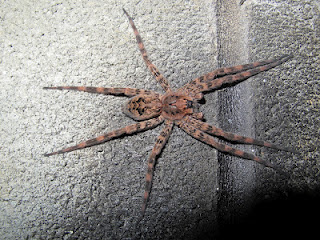
As I was coming down the ladder, I came eye-to-eye with a female Fishing Spider.  I enjoy finding big spiders and this one is about as big and beautiful as they get around here.

There aren’t many animals with a coat as beautifully colored and marked as this girl. 

Atop one barn wall was a fresh shed from a Black Rat Snake.  This is a common find when the snakes are hunting in the barn.  If a week goes by without a new shed appearing, I figure the snakes are in the house.

On the way back to the house I found this walnut shell left by a squirrel.  It must have known how much I like faces.  Sometimes you don’t have to go far to have an exciting walk.  It wasn’t until I walked back into the garage that I noticed I had forgotten to get the pliers.