Showing posts with label Butterflies. Show all posts

Friday, August 4, 2017

Silvery Checkerspots

I usually don’t see more than a half dozen Silvery Checkerspot butterflies at Blue Jay Barrens in any one year.  This has been a constant situation for over 30 years, even though we have an abundance of Wingstem, the Silvery Checkerspot’s host plant.  For some reason, Silvery Checkerspots are everywhere this year, and I am enjoying the spectacle.

A couple of days ago, I sat beside a patch of Orange Coneflower that was being visited by about a dozen of the small black and orange butterflies.  I just watched the show for quite a while before turning on the camera.  I had never had any luck getting a good photo of this species, but I knew that was about to change.

After a few minutes, the butterflies resumed their nectaring and chasing activities as though I was just another part of the landscape.  That’s one of the neat things about many animals.  Their brains don’t interpret inanimate objects as threats, so if you can get yourself situated without scaring them away, the animal will soon continue with its normal activities.

The above video shows an interesting behavior associated with nectaring on the coneflowers.  The butterfly would pivot atop the flower head and probe each open floret as it went.  Some butterflies turned clockwise, while others turned the opposite direction.  Individual butterflies that I followed from flower to flower, each turned in the same direction as it had on the previous flower.  My sample size wasn’t large enough to make any valid statistical conclusions, but I began to wonder if butterflies could be right-handed or left-handed.

Sunday, May 28, 2017

Edwards' Hairstsreak Larvae - Night Feeding

Within the Blue Jay Barrens prairie openings are a scattering of medium to small sized Blackjack Oaks.  Some of these trees are decades old, but various environmental factors keep them from getting very large.  Dry site conditions limit water available to the tree, White-tail Deer find them to be the perfect choice for rubbing antlers, Periodical Cicadas cause a dramatic die-back every 17 years and a wide variety of insects find the leaves extremely palatable.  I make several close examinations of these trees each spring as I follow the development of the Edwards’ Hairstreak butterfly larvae, one of those species with a dietary preference for Blackjack Oak.

Edwards’ Hairstreak eggs hatch just as the oak buds begin to swell in early spring.  The larvae feed on the buds and newly developing leaves.  On May 8, temperatures dropped to 29°F causing frost and freeze damage to many plants.  Damage to Blackjack Oaks varied between individual trees, but all suffered the loss of some new growth.  This was a setback for both the trees and the Edwards’ Hairstreak larvae.  Fortunately, buds were not affected and regrowth was rapid.

When I checked the Blackjack Oaks three days ago, the leaves were showing signs of heavy predation by the Edwards’ Hairstreak larvae.  When this magnitude of damage occurs to the leaves it is a good indicator that the larvae have reached their final instar stage and will soon be pupating.  At this point it does no good to search the tree for larvae, because they do not spend the day in the open.

Young Edwards’ Hairstreak larvae remain in the open feeding through the day.  When they become older, they feed only at night and spend the day at the base of the oaks, hidden in cavities constructed by Allegheny Mound Ants. 

Near sundown, the larvae leave their shelter and begin climbing the tree.

Each larva is accompanied by its own cadre of ants. From the time they hatch until emergence as adults, the Edwards’ Hairstreaks are accompanied by ants.  The larvae achieve a degree of protection from the ants and the ants receive a sugary Honeydew solution excreted by the larvae.

The larvae on the first tree went too high to be easily observed, so I switched my attention to a smaller tree that displayed feeding activity.  This tree was less than three feet high and struggling to regrow leaves killed by the freeze.

The larva’s head is located near the top of this photo.  As the larva eats, an ant visits honeydew producing glands near the larva’s tail.

It’s fortunate that pupation is near.  This tree was loaded with larvae.  At the rate they’re eating, the tree may soon be stripped bare of leaves.

The above video is a compilation of several shots of moving and feeding Edwards' Hairstreak Larvae.  Make sure your sound is on, so you can enjoy the call of the Chuck-will's-widow while you watch.  This video, in a possibly clearer form, may also be viewed on YouTube by clicking HERE.

Wednesday, April 13, 2016

Redbuds and Butterflies

Blooming of the Redbuds coincides with the emergence of two of my favorite butterflies.  Unfortunately, this is also the season for windy days, so each year my efforts to photograph these species is thwarted by gusty winds.  Today, about two hours before sunset, the wind stopped.  I took advantage of this uncommon calm to make a search for the elusive Henry’s Elfin and Olive Hairstreak butterflies.
I soon found Henry’s Elfins, but the position of the Redbuds allowed only backlit views.

I took my search to the east side of the field where I found a group of Redbuds receiving sunlight from just the right angle. 

Several Henry’s Elfins were in the trees, but they were keeping to the tree tops.  Besides that, most seemed to have buried themselves in the clusters of Redbud blooms.

Finally, I found some that offered a clearer view.  Their numbers are already higher than usual, and their season has not yet peaked.

Larvae of the Henry’s Elfin feed on Redbud.  Early season eggs are commonly laid on the Redbud flower.  Young larvae will consume flower parts and developing seed pods.  Older larvae typically move on to consume young leaves.

The bright green of the Olive Hairstreak is easy to spot among the pink Redbud blooms. 

Olive Hairstreaks visit Redbud flowers strictly for the nectar.  Their larvae feed on Eastern Red Cedar, which is extremely common here.  Looking for these butterflies on the Redbuds is the easiest way to assess their numbers.

Monday, July 27, 2015

Monarda Returns

It’s been a few years since Monarda fistulosa has bloomed so prolifically in this opening at Blue Jay Barrens.  Something about the environmental conditions during the winter or spring of 2011 caused a massive die-off of Monarda plants in this patch. 

During the past few years, Monarda has returned and is now approaching its earlier abundance.  With the return of the plants comes a return of the butterflies.   Monarda attracts a variety of pollinator species, with large butterflies being the most notable.

At the small end of the size scale is the Silver-spotted Skipper.  Smaller butterflies, which includes the other skippers and many butterfly species, seem to find the Monarda flower head difficult to handle.  As if in celebration of the return of the Monarda, Silver-spotted Skippers are around in record numbers this year.

The showiest of the butterfly visitors are the Swallowtail species.  This is the Spicebush Swallowtail.  Its habit of constantly fluttering its wings while feeding makes it difficult to photograph.

Blooming of Monarda seems to coincide with the emergence of the summer brood of Tiger Swallowtails.  Summer brood individuals are typically larger than those found earlier in the year and they are quite showy as they glide between Monarda blooms.  There are those that exhibit the typical yellow coloration and …

… others that are colored a silky black.  Despite their black coloration, the tiger stripes still show through.
I found it interesting that the swallowtails all seemed to feed while hanging from the side of the flower head.

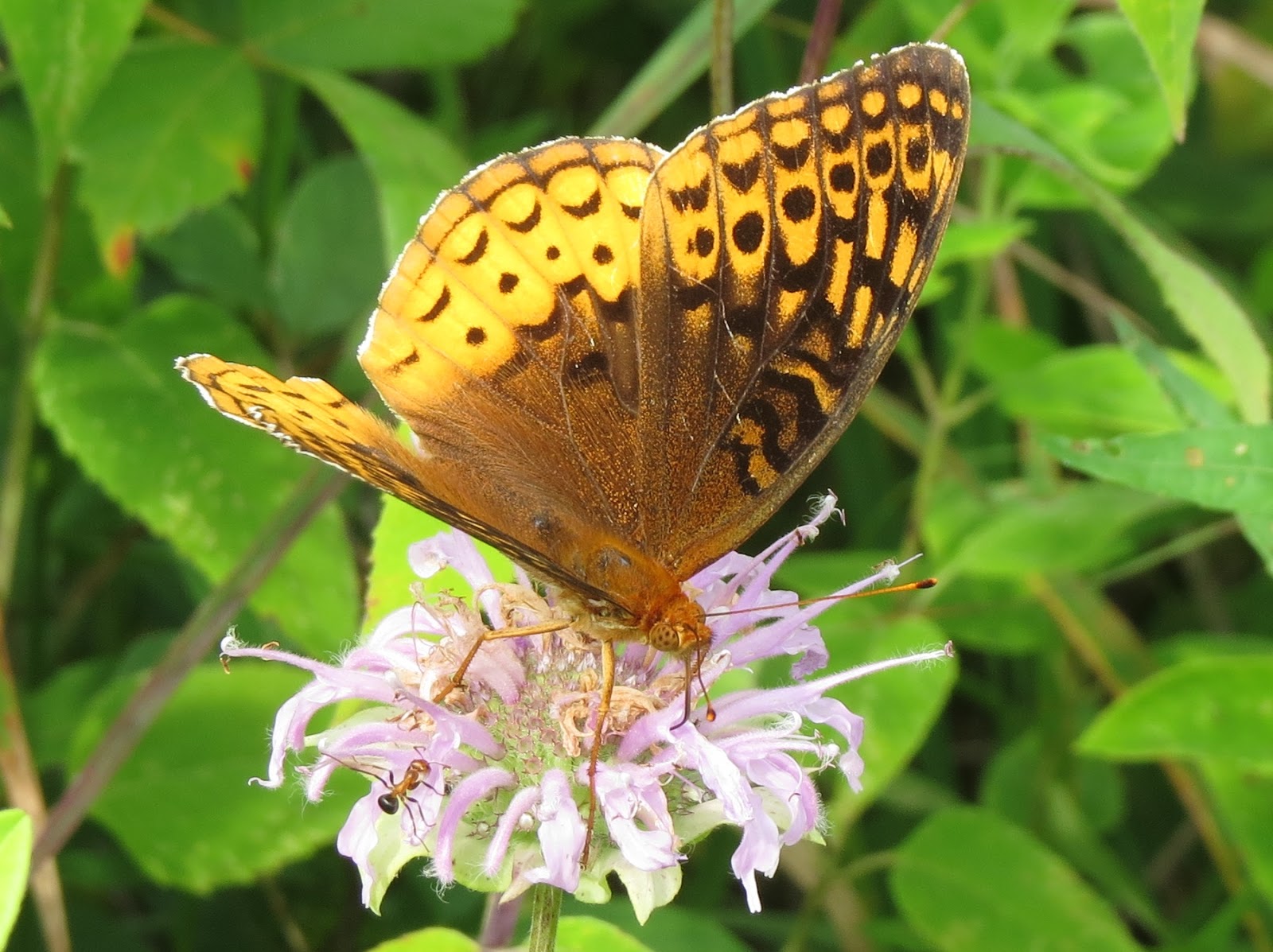
Great Spangled Fritillaries, however, tended to do their feeding while perched atop the flowers. 

The Monardas have even attracted a few Giant Swallowtails.  The Giant Swallowtails quickly move from flower to flower, spending so little time nectaring that I sometimes wonder if the act is even beneficial.  Finding them at flowers is about the only way to get a decent look at these fast fliers.

The Monarda is most famous as an attractor of Clearwing Sphinx Moths.  Using their front legs as anchors, Hummingbird Clearwings hover next to the flower as they draw nectar.  This species is currently outnumbering butterflies in the Monarda patch.

A few Snowberry Clearwings are also present this year.  Slightly smaller than the Hummingbird Clearwings, the Snowberries feed in a similar manner.  This is a species that I don’t often see here.

The Monarda’s attractiveness is not diminished by darkness.  A variety of moth species visit the flowers through the night.  The lack of multiple examples of nocturnal visitors more accurately reflects the photographer’s skills than it does the true number of night-time pollinators.

Wednesday, August 27, 2014

Sulphur Butterflies

Even though it is a most common butterfly throughout the State of Ohio, the Clouded Sulphur butterfly is an uncommon find at Blue Jay Barrens.  That is most likely because the Red and White Clovers upon which the Clouded Sulphur caterpillars feed is practically absent on this property.


During my childhood, Clouded Sulphurs were a particular favorite of mine.  No matter where we happened to be living, nearby agricultural fields abounded with Red Clover and with that plant came the butterflies.  My net captured hundreds of this species, which I would inspect closely and then release.


Clouded Sulphurs are common puddlers and will often blanket a small patch of mud.  I used to race through mud holes, raising clouds of butterflies.  It is fortunate that these butterflies are so quick to return to their mud.  As an eight year old, I had little patience for waiting on butterflies to regroup for my next run.


Mud holes are also uncommon in the well drained soils of Blue Jay Barrens.  The pond bottom is about the only decent place for puddling butterflies to gather.


Besides the resident Clouded Sulphur, Blue Jay Barrens has a couple of migrant Sulphurs that show up each summer.  This is the Cloudless Sulphur, a species that regularly shows up here in August.  The largest of the Sulphurs, this butterfly presents a bright lime-green appearance when in flight.  The large spots on the wings identify this individual as a female.  It’s possible that she will deposit eggs on some of the abundant Wild Senna growing in this field, but none of her offspring will survive the winter weather experienced in this area.  Next year’s Cloudless Sulphurs will come here from southern states with milder winters.


Thistle flowers are a favorite of this species.  These butterflies fly much faster than the average person can travel through the field, so chasing one down is problematic.  The easiest place to view them is on thistle flowers.


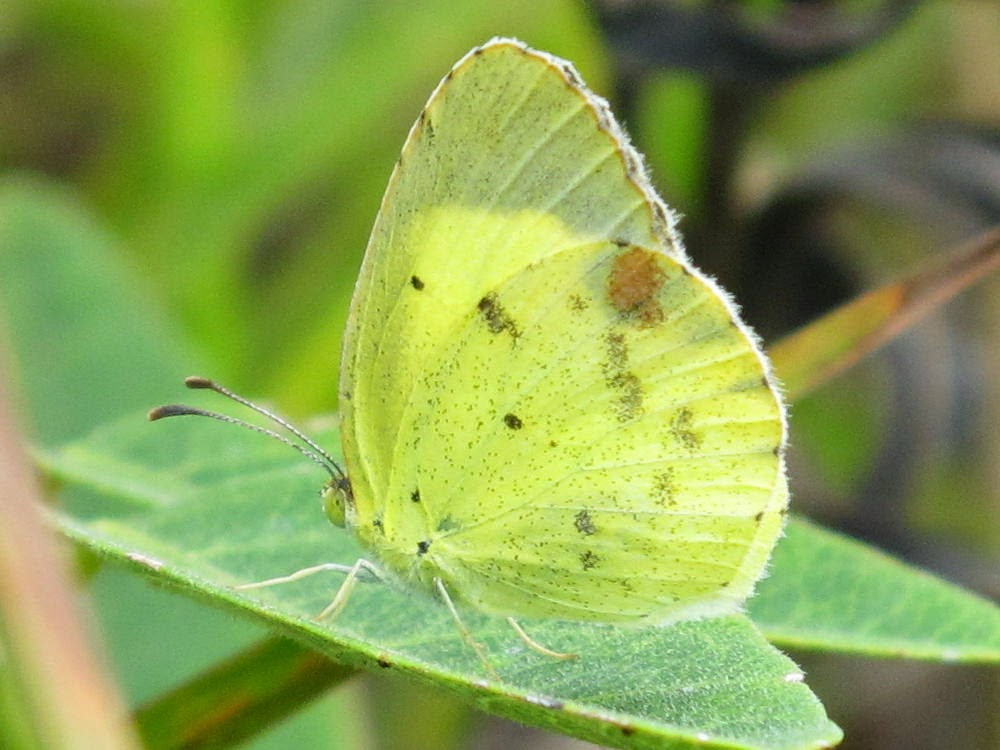
The Little Sulphur is the smallest of the Sulphurs.  It flies close to the ground and weaves its way through the tall vegetation.  Its small size makes it appear quite moth-like as it moves from one location to the next.


The best time to view this species is early in the morning, before the dew dries and the butterflies warm up.  At that time, disturbed individuals will only move a short distance before settling back down.  This is another migrant that moves in each year from more southern states.  Perhaps one day it will actually be a resident of this area.

Monday, July 7, 2014

Edwards' Hairstreaks 2014

The first week of July seems to be the peak flight period for Edwards’ Hairstreak Butterflies at Blue Jay Barrens.  Because of this, it has become a Fourth of July Holiday tradition for me to take a little time to survey the Edwards’ Hairstreak population.  Of course, I also look at many other things, but for this one outing my priority is to find the hairstreaks.


I had plenty to look at.  There were dozens of Edwards’ Hairstreaks nectaring on the Butterfly Weed.  I’ve never before found so many occurrences of multiple hairstreaks on the same flower clusters.


In order to have Edwards’ Hairstreak butterflies, a site must have young oak trees to provide food for the larvae and it must have Allegheny Mound Ants, an ant species that acts as guardians for the butterflies during their early developmental stages.  Click here for more details on Edwards’ Hairstreaks at Blue Jay Barrens.


When I first discovered Edwards’ Hairstreaks at Blue Jay Barrens twenty years ago, they were located in only one small area near the center of the property.  Since that time, I’ve been encouraging oaks to colonize areas near the large ant mounds.  Young Black Jack Oaks seem to be the preferred host species, so these trees are given priority in all management activities.


I was particularly impressed by the butterfly numbers at this site.  It was nearly ten years ago when I discovered a single Edwards’ Hairstreak in this small opening.  Now there is a thriving population.  Oaks and anthills indicate that the hairstreaks are a possibility.  Add in a clump of Butterfly Weed and you have the perfect opportunity to observe this butterfly.


I’m not sure how to sex these butterflies, but I would think eggs each time I saw an individual with such a robust abdomen.  I felt like shooing her off the flower and sending her over to the tree to deposit those eggs before one of the many flower lurking predators made a meal of her.  I always have to remind myself that wild animals probably know more than I do about what they should be doing to insure future generations of their species.


A few of the hairstreaks looked like they were freshly emerged, but most had lost some of their luster and were looking slightly worn.  Damaged wings suggested probable encounters with predators.


A couple just looked downright battered.  It looks like this one has had quite a time, but it proved to be a strong flier despite the wing damage.


It’s always encouraging to see positive results from your management efforts.  I’m hoping that the Edwards’ Hairstreak population at Blue Jay Barrens continues its expansion.

Monday, April 28, 2014

Flowering Shrubs

Two weeks ago we had snow on the ground.  Since then we’ve had several days that have reached 80 degrees and the plants are working hard to make up for lost time. I was out yesterday checking on the progress of the flowering shrubs.  Fragrant Sumac usually begins the show and attracts a wide variety of pollinators.  This year is a slightly different scenario.  The sumac is blooming later than usual and several other shrubs have developed competing blooms.


Redbud has reached its peak bloom.  I can’t remember ever seeing the Redbuds go so quickly from bare branch to full flower.


Viburnums are keeping pace with the others.  We haven’t had much in the way of cold nights to slow these guys down.


Sassafras seemed to go from bud to bloom in just a couple of days. 


Wild Plum is making a marvelous showing.  Development of fruit still depends on weather conditions yet to come.


Shrubs along this field edge are entering their third year without any competition from invasive exotics.  They are doing a nice job of filling in the holes left behind when the Autumn Olive and Multiflora Rose were removed.


Shrubs are a primary nectar source for many of the early butterflies and visiting the blooming shrubs is the easiest way to spot a few of the rarer butterfly species.  In a typical year the blooming periods of the various shrub species are slightly staggered.  This tends to concentrate the butterflies onto one species at a time.  With this year’s smorgasbord of blooms, the butterflies are more widely scattered.  Many of the flowering shrubs have now grown to a quite respectable height, so besides being spread out, the butterflies are high above my head.  This Henry’s Elfin is a species that deposits its eggs on the flowers of the Redbud.  I saw several high in the tops of the Redbuds, but none came within range of a decent photograph.


The most common small butterfly species is currently the Spring Azure.  I found these everywhere I walked, but they couldn’t manage to stay on a shrub flower long enough for me to get a photo.


This was the problem.  Juvenal’s Dusky Wings had claimed territories on every shrub around the edge of the field and were chasing away the Spring Azures whenever they came near.

Bumble Bees were taking advantage of the abundant flowers.  Princeton University Press just released the new Bumble Bees of North America Identification Guide and I thought I would do some work on Bumble Bee identification this summer.  The guide is full of great information, but it seems that many Bumble Bee species have a wide variation in color patterns and several common species share similar patterns, so simple visual observations may prove unsatisfactory for identification purposes.  I’ll give it a try anyhow.