Sunday, May 22, 2011

Upground Yellow Jacket Nest

This delicate little structure almost looks like one of the myriad species of fungi that are appearing this year, but if you were to pick it, you would find it not as benign as you might first suspect.


Inside the umbrella like shell is the beginning of a wasp nest. The queen has begun laying eggs, so it won’t be long before the colony really becomes active. As the colony grows, the cap will be enlarged to fully enclose the brood chambers. I believe this to be Vespula alascensis, but the descriptions and photos I’ve seen are of the workers and may not accurately describe the queen. I’ll recheck my identification if it reaches the point where workers are present.

I always say that all you have to do is step outside if you want to find something interesting. This nest is a perfect example. Well, I guess it’s perfect except for the fact that just above the front door to my house is not the ideal location for something that frightens most people. I really don’t mind if the resulting swarm chases people away, but I’d hate for them to scare away the UPS guy and if they buzzed my wife, I’d be in big trouble.


I took these pictures in the cool of the morning and the queen was content to stay in the nest and waggle antennae at me. In the heat of the afternoon she took a more defensive posture and took to the air whenever I came near.


Relocation of the nest is probably the best course of action. Normally, collecting a nest for relocation is accomplished during the night. In this case I can’t do that because there’s a nesting Phoebe just a few feet away and I don’t want to scare it off the eggs after dark. I went out a short while ago to make my capture and found the nest empty. The queen must be out foraging. I left my equipment by the door in anticipation of her return. It’ll be a good test of my reflexes to see if I can get a jar over her nest before she can take wing to defend her brood.

Saturday, May 21, 2011

Feeder Alliance

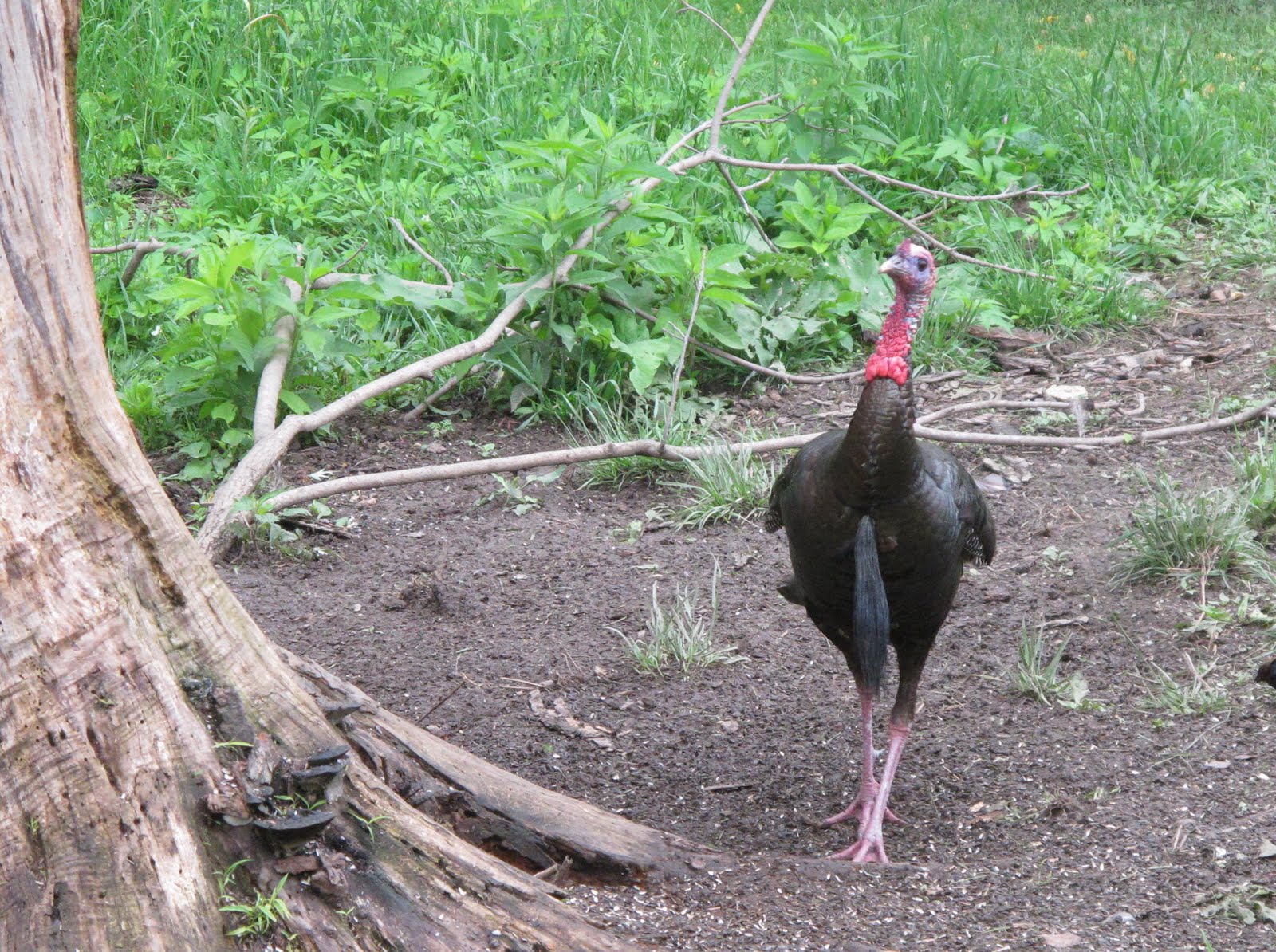
The Wild Turkey breeding season is coming to a close. A few of the males are still displaying, even though molting tail feathers are making the sight less impressive.


Most of the females are sticking close to their nests. Those that show up at the bird feeder have no interest in a displaying male.


Feed on the ground is quickly cleaned up and the feeding birds disperse. This fellow missed out on the feast because of his need to display, but now he seems to have a look of anticipation. He’s keenly interested in something occurring above his head.


Gray Squirrel numbers have declined and I only see a few coming to the feeder. They tend to stay in the tree when the turkeys come to eat.


The squirrels normally reach the feeder by leaping from the tree trunk. The feeder tips and swings at the squirrel’s contact and I’ll bet you can guess what else happens.


Feed falls to the ground every time a squirrel visits the feeder. This turkey has figured that out and it will stand looking into the tree awaiting the arrival of a hungry squirrel. I’m still waiting for the turkey to jump up there and spill seed for himself.

Friday, May 20, 2011

Bridges vs Floods Round 2

Weather related records are being broken at a rapid pace this year. Some of the records stand for only a short time before they are again broken. Setting a record should be a positive experience, but I’ve not experienced much joy in these record breaking events. A recent intensive storm has set a new high flood level that will be very difficult to top. Foot Bridges that survived the previous record flood just last month were torn to pieces by the wild water that accompanied this last event. Evidence of this flood is going to be visible for a long time.


The only sure way to avoid flood damage is to stay out of places that flood. If you do put something in the path of the flood, expect it to be damaged. I’ve always known that any of my bridges could be torn apart by a wild flood. In anticipation of that fact, I designed the bridges so that the resulting pieces were predetermined. Although this six foot section of bridge decking is 600 feet downstream of its original position, it has not received any damage. It is intended to be one of several separate units that can be easily carried back and reassembled in the proper location.


Here’s the rest of the bridge decking, tethered by its safety cable. The logs used as bridge supports are in a tangle of debris downstream. Moving water is a powerful force, but that shouldn’t have been enough to demolish this bridge. Some logs showing in the debris tangle came from a neighboring property somewhere upstream of the bridge site. These logs, carried down the channel by the flood water, would act as battering ram and would have hit the bridge with enough force to take it apart. Had the water been free of debris, the entire bridge would have been sitting comfortably on the far bank as has occurred in the past.


When I constructed foot bridges across the creek, I had to decide just how much damage I was willing to accept and how much I was willing to deviate from my vision of the perfect crossing in order to reduce damage. As a child, one of my greatest joys was peering through the boards of a bridge deck and spying on the aquatic life beneath. My preference would be to have low bridges that provide an intimate nearness to the creek, but this type of bridge would move with every high water. Raising the bridges high enough to avoid any flood impact would result in a much longer span across the creek and a bridge deck far removed from the water. I chose a position in the middle and set the bridges so they would only be damaged by exceptional runoff events which would be expected once every five to ten years. This bridge was moved from its stone supports, but wasn’t really damaged. The path of bright green ground cover indicates the area that was swept clean by the flood.


The bridges will be repositioned when things dry out. I’ll mark the new high water levels and see if any adjustments to the bridge heights can be accomplished to make them a little more secure. I don’t want to get them too high, because there’s always the chance that I’ll fall off of one some day.

Thursday, May 19, 2011

Topsy Turvey Slippers

If you prefer projects that are controllable and follow a predictable course, you probably wouldn’t enjoy managing populations of wild native plants. I took a rainy walk through the woods in search of additional Yellow Lady’s Slipper plants and found instead that my existing plant had made a rather unexpected transformation. My slippers have reoriented themselves into a sole up position.


The reclining stalk with the single bloom straightened itself into an upright position. This maneuver flipped the flower onto its back. It’s now looking quite unorchid like.


At the same time, the stalk with the double bloom has bent itself double just below the upper leaf. The twin flower bearing stalks are now directed towards the ground and the blooms are in an upside down position.


Will potential pollinators recognize the flowers in this unnatural orientation? I’ve always felt that the chances were slim of a pollinator carrying Yellow Lady’s Slipper pollen to this isolated plant. Now it seems that this event has reduced those chances even further.


It’s not hard to imagine the double bloomed stalk becoming damaged and allowing the flowers to fall. The stem doesn’t appear damaged though, just bent. It’s harder to understand the reason for the reclining stem suddenly straightening up. I would expect the stem to fully develop prior to the emergence of the flower. Fortunately, I enjoy mysteries and will add this to my collection. I can almost imagine this being the work of Woods Elves that rearranged the flowers and then hid laughing behind a tree stump when I came by and did a double take at the new look of my orchid plant.

Wednesday, May 18, 2011

Fungus 2011

I’m beginning to wonder if the skies are going to look gray forever. We’ve been stuck in the same basic weather pattern for almost six months and the number of sunny days has been well below normal. Rains began to fall in late November and were a welcome relief from the prolonged drought we had just experienced. December and January didn’t produce large amounts of precipitation, but storm clouds were an almost constant occurrence. February rainfall jumped to above normal levels and March continued the trend. April reached 11.95 inches of rain for the month, which tied the Blue Jay Barrens record for total monthly rainfall. May has experienced six inches of rainfall so far and forecasts indicate much more to come. The normally dry soils have sustained a level of saturation that is far beyond any that I have witnessed during my experience with this property.


Prolonged wet weather favors those species that thrive in a moist environment. Many plants are exhibiting an enhanced vigor that is rarely seen. Plants are larger, blooming more profusely and in general, expressing themselves more forcefully than expected. One group of life forms that benefit most from the excessive moisture is the fungi.


What we see of the fungi are the fruiting bodies, that part of the fungus that produces the spores. Reproductive structures, like the cups formed by the Veined Cup fungus, grow quickly and require adequate moisture in order to remain hydrated through the period necessary to create and release spores. Without moisture, the fruiting bodies are not created and we don’t see the fungi.


Fungi illustrate an important principle that must be understood in order to be successful as a manager of natural biological systems. It’s necessary to identify the components of a system in order to develop an action plan for manipulating that system. The fungi that we see during a wet year have always been present, but they are normally present in their non-reproductive state which makes them exist in a condition that is outside of our normal awareness. A survey of fungi completed during a dry year could make it appear that they are lacking, but experience should tell us that we are missing something and need to make a greater effort to find the answers we seek. The same applies to plants and animals. They can be present in low numbers or in physical forms that we don’t easily recognize, but which we must consider if we are to make wise management decisions. Management plans developed using a single census of species, or even a census compiled by several visits over the same year, lack the basic information necessary to effectively manage towards specific goals. Monitoring and census of plant and animal species on a property are not only essential to the development of a management plan; they are a necessary action item within the plan itself. Proceeding with landscape manipulation without a well documented account of species present could result in an unintentional loss of critical species as well as a failure to achieve the desired goals for the project.


I’ve always associated fungi with things magical and mysterious. The ability to create an elaborate structure seemingly out of nowhere and practically overnight has got to be near the top of the list of wondrous things in the natural world. For me, fungi will continue to be a reminder of how little I know and how much I need to understand in order to successfully manipulate the landscape along a course that will bring about the special ecosystem necessary for the survival of those rare and unusual components of the natural world found at Blue Jay Barrens.

Tuesday, May 17, 2011

Double Yellow Lady's Slipper

The Blue Jay Barrens population of Large Yellow Lady’s Slipper, Cypripedium calceolus, has put on a spectacular show this year with three times the blooms that appeared last year. That sounds great, but once again I’m dealing with an extremely small population. In this case it’s just a single plant. None the less, the single stalk with flower that appeared last year has been outdone by the two stalks and three blooms that are currently present. Those adept at math can quickly see that this must mean one of the stalks is carrying two flowers.


I give credit for two flowers on one stalk even though one of the blooms failed to produce a proper pouch. It might be possible that the weather has helped the plant develop this year, but I feel that a more important factor is the fact that the deer have not eaten on the plant for the past three years. It was common for this plant to be chewed to the ground in the spring. A few years ago, a fallen tree formed a partial corral around the plant and that seems to have kept the deer from wandering into this area.


Even though the second flower didn’t fully form, I take it as a sign of increased vigor that the plant even attempted two flowers. I may have only a single plant, but I would like that plant to be as healthy as possible.


The second stalk also had some development problems and failed to produce an upright posture. As I do each time this plant blooms, I’m hoping that seeds somehow develop. I thought that was going to happen last year when the pod remained green and began to expand. Things looked good for a while and then the pod began to yellow and eventually dropped off.


At least the one plant I have is doing well. I keep looking for other Yellow Lady’s Slipper plants. I don’t know if this plant represents the last of a population that was once common here or if it is the first to show up. I believe that I’ll find another of its kind and when I do, I’ll wonder how I ever missed seeing such a distinctive plant.

Monday, May 16, 2011

Adder's Tongue Fern

Adder’s Tongue Fern is one of those low growing plants that is inconspicuous to the casual observer. It’s usually surrounded by other non-descript plants that blend into a bright green ground cover. I make a point of looking for it each spring.


This is Ophioglossum vulgatum, although positive identification of this genus can cause a certain amount of frustration. Different sources rely on varying descriptions of physical characteristics when describing the different species. In particular, I’m certain that I have Ophioglossum vulgatum, but I’m not sure that I don’t also have the rarer Opioglossum engelmannii.


There is a wide variation of leaf shape within each population of plants I examine. Leaves might be short and broad with a rounded tip or long and narrow with a pointed tip or wide with a blunt tip with a tiny spur. Some leaves have a central crease while others don’t. Some curl forwards on the sides and others arch backwards. There can be a whole range of shapes and sizes all in the same patch of plants. Trying to match physical characteristics to written descriptions can be very frustrating.


One characteristic that is supposed to be definitive for identification purposes is the pattern of leaf venation. You can see that this thick, fleshy leaf does not easily divulge the secrets of its veins.


I picked a couple of leaves and treated them to an alcohol bath to remove the chlorophyll. It turns out that venation can also vary greatly within an individual leaf. For the most part, the veins tended to match the patterns illustrated for vulgatum. When the plant nears the end of its season, I may do a more extensive collection of leaves and check venation. Collecting leaves late in the season should reduce stress on the plants donating to the collection.


I originally found these ferns growing in the old fence rows. Through the years I have seen a rapid increase of plants showing up in the fields. Most of the plants are found in dry, calcareous areas that more match the preferred habitat of engelmannii, so this adds to the feeling that this rarer species might also inhabit Blue Jay Barrens.


When you don’t have time to do extensive flora surveys of an area, you sometimes wonder if your casual observations of plant population increases might not be totally accurate. This plant, growing in the middle of one of the old crop fields, confirms that my observations are correct. Prior to 1985, plowing and chemical applications to this field would have made the existence of this plant impossible. This plant has to have arrived here after my management activities began.


It’s not just one plant showing up in the field that gives me confirmation. This whole area now supports hundreds of Adder’s Tongue Ferns living among the Indian Grass. Regardless of the species, I enjoy having this plant as a part of the Blue Jay Barrens flora.