Wednesday, June 22, 2011

Leaf Footed Bug

Summer is the time of big bugs. I’ve always enjoyed large insects. Partly because of the ease of viewing the various insect parts and partly because of the panic they cause when flying into a crowd. Big insects found early in the season are often present because they overwintered as either pupae or adults. This Leaf-Footed Bug, Acanthocephala terminalis, spent the winter as an adult and is now busy eating, mating and laying eggs.


Even though they seem to have all of the features found in the predatory assassin bugs, these are harmless plant eaters. I guess I should qualify that by saying they are harmless to other insects. Some species are known for their ability to inflict severe damage to agricultural and garden crops.


The name leaf-footed apparently comes from this wing-like projection on the hind leg. I think I would have called it leaf-legged, since the projection is not actually on the foot.


This is a true bug. The long tube-like rostrum, is held folded back beneath the head. What we can see is the sheath that protects the stylets. The stylets are composed of four separate parts which penetrate the plant and form the feeding tube. The sheath bends out of the way when the stylets are in use and then goes back into place as the stylets are withdrawn.


Bright orange antenna tips are an easily spotted characteristic of this species. Bright coloration is usually a warning that the insect should be avoided, but I haven’t read that this particular species poses any special hazard. I did pick it up following the photo shoot and it just walked about on my hand before flying off. No bite and no odor, so those must not be its problem.


Again, just like some of the well known assassin bugs, this species has an abdomen that is not fully covered by the folded wings and shows the fingernail pattern on the top of the wing. On some species it looks like a finger nail and on others it looks like a finger print, but either way, I think it’s a really neat feature.

Tuesday, June 21, 2011

Wild Petunia

The abundant rainfall has certainly spawned a crop of robust wildflowers at Blue Jay Barrens. Certain plants, like this Wild Petunia, Ruellia humilis, bloom every year regardless of the weather, but they are expressing themselves particularly well this year.


The tubular flowers don’t last very long and are often ready to drop the day after opening. Fortunately, the blooms develop in a long succession, so there is an extended period of time in which you can find blooms on the plant. The fused petals drop as a single unit, which sometimes litter the ground following a heavy rain or wind storm.


The stems are square with a variable amount of hairs. That variability also pertains to other parts of the plant. There can be such a wide variation in characteristics between plants that you sometimes wonder if you are dealing with more than one species.


To complicate things, there are two other Ruellia species that may be found in this same area. Ruellia strepens is also found at Blue Jay Barrens. One characteristic that separates the two is the width of the calyx lobes, which are the long pointy leaf-like parts attached at the base of the flower. Strepens is wider than 2 mm and humilis is less than 1 mm. An easy enough difference to check unless your measurements are consistently 1.5 mm, like the ones I keep getting. There’s also a rarity called Ruellia caroliniensis which is identified by the length of the leaf petiole. Less than 3 mm is humilis and more than 3mm is caroliniensis. What measurement do I always get? Of course it’s 3 mm. The only thing I can do is check all of the characteristics and go with the species that most closely matches.


Ruellia humilis can grow right in the roughest of the barrens. Even with more than twice the normal spring rainfall, the ground has already developed drying cracks. I keep looking for Ruellia caroliniensis, but so far none I’ve found none. It has been reported several times within a mile of Blue Jay Barrens, but it seems that shortly after being discovered, someone else decides that the identification was in error and declares the plant to be just another Ruellia humilis.


Wild Petunia is a perennial plant, so the luxurious growth should result in an expanded root system that will allow for another super growth season next year. It’s always the year after the abundant rainfall that these dry areas are most impressive. This is especially true if the next year is abnormally dry. The dryness will suppress the growth of plants not adapted to the dry harshness of the barrens, but the true barren plants will flourish. I hate to wish for a dry spring, but if it happens next year, the barrens will look spectacular.

Monday, June 20, 2011

Burrowing Wolf Spider - 2011

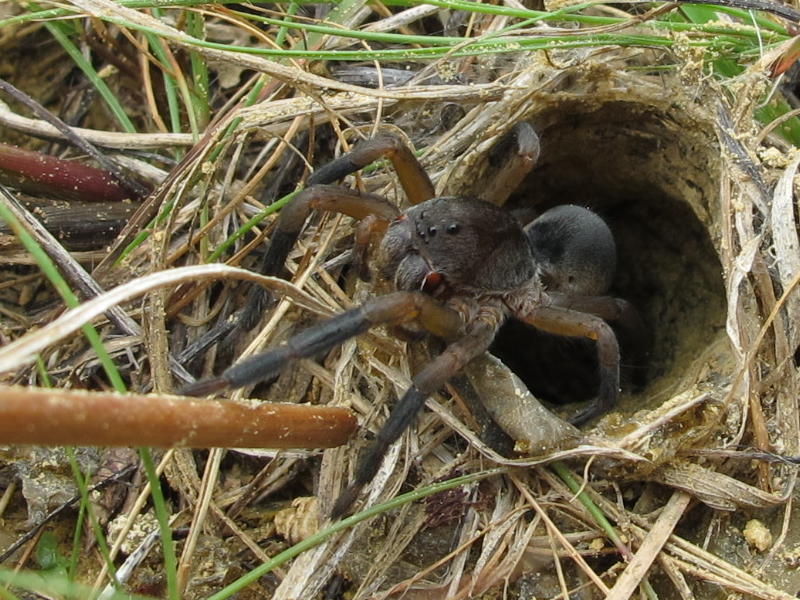
When I have the time, I’ll stop and check every spider burrow I find. These are made by the Burrowing Wolf Spider, a spider that is considered rare in Ohio. It’s a species of Geolycosa, but I still don’t know which one.


The spiders hunt by ambushing prey that wanders past the burrow. They are often near the top of the burrow, but quickly retreat when you approach. Sometimes you can get them to reappear if you use a grass stalk to mimic the disturbance caused by an insect passing by the burrow. This spider is creeping up the burrow in response to that trick.


A little more teasing and he’s almost in full sight. This trick doesn’t always work, so I was pretty excited that he was responding so eagerly.


This is about as far up the burrow as I’ve ever managed to lure a spider. I’m on my knees and elbows almost directly above the burrow and I know that any movement on my part will send the spider back down into darkness.


I guess this spider is really hungry. At this point I’m trying not to move the grass that’s almost touching the spider’s leg. I’ve got sweat running into my eyes, tiny things are biting big chunks out of my legs and for some reason, the camera doesn’t want to focus properly.


The spider must have known that I was having camera trouble. It posed while I took 20 not quite focused shots. Finally I shifted my position and the spider shot back down the hole. The definitive photos will have to wait for another day.

Sunday, June 19, 2011

Mystery Dig

Something has been digging in one of my barrens. There wasn’t a lot of evidence left behind, so I’m having a little trouble figuring out just what’s going on. The hole measures about six inches wide and three deep.


At the head of the dig there appear to be marks made by toenails.


There’s evidence of earlier digs having taken place on this site. In fact, I found this hole dug out last weekend and filled it back in the best that I could. Still no clues as to what the animal was after.


The area has a lot of bare ground, but the digging is concentrated in just one spot. There is a small island of soil just left of the dig site.


The island contains a small red cedar and a heavy patch of Indiangrass. This is where I found my only other clue.


The grass on the island has been mashed down by something either laying or sitting on it. The only animal I can think of that has sharp toenails and would curl up on a mound of grass in the middle of an open clearing is a dog.


I filled the hole and tamped it back with my boot. I’ll check this spot a little more regularly to see if I can figure out what this animal is up to.

Saturday, June 18, 2011

Little Jeff

Late spring is the time of year when you are most likely to run across a young salamander that has recently metamorphosed from a gilled aquatic organism to a lunged terrestrial creature. This baby faced individual is a Jefferson Salamander from this year’s hatch.


Jefferson Salamanders are the first to show up in the pond each winter. Egg clusters are usually present by the end of February and I’ve seen them as early as late December. Jeffersons usually take two to four months to complete their metamorphosis. The faster they develop, the less chance they have of being lost when the pond dries up.


Salamanders are normally thought of as sluggish creatures, but this little guy zipped into a hole so fast I could hardly get a picture.


Being underground is normal for these salamanders. They will spend most of their lives in burrows created in the soils of deciduous forests. Unfortunately, there is no forest anywhere near the pond. This hole disappears into what I consider to be a salamander unfriendly environment. The area does not benefit by any shade and the ground becomes hard as a brick in the summer.


The salamander and its hole are beneath this 4X4 cedar post located at the edge of my driveway. The intent of the post is to discourage people from driving across the buried copper line that brings propane to the house. The post is considered a temporary measure, even though I first put it there 22 years ago. Eventually, I’ll do some hard landscaping that will make it impossible for people to drive through. It seems to serve as an oasis for young reptiles and amphibians traveling the desert of my lawn. I find at least one young salamander under there each year along with assorted baby snakes and young toads.


The time of excessive rainfall is over and now the rain is avoiding Blue Jay Barrens. The pond continues to shrink in size and will probably be little more than a puddle by the July 4 holiday. I’m always encouraged when I find a young salamander. If I find one, that means there must have been many others that also survived to leave the pond.

Friday, June 17, 2011

Prairie Garden - Mid June

June is when the prairie garden goes through the green weedy stage. Of course I don’t consider it weedy. I call it that because now is when I’m frequently asked why I don’t mow that patch of weeds in the middle of the yard. The most noticeable feature at the moment is the Prairie False Indigo, Baptisia lactea. This tall perennial legume dominates everything, at least as far as height is concerned.


Prairie False Indigo begins growth in the late spring and suddenly shoots up tall spikes that produce creamy white flowers. A healthy plant can reach 6 feet or a little better. The pea-like flowers are attached singly to the central stalk. Leaves develop more slowly, but become an impressive display themselves later in the season. Leaf height is typically half that of the full plant.


It won’t be long before the prairie garden becomes more colorful. Butterflyweed isn’t a common plant in the more established prairies of Blue Jay Barrens, but I scattered a few seeds here to make this project a little more palatable to the uninformed public.


There may not be a lot of color, but the prairie garden is full of interesting plant features. The False Gromwell flower stalks are beginning to unfurl. The curled stalk straightens a little bit with each flower that matures. The entire stalk will be held up straight by the time the seeds are ripe.


Dwarf Plantain, Plantago virginica, is one of those plants that needs open soil in which to grow. Being an annual means that this plantain must produce a good crop of seed in order to guarantee a population next year. It’s odd that the species is so rare here, since there are so many areas of bare ground. Populations don’t seem to last for more than a few years in any one spot before dieing out. The frequency of the plant seems to stay relatively constant, but the locations keep changing.


Except for the absence of dead plant material from last year, you wouldn’t know that this area had been burned in the spring. When left unburned, the old plant residue disappears through the course of the summer as it’s consumed by soil organisms. I wonder how much the soil biota suffers when we deprive them of this organic feast.


The prairie grasses are putting on some rapid growth this spring. Excessive rainfall and above average temperatures seem to really encourage the growth of this Sideoats Gramma.


The Spider Milkweed has managed to produce one seed pod. The Milkweed Bugs are already probing for a taste of the developing seeds.


Another of the uncommon milkweeds, Green Milkweed, Asclepias viridiflora, is preparing to bloom. This is a rather inconspicuous species that only shares its charms with those who are willing to get their eyes up close.

Thursday, June 16, 2011

Pasture Thistle

Thistle flowers have to rank among the most attractive of all blooms. The bloom of the Pasture Thistle, Cirsium pumilum, presents a kaleidoscope of color when viewed from above. The early season blooms mark the beginning of the summer pasture blooming season. Being a short statured plant with a maximum height of about 18 inches, the Pasture Thistle presents its flowers before the taller growing prairie species cover it over.


A biennial species, the Pasture Thistle’s first year is spent as a basal rosette of prickly leaves. In the second year, a flower stalk shoots up from the center of the rosette. The thickness of the stalk often makes it appear mismatched to the basal portion.


Several spiny leaves grow from the stalk. A dense mass of soft hairs cover the stalk itself. The plant seems armed to defend itself against a wide array of predators. Spines could help discourage large browsers from nibbling the plant and the hairs may make it difficult for small insects to ascend the stalk.


Rows of spine tipped phyllaries, situated below the flower head, protect the receptacle where the seeds will eventually develop.


Another apparent defense against insects making their way upward to the flowers is the presence of a glutinous ridge running the length of the phyllary. Glutinous means sticky and several small insects have been trapped by this sticky strip. Pasture Thistles don’t always develop the glutinous ridge and its occurrence can vary greatly within a population. A similar thistle species, Cirsium hillii, always displays a strong glutinous ridge. Whenever I find one of these plants that is exceptionally sticky, I begin to wonder if I might have found one of the rarer C. hillii. After years of searching, I’m pretty sure that C. hillii does not occur here. C. hillii is a perennial species and would survive after flowering. Every one of the thistles that I’ve seen has died after producing seed. It’s still exciting to imagine that Blue Jay Barrens might host both species.


This has been an exceptional year for the Pasture Thistles. Normally producing only a single bloom, this year’s plants are showing two and sometimes three flower buds.


Like their larger relatives, Pasture Thistles are butterfly magnets. At this time of year, the thistles are the most abundant nectar source on the prairie. About a third of the flowers held at least one Great Spangled Fritillary.


Swallowtail numbers are also on the rise. This beauty is a Spicebush Swallowtail.


Bumblebees are frequent visitors to the thistle flowers. This fellow appears to be really embracing his floral feast.