Wednesday, May 23, 2012

Spraying Autumn Olive

I’m in the process of tracking down the rogue Autumn Olive that I cut and marked a few weeks ago, so I can treat the regrowth with glyphosate herbicide.  Even the most recently cut stems have produced suitably sized sprouts to receive a sufficient quantity of herbicide to be effective.  That’s not surprising since these aggressive invasive plants are nearly impossible to suppress.

I mapped the cut shrubs so I would be able to find them now.  The map shows the approximate location of the Autumn Olive and identifies the number of marking flags at the site.  I just have to get close and find all of the flags.  I didn’t remove the flags after spraying.  That will be done in a couple of weeks when I make my final check and treat any sprouts that managed to miss the spray application. 

Some stumps are slower to regrow than others.  The stump on the right was sprayed about a month ago.  At that time, the stump on the left was not showing any green growth.  It has obviously flourished since.  Autumn Olive has a habit of managing some new growth following a herbicide treatment, so it’s important to make a follow-up visit.  I try to make my final rounds during the first week of June.  Anything that’s going to grow will have done so by then.  It’s also important to get the flags collected before they are hidden by the rapidly growing vegetation.  The wire stemmed flags I put out this year amount to about a half mile of wire scattered around my fields.  I want to make sure it all gets removed.

While wandering around with my spray bottle, I treated a few other alien plants that have the potential for causing a disturbance to native ecosystems.  The large leaves of Common Burdock, Arctium minus, are a common sight around barn lots and farmsteads where they can reach impressive sizes.  The plant is a biennial and needs disturbed soil to provide a proper environment for seed germination.  In more natural landscapes, Burdock usually doesn’t reach the size or plant density displayed in disturbed areas.  It’s not at the top of the list as a noxious invasive, but it has enough negative qualities to make its elimination worth the effort.  The large leaves can create a dark enough shadow area that a bare spot is left when the plant dies.  The bare spot becomes an ideal seed bed for Burdock and other invasive plants.  The sticky seed heads are also a hazard to small animal life.  I have found the desiccated bodies of birds, bats and small mammals that became ensnared by the bristly hooks present on the seed heads.  Fortunately, this plant easily succumbs to a treatment of glyphosate.  A high percentage of the plants can be eliminated by applying glyphosate to just the central whorl of developing leaves.  The Burdock dies and incidental death of neighboring plants is virtually eliminated.

I also treated several Barberry shrubs.  These plants are fast becoming a problem in the woods.  I cut the Barberry off a few inches above the ground and applied glyphosate to the freshly cut stubs.  This treatment method is effective on many woody plants, but I’ve never before tried it on Barberry.  I thought this was a good time to put it to a test.  The plants were going to produce fruit this year, so cutting them eliminated the fruit and if the spray doesn’t kill them, at least it didn’t do them any good. 

Tuesday, May 22, 2012

Spider Milkweed and Caterpillar

Spider Milkweed is putting on a wonderful show this year at Blue Jay Barrens.  This is a spring blooming species that is usually well past flowering by the time summer arrives.  I thoroughly enjoy this plant.

The flowers are jumbo sized compared to other milkweed species, but seem to be the least attractive to butterflies.  The most frequent flower visitors are ants.  These small black ants are in every flower I check.

Blue Jay Barrens is at the extreme northern limit of the Spider Milkweed’s range.  This is a southern species, so I imagine cold winter temperatures are one of the factors controlling its northward expansion. 

The plants are generally long lived.  I’ve got a couple of clumps that have been around for at least 15 years.  Occasionally a plant will fail to return in the spring. On average, the number of plants continues to increase, so I’m fairly confident that Spider Milkweeds will remain a permanent resident.

I have populations of Spider Milkweed at three locations.  One is growing in dry ground on a hill top, the second is in dry, rocky ground on the upper slopes of a steep hillside and the third is in wetter soil near the base of a hill.  That tells me that the plant should thrive in any of the open areas found here.  Up until last year, I had six Spider Milkweeds growing in my Prairie Garden, but Allegheny Mound Ants moved in and chewed the plants to the ground.  I don’t know why this happened, but it makes me wonder if the ants will allow this plant to grow near their mounds.  There are currently no mounds near any of my existing Spider Milkweed populations.

All of the populations contain a few younger plants.  It typically takes several years before the plant is old enough to flower and then a couple years of small flower heads before producing the display shown in my first photo.  All of my plants of this species show a bit of a lean.  Young plants especially may grow in an almost horizontal position.

Last year, this plant hosted a batch of caterpillars of the Unexpected Tiger Moth, Cycnia inopinatus, which I photographed, but didn’t identify until they had disappeared.  I was quite excited when I discovered this to be an endangered species in Ohio.  The larvae begin feeding on the flowers and then progress to the leaves.  I found some signs of flower feeding, but could see no larvae.

I was luckier when I checked a plant in another population.  This cluster of flowers was full of larvae, at least three of which are visible in this photo. 

The larva host plant is growing on the hill behind the house, so it is in a convenient place for me to frequently check.  Hopefully, I’ll be able to follow the progress as these larvae develop.

Monday, May 21, 2012

The Lone Slipper

This Yellow Lady’s Slipper continues to be an annual source of joy and frustration.  The joy comes from greeting the plant each spring and reacquainting myself with the lovely bloom.  Frustration soon follows as I futilely attempt to locate a second plant of this species somewhere on the property.  At the end of the season it’s always just one plant.  It may develop multiple stalks, but it’s still the same plant.

The bloom lasts for weeks if not eaten or damaged. I suspect this persistence is due to lack of pollination.  A pollinated flower would wilt as the plant put its energy into seed production.  The virgin bloom just sits and waits.  This allows for long term enjoyment of the flower, but gives no chance for the development of new plants.

Bumblebees are said to be a common pollinator of Lady’s Slippers, but the chances of a Bumblebee visiting this single flower seem very low.  There’s nothing else in the vicinity of this plant that appears at all attractive to Bumblebees.  If a Bumblebee did enter this flower, it would have to be already carrying Lady’s Slipper pollen for the visit to be productive.  The odds against pollination are just too great to overcome.

Yellow Lady’s Slippers may appear quite showy at close range.  From a distance, the blooming plant blends right into its surroundings.  My search for other plants has been pretty thorough.  I’ve worked a tight grid pattern over all of the likely areas of Blue Jay Barrens and have found no other orchids. 

I wonder if this plant is a remnant of a larger population or if it is a lone colonizer.  I’ll probably never answer that question.  All I have is the hope that comes with knowing that if there’s one, there can be more.

At least that single bloom allows me to enjoy one of my favorite flower faces.  This always reminds me of a Jim Henson creation.  It might well be called the Muppet flower.

Sunday, May 20, 2012

Baby Wood Frogs

The great mass of Wood Frog tadpoles has finally made its transition into proper frog shape.  It’s really not proper to refer to these as baby frogs, since the tadpole is more accurately the baby, but the term seems to best fit these tiny miniatures that are just beginning to leave their aquatic environment.

They are already showing those characteristics that distinguish their species.  The dark patch behind the eyes and the folds of skin running along each side of the back are clearly visible.  There’s no doubt as to the identity of these little froglets.

Most of the little frogs are still showing a stub of tail.  When I looked at the tadpoles a week ago, the tail was still long and full.  Things have progressed rapidly since then.

Frogs can be seen anywhere on the pond’s surface and along the shore.  They add a bit of spice to the algae mat.

It’s unusual to have the pond covered with algae at this time of year.  Several large storms washed organic material into the pond  and that combined with unusually high temperatures to build this algae mat.  The presence of the algae doesn’t at all impact the development of frog or salamander larvae. 

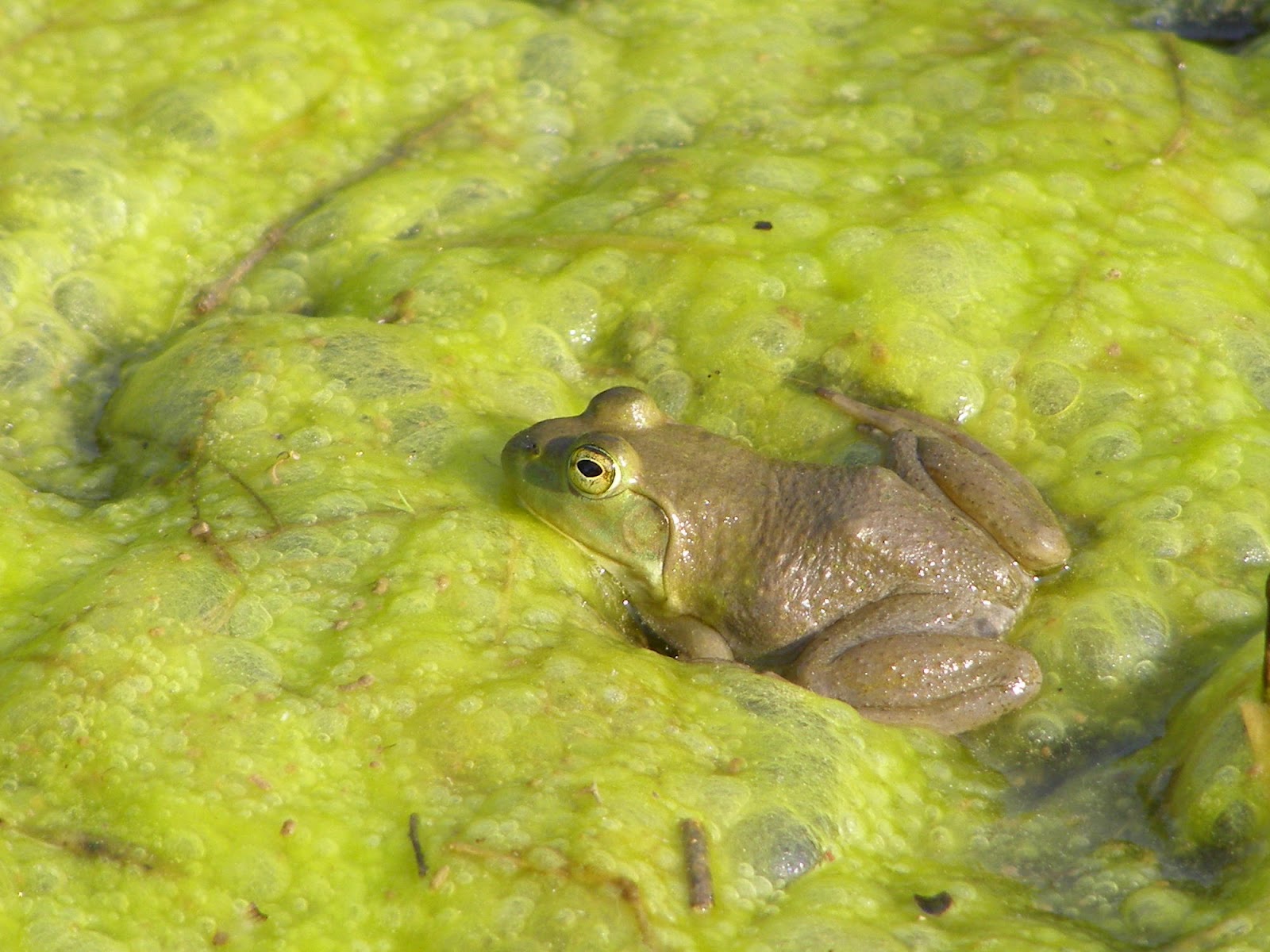
The danger to the frogs comes from this related species, the Bullfrog.  Bullfrogs have an insatiable appetite and will eat anything small enough to swallow.  This includes small frogs.

Presence of the Bullfrogs is also weather related.  Bullfrogs need a permanent body of water and don’t persist in ponds like this one that go dry in the summer.  These Bullfrogs have come from somewhere else and they do their traveling during rainy weather.  The frequent rains we’ve had this spring have been perfect for Bullfrog migration.  These are mostly younger frogs that have come in search of a permanent home.  They’ll find this home quite suitable, until the water disappears in July.
 
Most of the Wood Frogs are emerging in the area of flooded dogwoods.  That makes sense since Wood Frogs prefer a forested habitat.  After leaving the pond, the frogs will search for a suitable area in which to live.  They’ll return to breed in the pond each spring, but the majority of their lives will be spent in the woodlands.  I hope they’re lucky enough to find somewhere that suits their needs.

Saturday, May 19, 2012

Lizard on the Rocks

This is my first 2012 lizard encounter.  I found this large Northern Fence Lizard in one of the bedrock exposures on a steep, south facing slope. 


In my opinion the rocks make a perfect shelter.  I would certainly choose to live here if I was some small, vulnerable creature.


I shifted my foot and the lizard instantly looked in the direction of the movement.  These guys have excellent eyesight and always seem to see me before I see them.


The blue coloration on the throat identifies this specimen as a male.  The blue is most visible when the lizard is engaged in territorial defense behavior or courtship activities.


It doesn’t look like there’s any shortage of food items in this jumble of rock.  I seldom see lizards that are as plump as this fellow.


After a while, the lizard headed away and disappeared beneath one of the rock slabs.  He looks as though he’s daring me to follow.


I always give the rocks a look when I’m in the area, on the off chance that some animal will be out moving about.  I think they usually see me coming and make themselves scarce. 

A Camera Critters submission. 

Friday, May 18, 2012

Spraying Walnuts

Walnut sprouts have just reached the stage where they can be successfully treated with glyphosate herbicide.  Walnuts are the most frustrating of the many plants that I control through use of herbicides.  They begin to grow late in the spring and then grow so rapidly that they quickly become too large to safely spray without killing everything in the surrounding area.

Each walnut was marked with a red flag as it was cut, so I would be able to find the sprouts now.  The warm temperatures early in the spring caused many plants in the vicinity of the walnuts to grow remarkably fast.  The sprouts are difficult to find in the mass of vegetation.

The compound leaves of the walnut spread far to each side of the stalk.  The small leaflets make it difficult to spray without also covering neighboring plants.  Fortunately, the area most affected by walnuts is thick with Tall Fescue and other farmland relics that also need to be eliminated.

Many walnut sprouts don’t spread their leaves until they reach heights in excess of one foot.  This means that you can’t safely spray on days that have any noticeable wind.  You also can’t spray if the leaves are wet with dew or if you are expecting rain.  So to successfully spray walnuts, you must wait for those few days that the sprouts are at the optimum size and hope you can find a few hours when it’s not dewy, windy or rainy.  That can be awfully hard to do.

My area of walnut infestation is in the field directly behind the house.  Since I look at this field every day, I’m trying hard to create a view without invading walnut trees. 

The walnuts in the field came from nuts produced by trees in the yard.  These trees were planted by the previous owner and are one of the worst trees to put in a lawn.  I finally got tired of dealing with the nuts and stopped mowing around the walnut trees.  Squirrels now do me the favor of carrying the nuts off and burying them all over the place.  I know that some people have trouble growing walnuts from seed, but at Blue Jay Barrens all you need to do to get a seedling is put the nut on the ground.

Thursday, May 17, 2012

Black Rat Snake

I don’t post every one of my snake encounters, but I always take pictures.  Besides having a basic liking of snakes, I feel they have an important role in my overall management efforts.  I try to manage for healthy plant and animal communities.  I’ve always believed that an indicator of ecosystem health is its ability to support higher level predators.  The snake would not survive if the plant and lower animal base was not able to support the snake’s animal food supply. 

I found this Black Rat Snake searching a fallen log for potential prey items.  In this area, snakes are not normally considered top of the line predators.  There are still plenty of animals that would make a quick meal of this guy.  I assign importance to the snake population because that’s about the highest order predator that can sustain its existence totally within the Blue Jay Barrens Boundaries.  My small property can’t begin to sustain larger predators such as Coyotes, Hawks or Owls that may hunt over many square miles.  Individual Raccoons or Skunks may be able to live out their lives here, but there’s not enough area to maintain a viable population.  In making management decisions, I concentrate on those species that will most benefit by my activities.  Snakes fit neatly into that category. 

The snake checked out the entrance to every hole in the log.  Most of my Black Rat Snake encounters are around my house or barn, so I really enjoyed watching one in a more natural setting.

Failing to find any signs of possible prey, it continued its journey along the log.

At one point it crossed over and continued back along the other side.  Visibility of a light banded pattern is enhanced as the snake stretches its body across the log.  This pattern is the best long distance method of distinguishing the Black Rat Snake from the solid black Black Racer.  For some reason, many people prefer to make their identifications from a distance.

I wasn’t luck enough to witness the capture of prey.  After watching the snake unsuccessfully search both sides of the log, I moved on and left it to its hunt.