Friday, June 13, 2014

Kissing Krigias

I’ve been paying special attention to a small pot of Potato Dandelion, Krigia dandelion.  This pot contains the plants that escaped, with the help of a Chipmunk, from a much larger container of Potato Dandelions that had been established for many years.


This is what the plants looked like back in early April when I moved them from the middle of a junk pile into a pot of rich soil.  In just about every account I read of Krigia Dandelion it states that this plant is hard to transplant and grow.  That information comes from a 1963 publication by Julian Steyermark entitled Flora of Missouri in which Steyermark states “it does not transplant well and is difficult to grow.  It has been tried several times with failure in the author’s northern Illinois wildflower preserve“.  In my experience, Potato Dandelion is quite easy to transplant, especially if you are working with the dormant tubers.  It also grows with great vigor.  I think people have misinterpreted what Steyermark actually meant.  The quote seems to be saying that the plant is difficult to establish into a new, natural site.  With this I have to agree.


This is what those scrawny transplants look like now.  Potato Dandelion grows like a weed when protected from predators and relieved of competition from other plants.  If a natural site could be found that offers those advantages, there would be no stopping this plant. 


The pot was left sitting on a picnic table in a location that received nearly full sunlight.  Over 40 flower stalks emerged from the original 10 plants.  It will be interesting to see how many new tubers have been created in this small pot.


Potato Dandelion is a member of the Aster family and each bloom is a collection of individual flowers all arising from a common base.  Each flower has a single attending petal, so a count of the petals identifies the number of flowers present at the top of the stalk.  Each of these petals should be able to produce a seed.  Unfortunately, most of the flowers fail in their reproductive duties.


Pollinating insects regularly visit the flowers.  Most common are small bees and beetles.


This species of Jewel Beetle has been very common this year.  I believe this to be Acmaeodera ornata, but my references only cover about 20% of the species that could be encountered in this area, so I’m never completely sure I’ve arrived at the proper identification.  Whatever the species, the beetles were usually carrying a dusting of pollen on their bodies as they moved around the flowers.  You would think that type of activity would certainly result in some pollination.


In an attempt to increase the chances of pollination, I went out each day and forced all of the open blooms to kiss each other.  This process has got to be moving some pollen around.


So far, there have been no seeds produced, just empty husks.  Sometimes, plant species that reproduce themselves vegetatively can form large colonies of individual plants that are essentially clones of each other.  If that species needs to receive pollen from another plant in order to produce seed, that pollen would have to come from a plant that is not its clone.  It’s possible that Potato Dandelion fits that description and I’m dealing with a clone population that is basically all the same plant.  If that’s true, I may never get any seed.

Wednesday, June 11, 2014

Big Year for Angle-pod

One of the great things about botany is the never ending opportunity to discover things weird and beautiful.  I’ve got a memory full of WOW moments commemorating those special occasions when I first set eyes on a species of plant new to me.  One of the jewels of that collection is a remembrance of my first encounter with a blooming Angle-pod, Matelea obliqua.  This plant doesn’t skimp when it comes to weird or beautiful.


A single flower looks bright in the sunlight, but in the shadows, it is more of a deep burgundy that blends well into its surroundings.  On my first encounter, the flower cluster was almost in my face before it was noticed.  I just stared at it for some time before settling back to determine what it was.


Since then I have become quite familiar with this plant.  It has a habit of being an infrequent bloomer at Blue Jay Barrens, so I’m always thrilled to discover the flowers.  Weather conditions must have been just what were needed this year to encourage flower production.  Blooms are more abundant than I have ever seen them in the past.


The leaves are much more noticeable than the flowers.  Large leaves pair up along the stem and stand out in most types of mixed vegetation.


I most often find Angle-pod growing in open woods where it is liable to intercept a couple of hours of direct sunlight during the day.  It’s rare to find it beneath a closed canopy and I have never seen it growing out in the open.


Angle-pod is a vining plant that commonly sprawls across the top of surrounding vegetation.  Most of the tall growing plants have not yet developed stems capable of holding the additional weight of the Angle-pod and will bend or break if the vine tries to climb them. 


Angle-pod will climb if given support.  Out of a dozen plants in this spot, only one was doing much in the way of vertical growth.  I’m hoping that the abundance of blooms will result in some seed pods being produced.  I have yet to see an Angle-pod seed pod.  I’ve high hopes that will change later this summer.

Monday, June 9, 2014

Fence Lizard on a Fence

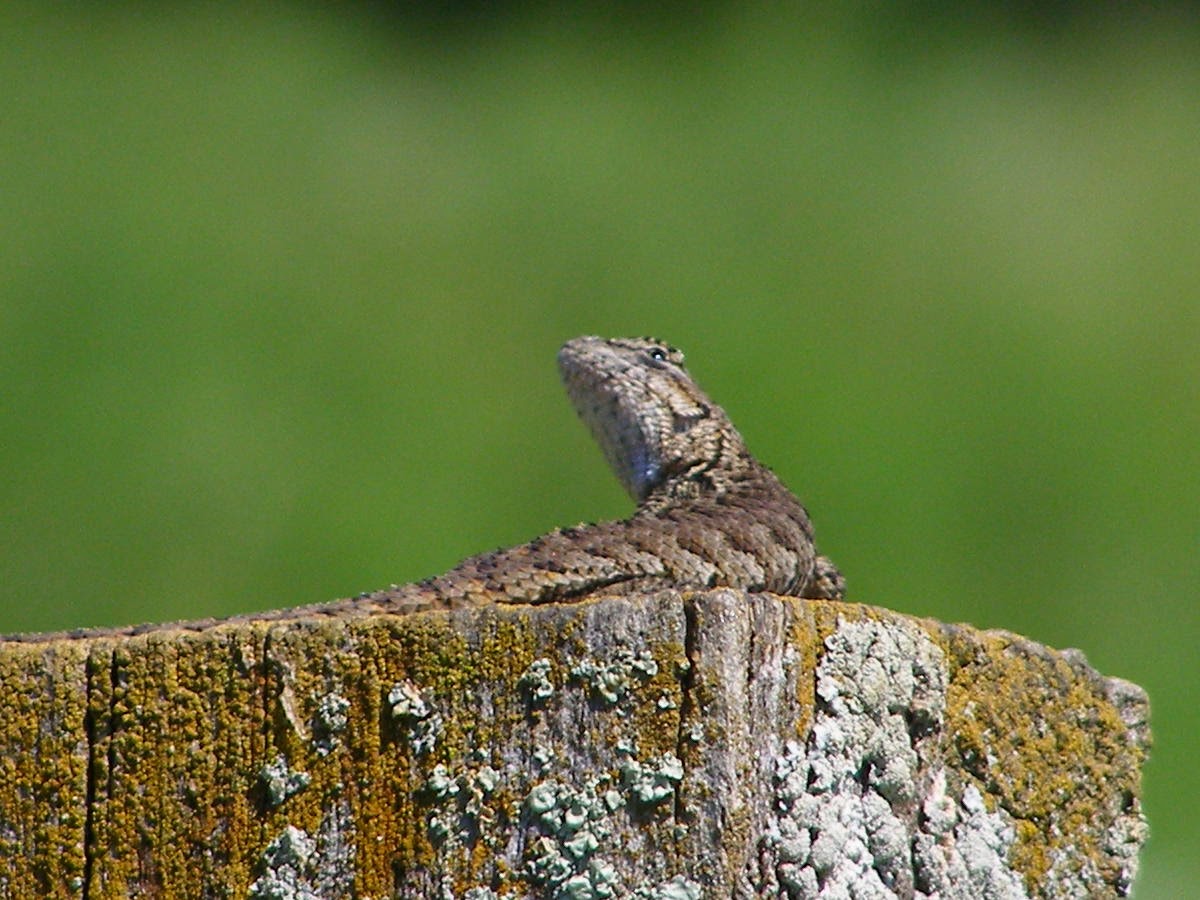
I’ve had hundreds of encounters with Northern Fence Lizards at Blue Jay Barrens.  My most recent encounter has the distinction of being the only time I’ve actually seen a fence lizard on a fence.


The lizard zipped up to the top of a fence post and gave a couple of head bobs, typical behavior for a male lizard.  Instead of the bright blue sides and throat normally associated with the male Northern Fence Lizard, this individual displayed only a blue blush in the throat area.  I recently read of research done by biology professor Tracy Langkilde of Pennsylvania State University in which she states that a high proportion of female Fence Lizards display some degree of blue coloration.  This fact effectively invalidates my previous assumption that lizards sporting blue coloration had to be males.  Limited head bobbing is also practiced by females of many lizard species, so I’m calling this one a female with weak male characters.


Any wild animal lounging in the open has to keep an eye to the sky in watch for avian predators.  The only things passing over this day were Tree Swallows.  The lizard glanced up each time one of these birds came near.


In between bird passes, a search was conducted for any insects that might make a suitable meal.


The fence posts are of native cedar locally grown and milled.  In the 25 years since they were installed, the posts have become a foundation for a variety of lichens and mosses.  I think this makes them more attractive to native wildlife such as the Northern Fence Lizard.


Even though this is the first time I’ve seen her on the fence, the lizard has been in the garden for several weeks running along the planting beds or scurrying across the mulched paths between.  She normally pays little attention to my activities.


If she doesn’t worry about me, it means that I have to worry about her.  Her coloration closely matches that of the garden soil and mulch.  I don’t want to discover that she has been trodden upon, so I’m careful to watch where I put my feet.


So far, she’s stayed close to the native planting part of the garden.  I see her most frequently darting in and out of the Ashy Sunflower and Prairie Dock thickets.


At other times I find her just lounging around.  Here she is taking in the morning sun.  She’s totally relaxed and not at all disturbed by my moving around nearby.  I’m looking forward to having her as a gardening companion through the summer.

Friday, June 6, 2014

Turtle and Ants

While on my way to the garden, I discovered this Eastern Box Turtle sitting at the edge of the mowed path.  I recognized this female as one who typically spends her summers feasting on fallen tomatoes.  Last year she had a decided preference for the taste of Early Goliath.  I made sure there was always a ripe tomato on the ground for her dining pleasure.


When she stuck her head out as I approached, I got concerned about the condition of her eye.  Eye infections are usually a sign that the turtle is in poor health.  I hated the thought of losing a friend I’ve known for so long.


Closer inspection revealed that the eye was in fine shape.  It was just closed.


The eye was closed for good reason.  The turtle was hosting a party of Allegheny Mound Ants.  The ants didn’t seem to be biting.  They were just investigating, as they would with any other stationary object found in their territory.


As I watched, more ants joined in.  The turtle had stopped right on top of a foraging trail and every ant to come along climbed on.  I’m wondering if the ants might be performing a cleaning service for the turtle.  They might be checking the turtle over for parasites or other hitchhikers and removing those undesirable pests.  The turtle stayed in place for another ten minutes and then wandered away.  If it had really been bothered by the ants, I figure it would have moved on much sooner.


The ants certainly did not treat the turtle in the same manner that they treated my feet.  If I stayed still long enough, they would probably clean me down to the bone.  The ants are fast moving and biting when on my feet, but they are calm and searching when on the turtle.  I think the ants and the turtle have a special relationship going on.

Wednesday, June 4, 2014

Kestrel Raids Nest Box

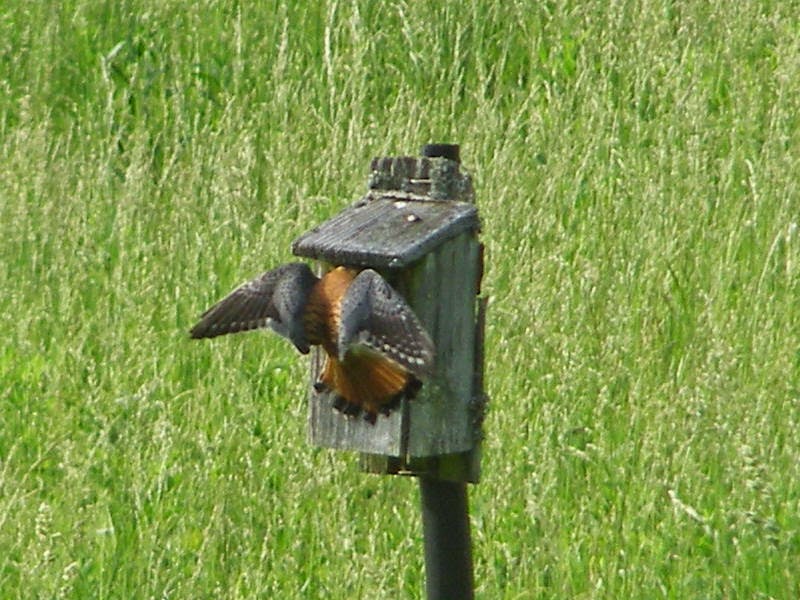
While walking the field trail I heard a commotion of Tree Swallows just beyond the next small hill.  Babies were yelling and adults were excitedly giving their distress call.  I assumed a predator was at work and hurried ahead with the expectation of finding a Black Rat Snake making a meal of baby birds.  Instead, I saw this American Kestrel perched atop the bird box.


The parent birds were in the air doing their best to encourage the kestrel to move on.


All they could manage was to make the Kestrel duck as they came over its head.


Then the Kestrel dropped down to the front of the box and made a determined effort to reach the young birds inside.


There was a great amount of flapping and shifting of position as the Kestrel worked to get its head and neck through the nest box entrance.  I expected a baby Tree Swallow to be pulled free at any instant.


The Kestrel was not rewarded for its effort.  This model bird box has an extra piece added to the front that extends the depth of the entrance hole.  The intent of this design is to make it more difficult for predators to reach in and down to the nest.  Apparently it is doing its job.


But the Kestrel just couldn’t resist giving it another try.


This must have given the young birds quite a scare.  The Kestrel has its full neck thrust into the box and its head is surely hanging just above the babies.


That had to be one frustrated bird.  No amount of trying was going to result in a meal being taken from this box.


Finally, the Kestrel turned its back and gave up.  I watched it make five separate attempts to reach the nestlings and it had obviously made some attempts before I arrived on the scene.  After resting for a moment, it flew off across the field and disappeared.  A minute later, the parents were back with food for the youngsters and life went on as before.

Monday, June 2, 2014

Dung Beetle

I was preparing to dip some water from one of my rain barrels when I found this beetle floating inside.  It appeared dead, but its legs moved when I plucked it from the water and it became more animated as it dried.  This beautiful beetle, Dichotomius carolinus, largest of the local Dung Beetles, was cause enough to take a break from my work to examine this magnificent specimen.


The beetle at first appeared to be adorned with pale stripes.  Closer examination revealed the stripes to actually be soil caked into grooves on the wing covers.  Dung Beetle larvae develop in the ground at the bottom of a deep burrow where they feed on a supply of dung placed there by the adult beetle.  The beetles can accumulate soil on their bodies when digging nest burrows or when burrowing out of the soil after pupation.


This is one tough beetle.  It measures just an inch or a little better, but feels like a stone resting in the palm of your hand.  If you try to hold it in a closed fist, it will use its strong front legs to force your fingers apart.  The photo shows the pose the beetle adopts when it begins digging.  Front legs try to force the soil sideways while the scoop shaped head forces lose material up and away.


All six legs are designed for digging and scooping.  Dung beetles feed on manure produced by large mammals, primarily domestic cattle and horses.  Their actions in a pasture situation are considered beneficial to the plants and soil because of the burrows and incorporation of manure into the soil profile.  Livestock also benefit by the rapid reduction of concentrated manure which results in fewer pests and parasites surviving within the manure piles.  Several exotic species of Dung Beetles have been intentionally introduced into the United States in an attempt to maximize the benefits of this group of insects.


Dichotomius carolinus is a native species and is typically not the most abundant Dung Beetle species in an area.  Most dung beetle research concentrates on grassland areas dominated by domesticated livestock, so the beetles are interacting with non-native species.  I wonder if this Dung Beetle species utilizes manure from the Whitetail Deer?  I’m sure they would have used manure from Bison, but Bison were extirpated from Ohio over 200 years ago.  The deer is the largest free ranging native ruminant in this area and hopefully produces a large enough concentration of manure to satisfy this particular Dung Beetle.  I may have to set up a couple of deer manure traps and see what shows up.


I found this neat mite living on the beetle’s body.  I’m not sure if it is actually a parasite or if it is just hitching a ride.  Each individual manure drop supports its own special ecosystem in which myriad species feed upon the manure and each other.  Some species are able to move from one manure source to another on their own power.  Species with limited mobility often use the more mobile species as transportation to fresh manure.


The mites preferred lodging was beneath the head near the attachment of the front legs.  That’s where it was when I set the beetle free.  Hopefully, both beetle and passenger found their way to fresh manure.

Friday, May 30, 2014

Orchid Colonization

As a youngster, I always thought of orchids as being extremely delicate plants that needed exacting conditions in order to grow and flower.  I probably formed that opinion from watching TV shows in which hothouse orchids expired from encounters with cold drafts or little boy’s fingers.  I held on to my opinion until adulthood, but things changed when I was introduced to some of Ohio’s resident orchid species.  If these plants could survive the wild extremes of our weather patterns, they must possess a healthy dose of toughness and stamina.  The Blue Jay Barrens orchids, such as these Large Twayblades, express some of those qualities.


These orchids are growing in what, 30 years ago, was an annually plowed field devoted to the production of agricultural grain crops.  This exact spot is near the edge of the field in a location that was also used as a travel lane to move harvest equipment in and out of the field.  I planted a White Pine windbreak here 28 years ago that has since developed into a pine shaded strip with a thick bed of needles.  Into this, orchids have arisen.


If these flowers are properly pollinated, there will result a multitude of tiny seeds that are light enough to be picked up and carried long distances by the wind.  Those seeds just have to find the proper environment in which to germinate and develop new plants.


It’s encouraging to think that the cropland soil could recover sufficiently in less than 30 years to be the proper medium for an orchid plant.  This event doesn’t fit my earlier perception of orchid behavior.  Highly compacted, heavily eroded cropland soil just doesn’t seem to be an ideal environment in which to find a plant as exotic as an orchid.


What was once a single blooming plant has become two.  This small leaf, growing beside the two mature plants, is indication that next year may bring a trio of blooming orchids.


Marked by sticks on my walking path is another species of orchid that has found the old crop field a suitable site for colonization.


Ragged Fringed Orchid is a plant of the open fields.  Unfortunately, it’s hard to see when growing in a field full of tall grasses.  Each year I mark those growing up in the trail, but something always seems to happen to them before they bloom.  I’m hoping one will produce a flower so I can get some photos.


This plant is looking quite healthy.  That bud should produce an impressive display.


This one isn’t faring nearly as well as the first.  Weevils have been feeding heavily here.


A third has succumbed to some type of wilt.  I’ve seen Ragged Fringed Orchids blooming in the field in the past, but that was pre digital camera.  I’ve already give it credit for being a tough plant and it has certainly established itself widely across the field.  It would just please me greatly if one of those tenacious plants would favor me with a flower.