Monday, May 11, 2015

Black Rat Snake

Yesterday, I had my first Black Rat Snake encounter of the year.  I usually find them basking in the sun at this time of year, but the high temperatures have topped 90oF every day this past week, so there has been no need for snakes to seek the sun for warmth.  I think this is a good photo for people with a fear of snakes.  Who could be afraid of an animal that is powerless to stop a fly from riding along on its nose?  Oh, maybe some people didn’t stick around long enough to notice the fly.

The snake was emerging from the unmowed area surrounding the bird feeders.  This area is directly between the barn and the house, and is often used by the snakes as they move back-and-forth between the two structures in their constant search for mice.  This individual is making its way to the house.

The bright sunlight makes it easy to see the pattern on the snake’s skin.  So far, I have yet to see a Black Rat Snake that has grown large enough to completely lose the pattern of its youth.

The snakes enter the house through the garage door which is on the side away from the barn.  I’ve watched many snakes make the trip along the house foundation on their way to the snake access left open for them at the lower corner of garage door.  I’ve noticed some mouse activity near my bird feed storage area, so I’m sure the snake will find a couple of easy meals.  Using the bricks as a measurement aid, I think this snake could just make five feet long.

I’m still learning how to use the video features of my camera, so I have once again attached a video to my post.  The stairwell leading to an old cellar beneath the house acts as a minor obstacle to the snakes.  Instead of going around, they crawl down one side and up the other.  I filmed the snake as it left the stairwell and continued its journey towards the garage.  The video can also been seen on YouTube by clicking HERE.  I usually must reduce the size of the video file in order to post to Blogger, so the YouTube version is often has much more resolution.

Friday, May 8, 2015

Foggy Virginia Pines

While out working yesterday, I noticed periodic clouds hanging around a clump of Virginia Pines.  It was as though little wisps of fog were drifting from the branches.

Like many plants at this time of year, pines are in full bloom.  The flowers aren’t showy, but they stand out nicely against a background of green pine needles.

Pines produce separate male and female flowers that appear at different locations on the tree.  These are male flowers, responsible for producing large quantities of wind born pollen.

The slightest breeze carries clouds of pollen away from the flowers.

Giving the branch a light tap releases an avalanche of pollen.  As a child, I learned that tapping a pollen laden pine branch, beneath which my sister was standing, was a sure way to get caught up on the current disciplinary doctrines being practiced by my parents.

This is the female flower, the desired destination for all of that pollen.  It looks like plenty has found this particular flower.  Of course, most of the pollen never reaches this point.  It’s wind carried pollen that is the bane of many allergy sufferers.

There is a small area that I have allowed to grow up into a pine thicket.  The thicket grew up around a few large Virginia Pines that had managed to colonize the field several decades ago.  There are a few other single large Virginia Pines scattered around the fields, but the small trees surrounding them were all cleared away to make room for the prairie vegetation.  Since the Virginia Pine is a native species that arrived here under its own power, I thought that a miniature pine forest might be an interesting addition to the diversity of ecosystems found at Blue Jay Barrens.

Other than some refreshing shade and a wealth of pine cones, the pine thicket hasn’t produced anything of remarkable interest.  Solid stands of young pines are notorious for having an almost desert like floor.  I’ll give it a few more decades to see what develops.

In an area dominated by brown and green, this rough orange growth encircling a pine branch was easy to notice.

This is a fungal disease know as Eastern Pine Gall Rust or Pine-Oak Gall Rust.  The infection starts small, but in a few years can form a raised collar as seen here.  The gall can remain active for up to ten years.  In the spring of the year, orange spores are produced that travel by the wind to infect oak trees.  Infected oak leaves produce hair-like galls on their undersides which release spores that infect pines.  This two host system means that spores released by the gall on the pine cannot infect another pine and spores from the oaks cannot infect other oaks.  Without pines and oaks in close proximity, the fungus cannot survive.

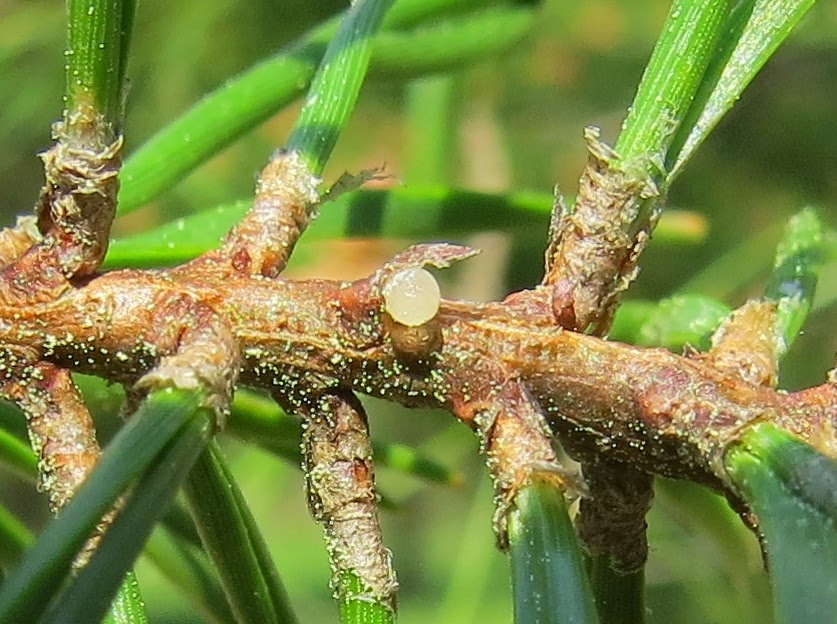
The pines are host to many types of interesting small animals.  Whatever hatches from this egg will probably be a consumer of pine needles.

This exit hole was left by some insect that spent its larval stage consuming the inside of a young pine cone.  With its seed cavity cleaned out, the cone died.

As with most plants at Blue Jay Barrens, Virginia Pine serves as host to numerous aphid colonies.  Where there are aphids, there will be Allegheny Mound Ants.  It is uncommon to find any aphid colonies here that are tended by other ant species.

I found these large aphids to be particularly interesting.  When disturbed, the mature aphids would break from the pack and run up the branch.  Most aphids have a top speed that would be described as a fast walk.  These aphids moved just as quickly as one of the scurrying ants.  I believe these aphids are of the genus Cinara, AKA Giant Conifer Aphids, but if I was charged with the task of assigning an appropriate common name, I think I would to call them the Running Aphid.

Monday, May 4, 2015

The Change to Summer Birds

I keep the bird feeders filled with sunflower seeds and cracked corn year round.  Although the diet never changes, the species of birds visiting the feeder vary from season to season.  The last few weeks has seen the arrival of what I think of as the summer visitors.  Many of these, like this Blue Grosbeak, would be difficult to view if they didn’t regularly visit the feeder.

Even though they are permanent residents in this area, I rarely see Brown-headed Cowbirds in the winter.  During the summer, I routinely see them at the feeder.  They are also to be found stationed atop the tallest trees around the property, watching to spot nest locations in which to lay their eggs.

A gathering place for birds that don’t typically visit the feeder is the vegetable garden.  Brown Thrashers patrol back and forth along the vegetable rows, plucking larvae from the plants and pulling grubs or cutworms from the soil.

Chipping Sparrows search the garden for both seeds and insects.  This guy kept chasing and eating some type of insect moving quickly across the planting beds.  He captured several in just a couple of minutes, but I never got a look at what he was hunting.

Field Sparrows have found the mulch of cut grass in the garden to be ideal nest material.  They are frequently seen leaving with mouths full of the fine grass stems and leaves.  The top of the fence is  a favorite perch.

Bluebird pairs seem to find an abundance of suitable insects inside the garden boundaries.  The female sits on one post …

… and the male usually sits on the next post over.  When an insect is spotted, they will fly down to pick it up and then return to the post.

With all of those garden insects to feed on, it’s no surprise that the Bluebird couple claimed the bird box nearest the garden.

The female has just begun incubating this clutch of five eggs, so I probably won’t be seeing much of her for the next couple of weeks.  After that, she’ll be busy ridding the garden of insect pests in order to feed her growing family.

With their aerial displays and propensity to chatter, Tree Swallows are usually the most noticeable of the summer birds at Blue Jay Barrens.  These birds were uncommon here 25 years ago.  When I first installed bird boxes, they were all occupied by Bluebirds of Chickadees.  Now, 80 percent of the box inhabitants are Tree Swallows.  The shallow pool of water at the site of my new toad pool construction has been getting a lot of attention from the swallows.

The area that has been stripped of vegetation seems to be a preferred site for the collection of nest material.

The final phase of Tree Swallow nest building is the addition of feathers around the rim of the nest.  The birds almost always use feathers from domesticated chickens or ducks.  The battling Wild Turkey males leave an almost daily offering of feathers in my yard, but the Tree Swallows don’t find them of interest.  Maybe they just have a preference for white feathers.

No Tree Swallow eggs have yet been laid, but I imagine that will change soon.  By the time the last of hatchlings leave the nest in late summer, the resident population of Tree Swallows will be about four times what it is now.

Friday, May 1, 2015

Tadpole Feeding Frenzy

The Wood Frog tadpoles have been growing rapidly and have just about eliminated algae and soft plant material from the pond.  In a typical year, the waste produced by the tadpoles acts as a fertilizer to stimulate the growth of algae which the tadpoles then eat.  As the tadpoles grow, they produce a greater quantity of waste which makes even more algae grow.  The excess rainfall we have had during the past few weeks has diluted the concentration of nutrients in the pond and slowed the algae growth.

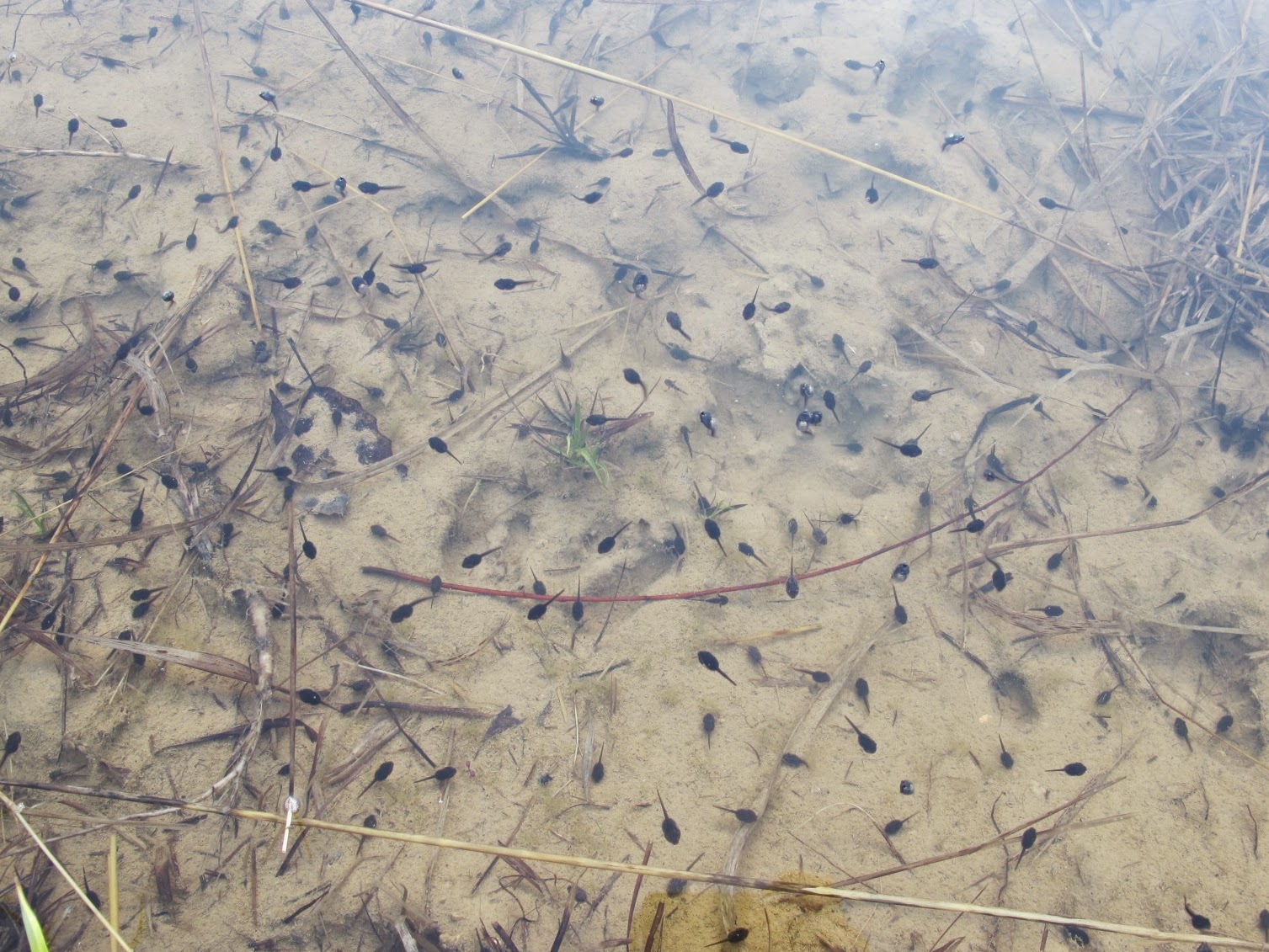
This is a typical Wood Frog tadpole dispersal pattern.  Each tadpole is engaged in a random search for food.  They nibble their way across the pond bottom, check every surface of submerged plant material, and even turn belly up to skim the film of pollen grains from the water’s surface. 

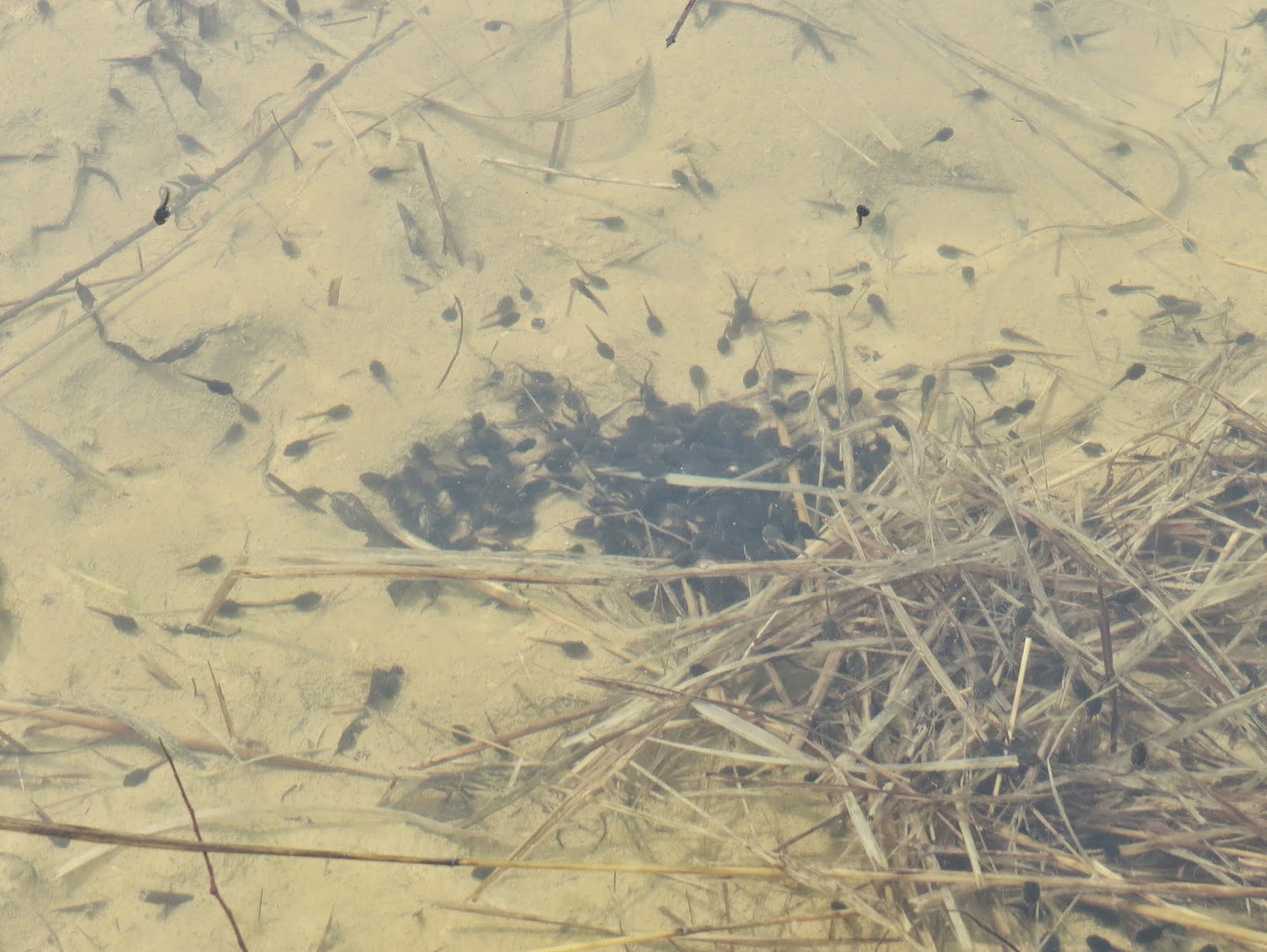
Occasionally, an especially appealing food source will cause a pile-up of tadpoles.

These tadpoles are all competing for some tasty morsel hidden from view by the mass of tadpole bodies.

This short video reveals the source of their excitement.  A chance to nibble on a drowned worm is the prize in this competition.  At this point the worm seems to have been broken into several sections.  One section of worm becomes visible when it is drug to the top of the heap and pulled out of the picture at the top of the frame.  As the tadpole runs off with the leading edge of the worm, three other tadpoles get pulled along for the ride.  The lead tadpole is only out of the picture for a second before it comes right back in and dives into the same confusion it had just escaped.  Its three followers are still trying hard to get some of the worm for themselves.  I’ve witnessed this same type of behavior directed towards a variety of partially decomposed small animals.  Tadpoles thrive on algae, but they love a bit of meat in their diet.  The video can also be seen on YouTube by clicking HERE.

Wednesday, April 29, 2015

Woodcock Nest Finale

Monday afternoon, during my daily visit to check on the Woodcock eggs, I discovered the nest site in a state of disarray.  It wasn’t torn apart, but the nest location was distinctly more visible than before.  I hurried forward to see if the change was due to a visiting predator, or a successful hatching.

It was a hatching, although not one that was completely successful.  Two of the original four eggs remained intact.  The other two looked to have released live chicks into the world.  Unfortunately, the young birds were long gone by the time I arrived on the scene.

The empty shells show all of the signs of a successful hatching.  The chicks peck in a circular pattern around the large end of the egg.  The series of cracks allows the end of the shell to lift off like a lid.  Occasionally, the chick’s toenails will make puncture marks in the small end of the egg as it pushes itself out of the shell.

During the time these eggs were incubating, there have been several thunderstorms and two flooding rains, and temperatures have ranged from 25oF to 82oF.  During the time this clutch was being laid there was a storm that produced 2.2 inches of rain and flash flooding.  The location of this nest in the low area next to the creek could easily have been flooded.  It’s possible that the two unhatched eggs were killed during that event.  Woodcocks only produce one brood per year, so I hope the two hatchlings are lucky enough to survive to adulthood.

Friday, April 24, 2015

Woodcock Eggs

I’ve been making daily checks on the nesting Woodcock I posted about last week.  I don’t get close.  There are two large cedars about 35 feet from the nest that make a good hide.  A gap between the two trees is just wide enough for me to use my camera to zoom in on the nest and check the bird.  She has been facing a different direction on each visit, but she sticks tight to the nest.

Wednesday afternoon I saw this.  No woodcock in sight.

I moved in on the position and spotted four eggs.  The uncovered eggs are much easier to see than the sitting bird.

These birds don’t really make much of a nest.  Some of the material at hand seems to be rearranged a bit to make a depression deep enough to keep the eggs clustered together. 

The eggs were still slightly warm to the touch, so I was fairly confident that the Woodcock hadn’t been gone long from the nest and was probably close by hunting for worms.  The nearby area along the small tributary displays many holes left by feeding Woodcock.  I didn’t want to disrupt her return to the nest, so I left the area as soon as I captured a couple of images.

She was comfortably back on the nest the next day.  I’ll keep checking in hopes of viewing the newly hatched chicks.  The female leads the chicks off as soon they have all hatched and dried.  I’ll have to be extremely lucky to show up at just the right time for a sighting.  At least I should be able to find some broken egg shells.

Monday, April 20, 2015

Mid-Season Potato Dandelions

The container grown Potato Dandelions, Krigia dandelion, are growing so rapidly that their image changes daily.  As long as I employ methods to exclude predators from the container, the plants flourish.  The abundance of leaves provides energy for the production of flowers and underground tubers.  A single plant may produce a dozen or more tubers during the spring growing season.  At this rate of reproduction, it doesn’t take long to build up a large population.

I thought this would be a good time to check on the progress of Potato Dandelion plants growing from tubers planted last fall into this ridgetop site.  This most closely matches the site of the original Blue Jay Barrens population of the rare Potato Dandelion.

A combination of wind and rainfall runoff patterns create patches of bare ground in this area.  Plants growing in these bare spots receive enough sunlight to stimulate production of flowers.

Some of the plants are looking quite healthy.  All of this growth has arisen from a single bean sized tuber.

Other plants have suffered damage from foraging Wild Turkeys.  Turkeys also create patches of bare ground, but at a cost to the plants.

I originally planted some tubers at the base of this cedar.  Turkeys chose this location as a place to take dust baths, and created two large wallows.  What once looked similar to the area in the right foreground, is now devoid of plants.

Potato Dandelions at the original site struggle to put their leaves up through the leaf litter.

The extra effort necessary to push leaves up through the leaf litter is enough to cause these plants to fail to flower.  I will occasionally clear the fallen leaves from a small area and allow the plants to produce flowers.  It’s nice to see the plants bloom, but since the flowers don’t seem to produce any viable seed, the activity give little benefit to the population as a whole.  The non-flowering plants still produce many new tubers, so the population continues to expand.

There may be other populations of the plant at Blue Jay Barrens, but there is only a narrow window in the spring when the plants are easy to see and finding them is complicated by the presence of the White Trout Lily, Erythronium albidum.

White Trout Lily is probably the most abundant woodland spring flower growing in the uplands at Blue Jay Barrens.  The shape and color pattern of the young Trout Lily leaf is remarkably similar to that of the Potato Dandelion.  That’s the Trout Lily on the right.  With hundreds of Trout Lily leaves in view at any one time, it’s easy to see how a random Potato Dandelion leaf could escape notice.

As long as my container grown plants continue to produce plenty of tubers, I will transplant the excess into suitable locations.  It doesn’t look like I’m in danger of having a shortage.