Showing posts with label Allegheny Mound Ants. Show all posts

Sunday, May 28, 2017

Edwards' Hairstsreak Larvae - Night Feeding

Within the Blue Jay Barrens prairie openings are a scattering of medium to small sized Blackjack Oaks.  Some of these trees are decades old, but various environmental factors keep them from getting very large.  Dry site conditions limit water available to the tree, White-tail Deer find them to be the perfect choice for rubbing antlers, Periodical Cicadas cause a dramatic die-back every 17 years and a wide variety of insects find the leaves extremely palatable.  I make several close examinations of these trees each spring as I follow the development of the Edwards’ Hairstreak butterfly larvae, one of those species with a dietary preference for Blackjack Oak.

Edwards’ Hairstreak eggs hatch just as the oak buds begin to swell in early spring.  The larvae feed on the buds and newly developing leaves.  On May 8, temperatures dropped to 29°F causing frost and freeze damage to many plants.  Damage to Blackjack Oaks varied between individual trees, but all suffered the loss of some new growth.  This was a setback for both the trees and the Edwards’ Hairstreak larvae.  Fortunately, buds were not affected and regrowth was rapid.

When I checked the Blackjack Oaks three days ago, the leaves were showing signs of heavy predation by the Edwards’ Hairstreak larvae.  When this magnitude of damage occurs to the leaves it is a good indicator that the larvae have reached their final instar stage and will soon be pupating.  At this point it does no good to search the tree for larvae, because they do not spend the day in the open.

Young Edwards’ Hairstreak larvae remain in the open feeding through the day.  When they become older, they feed only at night and spend the day at the base of the oaks, hidden in cavities constructed by Allegheny Mound Ants. 

Near sundown, the larvae leave their shelter and begin climbing the tree.

Each larva is accompanied by its own cadre of ants. From the time they hatch until emergence as adults, the Edwards’ Hairstreaks are accompanied by ants.  The larvae achieve a degree of protection from the ants and the ants receive a sugary Honeydew solution excreted by the larvae.

The larvae on the first tree went too high to be easily observed, so I switched my attention to a smaller tree that displayed feeding activity.  This tree was less than three feet high and struggling to regrow leaves killed by the freeze.

The larva’s head is located near the top of this photo.  As the larva eats, an ant visits honeydew producing glands near the larva’s tail.

It’s fortunate that pupation is near.  This tree was loaded with larvae.  At the rate they’re eating, the tree may soon be stripped bare of leaves.

The above video is a compilation of several shots of moving and feeding Edwards' Hairstreak Larvae.  Make sure your sound is on, so you can enjoy the call of the Chuck-will's-widow while you watch.  This video, in a possibly clearer form, may also be viewed on YouTube by clicking HERE.

Wednesday, April 27, 2016

Edwards' Hairstreak Hatchlings


The eggs laid last summer by the Edwards’ Hairstreak butterflies have recently hatched and the buds of the Blackjack Oaks on the barrens are now full of Edwards’ Hairstreak larvae and their attendant Allegheny Mound Ants.

Most of the action takes place on these small Blackjack Oaks. The Edwards’ Hairstreak butterflies sometimes lay their eggs on the larger Oaks, but it’s much more likely that they will use an oak that is less than 6 feet tall.

In order to consume the sweet secretions, called honeydew, produced by Edwards' Hairstreak larvae, Allegheny Mound Ants stand guard and protect the larvae from predators.  The ants protect the larvae from hatching until emergence of the adult butterfly, even though the larvae only produce honeydew during the final few instars prior to pupation.  This type of behavior, where two different species interact to each species benefit, is called mutualism.  In the photo above, two larvae are located just to the left of the ant's head.

The larvae tend to begin feeding at the base of the bud. Leaves that unfurl in a couple of weeks will be laced with holes made by the larvae munching their way through the bud.

Blue Jay barrens has four different Prairie openings that contain quantities of young Blackjack Oaks. I found Edwards’ Hairstreak larvae on trees in all four areas. Some of the buds were really loaded down with larvae. There may not be anything left of these buds to produce leaves later on.

The key to finding the larvae is in finding the ants. If there are no ants on the tree, there are no larvae.  In a couple of cases, ants congregated to protect tree hopper larvae, which also form a type of honeydew. Even in these instances there were butterfly larvae feeding at the same location.

On occasion I would get a bit too close with the camera, causing an ant to take action against me. In each instance, I would direct the ant back onto its bud so it could continue with its duties.

I have been nurturing small Blackjack Oaks at Blue Jay Barrens in hopes of expanding the population size of the uncommon Edwards’ Hairstreak butterfly. I’ve been seeing signs of success during the past couple of years, but this year, the quantity of young larvae far exceeds anything I have seen in the past. The ants have always been present, and now the addition of more trees means more butterflies. The numbers of adult butterflies should be truly amazing this summer.

I’ve included a couple of short videos showing Allegheny mound ants interacting with the Edwards’ Hairstreak larvae. You can watch the above video on YouTube by clicking HERE, or the below video by clicking HERE.


Friday, May 8, 2015

Foggy Virginia Pines

While out working yesterday, I noticed periodic clouds hanging around a clump of Virginia Pines.  It was as though little wisps of fog were drifting from the branches.

Like many plants at this time of year, pines are in full bloom.  The flowers aren’t showy, but they stand out nicely against a background of green pine needles.

Pines produce separate male and female flowers that appear at different locations on the tree.  These are male flowers, responsible for producing large quantities of wind born pollen.

The slightest breeze carries clouds of pollen away from the flowers.

Giving the branch a light tap releases an avalanche of pollen.  As a child, I learned that tapping a pollen laden pine branch, beneath which my sister was standing, was a sure way to get caught up on the current disciplinary doctrines being practiced by my parents.

This is the female flower, the desired destination for all of that pollen.  It looks like plenty has found this particular flower.  Of course, most of the pollen never reaches this point.  It’s wind carried pollen that is the bane of many allergy sufferers.

There is a small area that I have allowed to grow up into a pine thicket.  The thicket grew up around a few large Virginia Pines that had managed to colonize the field several decades ago.  There are a few other single large Virginia Pines scattered around the fields, but the small trees surrounding them were all cleared away to make room for the prairie vegetation.  Since the Virginia Pine is a native species that arrived here under its own power, I thought that a miniature pine forest might be an interesting addition to the diversity of ecosystems found at Blue Jay Barrens.

Other than some refreshing shade and a wealth of pine cones, the pine thicket hasn’t produced anything of remarkable interest.  Solid stands of young pines are notorious for having an almost desert like floor.  I’ll give it a few more decades to see what develops.

In an area dominated by brown and green, this rough orange growth encircling a pine branch was easy to notice.

This is a fungal disease know as Eastern Pine Gall Rust or Pine-Oak Gall Rust.  The infection starts small, but in a few years can form a raised collar as seen here.  The gall can remain active for up to ten years.  In the spring of the year, orange spores are produced that travel by the wind to infect oak trees.  Infected oak leaves produce hair-like galls on their undersides which release spores that infect pines.  This two host system means that spores released by the gall on the pine cannot infect another pine and spores from the oaks cannot infect other oaks.  Without pines and oaks in close proximity, the fungus cannot survive.

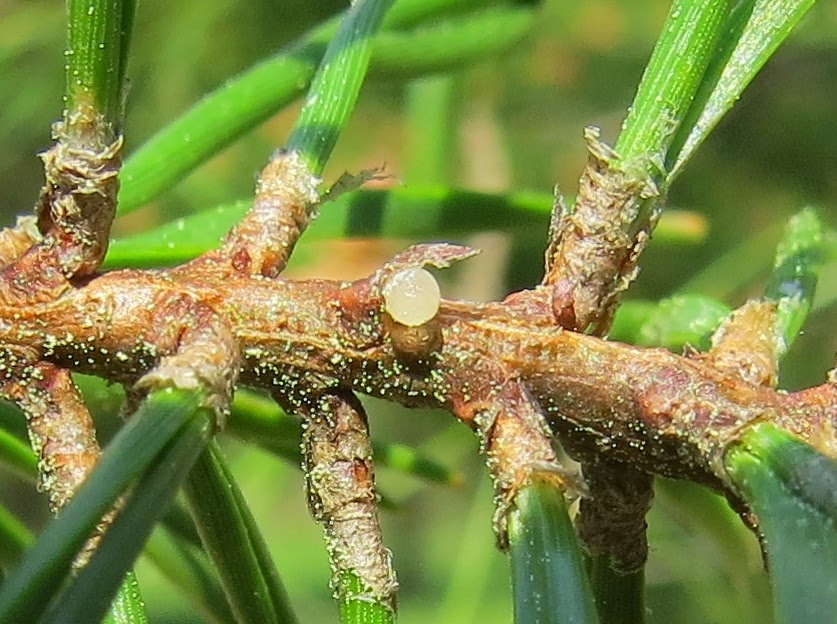
The pines are host to many types of interesting small animals.  Whatever hatches from this egg will probably be a consumer of pine needles.

This exit hole was left by some insect that spent its larval stage consuming the inside of a young pine cone.  With its seed cavity cleaned out, the cone died.

As with most plants at Blue Jay Barrens, Virginia Pine serves as host to numerous aphid colonies.  Where there are aphids, there will be Allegheny Mound Ants.  It is uncommon to find any aphid colonies here that are tended by other ant species.

I found these large aphids to be particularly interesting.  When disturbed, the mature aphids would break from the pack and run up the branch.  Most aphids have a top speed that would be described as a fast walk.  These aphids moved just as quickly as one of the scurrying ants.  I believe these aphids are of the genus Cinara, AKA Giant Conifer Aphids, but if I was charged with the task of assigning an appropriate common name, I think I would to call them the Running Aphid.

Wednesday, January 7, 2015

Snowy Ant Mounds

A dusting of snow on the ant mounds made them stand out like beacons in the tall grass fields.  I took this opportunity to get out and document the abundance of Allegheny Mound Ants, Formica exsectoides, at Blue Jay Barrens.  The larger mounds may contain more than a quarter of a million ants.  When you see clusters of mounds like this, it’s easy to see why the ants are so commonly encountered in the summer prairie.

The mounds are even easier to see in the mowed field.  The largest of the mounds tend to stay active for many years, even decades.  Smaller mounds appear and disappear more rapidly.  A group of ants will sometimes appear and within weeks, build a mound 8 inches high and 16 across.  A few months later, the mound may be abandoned.  I’m guessing that the temporary mound is used as a base from which to exploit a seasonal food supply or to access a new foraging area.

Considering the number of ant mounds in the field, it’s amazing that only a couple received any damage when I mowed.  This view shows about two acres of field with 43 visible ant mounds.  It’s obvious that the ants are a major component of the ecology of this field.

Mounds are most commonly found in the open, but there are a few mounds in the partial shade of the field edges.

Both the near field and the field beyond the trees contain numerous mounds.  Ants can be found anywhere in the grassy fields, but they are rarely encountered in the 60 foot wide band of trees separating the two fields.

The snow highlights a deer trail and a neighboring ant mound.  This mound, just over two feet high and four feet wide, is considered average size for Blue Jay Barrens. 

It’s strange that there are large open areas that are free of ant mounds.  I’m sure that there are certain conditions necessary for the survival of a large ant colony, but even if these fields are unsuited, I would expect to find failed attempts at mound building. Allegheny Mound Ants are certainly in the top ten group of most interesting animals inhabiting Blue Jay Barrens.  Study of this species could easily monopolize my time for many years, but I guess I’ll just have to be satisfied with casual observations while my time is spent dealing with the property as a whole.

Monday, November 17, 2014

Mowing and Ant Hills

Mowing the fields is made slightly more difficult by obstacles that must be avoided by the mower.  Top of the list is the earthen mound made by the Allegheny Mound Ants, Formica exsectoides.  A mower and mound confrontation is detrimental to both parties, with the ants and mower operator taking the brunt of the negative impacts.  Large mounds that are kept free of vegetation are easy to see and avoid.

Not all mounds are so well groomed.  Some are so much a part of the vegetation that the two are inseparable.  Mounds such as this are nearly impossible to detect.

Most fall into the middle range with bare tops and vegetated sides.  I don’t understand why some colonies keep their mounds vegetation free, while others in seemingly identical locations, allow plant growth to cover the mound.

There is also the occasional abandoned mound that still stands tall and is covered in plant growth.  These mounds are a little more solid than one that is active and can cause quite a jolt when hit by the mower.  These abandoned mounds are often recolonized and rebuilt to their earlier dimensions.

I was pleased to complete the field mowing with only four mound hits.  Two took the tops off of very small mounds, one of which showed no signs of recent ant activity.  The other two hits were glancing blows delivered to medium sized mounds less than 12 inches tall.  The ants have already closed the breaches to their mounds.

Unfortunately for the ants, there are other threats that prove more formidable than my mower.  Something attacked this mound and spread debris several feet into the field.

The ants have made some attempt at repairs, but the cold temperatures have hampered their efforts.  Many chambers are exposed to the air, compromising climate control within the mound.

Exposed tunnels at the top of the mound can allow heat and moisture to easily exit.  I imagine these tunnels have been sealed shut somewhere within the mound itself.  I’ve seen animals nearly take a mound down to nothing and the ants build it right back up again.

Crows have taken to using the mounds as perches as they forage through the mowed field.

They don’t seem to have any real interest in the mound and don’t do any damage.  The only evidence of their frequent visits is a growing collection of Crow droppings.

Most of the vegetation on the mounds appears to be non-native in origin.  The halo around this mound is a mix of bluegrass and fescue, both species that already had a presence in the field.

Several mounds host a mix of exotic species that are found only on the mounds.  These species are mow poised to move into the fields if conditions become favorable.

Hairy Bittercress has just made it to the mounds in the past few years.  This weedy species began by colonizing disturbed ground near the house and barn.  It now seems to be a permanent resident of those locations.  I’m wondering now if this species could eventually present a threat to the winter annuals growing in the barrens.  I’m not sure how the seeds are traveling, but their method is obviously efficient.

I’ll have a few months to visit with these mounds before the tall grass returns to once again hide them from sight.  After that, I won’t see most of them again until the next time the field is mowed.