Showing posts with label Pots. Show all posts

Wednesday, July 20, 2016

Nodding Wild Onion Project

After eight years of trying, it appears that I’m finally learning how to raise captive Nodding Wild Onions, Allium cernuum.  It’s a good thing too, because the last of the wild plants disappeared from Blue Jay Barrens three years ago.  The onions in this pot represent the offspring of six plants taken from the wild and relocated into my prairie garden.  That left only a dozen plants growing in their original location, a site that was too shady for the plants to produce flowers.  You can read about the original relocation by clicking HERE.

The plants in this pot appear to be doing their best to break through the chicken wire barrier and reclaim their positions as wild plants.  There are more onion flowers this year than I’ve had in total over the last seven years.

This spring, I took a few young plants from the pot and relocated them to one of the native plant beds in my vegetable garden.  All of those plants have grown wonderfully.  They are currently sharing the bed with Spider Milkweed, Leavenworthia uniflora, and Draba cuneifolia.  I think the species in that mix should work well together.

Nodding Wild Onions produce lovely blooms that attract a wide variety of insects.  Here we have a beetle, a fly and a bunch of ants.

The most common pollinators this year are small green Sweat Bees.

Butterflies are not frequent visitors of the onion flowers, but there are sometimes exceptions.  This Olive Hairstreak spent close to five minutes exploring the onion flowers.  The Olive Hairstreak spring brood was quite successful this year.  The second brood is now coming on more strongly than I have seen in many years.

Early onion flowers are already producing seed pods.  I should have ample seed to increase my captive population of plants, as well as scatter some seed out into suitable wild sites.  It’s taken longer than I had originally thought, but I’m now becoming optimistic that this project could be successful.

Monday, March 14, 2016

Draba cuneifolia

For several years now, I have maintained a population of the uncommon winter annual, Draba cuneifolia, in a container filled with a substrate that superficially mimics that found in its natural habitat on the barrens. This artificially maintain colony has been thriving.

These interesting little plants have just begun to bloom. Previous year’s seed crops have allowed me to return a great quantity of seed to the barrens. Seed is always scattered in areas from which the original seed came.  The bounty of seeds from the container grown plants has far exceeded that which could have been expected from plants produced on the barrens. 

As with many captive plant populations, this one has refused to respect its defined boundaries and has dispatched its seed to produce new colonies.  I am now finding Draba cuneifolia growing along the concrete foundation of my barn…

from cracks in the decomposing concrete of the apron outside the barn door…

and even out of the drain holes of other containers.

In October 2014, I found some Draba cuneifolia seeds stuck in the folds at the bottom of my seed collecting sack. I scattered the seed in a garden bed that I am using for the production of Spider Milkweed, Asclepias viridis. Draba seeds need to go through a period of high temperature before they will break dormancy, something that apparently didn’t happen at the bottom of my seed sack. It wasn’t until November of the following year that I began to see Draba cuneifolia seedlings. The orange ribbons mark locations of the milkweed plants which will do most of their growing after the Draba has already set seed.

The Draba cuneifolia grow extremely well in the deep, fertile soil of the garden bed. Were I to discontinue removing competing plant growth from these beds, the Draba would not survive.

All of these plants are loaded with flower buds and will soon be in bloom.

We had three days in a row of extremely cold temperatures during a time when there was no snow cover on the ground. Several of the exposed Draba cuneifolia showed signs of freeze damage.

Those damaged plants survived, but as they grew, they abandoned their single rosette form. Growth from multiple points caused plants to take on the appearance of small shrubs with numerous branches growing in all directions.

Draba cuneifolia growing on the barrens also showed signs of cold weather damage. Both of these plants display dead leaves, but they are still growing. Unfortunately, life on the barrens is more stressful for the species and the plants do not produce the vigorous growth of those growing in the garden.

I enjoy seeing the genetic potential expressed by the plants growing in the garden, but it’s these tiny wild grown specimens that I admire most. They are poor competitors and can survive only where other plants fail. Life on the barrens is rough, but these little plants are tough enough to survive there.

Friday, January 8, 2016

Arrowhead Rescue

Before I propped it up on a convenient gravel bar, this young Arrowhead plant, Sagittaria brevirostra, was riding the creek currents on its way out of Blue Jay Barrens.  I’ve never before collected anything but seed for my propagation studies, but I thought, since it was leaving the property on its own, I might has well transfer it to a pot and watch its development.

Survival of the specimen should be easy.  The plant already possessed a healthy root system and a tuber packed full of energy.

I find the Arrowheads typically growing in mud banks developed on the insides of creek curves.  These mud banks are transient, growing and shrinking at the whim of an unpredictable flood cycle.  Sometimes, entire colonies of the plants are lost to a particularly violent flood.  I imagine those plants travel downstream with the possibility of colonizing a new mud bank.

The plant was moved from the creek to a pot on May 20, 2015.  Two months later, the pot was filled to capacity with plants.  I emptied the pot and began to separate the plants in preparation for repotting.

Each new plant was equipped with a profusion of roots and rhizomes.  It was easy to see that a single plant finding its way to a suitable site could quickly produce a large population.

What once filled a single pot, seemed still crowded when spread into three.

The original rescued plant was the only one of the bunch that was not growing tall and straight.  When removed from the original pot, its roots were still near the surface of the soil as originally planted.  The rest of the plants arose from rhizomes that had penetrated to the bottom of the pot.

By early August, the plants were flowering.

This Arrowhead species produces individual male and female flowers.  A small fly visits this male flower.  Small bees and flies were the most frequent visitors to the arrowhead flowers.

The female flower.

The individual fruits are clustered to form a spiked ball.  Each fruit, achene, bears a single seed.

Shape of the mature achene is one characteristic used in the identification of species within the genus Sagittaria.  Achene shape can vary greatly among different plants of the same species and also within a single flower, so one should never be comfortable with an identification based on a single achene.

This species has little tolerance for the cold and was zapped by the first hard frost.  Plants in the creek grow where the creek water keeps the soil at a temperature above freezing.

I didn’t think the plants would survive their pots freezing solid, so they will spend the winter buried in a leaf filled pit with a loose covering of boards.  It would take a record cold year for freezing temperatures to reach the pots stored here.

Wednesday, April 15, 2015

April Winter Annuals

My artificial barrens in a pot continues to evolve.  Originally planted in the container were Draba cuneifolia, Draba reptans, and Leavenworthia unifloraDraba reptans persists in small numbers and is hardly noticeable.  Draba cuneifolia and Leavenworthia uniflora aggressively compete for dominance of the container.  Since its creation, no two seasons in this container have been the same.

In 2013, Leavenworthia uniflora dominated the container.  Last year there was a fairly even mix of Draba cuneifolia and Leavenworthia.  This year the Draba cuneifolia is definitely in control.  Draba flower stalks form a miniature forest.

A loose cluster of flowers forms atop the stalk.  These plants are just beginning to bloom.  The flower spike will continue to enlarge and the immature buds seen in the center of the cluster will be brought into position to open.

A number of these small bees were busy visiting the Draba flowers.

Wild Draba cuneifolia plants are also doing well this year.

It’s unusual for the plants on the barrens to grow this large.  I’m certain that their growth patterns are influenced by weather conditions, but I don’t know if it was spending several weeks buried by snow or the excessive rainfall during the last six weeks or some other factor that is responsible for the impressive growth this year.

Draba reptans is also performing above expectations this year.  This plant toppled over, but that won’t stop it from producing a good crop of seeds.  Total height, or length, of this plant is not much over an inch, so it didn’t have far to topple.

Draba reptans is similar in appearance, but smaller than Draba cuneifolia.  One characteristic that separates the two is the hairiness of the flower stalk.  The stalk on reptans is practically hairless, while the cuneifolia stalk has a fuzzy hairiness along its entire length.

Drabas and Leavenworthias are blooming side-by-side in the container barrens.  Draba cuneifiolia has a shallow indentation at the end of each of the four petals.  Leavenworthia petals are all well rounded.  A couple of non-native Draba verna have also managed to invade the container.  Seen in the lower right of the photo, Draba verna petals are split almost in two, so the flower appears to have eight petals instead of four.

This year’s Leavenworthia plants are quite tiny and have only a single flower stalk.  I’m afraid they couldn’t compete with the rapid early growth of the Drabas.

Contrary to what I’ve noticed in past years, the Leavenworthia growing on the barrens are much more robust than those in the container.

Most of the barrens grown specimens are producing multiple flower stalks.  The seed produced from these should be a definite boost to future generations.

The Draba cuneifolia in the container are going to make a tremendous amount of seed.  I’ll collect as much as I can and scatter it out on the same barrens from which I originally gathered the seed for this container collection.  If my original removal of seed from the barrens resulted in a diminished population of Draba, I’m sure my replacement of seed has more than made up for the loss.

The container plants are producing so much seed that I’m now finding Draba cuneifolia growing in the cracks of the concrete apron outside my barn door.  I love it when a rare plant begins to behave like a weed.

Wednesday, January 14, 2015

Potato Dandelion Transplants

I was in the woods yesterday and decided to go by and check on the Potato Dandelion, Krigia dandelion, tubers that I transplanted last August.  At least a few of the tubers survived and have developed clusters of leaves.

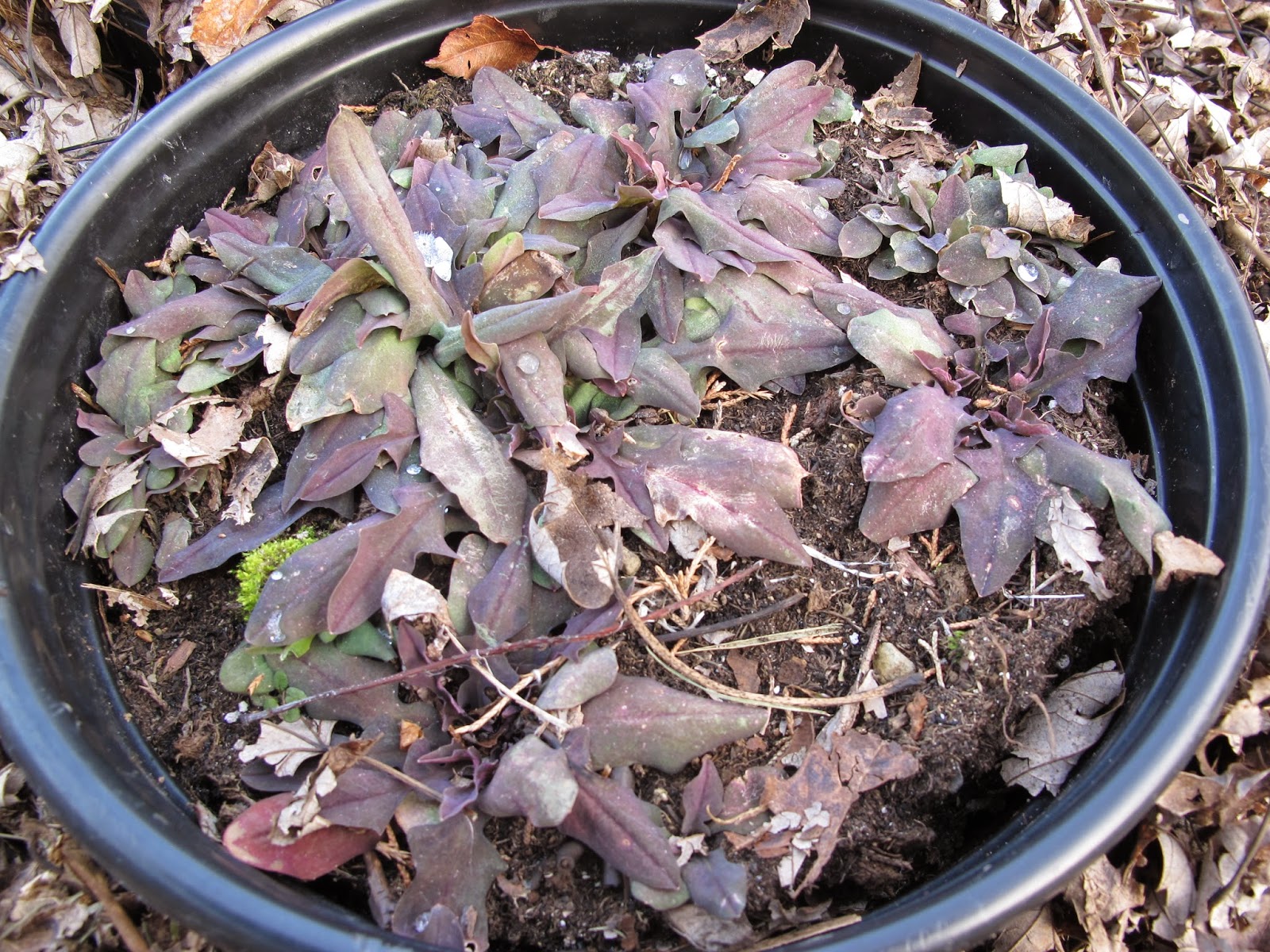
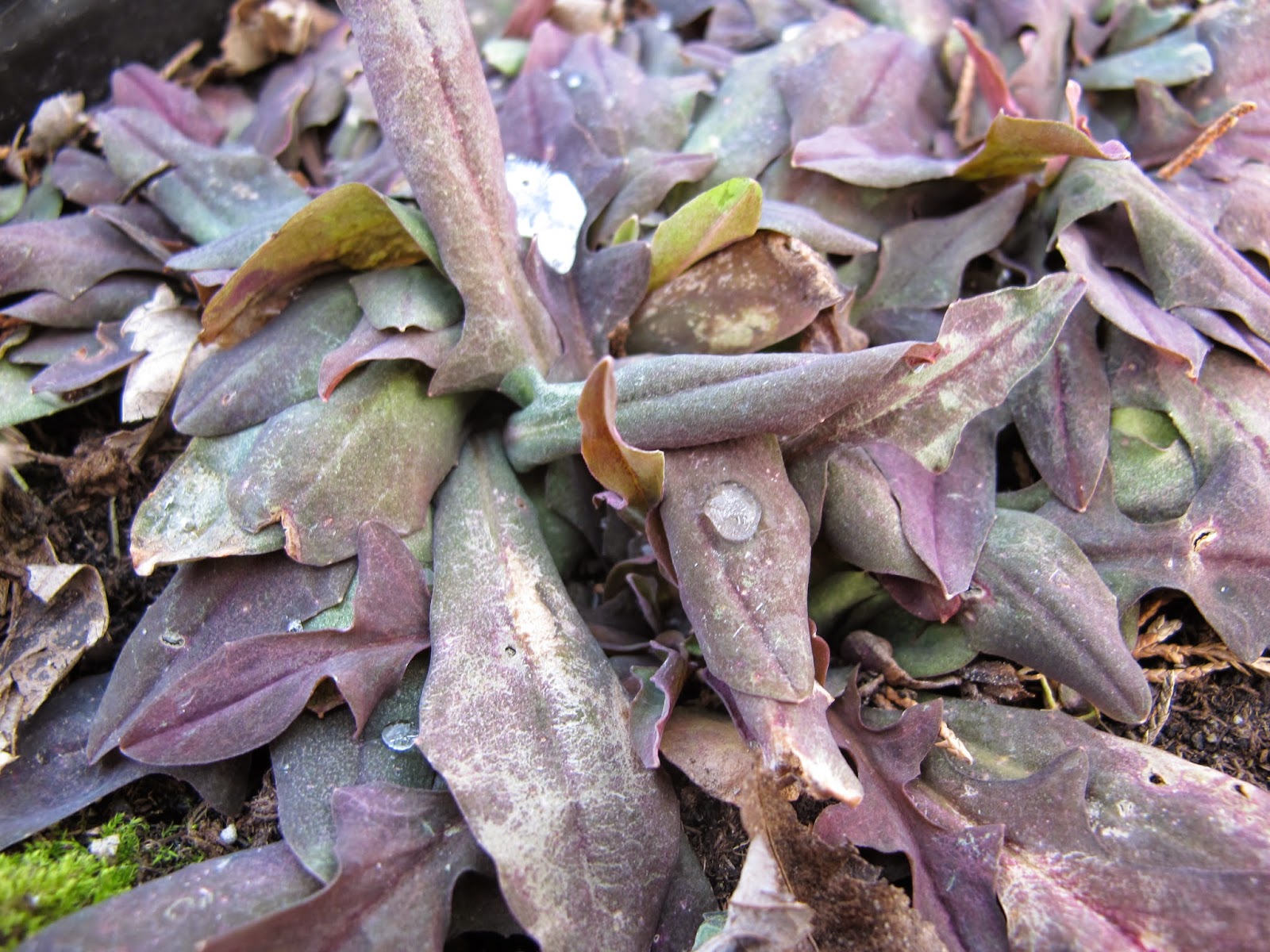
Cold weather causes the leaves to blush a bright lavender.  When temperatures begin to moderate, green blotches will develop that give the leaves a pattern similar to early Trout Lily leaves.  I think this coloration causes the plants to be overlooked by the casual observer.

I planted over 50 tubers along this ridgetop, but only found a small number of plants yesterday.  The bare ground chosen to receive the tubers in August has since been covered by fallen leaves.  By late April the Krigia plants will have developed enough for the leaves to be easily seen above the forest leaf litter.

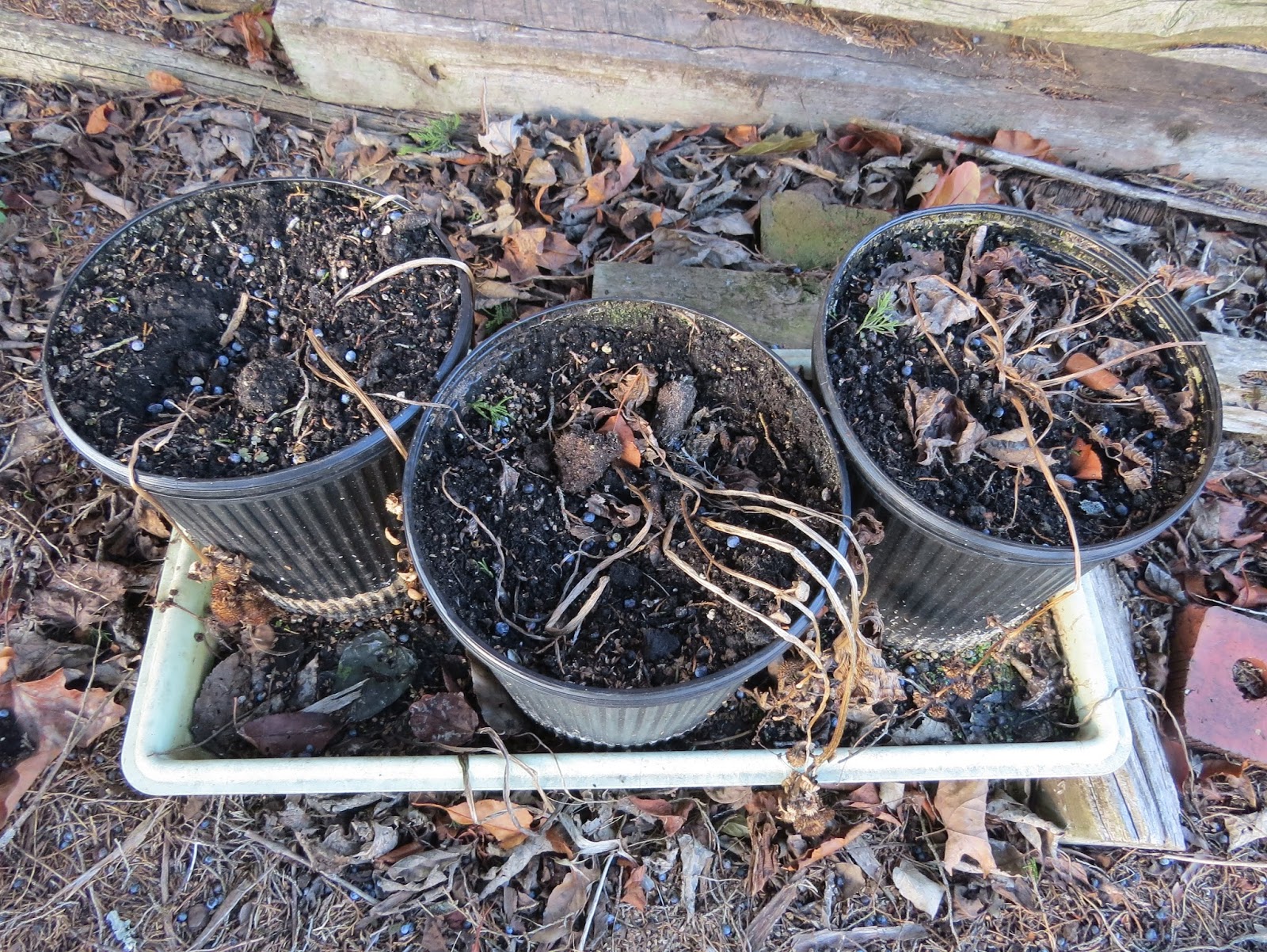
In addition to planting tubers in the woods, I introduced a few into a new container.  These plants are growing in a 22 inch diameter container that had been filled with recycled potting soil.  First growth appeared in late September.  Growth was rapid until the sub-freezing weather arrived.

Leaves show signs of stress from exposure to cold, dry air.  Each warm spell allows the plant to increase the size of the youngest leaves emerging from the center of the rosette.

This is the seven inch diameter pot that housed the stray Potato Dandelions found growing in the burned shed site last April.  After sifting out the large tubers last August, I returned the soil to the pot.  There were enough small tubers left in the soil to produce this growth.

A few drops of water, left by the rain a few days ago, remain frozen on the leaves.  I’ve seen these plants receive much worse damage than this and still recover with the return of warm weather.  So much about this species suggests that it should thrive in this area, but it still remains a rarity in Ohio.

This 18 inch diameter container has been producing Potato Dandelions for many years.  Somehow, this pot has become contaminated with Chickweed.  After harvesting the tubers in August, I’ll add a couple inches of fresh soil to this container.  That should reduce the possibility of Chickweed next year.

Leaf damage is not quite as bad in this container, even though there are still ice crystals sitting on the leaves.

Most of the plants show minimal damage.  All three pots are situated in different locations and this pot was in a position that allowed snow blowing from the barn roof to cover most of the plants.  The snow protected the leaves from the dry air, which seems to be the major cause of leaf damage.  I hope to have an abundance of tubers for transplanting next summer.  Given time, I should be able to find other suitable locations in which this plant can thrive at Blue Jay Barrens.