Showing posts with label Trap-Door Spider. Show all posts

Friday, October 3, 2014

Another Trapdoor Spider

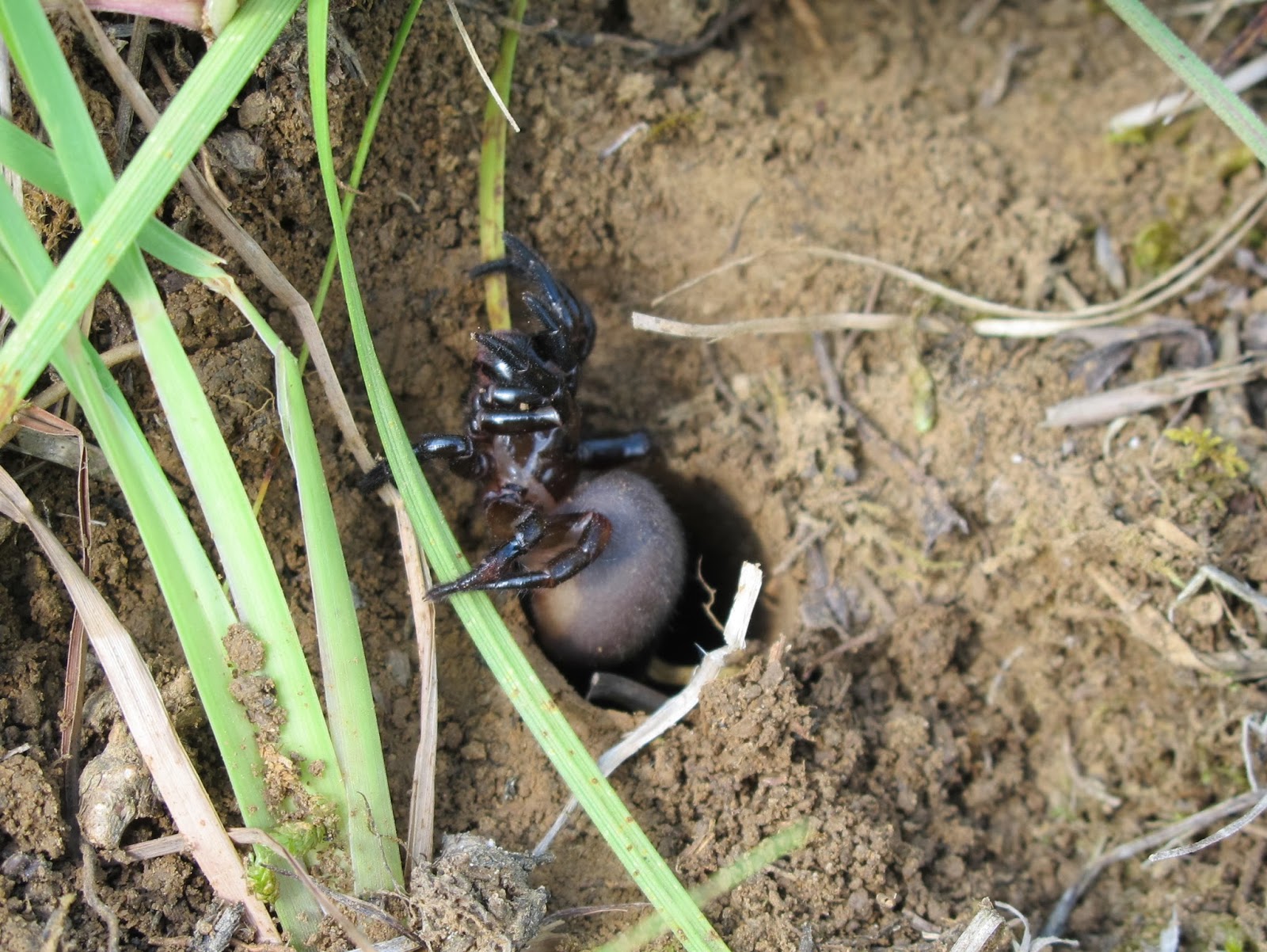
I recently unearthed another Trapdoor Spider.  I believe this is also a Ummidia species, probably the same as the one I dug up last year.  This individual was smaller than my previous find and might be an immature specimen.

Note:  I’ve since been informed that the spider is actually an Antrodiaetus species that constructs a folding door as opposed to a hinged trap door.  See the addendum at the end of the post for additional information.

When disturbed, the spider tucked in its legs and remained still.  It maintained this attitude as long as I was nearby.  Even when picked up, it stayed immobile.  Only when I backed away did it extend its legs and begin to crawl.

The eyes sit atop the head in a short turret arrangement.  These spiders are ambush hunters that leap from their burrows to snag passing insects.  I imagine it would be important for the eyes to be positioned so that the spider could see through the slightest crack made by lifting the protective lid covering the spider burrow.

The chelicerae, those thick appendages protruding from beneath the head, are primary mouth parts used to capture prey.  The bulky portions visible in the photo are the muscle and each is tipped by a fang.  As the muscle portion lifts, the fangs are extended and thrust downward into the prey.  The prey is then pulled into the burrow for consumption.  Venom injected by the fangs quickly subdues the victim.  The attack and capture can be completed in a fraction of a second.

Besides the smaller size, the most noticeable difference between this spider and last year’s is the size of the pedipalp, the leg-like appendage located beside the mouth.  In the larger spider, the pedipalp was quite noticeable from above and looked much like another leg.  To find the pedipalp in the smaller spider, I had to tip it and get a view from beneath.  In the photo above, the head is to the right and you can count the bases of four legs before coming to the downward curving pedipalp.   I’m assuming that the pedipalp will get longer as the spider matures.

The spider was unearthed here at the site of the Toad Pool Project Phase 2.

Vegetation on the site looked much like this before it was stripped away.  Classic Kentucky 31 Tall Fescue made up more than 50 percent of the ground cover.

Fortunately, the spider qualified for the Blue Jay Barrens Disaster Relief Program and was furnished with a new home.  Because of ongoing drought conditions, the ground had to be soaked with water in order to soften it up enough for burrow construction.  The spider’s small size required a pinky finger sized burrow.

The spider wasted no time scrambling into its new retreat.

I came back about an hour later and found the spider applying webbing to the burrow entrance.  My substitute burrow probably doesn’t meet Trapdoor Spider specifications, but I’m hoping it’s close enough that the spider can rework it to suit.  I’d love to go out and find a cap on top of the burrow and watch the spider leap from its concealed burrow to capture some hapless prey.

Addendum: Afternoon October 3, 2014.

About 12 hours after posting the above information, I received an email from Rich Bradley, Ohio spider expert currently with The Ohio State University and author of Common Spiders of North America, with information on the correct identification of the above spider.  It is actually an Antrodiaetus species in a group commonly known as folding door spiders.  Instead of an actual lid topping the burrow, there are two panels of web that can be pulled together or spread apart like curtains over a window.  The feature I failed to recognize while trying to make my identification is the slightly darkened, callous-like feature near the front of the abdomen.

That slightly raised area is a sclerite, a patch of hardened exoskeleton.  I had read about this feature, but was expecting it to be much better defined and easily visible.  Of course, now it is easily visible since I know what to look for.

The total length, 17 mm, is right in line for Antrodiaetus.  When I don’t happen to have a measuring device with me in the field, I photograph the subject against a background that I can easily measure later.  The palm of my hand works perfectly.

Wednesday, January 29, 2014

Animals 2013 - Trapdoor Spider

In 2009 I found an abandoned burrow of a Trapdoor Spider.  That light colored lump to the left is actually a silken cap that can be pulled snug down to close the burrow entrance. 


When closed, the camouflaged cap makes the burrow nearly undetectable.  The Trapdoor Spider hunts by lunging out from beneath the cap to grab passing prey and then pulling the catch into the burrow for consumption.  I have always wanted to witness this spider in action.  Having found evidence that the spider lived at Blue Jay Barrens, I was keen to find the living animal.


My first encounter with a live Trapdoor Spider occurred by accident on July 1, 2013.  I inadvertently sliced the top from a burrow while hoeing weeds in the vegetable garden.  Trapdoor Spiders cover the sides of the burrow with a thick layer of silk and this was the first thing I noticed when the burrow was uncovered.  My excitement level rose quickly when I saw the spider inside.


I used a weed stem to encourage the spider from the burrow.  It crawled right out with no display of aggression.


This is one neat looking spider.  It presents an odd appearance because it seems to have ten legs instead of eight.  In this photo the spider is facing to the left.  The two short projections are the chelicerae or jaws which terminate in fangs.  Beside those, looking much like a first set of legs, are the pedipalps which seem to play a part in the mating process.  The first real legs are found just behind the pedipalps.


The shape of the carapace covering head and thorax gives the spider a distinctly crab like appearance. 


In order to capture features that may aid in identification, I took shots of the spider from as many angles as possible.  My most useful identification guide, Spiders of North America – an Identification Manual by Ubick et.al., often requires magnified examination of specific spider parts that are obtained by dissecting a non-living specimen.  I had no intention of sacrificing this individual, so I was hoping for the best with my photos.  Fortunately, I was able to get some positive shots of a characteristic depression in the tibia of the third leg which identified this as a member of the genus Ummidia.  The keys in the manual ended at genus with a note that it was widespread in the U.S., being represented by 50 species, only 10 of which have been described.


Like a well trained dog, the spider rolled onto its back for some shots of the ventral surface.  The fangs can be seen to the left.  The light patches on the abdomen are coverings over the lungs.  Air enters the lung chamber by way of spiracles accessed through slits at the edge of the cover.


It wasn’t safe for the spider to remain in the garden, so I chose the nearest barren with suitable soil conditions as a relocation site.  This area is very similar to that in which I found the 2009 burrow.


I fashioned a new burrow by stabbing my finger into the ground and firming the soil near the surface. 


 The spider wasted no time backing its way into its new home.


I checked back a couple of weeks later to see how things were going.  The inside of the burrow had definitely been reshaped and the outside edge had been reinforced by spider silk.  Unfortunately, there was no sign of the spider.  Hopefully, the spider found a more suitable location for a dwelling and dug its own burrow.  I’m happy to have seen the live spider, but I’m still determined to see an occupied burrow in action.

Saturday, July 18, 2009

Trap-Door Spider Burrow

The burrow of Ummidia audouini, a Trap-Door Spider commonly found in States south of Ohio. I’ve seen film of this spider on nature videos, but this is my first personal encounter. Too bad the spider wasn’t around to share my excitement. The burrow looks to have been abandoned some time ago. You can see that the silk covered walls are a bit tattered. The white object to the left is the lid to the burrow as seen from its lower side. The spider hunts by sitting at the entrance to the burrow with the lid pulled over itself. When the insect prey wanders by, the spider throws off the lid and grabs its meal.

I flipped the lid back into place to get an idea of what a hidden burrow must look like. It’s almost impossible to see here even though the lid isn’t even pulled down tight. I’m going to try looking for an active burrow, but it seems like an almost impossible task.

My finger again as a size reference. Some day I’ll have to put my finger next to some familiar object so you can see its true size. You’ll just have to believe me when I say my finger is of average dimensions. I mean average as compared to the rest of my fingers.

As you can see by the gravelly surface of the soil, this burrow was found in one of the barrens. Have I mentioned barrens at all this week? The burrow had a lot of sand down inside. Just an observation. I don’t know why there would be so much sand.

This shot was cropped out of the photo above to show you the small spider sitting just below the burrow. Not the same species as that which built the burrow. The black object is the head and thorax of a small ant being consumed by the spider.