Showing posts with label Monarda fistulosa. Show all posts

Monday, July 27, 2015

Monarda Returns

It’s been a few years since Monarda fistulosa has bloomed so prolifically in this opening at Blue Jay Barrens.  Something about the environmental conditions during the winter or spring of 2011 caused a massive die-off of Monarda plants in this patch. 

During the past few years, Monarda has returned and is now approaching its earlier abundance.  With the return of the plants comes a return of the butterflies.   Monarda attracts a variety of pollinator species, with large butterflies being the most notable.

At the small end of the size scale is the Silver-spotted Skipper.  Smaller butterflies, which includes the other skippers and many butterfly species, seem to find the Monarda flower head difficult to handle.  As if in celebration of the return of the Monarda, Silver-spotted Skippers are around in record numbers this year.

The showiest of the butterfly visitors are the Swallowtail species.  This is the Spicebush Swallowtail.  Its habit of constantly fluttering its wings while feeding makes it difficult to photograph.

Blooming of Monarda seems to coincide with the emergence of the summer brood of Tiger Swallowtails.  Summer brood individuals are typically larger than those found earlier in the year and they are quite showy as they glide between Monarda blooms.  There are those that exhibit the typical yellow coloration and …

… others that are colored a silky black.  Despite their black coloration, the tiger stripes still show through.
I found it interesting that the swallowtails all seemed to feed while hanging from the side of the flower head.
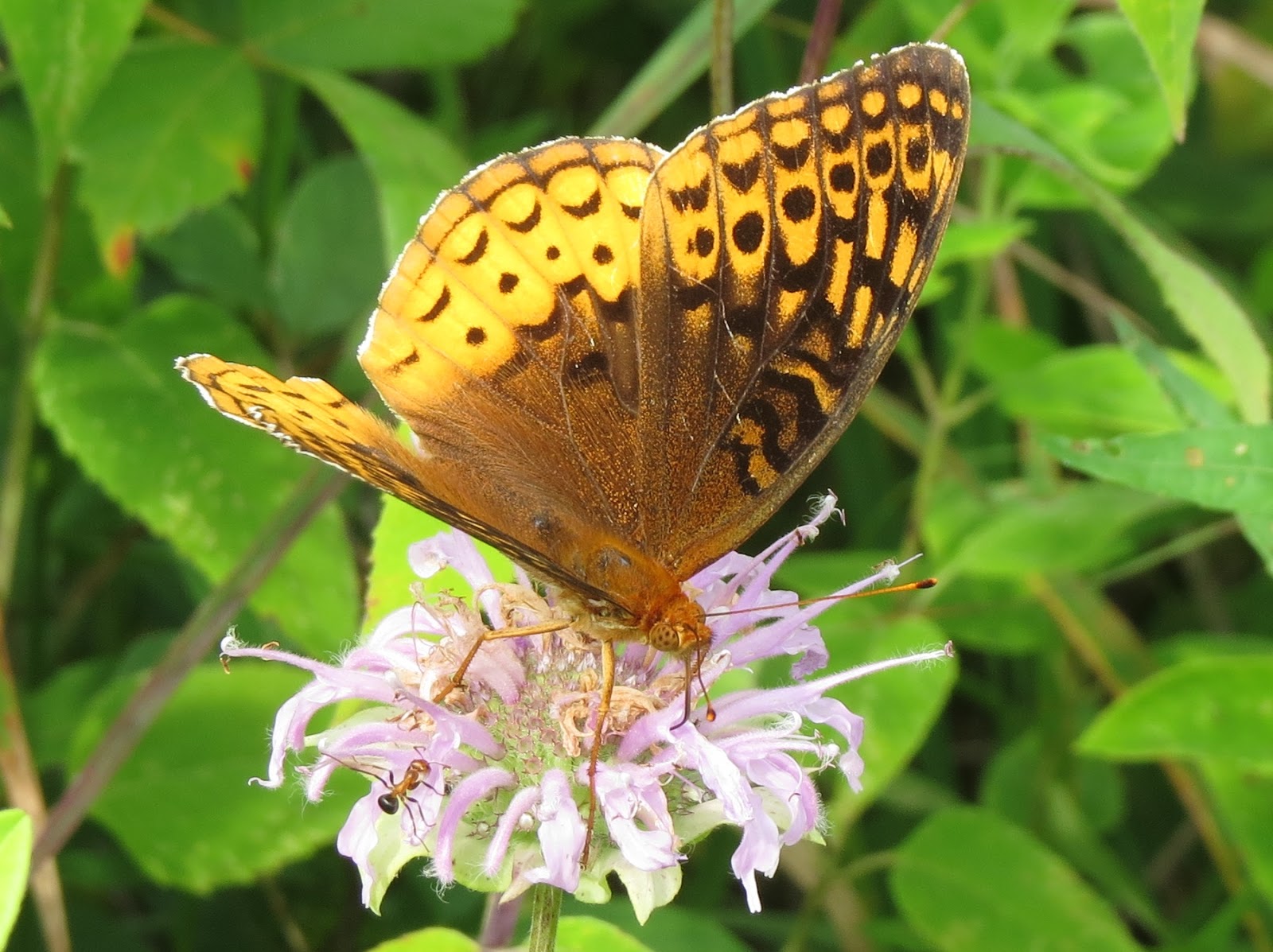
Great Spangled Fritillaries, however, tended to do their feeding while perched atop the flowers. 

The Monardas have even attracted a few Giant Swallowtails.  The Giant Swallowtails quickly move from flower to flower, spending so little time nectaring that I sometimes wonder if the act is even beneficial.  Finding them at flowers is about the only way to get a decent look at these fast fliers.

The Monarda is most famous as an attractor of Clearwing Sphinx Moths.  Using their front legs as anchors, Hummingbird Clearwings hover next to the flower as they draw nectar.  This species is currently outnumbering butterflies in the Monarda patch.

A few Snowberry Clearwings are also present this year.  Slightly smaller than the Hummingbird Clearwings, the Snowberries feed in a similar manner.  This is a species that I don’t often see here.

The Monarda’s attractiveness is not diminished by darkness.  A variety of moth species visit the flowers through the night.  The lack of multiple examples of nocturnal visitors more accurately reflects the photographer’s skills than it does the true number of night-time pollinators.

Friday, March 28, 2014

Prairie Garden Spring Maintenance

The dead growth in the Prairie Garden is removed each spring.  I used to do an occasional spring burn, but abandoned that management technique because of the potential threat to the overwintering pupae of the state endangered Unexpected Tiger Moth, Cycnia inopinatus.  Now I mow and lightly rake, which greatly reduces the threat to the pupae tucked away in the leaf litter at the base of their larval food plant, Butterflyweed.


Red flags act as warnings to use caution with the mower in certain areas.  I’ve learned not to trust myself to remember every little obstacle hidden in the tall grass.


The plants would grow even if I allowed this dead material to remain.  The reason for removing the top growth is to facilitate observation of the various growth stages of each species.  Getting to know the plants at different times of the year was my primary motivation for creating this garden.


Even though the grass looks impenetrable when viewed from a distance, it actually has many openings that allow sunlight down to low growing plants.


It only takes a few passes with the brush mower to get things cut down.


What’s left looks pretty brown.


A closer look reveals a lot of color being displayed by early season growth.


Western Sunflower, Helianthus occidentalis, begins growth early in the season.  Even though Western Sunflower will grow to a height of six feet or more, most of the leaves remain at ground level, so the plant must make full use of early season sunlight before it becomes shaded by neighboring plants.


This is Hairy Bittercress, a weedy non-native that I first found here about 20 years ago.  It is now everywhere around the yard.


Hairy Bittercress thrives in bare, disturbed earth.  Large ant mounds provide an ideal growing environment.  All of my yard mounds harbor this weed and the plant is beginning to show up on ant mounds in the fields.


Fortunately, most of the greenery in the prairie garden is due to growth of native species.  These are the basal leaves of Gray-headed Coneflower, Ratibida pinnata.


Wild Bergamot, Monarda fistulosa, is coming along nicely.  A morning low of 11 degrees doesn’t seem to have done any damage to the leaves.


The population of Round-podded St. Johnswort, Hypericum sphaerocarpum, keeps shifting its position around the garden.  Clumps of plants live for two or three years and then die.  There are always new plants coming up somewhere else to take their place.


Prairie Dock has hardly made it out of the ground, but something has already nipped off the first leaf.  Deer browse heavily on this plant in the early spring, but ignore it later on.  I imagine that more suitable forage becomes available as the season progresses.


I suspect this to be the work of an Eastern Cottontail.  There seems to be a rabbit’s nest in the garden every year.  Usually she digs up some plant that I’m particularly sorry to lose.

Friday, July 29, 2011

Absent Monarda

Things always change. Sometimes it’s a slow gradual change that allows you to adjust to the new conditions. Other times it’s a quick change that leaves you wondering what happened. The Monarda fistulosa has given me both this year. At the slow end of the scale is another slight increase in the size and numbers of Monarda populations.


The quick change took place here at the site of my oldest and largest population of Monarda. The level center section of this small valley has always provided an almost solid blanket of Monarda blooms that brought in swarms of bees and butterflies. As you can see, the flowers are not here now.


This area was solid with Monarda blooms last year. Now Monarda is completely absent; not just the blooms, but also a complete absence of plants. There is some Monarda growing in the background where the ground begins to rise from the valley floor. During the late winter and spring, the level part of the valley was frequently inundated and was almost constantly saturated. This amount of moisture is uncommon, but it has happened in the past without loss of the plants.


The fact the slightly higher and drier ground around the perimeter of the site still contains a good stand of Monarda, makes me think the water was somehow a factor in the disappearance. This same site suffered a Monarda die-off about seven years ago when the plants were all killed back by a late freeze. It took a couple of years, but the Monarda eventually returned. I expect that the plants will once again reclaim this area.


The most disastrous effect of the Monarda disappearance is the loss of a prime gathering area for the Hummingbird Clearwing Moth. There are still plenty of flowers scattered around, so the moth population shouldn’t be hurt, but I’ll really miss the spectacle of dozens of these magnificent moths buzzing around the same small area. Maybe with no moths to distract me, I’ll see something even more wondrous.

Friday, July 16, 2010

The Monarda Patch

Wild Bergamot, Monarda fistulosa, has just begun its blooming season at Blue Jay Barrens. The opening of these lavender blooms is a Siren’s call to the large butterfly species. A Tiger Swallowtail is filling up on nectar.

Monarda is a plant of the open fields and grows best in the deep moist soils of the small valleys. The success of the blooming season is, to a large extent, influenced by the weather in early May, when the Monarda is just beginning to grow. A May frost can kill back the top growth and radically decrease the number of blooms.

Hanging around the Monarda patch is a great way to see a variety of butterflies. This is the Silver-Spotted Skipper.

Most visiting butterflies are of the larger species such as this Pipevine Swallowtail. The tube shaped flowers are too deep to allow the smaller species to reach the nectar.

It’s almost impossible to view a field of Monarda without seeing some butterflies. In another week, this area will appear almost solid lavender.

Deep soils mean tall plants. Joining the Monarda are other tall growing species such as milkweeds, dogbane, coneflowers and the tall grasses.

Monarda is a perennial plant that branches out to produce a large number of blooms. I’ve found the seed to be extremely easy to germinate and have introduced the plant into new areas by shredding the dry seed heads and throwing them into suitable areas.

Monarda is a mint with square stems and the typical irregular flower shape. Having the oddly shaped petals arranged in this type of circular pattern can give the flower head an unkept appearance. I sometimes think this flower is viewed to best advantage as a mass at a distance.

The developing flower bud is protected by a cluster of leaf-like bracts. In some ways, this cluster of bracts is just as attractive as the bloom.

Blooming begins in the center of the disk and progresses outward. The result is an area of baldness that increases in size as the next rank of flowers opens, gets pollinated and loses its petals.

There are still a lot of yet to open flowers between the current blooms and the now fully extended bracts. Each successive layer of flowers is more oriented to the horizontal and gives the flower head the appearance of being in decline. We still have a couple of weeks before that happens.