Showing posts with label Orange Coneflower. Show all posts

Friday, August 4, 2017

Silvery Checkerspots

I usually don’t see more than a half dozen Silvery Checkerspot butterflies at Blue Jay Barrens in any one year.  This has been a constant situation for over 30 years, even though we have an abundance of Wingstem, the Silvery Checkerspot’s host plant.  For some reason, Silvery Checkerspots are everywhere this year, and I am enjoying the spectacle.

A couple of days ago, I sat beside a patch of Orange Coneflower that was being visited by about a dozen of the small black and orange butterflies.  I just watched the show for quite a while before turning on the camera.  I had never had any luck getting a good photo of this species, but I knew that was about to change.

After a few minutes, the butterflies resumed their nectaring and chasing activities as though I was just another part of the landscape.  That’s one of the neat things about many animals.  Their brains don’t interpret inanimate objects as threats, so if you can get yourself situated without scaring them away, the animal will soon continue with its normal activities.

The above video shows an interesting behavior associated with nectaring on the coneflowers.  The butterfly would pivot atop the flower head and probe each open floret as it went.  Some butterflies turned clockwise, while others turned the opposite direction.  Individual butterflies that I followed from flower to flower, each turned in the same direction as it had on the previous flower.  My sample size wasn’t large enough to make any valid statistical conclusions, but I began to wonder if butterflies could be right-handed or left-handed.

Monday, August 31, 2015

Orange Coneflower Visitors

Summer 2015 has produced some wonderful displays of single species flower patches.  Masses of Indian Hemp, Milkweed, Purple Coneflower and Monarda all developed attractive displays that drew in a multitude of insects and other animal species.  Now the patches of Orange Coneflower are drawing all of the attention.  Visitors to the Orange Coneflower blooms are usually the most impressive of the season.  I spent about 15 minutes observing visitors to a single 20 square foot patch of Orange Coneflower and was not disappointed with the diversity I witnessed.

Some visitors are attracted by the prospect of making a meal of nectar or pollen.  Orange Coneflower does not typically attract large butterflies, but some of the smaller species are known to visit.  The Pearl Crescent was looking particularly crisp and clean.

I saw two Horace’s Duskywings visiting the patch.  One was looking rather battered, but this one was appeared fresh.

I wasn’t sure this was really a living micromoth until it flew off at the prod of a finger.  At a glance the tiny moths often appear to be just a random bit of chaff.

This is a species of Eristalis fly.  Look at the pollen on those legs and body.  This guy is certainly no slouch when it comes to pollination.  Larvae of this species are aquatic, commonly being referred to as rat-tailed maggots.  Frequent heavy rains through the summer have provided plenty of breeding grounds for these flies.

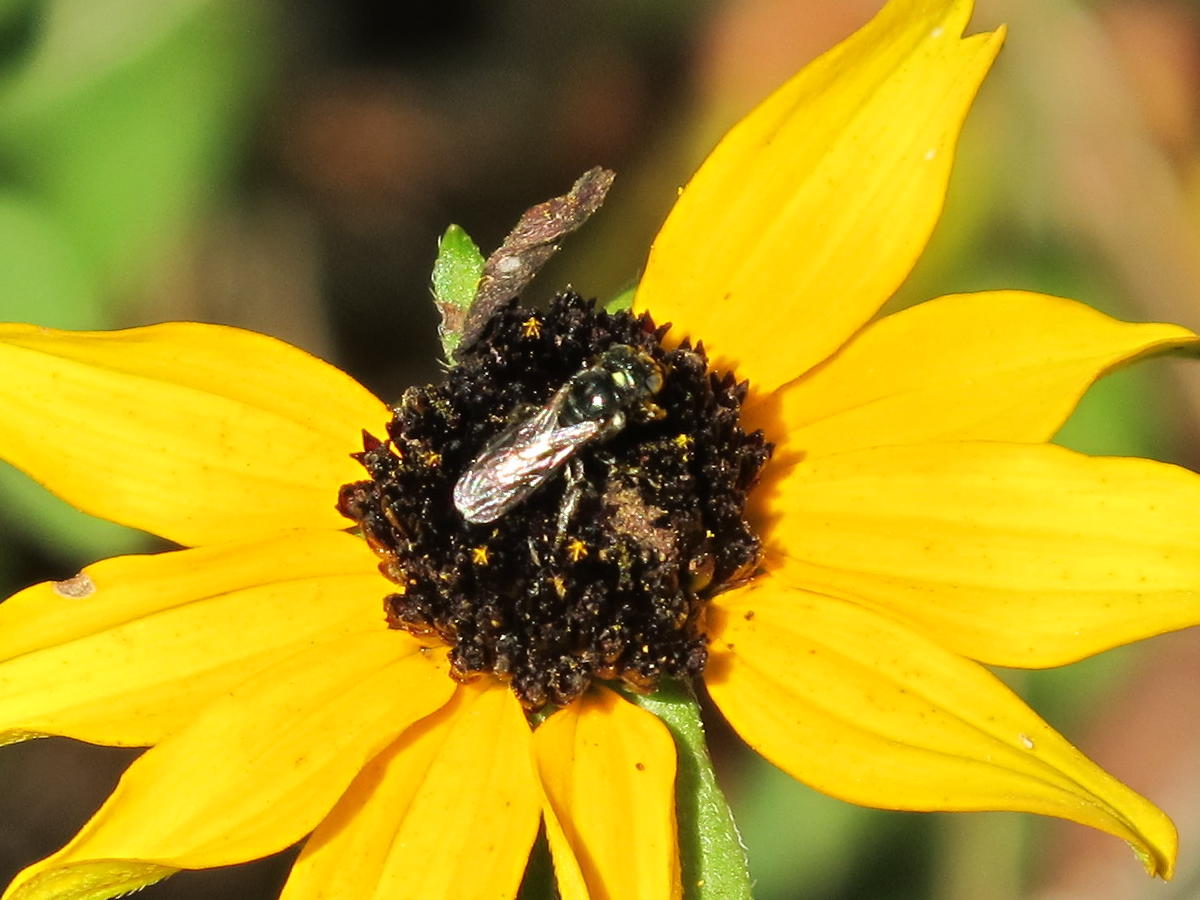
Tiny solitary bees are everywhere this year.  I’ve found them on every species of flower I’ve examined.  They also like to ride along on me and drink sweat while I’m working.

The slightly smaller black bees have also been quite numerous.  They seem to carry pollen on every part of their body.

There were also many that I was unable to identify.

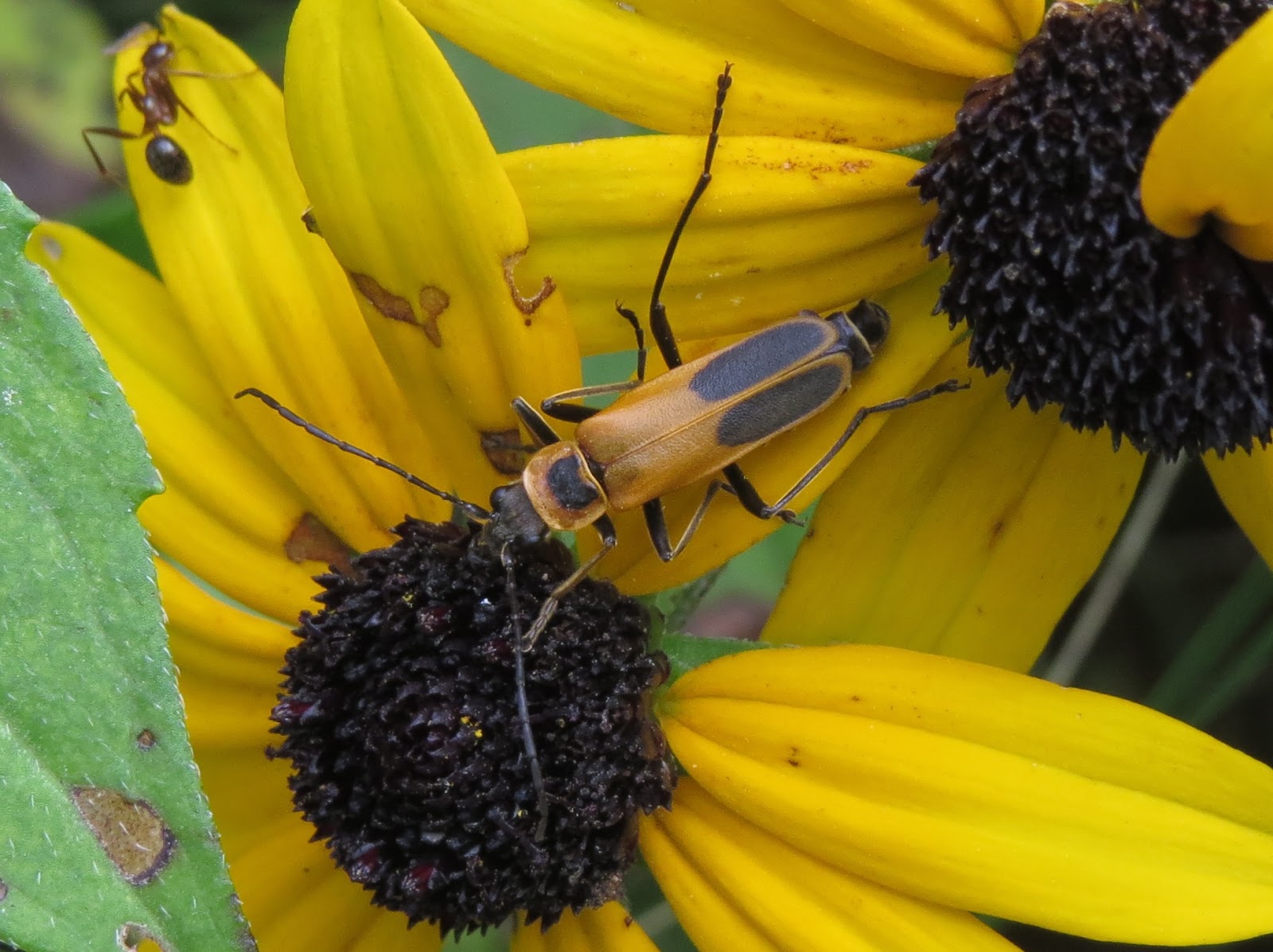
As usual, Soldier Beetles abound.  They move randomly among the flower heads feeding on pollen and flower parts.

There was an interesting encounter between weevils and a small ant.  The ant bit repeatedly at the weevils, but limited its aggression to the weevil’s wing covers.  The weevils continued with their activities, apparently unaware of the ant.

A variety of caterpillars were feeding on the flowers.  I wonder how long a light green looper can sit atop a dark flower disk without attracting the attention of some predator.

One of my favorite caterpillars is the camouflage looper.  With miscellaneous bits of plant material glued to its body, the looper looks more like a plant deformity than a living animal.

This camouflage looper is only lightly adorned, so the actual body of the looper is visible.  This species is frustrating to photograph because even in the best of shots it doesn’t really look like a caterpillar.

Some caterpillars spend their time hidden in the flower head.  Expelled frass is the only evidence that a living creature lurks inside.

Splitting the seed head reveals this little guy feeding among the developing seeds.

Placed on a new seed head, the caterpillar quickly burrows to safety.

This small Tachinid species may be getting a meal from the flower or it could be searching for an insect to act as host for its young.  Large patches of flowers are like a watering hole in the desert.  Animals come to feed on the flowers and predators wait to feed on the flower visitors.

Several small Braconid Wasps were searching the flower heads for possible hosts to receive the wasp’s eggs.  The wasp can reach its ovipositor deep into the seed head to deposit an egg on a hidden caterpillar.

The petals surrounding the flower head are a tasty treat for some insects.

Grasshoppers often feed on the petals.

Leaf Hoppers, such as this Tylozygus species, feed on the plant juices.  Sometimes its hard to tell whether an insect on a plant is actually using that plant as a food source or if that’s just where the insect happened to come to rest.

A flower perch is an ideal location for a young Gray Treefrog to await its next meal.  The treefrogs have taken advantage of the unusual number of breeding sites created by the exceptionally rainy summer.  Little frogs are everywhere.

Abnormalities of the flower structure often indicate the presence of some animal visitor.

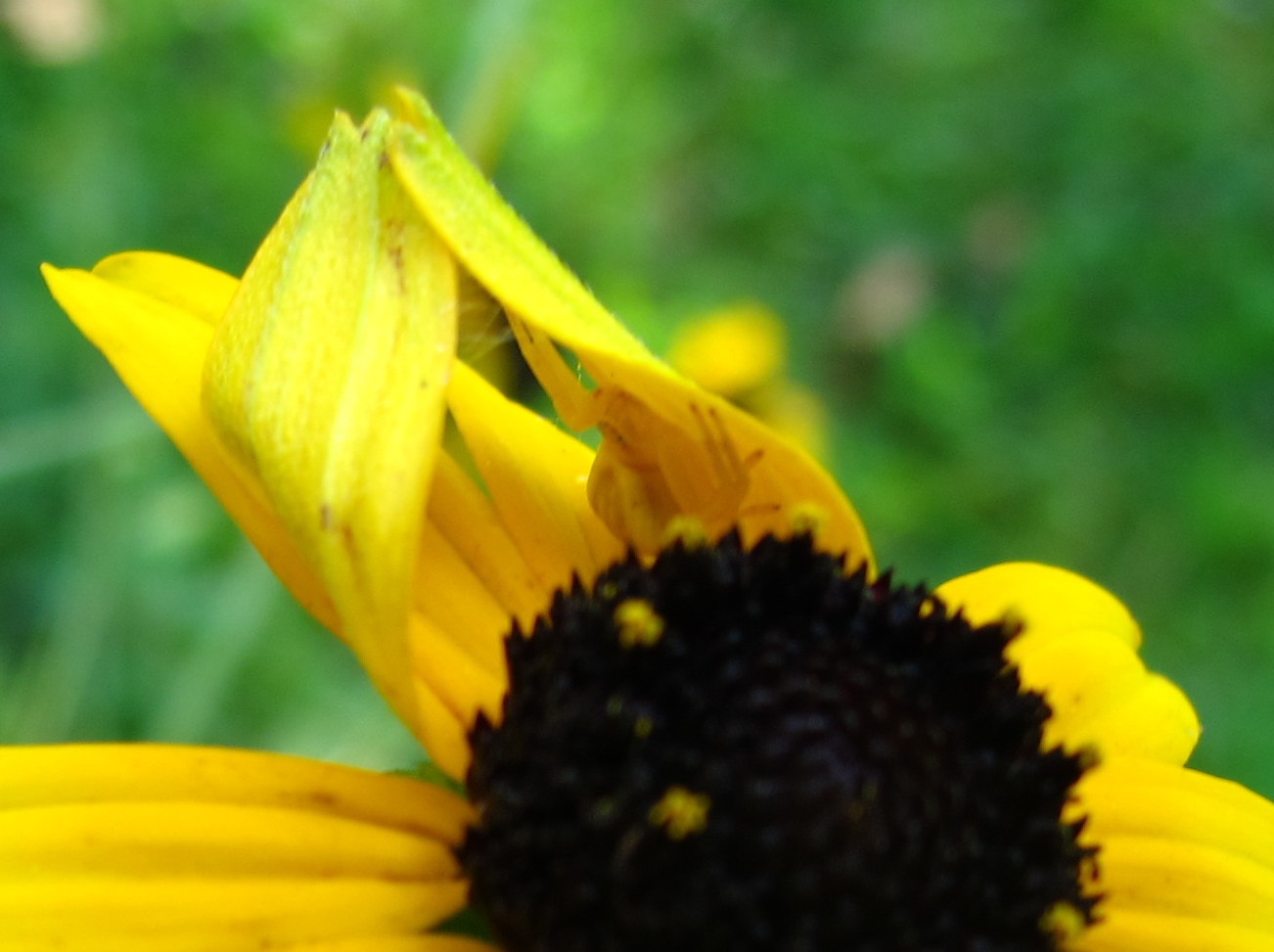
A crab spider has joined the tips of two petals together to form a shelter.

Crab spiders are a common feature of the flower heads.  Some display coloration that helps them blend with the dark central disk.

Others blend with the yellow petals.

Many species of spider hang around the flowers.  Some don’t match color at all, but their posture still allows them to appear to be a natural blemish on the plant.
Ambush Bugs sit ready to grab insects with the curved pinchers of their front legs.  A strangely motionless insect sitting on or dangling from a flower is often in the grip of an Ambush Bug.

The predatory Damsel Bug probes for insects within the flower seed head.

This Spiny Assassin Bug nymph assumes the standard position beside the flower head as it awaits the arrival of a meal.

A highly colorful, though unexpectedly cryptic, Sycamore Assassin Bug nymph prowls the flowers in search of prey.

A large Robber Fly uses the flower as a perch from which to watch for flying insects passing by.  The Robber Fly will catch its prey in the air and return to the perch to feed.  With my allotted time expired, I moved on to complete my scheduled work for the afternoon.  Not a bad tally of interesting animals from 15 minutes of observation, and these are just the ones I captured with my camera.  

Thursday, September 6, 2012

Drier Prairie

My original plan was to post about the improved conditions on the prairies following the rains created by the remnants of Isaac that passed through over the Labor Day weekend.  Unfortunately, the total accumulation for the four day event came to one tenth of one inch of rain.  I’m beginning to think we live beneath a rain excluding bubble.  Within ten miles of us in any direction, the rainfall totals for that same period were between two and five inches.  So, the prairies are drier than ever and I’m left wondering by how much this year is going to beat our standing drought record.


Besides being abnormally short, the prairie grasses are having trouble remaining upright.  I’m sure they’ve drawn about all the moisture they can from the shallow soil.  By mid-day the grass is so wilted that it drapes itself across the ground like thin plastic ribbons.


The Reindeer Lichen turns to dust beneath my boots.  I avoid the areas with a predominantly lichen ground cover, but there’s enough lichen scattered through the grass to make a loud crunch every time I take a step.  Fortunately, the Reindeer Lichen regenerates quickly during the rainy season.  The crushed pieces travel with wind and water to establish lichen colonies in other suitable areas.  Even so, I prefer when the lichen is moist and springy.  Then you can travel through the tall grass in almost total silence.


At this time of year the grass should be taller and greener.  I shouldn’t have such a clear view of the ant mounds in September.


A new brood of Allegheny Mound Ants has hatched and the spent cocoons have been discarded atop the mound.   That event is typically followed by new excavation and a fresh exterior being added to the mound.  By the time winter arrives, the mounds are contoured so that rainfall and snow melt flow right off.  There is some new material being brought to the surface, but it’s so dry it can’t be used for any sort of mound repairs.  The winter mounds may look a bit shabby if we don’t get some rain soon.


This slope should be covered with eight foot tall Big Bluestem, but maximum height now is closer to 30 inches.  A few super short Orange Coneflowers and Western Sunflowers stand tall among the dwarfed grass.


Western Sunflower on this site usually sends up a divided flower stalk that produces anywhere from three to nine blooms.  The few plants that bloomed this year were able to produce just a single flower.  These plants do most of their expansion by vegetative means, so the loss of a seed crop is not a disaster.  It’s the birds that will lose on this deal.  Western Sunflower seeds are a favorite of many bird species and this is just one more source of food that will not be available this coming winter.


Friday, August 31, 2012

Orange Coneflower

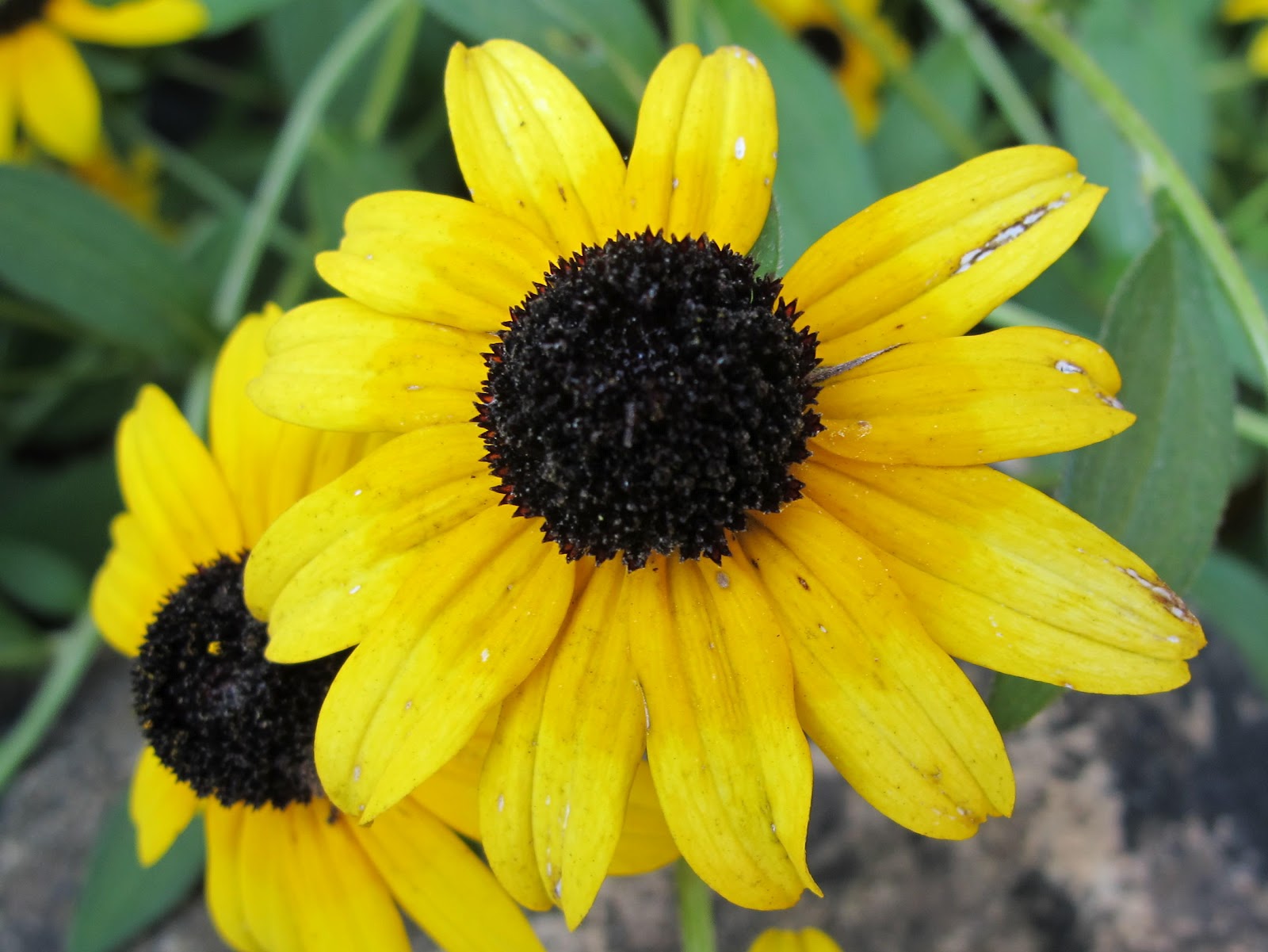
One plant that doesn’t seem much bothered by the drought is Orange Coneflower, Rudbeckia fulgida.  It may appear to be a bit worn, but that’s its normal condition at this stage.

The fertile flowers are found in the central disk.  The flowers mature in succession, beginning with the outer edge and moving toward the center of the disk.  As blooming progresses, the disk expands upward until the center sits well above the yellow rays.

Orange Coneflowers tend to grow in wetter conditions such as are found at the base of slopes or in natural drains through the field.  They also tolerate dry conditions.  I think these two characteristics account for the plant’s vigor during this year’s unusual weather conditions.

Orange Coneflowers are hardy perennials.  Flower stalks will die over winter.  Next year’s growth will come from basal rosettes that form from short stolons produced by the flowering plant.  These basal rosettes typically remain green through the winter and will develop rapidly as soon as it warms in the spring.

Several insect species find the Orange Coneflower of interest.  An unidentified moth larva boring up the center of the stalk produces this dusty material.  The timing of this activity doesn’t seem to affect the ability of the plant to complete flowering and produce viable seed.  Over half of the plants typically contain one or more larvae.

Small bees are the most numerous of the flower visitors.

A few Soldier Beetles are around, but I’m seeing fewer than normal for this time of year.

This neat little fly spent quite some time moving from flower to flower.  This is a member of the Tachinid Fly family, the larvae of which develop inside an insect host that ultimately does not survive the encounter.  Most in that family are big, hairy brutes.  This fellow is a species of Cylindromyia, a genus of wasp mimics.  I don’t see these guys very often and enjoyed observing this one for the few minutes it was around.

There appears to be some type of larva feeding down among the disk flowers and leaving a mass of excrement to mask its passage.  I dug into several of the affected flowers and found nothing but an empty tunnel.  One thing noticeably absent from the flower heads was Crab Spiders.  I can usually find dozens of these small yellow spiders perched on the flowers.  Here is one more regularly common animal species that has failed to appear this year.