Showing posts with label Whitetail Deer. Show all posts

Thursday, April 29, 2021

Deer in the Toad Pool


These two small pools were constructed in an attempt to encourage toad production at Blue Jay Barrens.  The pool in the foreground is in its eighth year and the one behind was constructed five years ago.  Utilization of the pools by breeding Eastern Toads has increased each year.  Thousands of small toads have morphed from these pools to inhabit the surrounding area.  The temporary pools lose their water by midsummer and remain dry for several months.  Aquatic predators that would feast on the small tadpoles do not become established.  Click HERE for more on pool construction.


A multitude of other wildlife species regularly visit these pools.  Indentations in the pool bottom are made by Whitetail Deer that come to drink.


Heavy rains don’t cause the pool water to become cloudy with sediment, so what makes the water occasionally look like this.  Even when the weather has been rain free for several days, the water can suddenly take on the appearance of creamed coffee.  In an effort to discover what was happening, I installed a motion activated wildlife camera set to observe both pools.


I discovered that deer visits were the cause of the muddy water.


This compilation video shows the deer in action.  I don’t know how to explain their behavior.  This doesn’t happen every day, but it’s not uncommon to see it occur several times each month.


Other than developing a coating of silt on the egg strings, the toad eggs are relatively unaffected by the erratic deer activity.


The eggs have hatched and toadpoles are developing normally.  I’m expecting another successful influx of young toads into the local population.

Friday, February 17, 2017

Sick Deer

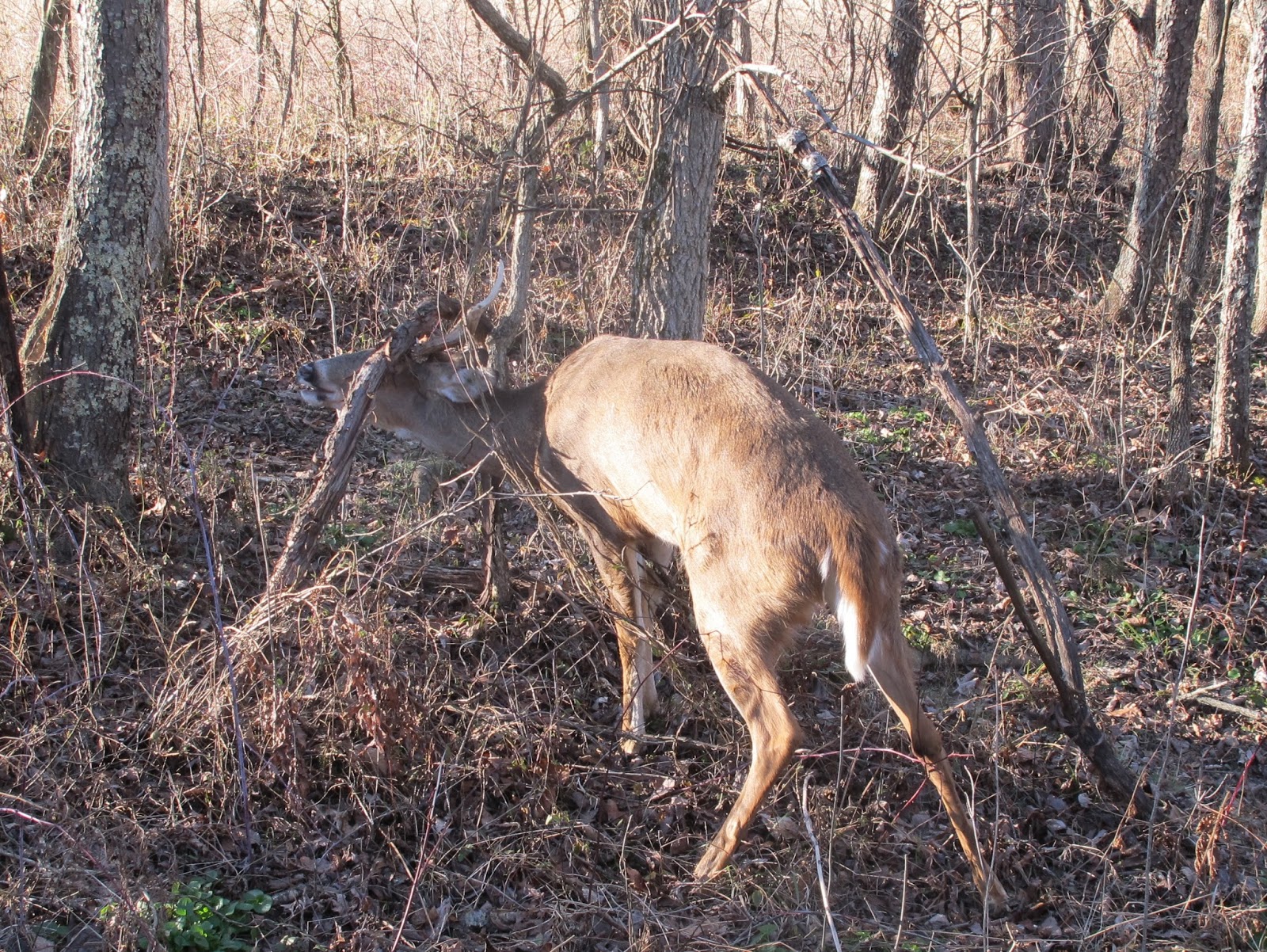
One evening last week I had an interesting encounter with a Whitetail Deer.  I had just set my tools down and was walking forward to take some before photos of a planned work area, when I spotted a buck deer about 30 feet up the hill from me.  The deer was trying to shed its antler by pushing it against a thick grape vine.  It was obvious from first glance that the buck was not exhibiting the behavior typical of a healthy deer.

The antler slipped from the vine and the deer lurched forward, the grape vine now arching above its neck.  Here it stayed for several minutes.

The deer was breathing heavily and its eyes were kept partially closed.  At this point I thought the deer might just be exhausted from trying to dislodge the stubborn antler.

After its rest, the deer circled around and came at the grape vine again.  It had no better luck this time and circled around for a third try.

Leaving the deer to its business, I went ahead and took a few photos of my planned work area.  I heard some branches breaking and turned in time to see the deer stumble away from the grape vine, get tangled in a small shrub and stagger down the hill to fall right on top of my tools.

The deer stayed down for about a minute before getting back on its feet.  Its body looks to have lost a lot of muscle.  It was here that I began wondering if the deer was just on the downhill end of a long life or if it was diseased.

After standing for a couple of minutes, the deer began to walk in a tight circle.  The video above shows part of its roundabout journey.  Before filming, I was able to sneak in and get my bow saws and tool bag out of the way, but each time I moved in, the deer lunged in my direction.  Not wanting to risk a deer related injury, I left my pole saw and gloves to fend for themselves.  The deer seems quite adept at stepping on the pole saw on each circuit.

Eventually, the deer worked its way down the trail.  In the half hour between the taking of this shot and sundown, the deer traveled about 60 feet and fell down four times.  The following morning I found the deer another 200 feet down the trail.  It was down and didn’t look like it would be getting up again.  I reported the presence of a potentially diseased deer to the local Wildlife Officer who arrived to put the deer out of its misery and collect samples to be tested for disease.

Wednesday, April 2, 2014

What About Those Deer?

Nothing seems to elicit ooh’s and aah’s from hikers as much as a chance encounter with a Whitetail Deer.  I used to react that way 30 years ago.  Now, when I can’t seem to walk anywhere without seeing deer, they tend to lose their allure. 


I’ve begun to think of deer in the same way that urban dwellers often view rats.  If you see one during the day, there are a dozen hidden away that you won’t see until the sun goes down.  Wait for that period between sunset and dark and you’re likely to find deer coming out from everywhere.


This photo, taken near dark through my dining room window, shows 22 deer browsing in the field behind the house.  I’m still debating how the increasing deer population will factor into my management decisions.  I manage Blue Jay Barrens in an attempt to create healthy native plant and animal communities with an emphasis on developing populations of rare and unusual species.  A major component of management is the identification of variables that affect achievement of the desired goals.  Deer are a variable that will definitely influence the nature of the plant populations.  Will their actions work against my achieving the desired management goals and what can be done about it if they do?


Signs of deer activity are easy to spot.  Deer trails are showing up everywhere.


The trails through the tall grasses are so numerous that it’s almost like following a maze.


With the trails comes soil disturbance.  Disturbed soil is necessary for the colonization of many plant species.  This is good when those species are natives.  Unfortunately, aggressive non-native invasives thrive in these situations and can use these trails to infiltrate native stands.


Deer seem to feed on just about any plant.  Their constant browsing often shapes the growth pattern of woody shrubs.  Patches of Late Low Blueberry, Vaccinium pallidum, all display a flat top appearance due to constant browsing.


The pruning causes an increase in stem development like that found in a well groomed hedge. 


Due to a profusion of buds along the stem, deer browsing does not typically kill woody plants.  Buds just below the browse point are ready to take over as leaders and regrow what was lost.


Deer tend to favor certain plant species.  As the deer population increases, less desirable plant species begin to show signs of deer browsing.


Yucca, a non-native plant in this area, has leaves tougher than anything else in the landscape.  This is the first year I’ve noticed them being eaten by deer.  If the deer would concentrate their efforts on non-native species, I wouldn’t be questioning their desirability at Blue Jay Barrens.


Deer are certainly doing their part to recycle plant material back through the soil ecosystem.  The question is whether those droppings come from plants adapted to surviving continual browsing or rarities such as the orchids that suffer greatly from an annual pruning.  It will certainly be interesting to see what changes the deer bring to the landscape during the next decade.

Thursday, February 20, 2014

Feeder Deer

My bird feeding activity also attracts some non-bird visitors.  Most conspicuous are the Whitetail Deer.  Deer visit the yard year-round, but their time spent around the feeders increases considerably when the ground is covered by snow and ice.


When not in the yard searching for bits of corn, the deer are usually somewhere nearby in a position to observe my exit from the house.  They associate my presence with the appearance of a corn treat.


A feed bucket in my hand is an invitation for the deer to head for the yard.  Most of these deer first visited the yard as fawns, led by their mothers who were searching for early apples.


It doesn’t take any special skills to discover deer tracks around here.


One young buck developed a taste for sunflower seeds and began waiting beneath the feeder for birds to drop a seed of two.


He kept a close eye on the birds and collected the seeds as soon as they were pushed from the feeder.


His next evolution in seed gathering involved scraping at the feeder pole with his paw.  This maneuver was good for a few seeds, but it also tended to keep the birds away and resulted in a net decrease in seeds obtained.


The scent of the seeds must have been strong.  He would hold this attitude for 20 seconds at a time and then search the ground before once again looking upward.


After a few false starts, he learned that he could get the seeds himself if he held his head beside the feeder and stuck his tongue out to the side.  Judging by the rate at which seed was disappearing, he must have been filling his belly.


He looks awfully pleased with himself.  Shortly after this shot was taken, I built a collar around the base of the feeder that effectively blocks his attempts at obtaining more feed.  I’m wondering how long it will take him to find a way around that. 

Saturday, June 2, 2012

New Fawn

I see Whitetail Deer fawns every year, but I usually don’t find them when they are this small.  This one can’t be more than a few days old.

The doe left her fawn in an area of high grass in the lawn.  This is one of those areas that I don’t mow regularly.  About two weeks ago I cut the tall growth, raked it up and used it as mulch in the vegetable garden.  There’s not much cover, but it was enough to hide the fawn from a distance.

The fawn has no defenses and relies on camouflage to avoid predation.  Any movement would reveal its presence, so it remains perfectly still.

The color and pattern of the fawn normally blends well with the surrounding vegetation.  The combination doesn’t work as well when the fawn is surrounded by a mixture of exotic lawn and farm grasses.

The fawn’s only visible sign of awareness of my approach was a slow dropping of the eye lids.  That makes sense since the highly reflective eye would be quite a visible attractant.

The fawn was about the size of a small house cat.  There was no really good object to use as a size reference, so I held my open hand about an inch above the fawn’s body.  I could have covered the entire animal with both hands.  I’m sure I’ll see a lot more of this guy before summer is over.

A Camera Critters submission.

Wednesday, May 16, 2012

Mayapple Feast

I returned to a place I had just visited the previous day to find that something had eaten a substantial meal of Mayapple plants.  I know that all of the plants were untouched the night before, so this was the result of a single night’s activity.

Other than loss of the fruit, I rarely see any damage done to Mayapples.  I was curious as to the identity of the culprit.  Three notorious plant eaters came instantly to mind:  Cottontails, Groundhogs, Whitetail Deer.  The feast consisted of several plants.  The heights of the remaining stalks suggest that in some cases, very little of the plant was actually consumed.  This doesn’t seem consistent with the feeding behavior of the Cottontail.  Cottontails bite a stalked plant off at the base and then sit upright while eating their way up the stalk.  They rarely eat from the top down to the ground.  I imagine their feeding method allows them to watch for predators while feeding. 

Groundhogs have a feeding pattern that’s similar to that of Cottontails.  If they were not going to consume the leaf, they would eat the stalk right up to the base of the leaf and leave little or no stub.  With an almost machine like proficiency, a Groundhog would have left each leaf with the same amount of stem attached.

The partially cut, partially torn stub makes me lean towards deer.  Deer are the most likely animal to leave varying lengths of stem both on the leaves and standing from the ground.  I’ve also watched deer leave this same type of bite signature on many different types of plants.

I still don’t know why an animal with constant access to Mayapples would suddenly make this one time assault on the plants.  Maybe the plant corrected some dietary deficiency present in the animal.  The single meal may have brought the deer back into normal balance.  I’ll probably never know for sure.  Many discoveries just leave me with a lot of unanswered questions.

Just up the hill from the Mayapples and in plain sight of my location, a group of Wild Turkeys engaged in courtship activities.  I saw them look in my direction, but they never stopped what they were doing or attempted to move away.  This bunch includes four Toms who are regular visitors to my yard.  They move out of the yard when I’m around, but come right back when I leave.  Now they seem to be getting used to my presence where ever we happen to meet.  I guess they don’t realize that there are a few more days left of Turkey season and they should be a little more wary of anything wandering around on two legs.

Sunday, February 12, 2012

So Many Deer - So Little Corn

As soon as snow began to cover the ground, the deer swarmed to the bird feeder looking for some bits of corn.  They reminded me of people mobbing the grocery store for bread and milk ahead of a snow storm. 

Just as you would expect from the pre-storm grocery crowd, there were some aggressive individuals in the mix.  This doe wanted corn, but didn’t want to share the table.

One by one she chased off the rest of the herd.

Eventually, she had the corn to herself.  Her chasing probably burned off more calories than she recovered from the corn.

Her companions huddled out of reach.  They acted like children, each encouraging the others to move forward to see if all is clear.

They finally retired to the field in search of more standard and substantial food items.