Common Milkweed is now in full bloom at Blue Jay Barrens. Common Milkweed has a strong network of rhizomes that allow a single stalk to become many in a short amount of time. Milkweeds have just about surrounded the Water Garden this year. I had to remove some stalks from the driveway and a couple more that were threatening to block access to the front porch, but there are still plenty left for the Monarch butterflies and other animals.

Milkweeds form a mass of flowers whose stalks all originate from the same point, a form known as an umbel. The large number of flowers found in each umbel typically cause the umbel to appear in the form of a sphere.

The petals fold back to reveal a central column of reproductive parts which is surrounded by a set of five two-part structures known as the hood and horn. This arrangement has always reminded me of the old dental spit-sink with a hooked claw emerging from the drain.

Milkweeds do not produce the dust like pollen common in many flowers. To affect pollination, an insect carries a pollen mass, known as a pollinium, from one flower to another. A knot like affair joins two pollinia by short threads. The insect’s foot or leg catches the thread and pulls the pollinia from a slit between the hoods. The photo above shows the location of the slit with pollinia still intact. Above that is a pair of pollinia that have been removed from the flower. I guess a flower needs to attract a wide range of insect visitors when pollination requires an incidental snagging of a pollen mass followed by the proper placement of that pollen mass on a new flower.
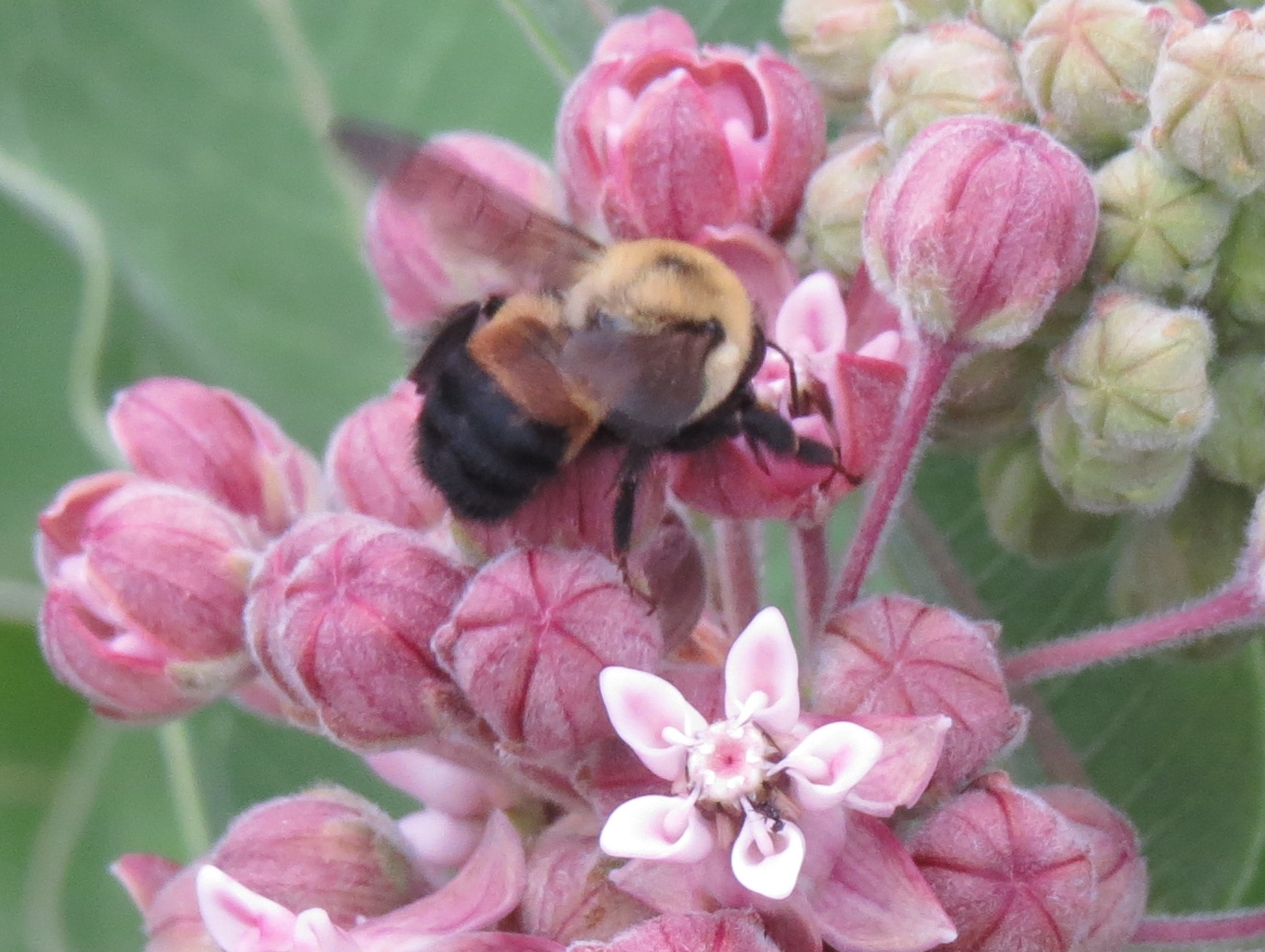
Milkweed flowers attract a wide range of bee species, from large…

… to small.

Some insects are attracted to the milkweed plant not by the flowers, but by other flower visitors. This is a Conopid fly. Conopid larvae are parasitic on bumblebees. The Conopid adult will attack a bumblebee in the air, force apart two abdominal segments, and lay an egg in the abdomen of the bumblebee. The larva consumes the bumblebee from within over the course of a couple of weeks. The action of this parasitic consumption causes the bumblebee to dig a hole and bury itself before dying, providing the Conopid larva with shelter in which to pupate and overwinter.

Like many other insects, the Conopid Fly uses mimicry to help avoid predation. In this case the fly looks suspiciously like a wasp. Would-be predators, fearful of a stinging response, are more likely to pass this fly by. The easy way to tell the difference between a fly and a wasp is to count the wings. A wasp has two pairs of wings, while a fly only has a single pair. In lieu of the second pair of wings found on bees and wasps, a fly has a pair of structures known as halteres. Halteres help to balance the fly in-flight. In the photo above, the two white objects at the rear of the thorax are the halteres.

Highly colorful Long-legged Flies flit about the leaf surfaces of many plants. The large milkweed leaves seem to particularly attract this insect.

It wouldn’t be a milkweed plant without Milkweed Bugs. Milkweed Bug pairs are often in mating tandem at this time of year. The reproductive process is not going to stop the upper bug from probing the milkweed flowers for a meal. The lower bugs is dragging around a pair of pollinia on its middle foot. The pollinia will be wasted if not deposited into an open flower.

Goldenrod Soldier Beetles are also busy with courtship rituals. These beetles are pollen eaters and will visit many species of flowers besides their namesake Goldenrods.

The milkweed flowers are brightly colored, strongly scented producers of abundant nectar. Most moth visitors appear after dark and are rarely noticed. The Hummingbird Clearwing is one of the few brightly colored moths that visit the flowers during the daytime.

Many species of skippers are attracted to milkweed. This is the Silver-spotted Skipper, one of the largest and most easily recognized of that group.

Butterflies of all sizes visit milkweed. On the smaller end of the scale are the tiny hairstreaks, like this attractively marked Banded Hairstreak.

Great Spangled Fritillary butterflies have been mobbing some of the milkweed flowers. If your interest is in viewing butterflies, and other interesting animals, it’s worth encouraging a few Common Milkweed plants to live somewhere near your house.
Still photos don’t do justice to mobbing butterflies, so I
offer the short video above.