Showing posts with label Salamander Larva. Show all posts

Wednesday, December 16, 2015

Newt Larva

After being dry for nearly six weeks, the pond was partially restored by a two inch rain during the last week of October.  I’ve been carefully watching for the arrival of the first breeding salamanders of the season.  Both Jefferson and Streamside Salamanders have been known to enter the pond in December.

Last night I spotted several small salamander larvae moving about in the water.

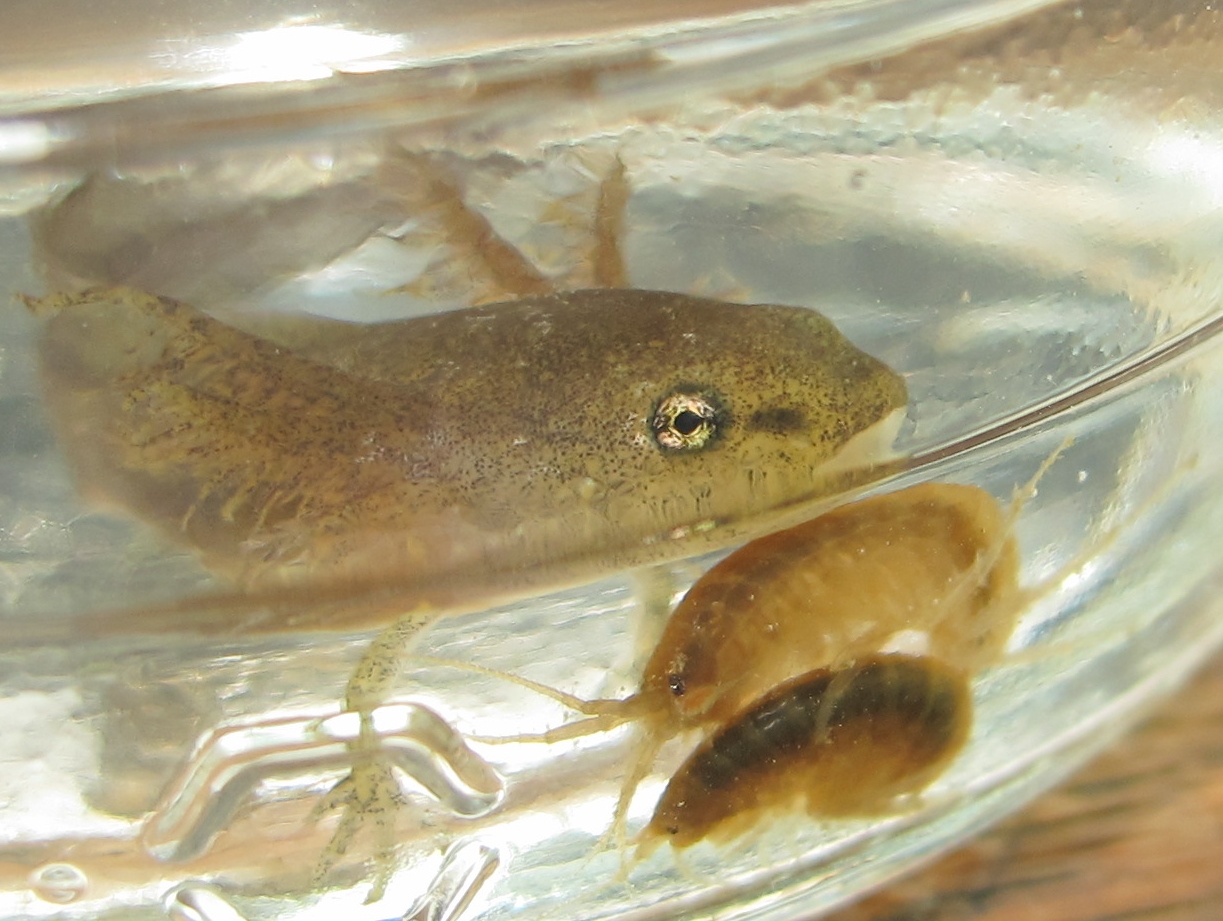
Using a fine meshed aquarium net, I scooped one out for closer examination.  The larva may look large in the photo, but it is actually only about an inch and a half total length.  The mesh of that net has 16 openings per lineal inch.  Beside the larva is a freshwater amphipod.

From the net, I dropped the larva into a glass jar for observation.  Identifying characteristics are poorly developed in a specimen this young, but there is no doubt that this is the larva of a Red-spotted Newt.  Red-spotted newts have a definite spring breeding season, but also seem to be opportunistic breeders throughout the year.  Breeding behavior is common in the water garden during summer and early fall, especially following a heavy rain.  This individual probably hatched from an egg deposited soon after the late October rain.  Eggs typically take three to five weeks to hatch, and warm water would have allowed hatching to occur closer to the three week mark.  I estimate this larva to be about a month old, so it still has four or five months to go before beginning a terrestrial life style.

As the larva develops, the head will become smaller in relation to the body and will develop more of a taper towards the snout.

The hind legs are just buds.  They will grow steadily over the next couple of months.

The beginnings of the distinctive dark eye stripe is just now forming between the eye and mouth.  By the time salamander larvae appear in the pond, the newt larvae will be formidable predators.

Monday, June 15, 2015

Water Garden Predators

The Blue Jay Barrens Water Garden will be celebrating its 15 year anniversary this summer.  On August 4, 2000 I installed a liner into the completed excavation and diverted runoff from downspouts in the front of the house to the leak proof pool area.  Two days later, a light rain put an inch of water in the bottom of the pool, and that night, treefrogs deposited several egg clusters.  Since then life in the pool has been in a state of constant change.  Each year is a new experience with new players, both plant and animal, finding a place in this tiny pool.  Most conspicuous in the pool these last few years has been a growing number of predators that feed on the masses of small animals attracted to a permanent body of water.

All plants in the Water Garden are native to this area, with the exception of the Water Lilies.  I’ve had a desire for a pool of Water Lilies for most of my conscious life, so I bought some tubers, planted them in weighted tubs and put them into the Water Garden.  After a couple of years, the Water Lily root mass grew so large that it floated the pots to the surface.  My thought was to transplant the tubers into larger pots with heavier weights, but when I hauled the plants out of the water I found that the lily roots had completely enveloped the pots.  I settled for adding more weight by strapping bricks around the outside of the root mass.  This worked for a couple more years, then up came the root masses with all of my bricks neatly hidden inside.  At that point I decided to just leave the lilies alone.  Now the root masses rise to the surface each summer with the growth of new roots and then sink again in the fall as the roots die back.  Islands created by the root masses are becoming populated with a variety of aquatic plants that don’t mind a winter long emersion.

In last few days there has been a mass emergence of damselflies from the pool.  The shed skin of the aquatic nympth is left behind by the newly emerged adult form.

Both the aquatic and adult forms of damselfly are predators.  Adults capture and consume small flying insects, while the aquatic nymphs feed on insects, tadpoles, fish, worms and anything else small enough to be captured and held.

Adults seem to emerge most often under the cover of darkness.  In the morning, newly emerged individuals can be found resting on stable structures near the water.  It takes a while for the wings and exoskeleton to harden, and for the full coloration of the adult to develop.

Unlike most other damselflies, Spreadwing Damselflies hold their wings slightly apart.  These damselflies are slightly larger than the average.

This is one of the Bluet Damselflies.  This is a small, delicate Damselfly that is quite common here at Blue Jay Barrens.

Male and female bluets join in tandem for mating and egg laying.  This pair is insuring a supply of Damselflies will be around next year.

Aquatic plants growing in pots set on a shallow shelf at the edge of the Water Garden have long since escaped confinement and found their own anchorage.  A tangle of rush stalks and other dead vegetation give a foundation for an assortment of water loving vegetation.  Some were planted when the Water Garden was first filled, but most have arrived by more natural means.

The thick vegetation may be a place of safety for some, but it also harbors a healthy population of predators.  These young spiders have just recently emerged from heir silken egg sack.

Most of these will fall to larger predators or relocate far distant from here, but several will stay and grow to adulthood in the lush vegetation of the Water Garden.

Red-spotted Newts are the top of the line submerged predator.  They can detect the slightest movement and will investigate any creature their own size or smaller.  If they can fit it in their mouths, they will eat it.  I don’t believe you can stuff a newt so full that it would stop trying to eat more.  Males like this one are continually cruising the pool looking for food and for breeding opportunities.

Female newts typically remain more hidden, but they are still alert for anything that may be food.

When newly hatched, salamander larvae are heavily preyed upon by the newts.  As the salamanders  grow, they become a predator as efficient as the newt.  The difference between the two is that the salamander only spends a portion of its life in the pool.  It will soon mature into a land dwelling form and take off for a more terrestrial lifestyle.

Bullfrogs are probably the most aggressive above water predators in the Water Garden.  As long as he can avoid the notice of Minks, Raccoons and Herons, this guy should have no problems.  Anything smaller than this guy’s mouth is in danger of being eaten.  Bullfrogs are typically just temporary visitors and after a few weeks will move on to new hunting grounds.  If it ever rains here again, this frog will probably move on.

Adult Green Frogs have a chance of competing against a large Bullfrog, but those that have just recently transformed from the tadpole stage are just Bullfrog food.  This young frog has just lost the last of its tail stub and is watching for a flying insect to come within grabbing distance.

Gray Treefrogs have a tough time competing in a permanent pool.  Predators make quick work of the newly hatched tadpoles and the adult frogs are in danger of becoming a Bullfrog meal.

Northern Water Snakes will also make a meal of tadpoles and frogs.  There are at least two mature water snakes now living in the Water Garden.  They arrived here as youngsters several years ago and have been growing steadily since.

I’ve resigned myself to the fact that the Water Garden has become a home for top level predators.  That is why I’ve initiated other projects to provide temporary pools to those aquatic creatures that cannot deal with a high predator load.  I’ll just keep enjoying the Water Garden and see what comes next.

Friday, June 5, 2015

Salamander Larva Rescue

Rainfall patterns have been decidedly odd so far this year.  January and February both had below average precipitation.  March had 6.6 inches of rain, but six inches of that fell in the first two weeks of the month.  By the end of March, it was beginning to look like we were definitely experiencing a drought.  April totaled 7.4 inches of rain, but over six inches of that fell in the first two weeks.  Over the next few weeks, things slipped back into drought conditions.  May totaled only 1.5 inches of rain.  Combine that with a week of temperatures topping out in the 90’s and the drought soon became serious.  The seasonal spring that feeds the toad pool stopped flowing in mid-May.  By Memorial Day it was obvious that the pool would only survive for a few more days.

I went out with net and tub to begin removing tadpoles from the pool for relocation to the pond.  The pool began the season with a healthy population of Jefferson Salamander and Wood Frog tadpoles.   The surviving salamanders were now hiding in deep hoof prints left by the deer.  I soon became adept at using a stick to scare tadpoles from the hoof prints and into a waiting net.  After a while the water would become muddy enough to hide the tadpoles, so I would have to wait for things to settle down before continuing.  I scooped tadpoles twice a day for three days.  By day four there was no water left, but I think I had removed most of the tadpoles by then.

The pool water would have lasted longer if the deer didn’t have such a fascination for that big puddle.  Sometimes in the evenings as many as a dozen deer will gather at the pool.  Acting just like a bunch of children, the deer run back-and-forth through the pool.  Sometimes they just stand on the edge and make a series of jumps in and out of the water.  Some tadpoles probably get trampled and others may suffer from the muddy water left by the deer.  The most damaging thing the deer accomplish is to push soil from the banks into the center of the pool.  In this photo, the pool has only half of its constructed depth because of the deer activity.  It would have helped considerably to have that extra depth filled with water instead of soil.

This was the first batch of refugees to move into the pond.  Some of these are already losing their gills and preparing for a life out of the water.  The final rescue count was about 60 salamanders and an equal number of Wood Frogs.

The pond should last plenty long enough for the salamanders to complete their development.

While I had them, I put a few tadpoles into an aquarium for observation.  All looked healthy.

The Wood Frog tadpoles also looked to be in good shape.

To compensate for their ordeal of spending a day in the aquarium, I filled the salamander’s with earthworms and fed the Wood Frogs some algae wafers.  I thought full bellies might keep the salamanders from dining on their tankmates.

I was wrong.  Despite a healthy meal of worms, this guy still had room for a Wood Frog tadpole.  It only took him a couple more gulps to suck that tail inside its mouth.  For several weeks I had been noticing a decline in the frog tadpole population.  I guess this explains both the salamander’s rapid growth rates and the steady loss of frog tadpoles.

Wednesday, May 21, 2014

Streamside Salamander Larvae

Streamside Salamanders began hatching about three weeks ago.  Now I’m seeing the larvae in every part of the creek.  The cooler water temperature of the creek causes these larvae to develop more slowly than their relatives living in upland pools.  While the salamander larvae in the pond are nearly ready to leave the water, these creek dwelling larvae will remain in their aquatic environment for several more weeks.


Each year finds more Streamside Salamanders breeding in the creek and many have recently begun to utilize the smaller tributaries.  I am assuming that the salamander population has been increasing since stream disturbance, such as cattle access, stopped when I purchased the property.


Fish do not travel up these small tributaries, so the pool dwelling salamanders are not threatened by that voracious predator.  The down side is the fact that the smaller tributaries stop flowing earlier in the summer than the main creek.  Larvae in the tributaries are at a greater risk of losing their water supply before they have time enough to develop sufficiently to adopt a terrestrial lifestyle.


In the main creek, Streamside Salamanders are utilizing most of the prime breeding rocks.  Larvae hatching from beneath large flat rocks in the fast moving stream reaches are swept into the quiet waters of downstream pools.


Streamside Salamanders are now numerous enough that each set of riffles produces some larvae for the adjoining pool.


Larvae of this species develop a more streamlined shape than species living in quiet ponds.  Even in the pools, the water can sometimes move quite swiftly and the larvae need to keep from being swept away.  Their long, thin shape helps the larvae settle in and ride out times of storm runoff.


Even the gills appear to be stouter and more compact.  We’ve had plenty of rain this spring and the water table is high.  The creek should keep flowing well past the time that the salamanders lose their gills and move away into the surrounding woodland.

Monday, May 5, 2014

Toad Pool Update

Salamander larvae are developing quickly in the warm waters of the toad pool.  The plump belly on this guy attests to the fact that the pool has no shortage of food items suitable to hungry young salamanders.


Vegetation has filled in nicely around the pool.  Unfortunately, no toads have yet visited.  Depressions in the mud bottom are the result of deer traffic.  Several deer trails intersect here.  Recent rains have recharged the ground water reservoir responsible for keeping the pool full, so there should be no repeat of last year’s disastrous premature water loss. 


Salamander larvae do nothing but eat.  Large heads accommodate large mouths and the salamander will eat anything it can get through its mouth.


External gills on the back of the head will remain until the salamander has developed enough to leave the water and begin a terrestrial existence.  The developing front legs can be seen directly below the gills.  The rear legs are just beginning to emerge.  This individual needs about another four weeks before it ends its larval stage.


Wood Frog tadpoles remain plump and are growing rapidly.  Hind legs will begin to show in another week of so.  It’s likely that the piece missing from this tadpole’s tail was removed by a hungry salamander larva.


Even though they are not predatory, Wood Frog tadpoles also live to eat.  They feed on plankton, algae and decomposing plant and animal matter.  Their feeding activities clean away algae and keep the water clear.  Their waste products feed plankton and algae, so the more they eat, the better conditions are for more food to grow.  This is how masses of tadpoles manage to prosper while crowded together in small puddles.


Some of the largest salamander larvae are a potential threat to the Wood Frog tadpoles.  I usually think of salamander larvae as fragile creatures, but they can be terrors to other aquatic life in the pool.


I saw this salamander trying to swallow something that had been reduced to a pulpy white mass.  It just couldn’t quite get the whole thing in its mouth.  I’m sure that the salamander wasn’t going to give up and whatever the food item was, it eventually went down.