Showing posts with label Wood Frog Tadpoles. Show all posts

Friday, June 5, 2015

Salamander Larva Rescue

Rainfall patterns have been decidedly odd so far this year.  January and February both had below average precipitation.  March had 6.6 inches of rain, but six inches of that fell in the first two weeks of the month.  By the end of March, it was beginning to look like we were definitely experiencing a drought.  April totaled 7.4 inches of rain, but over six inches of that fell in the first two weeks.  Over the next few weeks, things slipped back into drought conditions.  May totaled only 1.5 inches of rain.  Combine that with a week of temperatures topping out in the 90’s and the drought soon became serious.  The seasonal spring that feeds the toad pool stopped flowing in mid-May.  By Memorial Day it was obvious that the pool would only survive for a few more days.

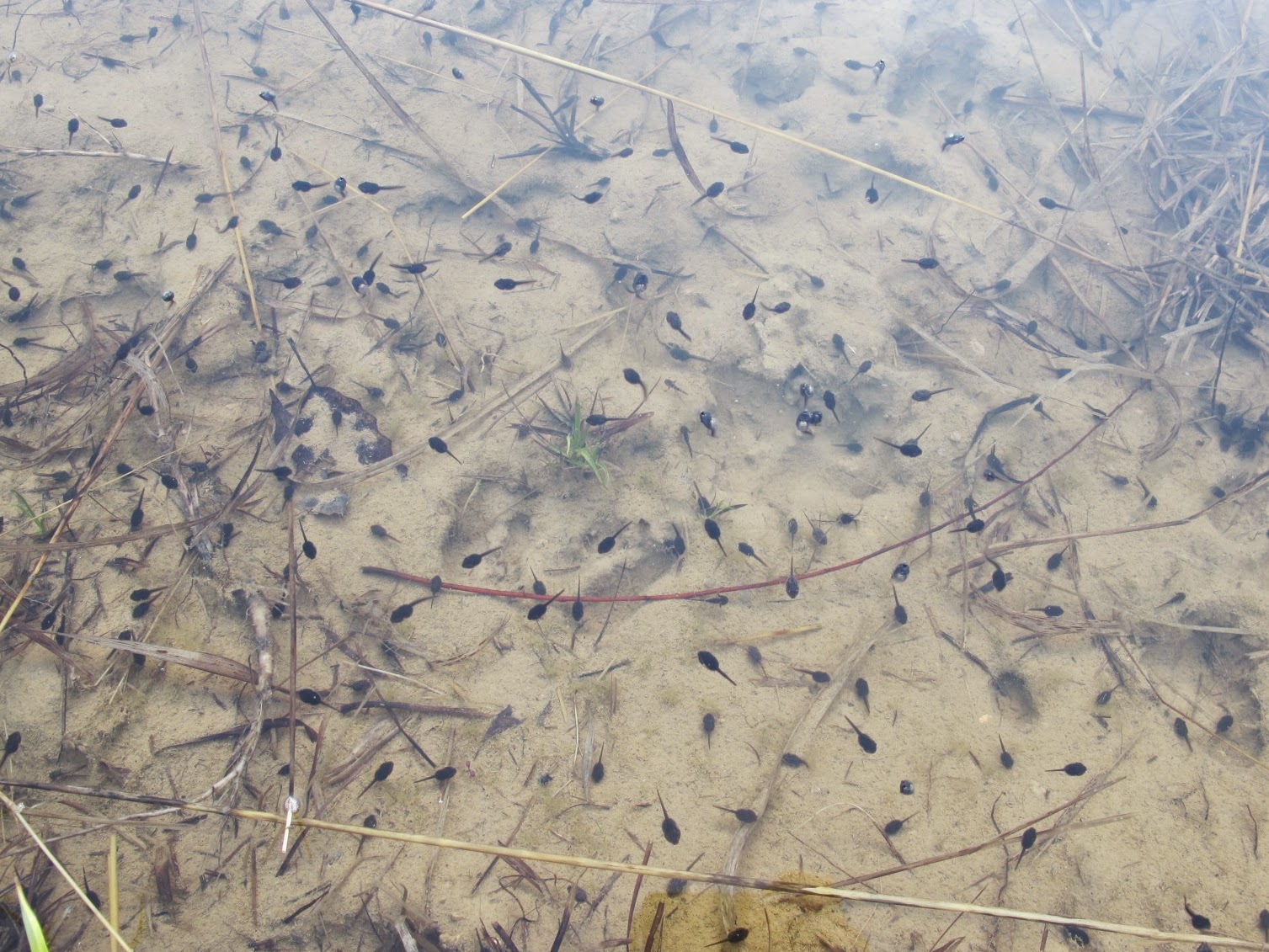
I went out with net and tub to begin removing tadpoles from the pool for relocation to the pond.  The pool began the season with a healthy population of Jefferson Salamander and Wood Frog tadpoles.   The surviving salamanders were now hiding in deep hoof prints left by the deer.  I soon became adept at using a stick to scare tadpoles from the hoof prints and into a waiting net.  After a while the water would become muddy enough to hide the tadpoles, so I would have to wait for things to settle down before continuing.  I scooped tadpoles twice a day for three days.  By day four there was no water left, but I think I had removed most of the tadpoles by then.

The pool water would have lasted longer if the deer didn’t have such a fascination for that big puddle.  Sometimes in the evenings as many as a dozen deer will gather at the pool.  Acting just like a bunch of children, the deer run back-and-forth through the pool.  Sometimes they just stand on the edge and make a series of jumps in and out of the water.  Some tadpoles probably get trampled and others may suffer from the muddy water left by the deer.  The most damaging thing the deer accomplish is to push soil from the banks into the center of the pool.  In this photo, the pool has only half of its constructed depth because of the deer activity.  It would have helped considerably to have that extra depth filled with water instead of soil.

This was the first batch of refugees to move into the pond.  Some of these are already losing their gills and preparing for a life out of the water.  The final rescue count was about 60 salamanders and an equal number of Wood Frogs.

The pond should last plenty long enough for the salamanders to complete their development.

While I had them, I put a few tadpoles into an aquarium for observation.  All looked healthy.

The Wood Frog tadpoles also looked to be in good shape.

To compensate for their ordeal of spending a day in the aquarium, I filled the salamander’s with earthworms and fed the Wood Frogs some algae wafers.  I thought full bellies might keep the salamanders from dining on their tankmates.

I was wrong.  Despite a healthy meal of worms, this guy still had room for a Wood Frog tadpole.  It only took him a couple more gulps to suck that tail inside its mouth.  For several weeks I had been noticing a decline in the frog tadpole population.  I guess this explains both the salamander’s rapid growth rates and the steady loss of frog tadpoles.

Friday, May 1, 2015

Tadpole Feeding Frenzy

The Wood Frog tadpoles have been growing rapidly and have just about eliminated algae and soft plant material from the pond.  In a typical year, the waste produced by the tadpoles acts as a fertilizer to stimulate the growth of algae which the tadpoles then eat.  As the tadpoles grow, they produce a greater quantity of waste which makes even more algae grow.  The excess rainfall we have had during the past few weeks has diluted the concentration of nutrients in the pond and slowed the algae growth.

This is a typical Wood Frog tadpole dispersal pattern.  Each tadpole is engaged in a random search for food.  They nibble their way across the pond bottom, check every surface of submerged plant material, and even turn belly up to skim the film of pollen grains from the water’s surface. 

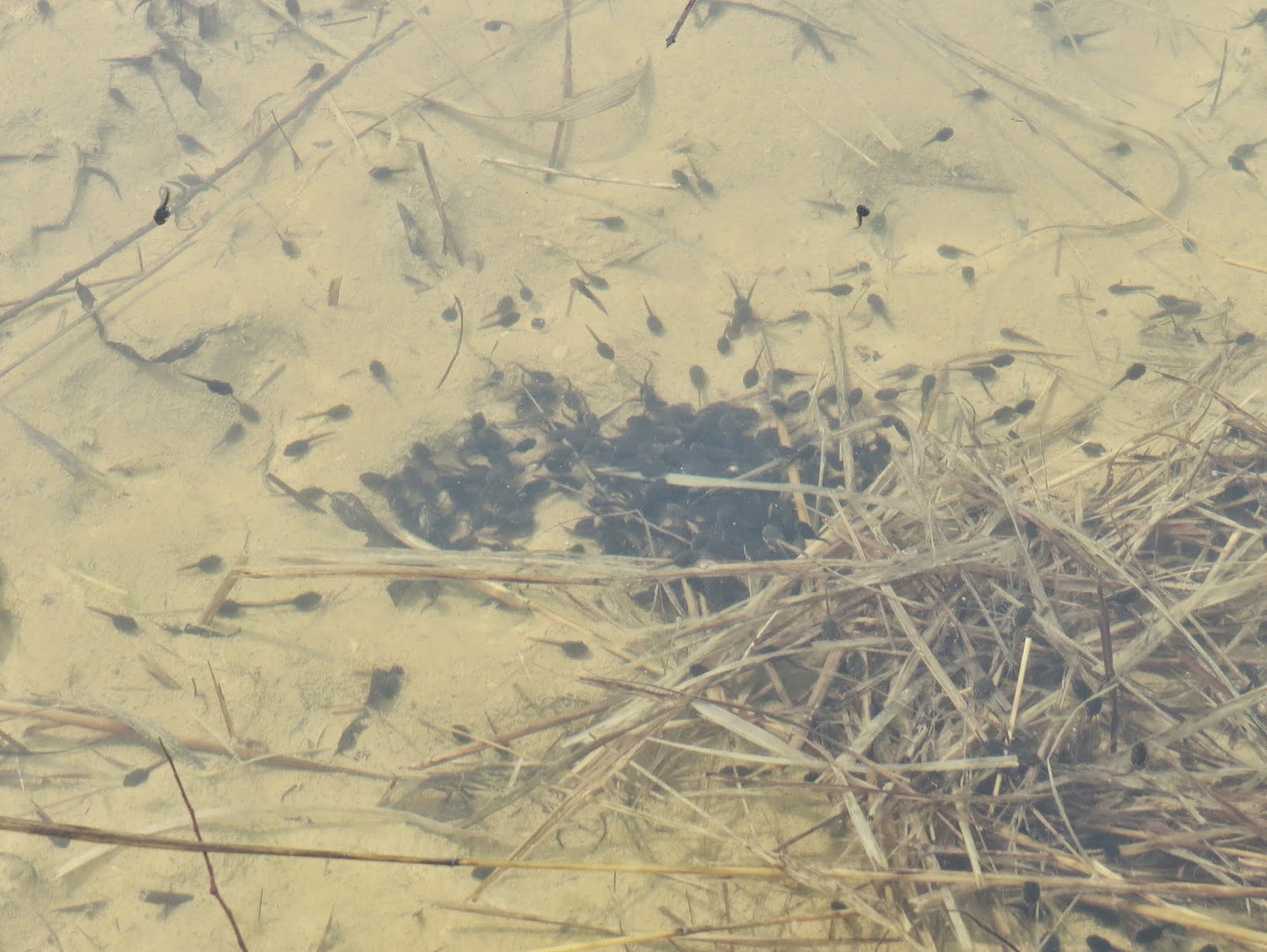
Occasionally, an especially appealing food source will cause a pile-up of tadpoles.

These tadpoles are all competing for some tasty morsel hidden from view by the mass of tadpole bodies.

This short video reveals the source of their excitement.  A chance to nibble on a drowned worm is the prize in this competition.  At this point the worm seems to have been broken into several sections.  One section of worm becomes visible when it is drug to the top of the heap and pulled out of the picture at the top of the frame.  As the tadpole runs off with the leading edge of the worm, three other tadpoles get pulled along for the ride.  The lead tadpole is only out of the picture for a second before it comes right back in and dives into the same confusion it had just escaped.  Its three followers are still trying hard to get some of the worm for themselves.  I’ve witnessed this same type of behavior directed towards a variety of partially decomposed small animals.  Tadpoles thrive on algae, but they love a bit of meat in their diet.  The video can also be seen on YouTube by clicking HERE.

Friday, April 10, 2015

Rain and Flooding

Blue Jay Barrens is about as wet as it can get.  A long sequence of storms moving through during the past week has dropped nearly six inches of rain over the area.  Storm clouds moved through once or twice every day.

The soil, already fully hydrated by over six inches of rain in March, quickly became saturated and the output of each storm had nowhere to go but to run overland to the creek.  A storm yesterday afternoon produced 0.8 inches of rain in 15 minutes.  The result was a flash flood, the third this week.

Water from the township road carried red clay particles to the pond.  It looks like a bowl full of mud, but the water clarity is not as bad as it appears.

A closer examination shows the water to still be fairly clear.  The clay tint makes the dark Wood Frog tadpoles easy to see. 

The tadpoles have just recently taken on the traditional tadpole shape and become free swimming.  If these rains persist, there will be no problem of the pond drying up before the tadpoles transform into little hoppers.

The diversions around the vegetable garden have been working overtime this spring.  The garden sits in a level area that was formed by eroded soil being trapped by an elevated roadway.  Without the diversions, water would inundate the garden after every rain.

After each storm, I check to see that the female Carolina Wolf Spider is alive and well.  So far, she seems to have been unaffected by even the heaviest of rains.

Small upland waterways swell to wide streams as the water quickly rushes downhill.  After each rain event, I try to get down to the creek to see how the increased water flow moves through the channel.

The quickest way to the creek is over the hill.  Even in the driest, most well drained locations, water still stands on the surface.

Five minutes after the rain has stopped, concentrated water flow is still pouring from small woodland watersheds along the creek. 

Water running from these woodland areas is generally clear, but it carries a heavy load of leaves.  The result is a mosaic of bare ground and thick piles of leaves.  This will influence the pattern of plant growth through the rest of the year.

I’m always relieved when I see the bridges still intact.  All but one of the bridges have been replaced to an elevation above the record flood level.  If we do get a flood capable of tearing out this bridge, I hope I’m here to see it, because it will be a truly rare and terrifying event.

Calm and scenic features, such as a small waterfall, are covered over by the flood.  It’s always a surprise when the water drops and the creek resumes its earlier appearance. 

Water pools in the flood plains as it waits for a chance to seep into the ground.  This soil is very well drained and normally allows rapid water infiltration.  Its appearance now makes you think of vernal pools and amphibian breeding, but given a day without more rain, it will pass all of this water into the creek.

This is the last bridge needing to be repaired and elevated.  It has been moved and battered by flood water many times over the years.

Downstream of the bridge is the area blocked by a log jam a couple of years ago.  Since the removal of the jam, water now flows freely through the channel.

Since I wait for the lightning to clear the area before venturing out after a storm, I usually miss seeing the water at its highest level.  At the peak of the flood, water left the creek channel and moved overland.  This area was scoured clean when the water was suddenly blocked by the formation of a log jam and forced out here.  It’s likely that a new channel will be formed here someday.  I could have left the log jam in place and let the new channel form, but this little area has a nice collection of woodland flowers that I would like to enjoy for a while longer.

The third of three large bridges is now well above flood level.  This bridge was repaired using sections of decking from two older bridges.  I think this one is elevated and anchored well enough to withstand any flood.

I find still photos of rapidly moving water to be lacking in impact, so I have included a short video that captures the movement and sound of the angry creek.  It is also available for viewing on YouTube by clicking HERE.

Monday, March 30, 2015

Amphibian Egg Progress

The bulk of salamander and Wood Frog egg laying at Blue Jay Barrens occurred between March 13 and March 17.  In the two weeks since egg laying began, air temperatures have ranged from a low of 10oF to 75oF.  Water temperature has not suffered such wild fluctuations, due to the constant inflow of relatively warm spring water.  Despite these varying conditions, development of salamander eggs is progressing at a rapid pace.

Several of the Jefferson Salamander egg clusters show eggs with white colored centers.  This usually indicates the presence of fungus feeding on unfertilized and damaged eggs.

There are still plenty of live embryos in these masses, so there should be no shortage of larvae hatching into the pond.

Jefferson Salamanders concentrated their egg laying efforts on sticks floating in the pond.  Several large sticks are completely covered with Jefferson egg masses.  Streamside Salamanders made heavy use of the hard surface structure I placed in the pond for their use.

The structure was composed of a mixture of clay drainage tiles, bricks, rocks, and boards.  My thought was to see if the salamanders preferred one substrate over another.

Substrate type didn’t seem to matter.  There were eggs everywhere.

Once the lower surfaces were covered with eggs, the salamanders began attaching eggs wherever they could find a hard surface.  Next year I will try placing the material so there are more spaces between the various components.

Wood Frog egg masses are beginning to lose their cohesiveness and spread across the water surface.

Frog tadpoles are becoming free swimming and detaching from the egg masses.

Development of the eggs on the outside of this mass seems to be several days behind those eggs in the center.

Eggs in the top of the mass are most susceptible to damage from weather conditions.  Ice formed over the top of these eggs several times during the past two weeks.  Several embryos seem to have been killed from freeze damage.  Larvae hatching from that top layer of eggs also seem to have a tough time working their way out to open water.  Even so, plenty of live tadpoles will result from this hatching.

Attracted by the movement of hatching tadpoles, one of the breeding pond’s super predators moves in to investigate this newly available food source.  Red-spotted Newts will take their toll on the young salamander and frog larvae.  They can’t eat them all, even though they will try.  Plenty of young salamanders and frogs will live to add their efforts to future annual breeding activities.

Wednesday, June 18, 2014

American Toad

Eastern Moles tunneled extensively through my vegetable garden during this past winter.  They are no longer active and the tunnels they left behind periodically collapse to provide an entrance to the underground labyrinth.  A fresh opening at the end of one of my garden beds showed signs of movement inside, so I went to investigate.


The color matched the surrounding soil, but this was no lump of dirt.  An American Toad was using the mole tunnel as a daytime retreat.


As I looked in at the toad, it turned and peered back at me.  Toads have always been a favorite of mine.  When I was nine years old, my best friend through the summer was a toad.  He lived in a shaded pen in the flower bed and I took him out every day to hunt for food.  As I turned stones or dug through the soil, he would climb over my fingers in an effort to be right up front when a tasty morsel was unearthed.  When school began in the fall, I just removed the walls of his pen and left him to forage on his own.


A toad will eat just about any slow moving creature small enough to fit in its mouth.  I dropped a couple of earthworms down the hole for this guy.


It was just too difficult to get a good shot of the toad eating while it was down in the mole tunnel.  The toad ate every worm I sent its way, but the best view I got was of the toad with a worm end sticking from its mouth.


I tried holding the worm at the tunnel entrance and the toad obligingly came out to accept the offering.


The toad was just too fast for me.  The worm was taken and swallowed before my camera could react.  I think the toad got full, because after a few worms, it crawled on down the tunnel and disappeared. 


The exciting thing about this toad discovery is the fact that the toad was within 120 feet of my toad pool.  Built specifically for use by breeding toads, the toad pool has yet to receive its first toad egg.  To be fair, the pool has only been in existence for two breeding seasons.  With toad numbers on the decline at Blue Jay Barrens, I am hopeful that the addition of suitable breeding sites will reverse that trend and result in toad encounters once again being a common occurrence.


Wood Frogs have demonstrated that the toad pool provides adequate food and water to satisfy the needs of tadpoles through their development to small frogs.  Maybe it will be next year that the toads prove that the toad pool idea was properly conceived and executed.  The pool has attracted a wide variety of wildlife, but until the toads arrive, I’ll have to consider the project to be a failure.