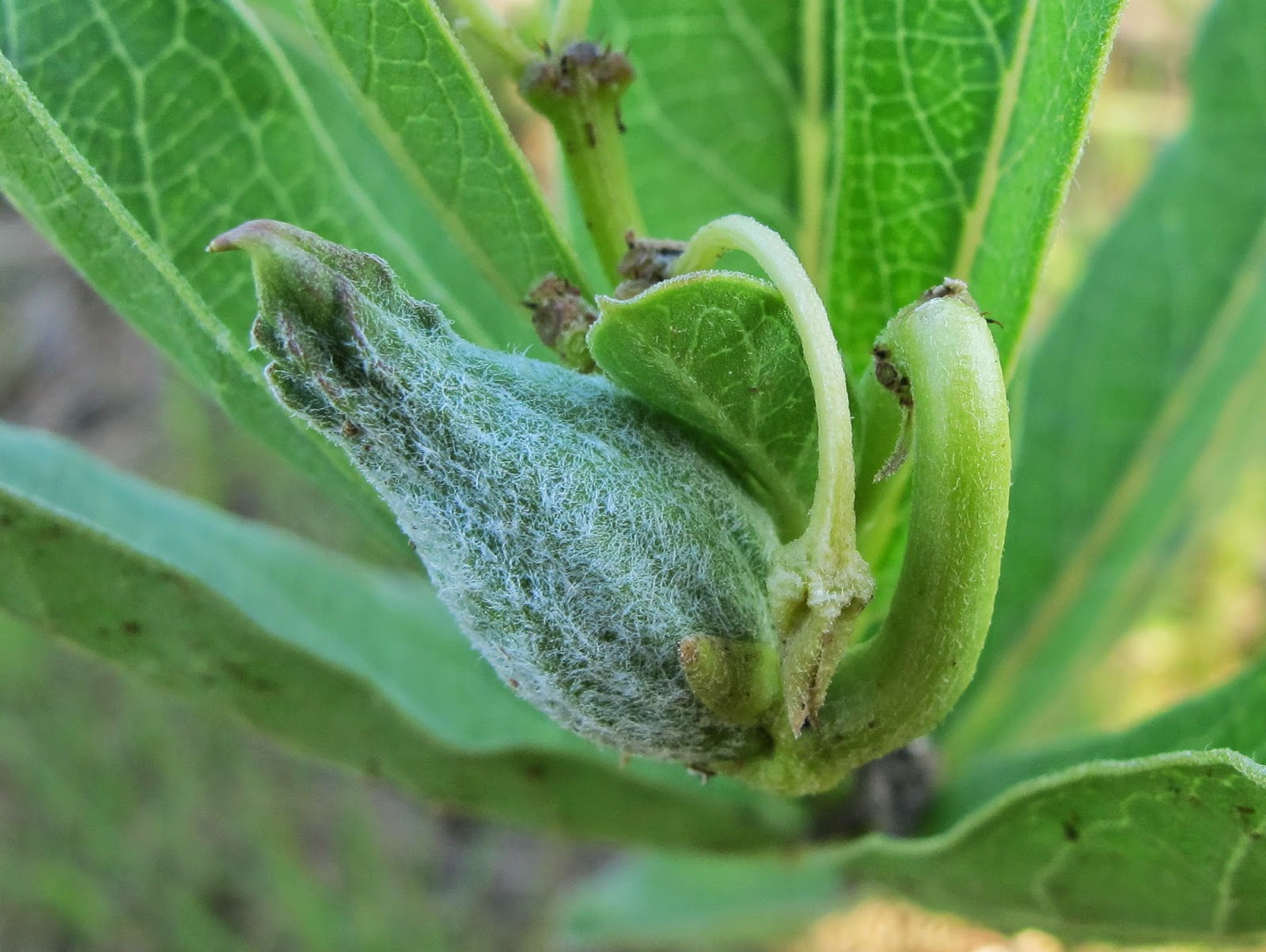
Showing posts with label Unexpected Tiger Moth. Show all posts

Sunday, July 8, 2018

Cycnia collaris Brood 2

Another batch of Cycnia collaris, formerly Cycnia inopinatus, is munching its way through the clump of Common Milkweed beside my front porch.  I’m assuming these larvae to be the offspring of the brood that showed up in May and went into pupation a few weeks ago.  That would make these larvae brood two .

More than a few of the brood one Cycnia larvae must have avoided playing host to Tachinid fly offspring and survived to adulthood.  I counted 69 larvae of this State Endangered moth species feeding on a single milkweed plant.  Additional larvae were present on many other milkweed plants close by.  As with the previous brood, it appears that the adults emerged from the leaf litter at the base of the plants and deposited a nice batch of eggs on plants readily accessible.

Larvae just recently moved onto the leaf on the left side of the photo.  They made the move after reducing the leaf on the right to a bare skeleton.

There’s not much tender young growth on the milkweed plants right now.  This doesn’t seem to slow down the Cycnia larvae at all.  The smallest larvae appear to have no trouble dining on the oldest and toughest of leaves.  The thick leaves allow the larvae to eat a lot without moving very far.  This sometimes results in a frass chain forming behind the larva.

Several severe storms have knocked down the milkweeds during the last few weeks.  Some plants have given up trying to right themselves.


The Cycnia females found the horizontal milkweeds to be just as desirable as those in a vertical position.  The larvae are quickly stripping the edible material from these leaves.  Having this action occurring right outside my front door has provided an ideal opportunity to learn something about the habits of this rare species.

Sunday, June 17, 2018

Unexpected Cycnia and Tachinid Flies

The Cycnia collaris larvae have disappeared, presumably to complete the next phase of their life cycle.  It was a lot of fun to have the opportunity to observe their behavior on a daily basis, even though some of the observations were rather disturbing.

The 70 or 80 larvae that began their lives crowded in a small clump of Common Milkweed plants, soon became mobile and began to disperse.  Larvae of a size approximating half of their potential full grown dimensions were found wandering as far as 50 feet from their birth plants.  In all cases there were milkweed plants in the direction of their travels.  It wasn’t long before all larvae were absent from the original plants.

Their dispersal pattern spread the larvae out, but instead of having a couple of larvae on each plant in the vicinity, they clustered into small groups.

Once they got settled into their new locations, I began seeing some ominous ornamentation on many of the larvae.  On closer examination, each white spot was identified as the egg of a predator.

This is the culprit, a Tachinid Fly, a species that lays its eggs on the bodies of other insects.  Observers of Monarch butterfly caterpillars are familiar with this species and its ability to decimate caterpillar populations on milkweed plants.  Fly larvae hatch from the eggs and immediately enter the body of the caterpillar, where they will feed until they are mature enough to pupate.  Caterpillars do not survive the experience. 

Most affected larvae displayed one or two eggs.

Rarely, I found larvae carrying three eggs.  About half of the larvae I inspected were carrying fly eggs.


The video shows a fly searching the leaf for larvae.  Although the fly investigates two of the three larvae found beneath the leaf, it laid no eggs.  When I later checked, these three larvae were already carrying eggs.  Perhaps the fly senses larvae that are already infested, and passes without leaving additional eggs.  In an earlier encounter I watched a fly chase a Cycnia larvae that was running across the surface of a leaf.  The fly was approaching from the right and the larva kept making quick directional changes to the left. When the fly was within range it leapt on the Cycnia larva’s head.  Almost immediately, the Cycnia larva snapped into a C shape and popped off the leaf.  It ended up in the water, so I scooped it out and gave it a close examination.  Two fly eggs were attached just behind the head.  I am assuming that one or both of these eggs had just been attached.

Monday, May 21, 2018

Common Milkweed Hosting Larvae of Unexpected Tiger Moth

My first encounter with the Blue Jay Barrens population of the Ohio endangered Unexpected Tiger Moth, Cycnia collaris, formerly Cycnia inopinatus, was seven years ago.  My encounters with this species have increased each year since then, and this year is no exception.

Unexpected Tiger Moths are a milkweed dependent species.  Last fall, a few larvae were found on Common Milkweed, Asclepias syriaca, growing in the narrow strip between my driveway and Water Garden.  When larvae of this species are ready to pupate, they move into the plant litter at the base of the host plant and pupate near the soil surface.  I am assuming that this is exactly what occurred last September.  This spring, the adults emerged and apparently laid masses of eggs on the young milkweed plants emerging at the time.

The larvae are present in numbers many times greater than what I saw last year.    The amount of plant damage occurring from feeding larvae is readily apparent.

Most of the feeding is occurring on the young leaves at the growing tip of the plant.  There are about 10 larvae working on the particular plant.

Plants with more larvae show more leaf damage.

There are at least 20 larvae working on this plant.  The milkweed can’t grow quickly enough to stay ahead of these ravenous caterpillars.

Many of the larvae are moving out to begin feeding on the older leaves.  This intensive feeding won’t harm the milkweed.  This batch of larvae, the first of two yearly broods, will soon mature and leave the plant to pupate.  The plant will recover and be ready to hopefully host another batch of larvae in August.


The video shows feeding activity in one of the areas of highest larvae concentration.  Click HERE to view the video on YouTube, which usually provides a clearer image.  Click HERE to view earlier posts concerning this species.

Friday, September 15, 2017

Cycnia inopinatus Caterpillars

I’m always pleased when an uncommon plant or animal species shows up in unusually large numbers. This year, I am finding the caterpillars of the Unexpected Tiger Moth, Cycnia inopinatus, to be several times more abundant than they have ever been in any past year. Having a bright orange body decorated with tufts of black hairs, this species is hard to miss when it’s around.

The Unexpected Tiger moth is listed as an endangered species in the state of Ohio. Its caterpillars feed exclusively on milkweeds, with Butterflyweed, Asclepias tuberosa, probably being the most common host plant. So far this year, I’ve found caterpillars on Butterflyweeds scattered over about a 30 acre area.

In late spring and early summer I’ve seen the caterpillars feeding on Spider Milkweed, Asclepias viridis. Recently, I’ve found several caterpillars feeding on the leaves of Common Milkweed, Asclepias syriaca.

A five-year-old clump of Butterflyweed growing next to my driveway is currently hosting a half dozen caterpillars. Later this year the caterpillars will move into the leaf litter at the base of the plant and pupate. They will remain there through the winter and emerge as adults next spring.

The Common Milkweed being used as a host plant is growing at the edge of my water garden. So far, this is the only Common Milkweed plant that I have found hosting any Unexpected Tiger Moth caterpillars.

Oleander Aphids have been abundant on all of the milkweeds this year. Caterpillars seem to avoid leaves that are excessively covered with aphids and honeydew, but there are enough clean leaves that the caterpillars do not seem to be lacking an adequate food supply. I hope this abundance of caterpillars results in record numbers of adult moths next spring.


The above video shows some of the typical caterpillar activities.

Friday, May 27, 2016

Spider Milkweed Project

Two years ago, I planted seeds of the Spider Milkweed, Asclepias viridis, in one of the garden beds, with the intent that the plants would host the larvae of the Unexpected Tiger Moth, Cycnia inopinatus.  That State endangered moth is primarily known for using Butterflyweed, Asclepias tuberosa, as a host plant, laying its eggs in the milkweed flowers.  I noticed that the Unexpected Tiger Moth had two broods at Blue Jay Barrens.  The early brood appeared prior to the blooming of Butterflyweed and was using Spider Milkweed as a host.  Adults emerging from that brood then layed their eggs on Butterflyweed flowers.  Populations of these two species of milkweeds were located in different areas of the property.  I thought that having the two species growing in close proximity might improve the breeding success of the moth.  Since I already had Unexpected Tiger Moths utilizing Butterflyweed in my garden, I decided to add a population of Spider Milkweed and see what happened.  This is their first year to bloom.

Spider Milkweed is the earliest milkweed to bloom at Blue Jay Barrens.  Shoots were breaking ground on April 18.

This is the same plant nine days later.  Multiple stems radiate from a common root system. 

Barely more than a week out of the ground and a cluster of flower buds has formed.

Plants are currently actively blooming.  I’ve been watching for both moths and larvae, but have seen neither yet.  These plants should produce enough seed for me to plant the rest of this bed to milkweeds and to scatter seeds back into the field where the original seeds were collected.

Sharing the bed with the Spider Milkweeds are Draba cuneifolia, which produced an abundance of seed, and …

Leavenworthia uniflora, which may have set a record for the greatest number of seed pods on one plant.

Monday, June 16, 2014

Unexpected Tiger Moth Larvae

The blooms of my favorite milkweed are quickly fading from the prairie landscape.  Spider Milkweed, Asclepias viridis, is an early season bloomer that generally ends its flowering period before the first day of summer.  Not only does this plant produce an amazingly interesting flower, it also is a focus of activity for a variety of animal species.  It’s impossible to look closely at these flowers without some small creature looking back.


The pale green flowers are impossible to miss.  If Spider Milkweed is in the mix, it will certainly be noticed. 


Having a multitude of insect visitors means a quick pollination.  Seed pods soon replace flowers.  By mid summer, seeds will fly and the plant will begin to enter its dormancy.


Among its many insect visitors, Spider Milkweed supports the larvae of the state endangered Unexpected Tiger Moth, Cycnia inopinatus.  The orange bodied larvae are easy to see against the green of the plant.


The Unexpected Tiger Moth is double brooded in southern Ohio and is generally associated with Butterfly Weed, Asclepias tuberosa.  The body color of the larva tends to blend with the orange flowers of the Butterfly Weed and provide some protective camouflage.  That strategy doesn’t work on the Spider Milkweed.  Many insect species that feed on milkweed develop toxicity by consuming and processing the toxic compounds in the plant.  Orange coloration is a common trait shared by these insects and indicates to predators that the insect is best left alone.  That may help this colorful larva to avoid predation.


I assume that the adult moth lays its eggs on the flower buds of the Spider Milkweed.  Signs of feeding on the flowers is the first clue that Unexpected Tiger Moth larvae are on the plant.  As the larvae grow, they move on to feed on the leaves.


During the last few years, I have noticed that the first brood of the Unexpected Tiger Moth utilizes Spider Milkweed and the second brood uses Butterfly Weed. That means it is necessary to have an adequate population of both milkweed species in order to have a healthy population of moths.  Currently at Blue Jay Barrens, Butterfly Weed is much more common than Spider Milkweed and the two species grow in different areas.  I am now attempting to establish Spider Milkweed populations in closer proximity to the Butterfly Weed to see if this increases the numbers of Unexpected Tiger Moths. 


Part of that activity will take place in my garden where this clump of Butterfly Weed has a history of hosting second brood Unexpected Tiger Moths.  It takes two or three years for a Spider Milkweed plant to reach flowering stage, so it will be a while before I know if my plan is successful.  I’m hopeful that I will eventually see this effort benefit the moth.  Even if it doesn’t, it will be nice to have more Spider Milkweeds growing in the fields.

Friday, March 28, 2014

Prairie Garden Spring Maintenance

The dead growth in the Prairie Garden is removed each spring.  I used to do an occasional spring burn, but abandoned that management technique because of the potential threat to the overwintering pupae of the state endangered Unexpected Tiger Moth, Cycnia inopinatus.  Now I mow and lightly rake, which greatly reduces the threat to the pupae tucked away in the leaf litter at the base of their larval food plant, Butterflyweed.


Red flags act as warnings to use caution with the mower in certain areas.  I’ve learned not to trust myself to remember every little obstacle hidden in the tall grass.


The plants would grow even if I allowed this dead material to remain.  The reason for removing the top growth is to facilitate observation of the various growth stages of each species.  Getting to know the plants at different times of the year was my primary motivation for creating this garden.


Even though the grass looks impenetrable when viewed from a distance, it actually has many openings that allow sunlight down to low growing plants.


It only takes a few passes with the brush mower to get things cut down.


What’s left looks pretty brown.


A closer look reveals a lot of color being displayed by early season growth.


Western Sunflower, Helianthus occidentalis, begins growth early in the season.  Even though Western Sunflower will grow to a height of six feet or more, most of the leaves remain at ground level, so the plant must make full use of early season sunlight before it becomes shaded by neighboring plants.


This is Hairy Bittercress, a weedy non-native that I first found here about 20 years ago.  It is now everywhere around the yard.


Hairy Bittercress thrives in bare, disturbed earth.  Large ant mounds provide an ideal growing environment.  All of my yard mounds harbor this weed and the plant is beginning to show up on ant mounds in the fields.


Fortunately, most of the greenery in the prairie garden is due to growth of native species.  These are the basal leaves of Gray-headed Coneflower, Ratibida pinnata.


Wild Bergamot, Monarda fistulosa, is coming along nicely.  A morning low of 11 degrees doesn’t seem to have done any damage to the leaves.


The population of Round-podded St. Johnswort, Hypericum sphaerocarpum, keeps shifting its position around the garden.  Clumps of plants live for two or three years and then die.  There are always new plants coming up somewhere else to take their place.


Prairie Dock has hardly made it out of the ground, but something has already nipped off the first leaf.  Deer browse heavily on this plant in the early spring, but ignore it later on.  I imagine that more suitable forage becomes available as the season progresses.


I suspect this to be the work of an Eastern Cottontail.  There seems to be a rabbit’s nest in the garden every year.  Usually she digs up some plant that I’m particularly sorry to lose.