Showing posts with label ants. Show all posts

Friday, August 28, 2015

A Neat Little Ant Byer

The Allegheny Mound Builder Ants, Formica exsectoides, are famous for the large earth mounds created as a home for their colony.  What typically go unnoticed are the numerous less imposing structures created by the ants to be used as temporary quarters for their foraging activities.  One such construction is seen at the base of this small Tuliptree.  Note: Species shown is now believed to be Formica integra.  See comment from someone more expert than I.

This pile of cedar needles contains tunnels and galleries used by the ants who are gathering food in the Tuliptree.  These strutures are sometimes called byers, an old English term referring to a small log and stick structure built to shelter livestock.  Pile of sticks is an apt description of the shelter built by the ants.

Here’s what attracted the ants.  That lump beneath the lower branch is a Tuliptree Scale.  Click HERE to read an earlier post about the scale insects.  As a byproduct of their meal of tree sap, the scales produce a sugary liquid known as honeydew.  The ants cannot resist the sweet treat.

The ant in the upper right is about to collect a freshly secreted drop of honeydew.  As long as honeydew is being produced, the ants will stick close to the scale insects.

Other ants work to maintain the byre.  This one is hauling a cedar needle up to the top of the pile.  Once the ants abandon their temporary shelter, the cedar needles will quickly settle down to a shallowly raised ring around the base of the tree. 

This type of ant byer is quite common at Blue Jay Barrens.  The unusual thing about this particular structure is the fact that it is in the open where it can be easily viewed.  It’s been a long time since I’ve seen such a nice byer uncluttered by adjacent vegetation.

Thursday, September 13, 2012

Ants and Dragonflies

 
The year is full of seasonal events.  Some I like and some I don’t.  As I was heading home yesterday evening, the road through our nearest town was closed in preparation for the annual fall street fair.  That’s one of those events I don’t like.  When I finally pulled into my driveway, I saw a large dragonfly swarm circling the Prairie Garden.  I always enjoy the fall swarms of dragonflies and this one was partly created by another of my favorite events.  Ants were swarming.

Ants taking off on their mating flight remind me of chumming the water for sharks.  Dragonflies come from all directions to feed on the ants.  This is usually an evening event and the lowering sun lights up both ants and dragonflies.  Unfortunately, it’s almost impossible for me to capture a photo that comes close to illustrating the beauty of the interaction between these two insects.  Nobody would guess that this photo contained a couple dozen flying ants and four dragonflies.

Occasionally I’ll capture an image that is recognizable as a dragonfly.  They all appeared to be Common Green Darners.

Other photos seem more suited to proving the existence of pixies or tiny x-winged fighters cruising above the fields of Blue Jay Barrens.

The dragonflies seemed to be targeting the large queen ants.  The queen’s flight was rather slow and there was a good bet that a dragonfly would nab her before she topped an altitude of 12 feet.  I think I just caught the tail end of the swarming event.  I probably would have been home in time to see the entire swarm if I hadn't had to detour around town.  During the peek of the swarm there would have been far too many ants in the air for the dragonflies to have caused much damage.  Those last few ants would have been trying to survive a sky full of predators.

The ants attempt to reach a high point, such as the tip of a blade of grass, before launching into the air.  This queen kept running up the grass blade and plummeting from the tip back down to the ground.  That’s probably why she’s one of the last to take to the air.  Maybe it’s best for her to be eaten, so she doesn’t pass on those bad swarming traits.

The workers and winged males were very small.  I had to crawl with my face almost to the ground in order to find them.  During the search, the neighbors drove past the house.  They just waved.  I guess my behavior no longer strikes them as being odd.

Amidst all of the workers was one that carried an ant cocoon in its jaws.  I guess being late hatching doesn’t excuse you from swarming.

Tuesday, August 21, 2012

Evening Primrose

A Common Evening Primrose, Oenothera biennis, managed to establish itself beside the barn.  This is a native biennial that prefers growing in areas of bare, disturbed soil.  I always let one or two grow to maturity each year.  The seven foot tall plants produce an abundance of pretty flowers, but you have to be an early riser to see them at their best.

Evening Primrose is a night bloomer.  Flowers open in late evening and wither in the early morning sunlight.  Sphinx moths are common night time visitors to this flower.  I’ve spent several nights out watching and have yet to see any insect come near the flowers.  I haven’t stayed out all night, but there should be some nectar hunters out in the hour on either side of midnight.

In years past, I’ve seen plenty of sphinx moths at these flowers.  This year’s flowers seem to be incredibly lonely.  I wonder if the sphinx moths have gone the way of my missing butterflies.

Within a few hours after sunrise, the flowers have faded away.  The flower stalk keeps producing more flower buds.  There are always a few new buds ready to open every night, so the actual blooming period lasts for quite a while.  Old flowers are busy developing seeds.  Something must be fertilizing the flowers, because the seed pods just keep growing.

Ants have claimed this plant and have created a temporary nest at the base of the stem.

These small ants are on constant patrol and can be found everywhere on the plant.

Several Spittlebug nymphs are residing on the plant.  Most make their foamy nest near the stem on the upper side of the leaf.


Nymphs stay safely hidden within their bubble nests and feed on sap from the primrose. Each foamy mass contained at least two nymphs.  This is a dorsal view of two nymphs.  The right hand nymph is oriented head down and the left is head up.

The nymphs crawl free of their nest to perform the final molt into adulthood.  The adults are capable of flight and take off to pursue a free roaming life style.

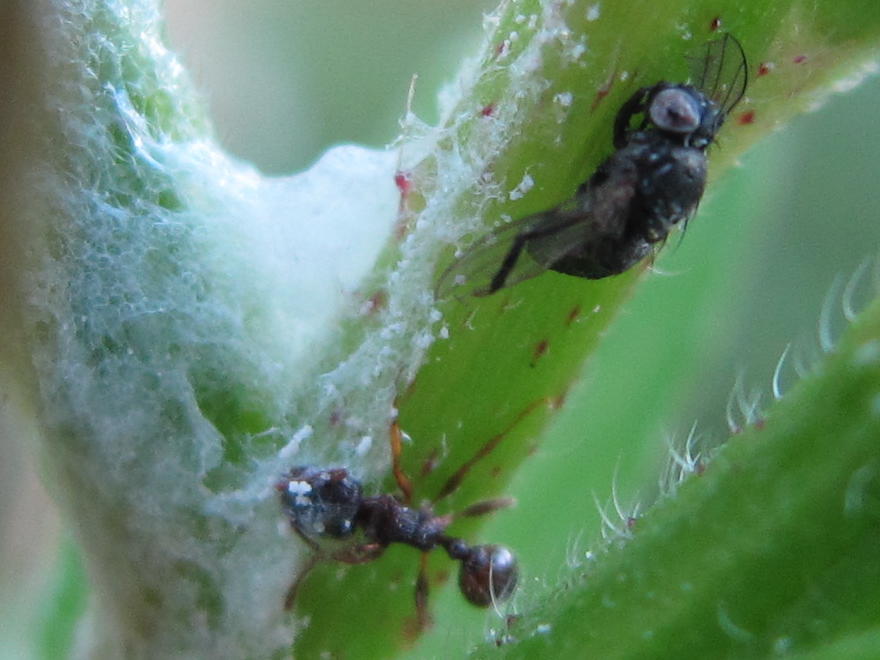
The foam is apparently a tasty, but dangerous treat for many insects.  This ant and fly seem to have gotten stuck and perished in the sticky substance.  Even if the Evening Primrose didn’t have such nice flowers, the insect interactions alone would be worth having a few of the plants around.

Friday, March 23, 2012

Ant Swarm

Everybody likes a good swarm and ants are master swarmers.  I believe this species is Acanthomyops interjectus, AKA Larger Yellow Ant, one of several that produces a lemony fragrance.  They nest behind the brick wall of our cellar and release thousands of winged queens around this time every year.  Usually the swarm takes wing in the basement, but this year’s warm weather may have altered their pattern to an outside departure. 
Workers are a yellow or copper color.  Other similar species share this appearance and identification comes down to things such as eye size, hair placement and body size.  I hope I was looking at the right things as I worked my way through the ant key.
Winged females stage beneath rocks and other cover or in shallow subterranean chambers.  When it comes time to leave the nest, the workers rapidly open passageways and shoo the fliers out of the nest.

The workers provide some protection during the exodus, but I think their primary function if to persuade the unfertilized Queens to get out and fly.  Workers are quite apt to give a laggard Queen a little bite of encouragement.

Once the Queens get moving, the action proceeds at a frantic pace.  The goal is to become airborne, mate and settle down somewhere to start a new colony.

The way they climb over one another, it’s a wonder any of them ever take off.  The literature identifies late summer as the breeding time for these ants.  Early spring swarms are described, but no winged males are reported.  I know that in all the years I’ve been watching this colony, I’ve never seen a spring time male.  So I’m puzzled as to what happens to all of these departing Queens if there are no males out there waiting.

After successfully mating, the Queen will shed her wings.  With no males in the vicinity, there could be no mating, but when the swarming activity began to reach its end, I noticed several wingless queens.  Most were wandering the ground in an apparent search for a secluded spot.  A few stuck with their winged colony members.  These may have disappeared back into the protective chambers with the Queens that didn’t make it into the air.  This swarm is in its fourth day with activity beginning about a half hour before sundown and ending about 20 minutes later.  The swarm suddenly erupts from the ground and at some silent signal, all the ants that haven’t flown are suddenly sucked back into their tunnels.

Not all of the hopeful Queens survive the flight.  Water is a death trap.  I frequently find winged Queen ants floating in the Water Garden.  When the flight originates only a few feet away, the number of floating ants really adds up.

The bounty isn’t wasted.  Just about everything likes to eat Queen ants.  Frogs cleaned up most of the swimming ants.  Water Striders also took advantage of the glut of food.  Apparently mating doesn’t interfere with eating, at least for the female.

Wednesday, March 14, 2012

Energetic Ants

Soil temperatures are warming rapidly and this has stimulated the Allegheny Mound Ants, Formica exsectoides, to almost frantic activity.  Damage inflicted upon the mound over winter is being quickly repaired.  This particular blemish was created by a deer that chose to go over the mound instead of around.

Some late winter mounds support a covering of green growth composed primarily of non-native plant species.  Kentucky Bluegrass and a variety of mustards make up the bulk of the growth.  Some colonies tolerate the vegetation on the mound, while others will have the mound cleared of all greenery by mid summer.

Judging by the rate at which debris is accumulating, there must be some major excavation going on down below.  The grass plants are already becoming buried.

Some large loads are being brought to the surface.  This piece was too heavy for a single ant to lift and had to be drug out of the way.

At some holes the ants formed a ring at the entrance, all facing into the mound.  This didn’t seem to fit any logical defensive strategy.

It turned out that those ants were waiting to receive excavated material from ants inside.  The receiving ants carried the material away to be discarded.  They would then return to the hole and wait for more material to be passed up.

I didn’t notice any ants foraging away from the mound, but I did find a group working to drag a cranefly larva up the side of the mound.  If the temperatures remain warm, ants should soon be moving out into the field in search of food.

Thursday, February 2, 2012

Ants Emerge

February 1 brought another day of 60 degree temperatures.  I guess the warmth finally soaked through the ant mounds, because the Allegheny Mound Ants were out making repairs today.

They paid little attention to the ant carcasses bundled up in the Flicker droppings.  I was wondering if there was something of nutritional value in the droppings that would be of benefit to the ants.  That might be the Flickers way of making reparation for ingesting so many of the colony’s members.

Some of the ants were just patrolling.  It’s not unusual for the ants to make a winter emergence, but they tend to stay on the mound during these times.  A drop in the temperature will send them quickly back inside.  It’s probably pretty risky to leave the vicinity of the nest during the winter season.  Ants foraging away from the mound could easily be caught by a cold front and get stranded out in the open.

Most of the ants were busy repairing the damage done by the Flickers.  The repair material was being brought up from somewhere inside the mound. 

The priority seemed to be closing the breach at the bottom of the hole and resealing the mound.  If the weather allows the ants to remain active, their next act will most likely be to fill the hole and restore the mound’s surface to its original smooth curve.

Judging by the smile, I’d say this guy is as happy as I am to be outside on such a beautiful day.

Wednesday, February 1, 2012

Ant Mound Flicker Droppings

January 31 high temperatures made it into the mid 60’s, so I decided to check out some ant mounds to see if there were any ants moving about.  There was no ant activity, but I did notice several holes left by a foraging Flicker.  Flickers on the ant mounds are a regular occurrence.

Flicker holes are usually narrow and deep.  I imagine they get their bill down the hole and then fish for ants with their tongue.  I remembered the comment made last week by James Trager about Flickers leaving droppings full of ant exoskeletons on the mound and began to search for similar droppings here.

No ants in this rather loose dropping.  I was wondering if the snail shell was already in place before arrival of the dropping or if it actually went through the bird.

This is what I was looking for.  There’s a lot of material packed into this little nugget.

Here’s a neat ant exoskeleton looking like it just took a trip through a trash compactor.  That’s pretty good evidence that the birds are actually feeding on ants.

Crumbling the dropping reveals a great assortment of ant parts.

Mixed in with the ants were many Eastern Red Cedar seeds.  Apparently the Flickers have also been feeding on the cedar fruits.  Thanks for the tip James.  It made for an interesting investigation.