Showing posts with label Storms. Show all posts

Friday, April 10, 2015

Rain and Flooding

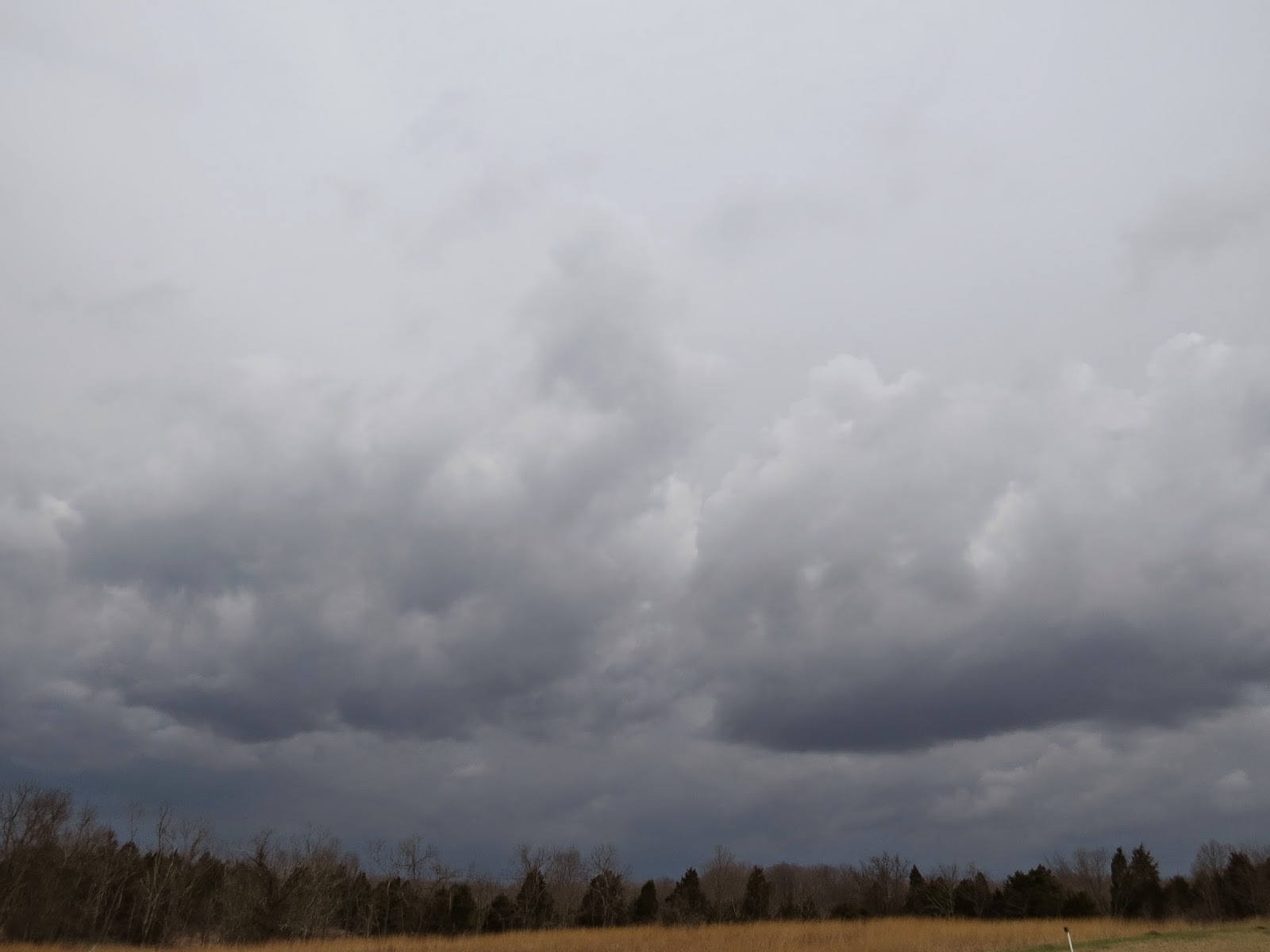
Blue Jay Barrens is about as wet as it can get.  A long sequence of storms moving through during the past week has dropped nearly six inches of rain over the area.  Storm clouds moved through once or twice every day.

The soil, already fully hydrated by over six inches of rain in March, quickly became saturated and the output of each storm had nowhere to go but to run overland to the creek.  A storm yesterday afternoon produced 0.8 inches of rain in 15 minutes.  The result was a flash flood, the third this week.

Water from the township road carried red clay particles to the pond.  It looks like a bowl full of mud, but the water clarity is not as bad as it appears.

A closer examination shows the water to still be fairly clear.  The clay tint makes the dark Wood Frog tadpoles easy to see. 

The tadpoles have just recently taken on the traditional tadpole shape and become free swimming.  If these rains persist, there will be no problem of the pond drying up before the tadpoles transform into little hoppers.

The diversions around the vegetable garden have been working overtime this spring.  The garden sits in a level area that was formed by eroded soil being trapped by an elevated roadway.  Without the diversions, water would inundate the garden after every rain.

After each storm, I check to see that the female Carolina Wolf Spider is alive and well.  So far, she seems to have been unaffected by even the heaviest of rains.
Small upland waterways swell to wide streams as the water quickly rushes downhill.  After each rain event, I try to get down to the creek to see how the increased water flow moves through the channel.

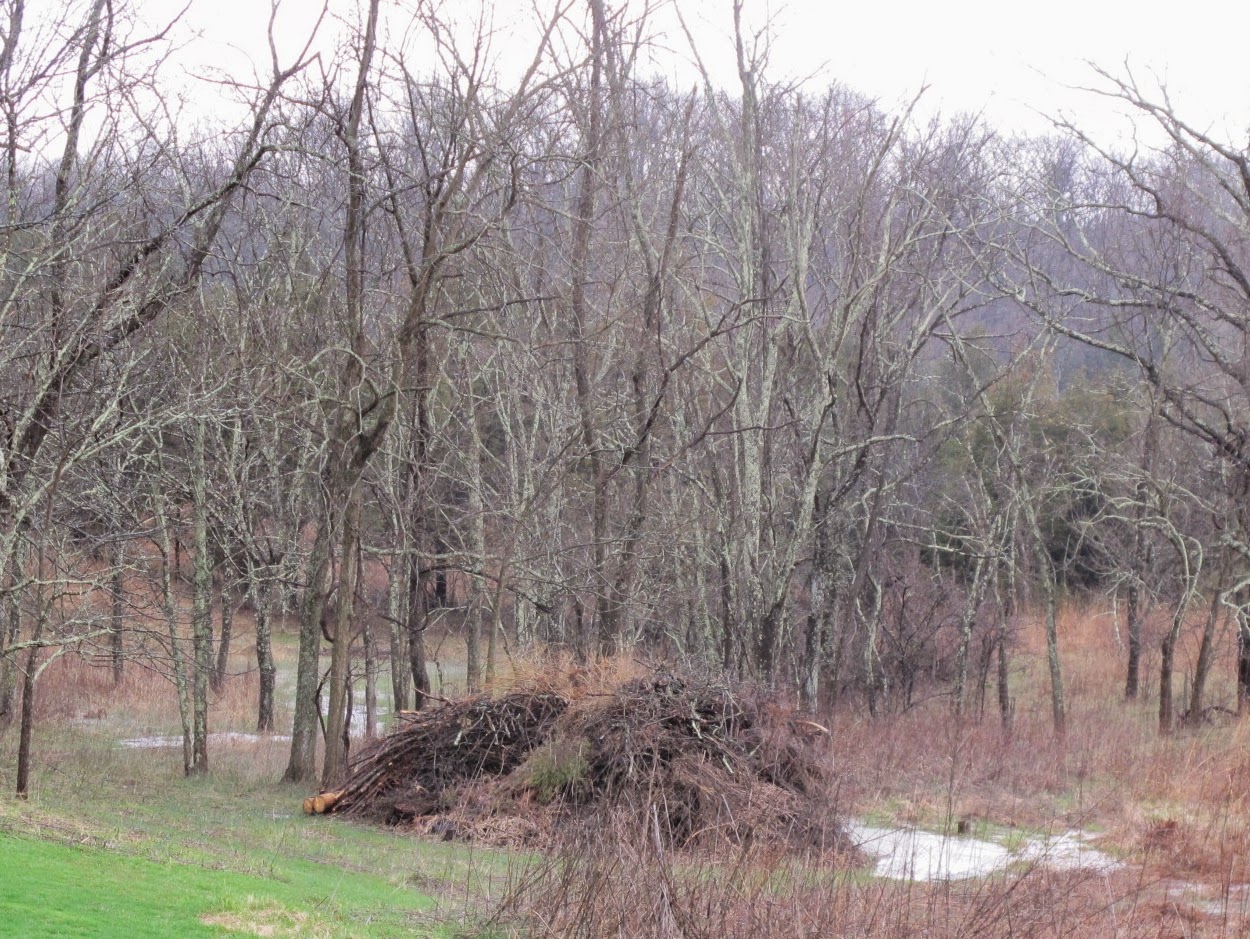
The quickest way to the creek is over the hill.  Even in the driest, most well drained locations, water still stands on the surface.

Five minutes after the rain has stopped, concentrated water flow is still pouring from small woodland watersheds along the creek. 

Water running from these woodland areas is generally clear, but it carries a heavy load of leaves.  The result is a mosaic of bare ground and thick piles of leaves.  This will influence the pattern of plant growth through the rest of the year.

I’m always relieved when I see the bridges still intact.  All but one of the bridges have been replaced to an elevation above the record flood level.  If we do get a flood capable of tearing out this bridge, I hope I’m here to see it, because it will be a truly rare and terrifying event.

Calm and scenic features, such as a small waterfall, are covered over by the flood.  It’s always a surprise when the water drops and the creek resumes its earlier appearance. 

Water pools in the flood plains as it waits for a chance to seep into the ground.  This soil is very well drained and normally allows rapid water infiltration.  Its appearance now makes you think of vernal pools and amphibian breeding, but given a day without more rain, it will pass all of this water into the creek.

This is the last bridge needing to be repaired and elevated.  It has been moved and battered by flood water many times over the years.

Downstream of the bridge is the area blocked by a log jam a couple of years ago.  Since the removal of the jam, water now flows freely through the channel.

Since I wait for the lightning to clear the area before venturing out after a storm, I usually miss seeing the water at its highest level.  At the peak of the flood, water left the creek channel and moved overland.  This area was scoured clean when the water was suddenly blocked by the formation of a log jam and forced out here.  It’s likely that a new channel will be formed here someday.  I could have left the log jam in place and let the new channel form, but this little area has a nice collection of woodland flowers that I would like to enjoy for a while longer.

The third of three large bridges is now well above flood level.  This bridge was repaired using sections of decking from two older bridges.  I think this one is elevated and anchored well enough to withstand any flood.

I find still photos of rapidly moving water to be lacking in impact, so I have included a short video that captures the movement and sound of the angry creek.  It is also available for viewing on YouTube by clicking HERE.

Friday, March 6, 2015

Return of Heavy Snow

The latest winter storm began dropping snow on Blue Jay Barrens early Wednesday evening.  Snow fell steadily through the night and continued until late Thursday morning.  The total snowfall was eight inches. That wasn’t close to being a record, but an eight inch snow is considered to be a major event in this area.  Temperatures are predicted to warm rapidly over the next week which should melt this snow fairly soon.  Of course, thick snow cover has a way of keeping temperatures colder than predicted, so I expect to be seeing this snow for a while.

Unlike our last snow event, this snow began with a couple inches of large wet flakes that stuck to whatever they touched.  This formed a base of snow on tree branches that caught much of the dry snow that followed.  Cedar branches developed a noticeable droop.  Some cedars lost their cone shape altogether and took on the appearance of sprawling shrubs.  Most will recover their shapes once the snow melts, but there are always a few left with a permanent disfigurement.

The Indian Grass managed to remain upright through this snow.  A few stalks developed a strong lean, primarily due to becoming saturated with water during a heavy rain event preceding the snow.

This winter storm officially began as rain on Tuesday afternoon.  Temperatures reached 50oF and almost two inches of rain fell during the next 24 hours.  By the time the rain changed over to snow, most of the snow from the prior storm had melted.

The rain was more than enough to fill the pond.  Cloudy water made it impossible to make a visual check for any new salamander activity.  Frozen slush now covers the pond’s surface, so I’ll have to wait for the melt to see what may be occurring in the water.  A few Spring Peepers began calling late Wednesday afternoon, but they grew silent when the temperature and the heavy snow began to fall.

During that brief period between one snow cover and the next, I noticed that voles had left the tall grass fields and extended their foraging tunnels into the lawn.  Voles forage in areas that provide a thick grass canopy capable of shielding their activities from predators.  Deep snow offers a temporary canopy cover that allows foraging in normally inaccessible areas.

Voles are plant eaters that feed on a variety of leaves, stems, bulbs and roots.  As they progress through an area, eating whatever they find suitable, they develop runways that are then used as travel lanes to quickly escape predators, move to and from temporary nests, or to access new foraging areas.  The floor of the runway is generally bare ground and the sides are lined with plant material unsuited to consumption.  Extensive systems are often developed.

I’m impressed by the amount of work the voles were able to accomplish in the short time the yard was covered by snow.  It’s a more impressive accomplishment when you consider that the vole was eating its way along.  Fortunately, I have no desire to make the lawn a manicured landscape of introduced grasses, so am not disturbed by the activities of a few hungry voles.

Friday, January 30, 2015

Some Color - By Request

I received a complaint that my posts have been featuring too much brown and gray.  Well, that tends to happen during the winter.  Fortunately, winter is a prime time for a wonderful atmospheric event that quickly turns a dreary day into a colorful diorama.

Most people are familiar with the fact that sunlight is made up of a broad pallet of colors, as demonstrated by passing light through a prism to reveal individual bands of color from red to violet.  As sunlight comes streaming through the atmosphere, it collides with air molecules and certain colors are deflected from the light stream.  This process is known as scattering and the scattered colors become visible.  Colors at the violet/blue end of the spectrum are most easily deflected and are broken out for us to see.  That’s what produces the blue sky.  Evening sunlight cuts diagonally through the atmosphere, so the light must travel a longer path.  By the time it reaches us, the violet and blue have already been removed from the beam to create a blue sky somewhere out west and we see the remaining colors from the red end of the spectrum. 

The scattering effect occurs each evening, but to get the best display, you need a platform upon which the show can be displayed.  That role is assigned to clouds that pick up the red and orange colors and present them for us to see.

Best condition for viewing occurs when clouds cover the sky, but don’t reach the western horizon.  The low angle of the sun allows the light to pass through the greatest distance of air and then hit the under sides of the clouds.

The back side of a storm front usually produces the best display, because there is usually a sharp delineation between the moisture laden clouds and the dry air pushing them along.

Naked winter trees backlit by the evening sky put the colorful display to best use.

Whether you get orange, red or pink is a function of the distance the light has actually traveled and the amount of scattering that occurred during the journey.

Blue Jay Barrens has been in the path of a series of clippers moving through out of Canada.  Several have passed through just at dusk and have left wonderful conditions for beautifully colored skies.

The timing isn’t always perfect.  Most of the storms have been in a hurry and sometimes drift away without putting on a show.  These sunsets have no bearing on the biological functions at Blue Jay Barrens, but they do a wonderful job of entertaining me. 

Friday, June 20, 2014

Uncontrollable

When managing land for biological systems, there are many factors over which you have no control.  Some of these have an enormous influence over your success.  A prime example is the weather.  Yesterday evening, Blue Jay Barrens was visited by a thunderstorm exhibiting high wind, heavy rain and hail.  Physical evidence of the storm’s passing was abundant.  Downed tree limbs, broken plant stalks and flooding were found everywhere.  What I observed from the relative safety of the front porch, was the toppling of the milkweeds.  It all began with the simultaneous arrival of howling straight line winds and a heavy downpour of rain that sent an impressive wave of water spray breaking over the eves.


Wind and rain subsided slightly as a flurry of hailstones joined the mix.


Milkweeds near the water garden, heavy with rain and battered by hail, began to give way before the wind.


As the hail thinned, rain increased in intensity.  Several milkweeds have remained upright.  At this point, I was thinking the worst of the storm had passed.


I was wrong.  Heavy rain continued, hail resumed and the wind returned with a roar loud enough to send me running to the other side of the house to see if anything dangerous was headed in my direction.  When I returned to the porch 20 seconds later, the wind was driving straight down and pushing spray into the porch and onto the ceiling.


We went from hurricane like conditions to a light summer shower in just a few seconds.  I watched the back end of the storm thrash the woods on the hill across the road and then it was gone.  Amazingly, some milkweeds are still standing.


Violent summer weather may be uncontrollable, but that doesn’t mean it’s unpredictable or unexpected.  The milkweeds around the water garden, as well as many out in the fields, get flattened every year.  Younger specimens can almost bring themselves back upright after a storm, while those at this stage will gradually reorient the top of the plant so the flowers are held up for insect visitors.  Their susceptibility to storm damage does not diminish their importance as a valuable part of the natural ecosystem.


The milkweed stalks have not broken at the base and can be returned to an upright position if stakes are provided for support.  Since these are growing right outside the front door, I’ll do my best to return them to their proper orientation.  My wife claims that they remind her of Triffids lurking in wait near the porch and I don’t want them to appear as though they are reaching out to her.


The leaves will carry their hail damage for the rest of the season.  The milkweeds colonized the water garden flower beds on their own several years ago.  I left them alone to grow and increase their numbers because this patch seemed to be a preferred egg laying site of the Monarch butterfly.  Monarch caterpillars have always been present on these plants by this date in past years and evidence of their feeding should be present on the leaves right along with the hail damage.  This year I have yet to see my first Monarch.  Plenty of other insects utilize the milkweed, but it just doesn’t seem right without the Monarchs.

Monday, August 13, 2012

Rains Still Can't Drive Away the Drought

We continue to have periodic rain storms, but they have done nothing to alleviate the drought.  A drought is not considered to be over until the rain water percolates through the soil and regains contact with the ground water aquifer.  The quantity of water delivered with each storm has been far less than that needed to saturate the entire soil profile.  What has developed is a shallow layer of moist soil overlaying dry.  Each storm on the horizon brings the promise of a long, soaking rain.

There has been enough rain to revive many of the plants.  Although this makes things look more pleasant, the plants may suffer from this action.  Blue Jay Barrens offers a dry environment for plant growth.  The soil typically dries out in early August and stays that way until November.  Perennial plants push new roots deep into the soil to take advantage of moisture found there.  In situations where there is no detectable deep level moisture, some plants will confine new root development to the moist zone near the surface.  Since plant roots are continually dieing and being replaced by new growth, much of this year’s deep root mass will not be available later on.  If harsh conditions return next year, these plants may suffer greatly when the surface area turns dry and there are not enough deep roots left to support growth.

I keep thinking that the next storm will be the one to put us back into a more normal pattern.  I’ve been constantly proven wrong.  We get the rain, but it’s usually in the amount of about half an inch.  We also get lightning, hail and wind.  Each storm takes down a few trees and drops debris everywhere.  We were lucky not to lose our electricity with this storm.  When I went out to assess damage, I could hear generators running on the ridge west of us, so I assumed their electric lines were down.  That night I could see no security lights and the early morning air carried the sound of chain saws working on the ridge.  I guess they got the brunt of it this time.

It has to have been a rough year for tree nesters.  So far this year I’ve found 11 downed bird nests with broken eggs and a half dozen fallen squirrel nests.  With the way the trees have been whipped around, I wouldn’t be surprised to learn that some nests were flung into the next county.

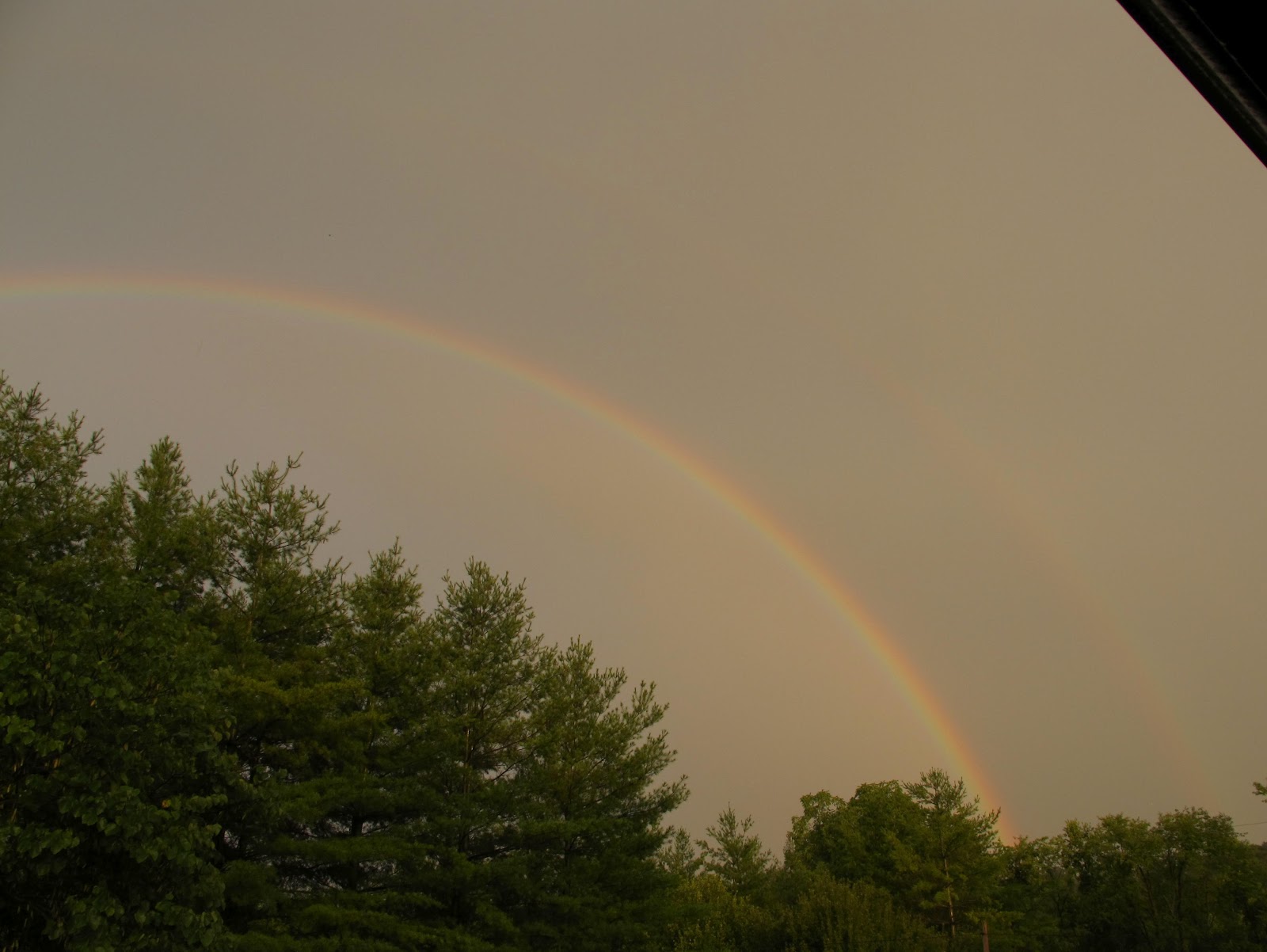
The violence is short lived and daytime storms end with a farewell rainbow.  I’ve seen more rainbows this year than I’ve seen over the past 10 years and there’s plenty of time left for more storms.  The wild weather makes it difficult to assign a cause to some of the atypical growth patterns showing up at Blue Jay Barrens this year.  It could be flood or drought or heat or any combination of weather events.  I guess I’ll just have to watch things unfold and learn what I can along the way.

Thursday, August 2, 2012

A New Woodland Clearing

I finished my survey of the woods and found another area that suffered several broken trees as a result of the wind storm that came through at the end of June.  In this case, about a dozen neighboring trees all went down together to create a sizable opening.

A huge void is now present in what was just recently a closed canopy. 

Because of heavy cattle usage long ago, this section of woods was almost park-like in its absence of shrubs and mid-level trees.  The lack of damage to the surrounding trees makes me think that a violent down draft occurred along with the straight line winds.

As with the other damage site, these trees were broken off rather than uprooted.

All of the downed trees had already been weakened by damage and defects inside the tree.  Trees in previously grazed woodland may grow for decades after the removal of the livestock, but they never recover from the damage that was done.  Eventually the weakened tree will fall to some unexpected event.

The trees all fell in the same general direction and the tops hit ground outside the newly formed clearing.  That has created quite a long row of tangled branches.

A few trees broke high on the trunk.  This area is going to be a wonderland of dead wood.  The Pileated Woodpeckers will be worn out trying to tear apart all of those dead logs and stumps.

This oak and maple have made an interesting tangle.  I believe the oak broke first and leaned over onto a larger tree.  As the maple fell, it caught the oak mid-trunk and drove it to the ground.  The oak top, hopelessly tangled in the large tree, remained in an upright position causing the trunk to suffer a second break.

It will take years for these logs to reach their final resting place on the ground.  As the smaller branches weaken from decomposition they will break and allow the trunk to shift or fall into a new temporary resting place.  There’s still plenty of danger here to the unwary person who inadvertently puts himself in the way of a shifting tree trunk.

There’s still about 40 feet of the oak tree being held vertically.  That will eventually fall and could still do a lot of damage if a hapless person were to be caught beneath.

That gaping hole in the canopy will let in a lot of sunlight.  That will not just change the look of the clearing.  All of the surrounding open woodland is going to have a sudden wealth of sunlight and a corresponding surge of understory growth.  It will be interesting to see how things progress.