My water garden is suddenly loaded with Cricket Frogs. This is something that hasn’t happened before and I’m not sure if they are adult frogs that moved in when other places began to go dry or if they are freshly metamorphosed youngsters. Whatever the reason, I love seeing all of these frogs.

Cricket Frogs are neat little things. Although they are considered treefrogs, their tiny toe pads aren’t well suited to an arboreal life style. I guess these are the treefrogs that specialize in roots and fallen leaves. Their warty skin and earth tone coloration makes them very well camouflaged on the ground, but their backs often display bright green patches or stripes.

I’m inclined to believe that these are young frogs that developed in the water garden. I heard a Cricket Frog calling in the water garden this spring, so I’m assuming some eggs were laid. Cricket Frogs have bred in the pond many times in the past, but have never moved to the water garden during dry weather. All of these frogs are at the lower end of the adult size range, which also seems to be the higher end of the newly metamorphosed size range. Plus, I saw one that looked like it had a nub of a tail, so I’m looking at them as kids.

The behavior of this guy also suggests that it is young. Here, it has spotted a Mound Builder Ant that is pulling itself out of the water.

This ant certainly looks like something that should be eaten.

Well, I managed to miss photographing the actual attack. The frog lunged, grabbed, spasmed and ejected the ant in less than a second. The ant seems a bit frazzled and the frog appears to be a little wiser. I think an older frog would have already learned not to grab the red and black things that give such a nasty bite.
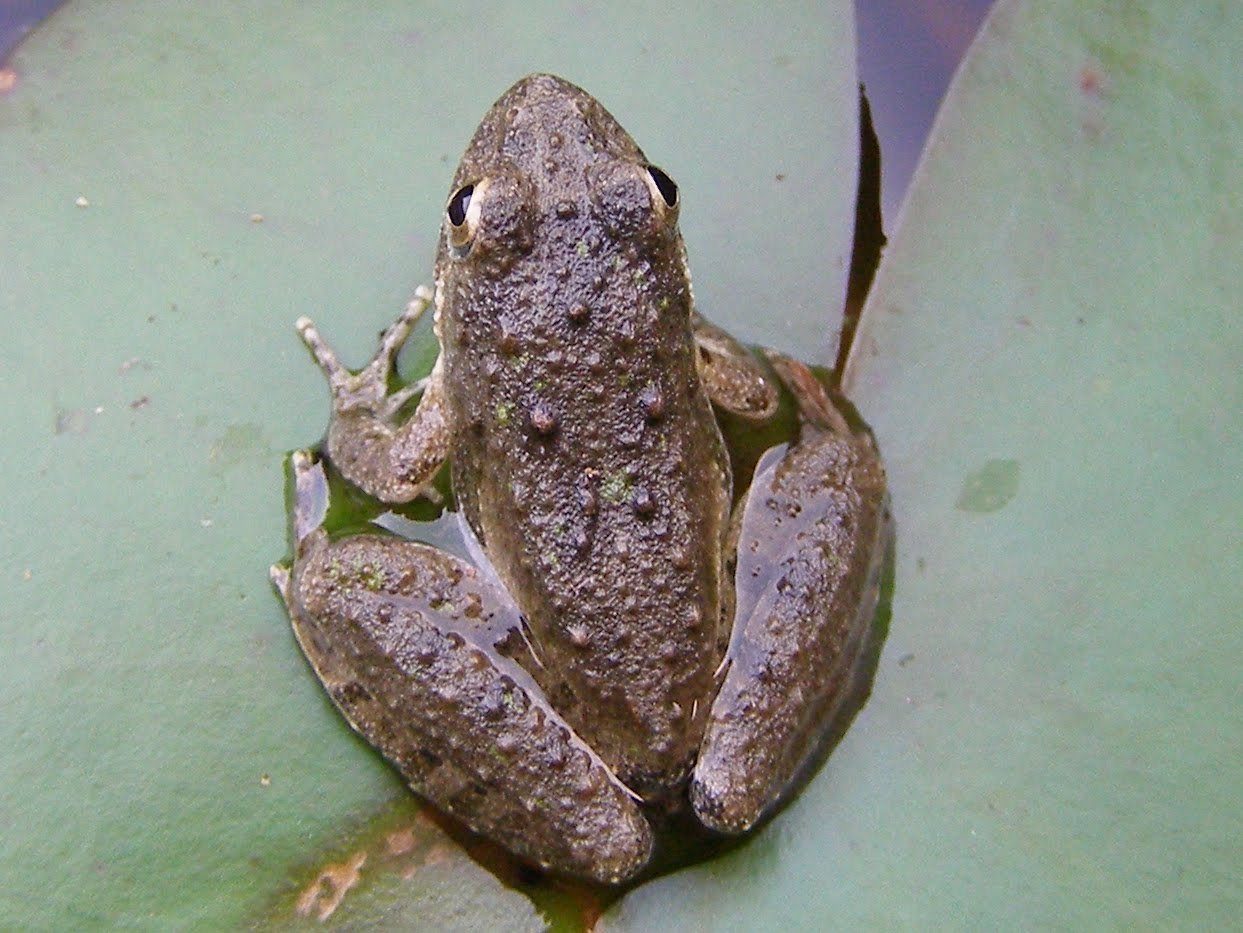 My water garden is suddenly loaded with Cricket Frogs. This is something that hasn’t happened before and I’m not sure if they are adult frogs that moved in when other places began to go dry or if they are freshly metamorphosed youngsters. Whatever the reason, I love seeing all of these frogs.
 Cricket Frogs are neat little things. Although they are considered treefrogs, their tiny toe pads aren’t well suited to an arboreal life style. I guess these are the treefrogs that specialize in roots and fallen leaves. Their warty skin and earth tone coloration makes them very well camouflaged on the ground, but their backs often display bright green patches or stripes.
 I’m inclined to believe that these are young frogs that developed in the water garden. I heard a Cricket Frog calling in the water garden this spring, so I’m assuming some eggs were laid. Cricket Frogs have bred in the pond many times in the past, but have never moved to the water garden during dry weather. All of these frogs are at the lower end of the adult size range, which also seems to be the higher end of the newly metamorphosed size range. Plus, I saw one that looked like it had a nub of a tail, so I’m looking at them as kids.
 The behavior of this guy also suggests that it is young. Here, it has spotted a Mound Builder Ant that is pulling itself out of the water.
 This ant certainly looks like something that should be eaten.
 Well, I managed to miss photographing the actual attack. The frog lunged, grabbed, spasmed and ejected the ant in less than a second. The ant seems a bit frazzled and the frog appears to be a little wiser. I think an older frog would have already learned not to grab the red and black things that give such a nasty bite.