Showing posts with label Asclepias viridis. Show all posts

Friday, May 27, 2016

Spider Milkweed Project

Two years ago, I planted seeds of the Spider Milkweed, Asclepias viridis, in one of the garden beds, with the intent that the plants would host the larvae of the Unexpected Tiger Moth, Cycnia inopinatus.  That State endangered moth is primarily known for using Butterflyweed, Asclepias tuberosa, as a host plant, laying its eggs in the milkweed flowers.  I noticed that the Unexpected Tiger Moth had two broods at Blue Jay Barrens.  The early brood appeared prior to the blooming of Butterflyweed and was using Spider Milkweed as a host.  Adults emerging from that brood then layed their eggs on Butterflyweed flowers.  Populations of these two species of milkweeds were located in different areas of the property.  I thought that having the two species growing in close proximity might improve the breeding success of the moth.  Since I already had Unexpected Tiger Moths utilizing Butterflyweed in my garden, I decided to add a population of Spider Milkweed and see what happened.  This is their first year to bloom.

Spider Milkweed is the earliest milkweed to bloom at Blue Jay Barrens.  Shoots were breaking ground on April 18.

This is the same plant nine days later.  Multiple stems radiate from a common root system. 

Barely more than a week out of the ground and a cluster of flower buds has formed.

Plants are currently actively blooming.  I’ve been watching for both moths and larvae, but have seen neither yet.  These plants should produce enough seed for me to plant the rest of this bed to milkweeds and to scatter seeds back into the field where the original seeds were collected.

Sharing the bed with the Spider Milkweeds are Draba cuneifolia, which produced an abundance of seed, and …

Leavenworthia uniflora, which may have set a record for the greatest number of seed pods on one plant.

Monday, June 16, 2014

Unexpected Tiger Moth Larvae

The blooms of my favorite milkweed are quickly fading from the prairie landscape.  Spider Milkweed, Asclepias viridis, is an early season bloomer that generally ends its flowering period before the first day of summer.  Not only does this plant produce an amazingly interesting flower, it also is a focus of activity for a variety of animal species.  It’s impossible to look closely at these flowers without some small creature looking back.


The pale green flowers are impossible to miss.  If Spider Milkweed is in the mix, it will certainly be noticed. 


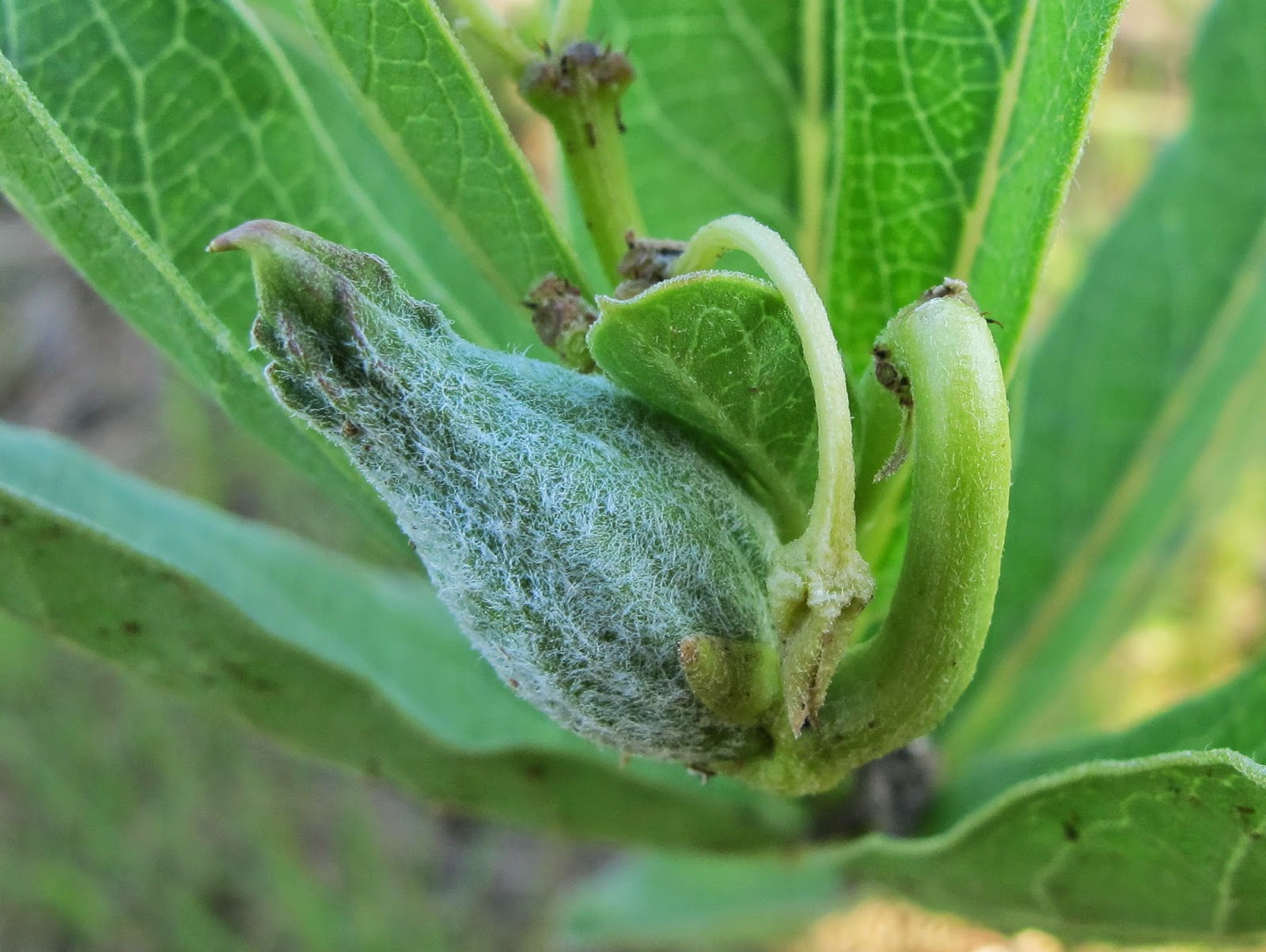
Having a multitude of insect visitors means a quick pollination.  Seed pods soon replace flowers.  By mid summer, seeds will fly and the plant will begin to enter its dormancy.


Among its many insect visitors, Spider Milkweed supports the larvae of the state endangered Unexpected Tiger Moth, Cycnia inopinatus.  The orange bodied larvae are easy to see against the green of the plant.


The Unexpected Tiger Moth is double brooded in southern Ohio and is generally associated with Butterfly Weed, Asclepias tuberosa.  The body color of the larva tends to blend with the orange flowers of the Butterfly Weed and provide some protective camouflage.  That strategy doesn’t work on the Spider Milkweed.  Many insect species that feed on milkweed develop toxicity by consuming and processing the toxic compounds in the plant.  Orange coloration is a common trait shared by these insects and indicates to predators that the insect is best left alone.  That may help this colorful larva to avoid predation.


I assume that the adult moth lays its eggs on the flower buds of the Spider Milkweed.  Signs of feeding on the flowers is the first clue that Unexpected Tiger Moth larvae are on the plant.  As the larvae grow, they move on to feed on the leaves.


During the last few years, I have noticed that the first brood of the Unexpected Tiger Moth utilizes Spider Milkweed and the second brood uses Butterfly Weed. That means it is necessary to have an adequate population of both milkweed species in order to have a healthy population of moths.  Currently at Blue Jay Barrens, Butterfly Weed is much more common than Spider Milkweed and the two species grow in different areas.  I am now attempting to establish Spider Milkweed populations in closer proximity to the Butterfly Weed to see if this increases the numbers of Unexpected Tiger Moths. 


Part of that activity will take place in my garden where this clump of Butterfly Weed has a history of hosting second brood Unexpected Tiger Moths.  It takes two or three years for a Spider Milkweed plant to reach flowering stage, so it will be a while before I know if my plan is successful.  I’m hopeful that I will eventually see this effort benefit the moth.  Even if it doesn’t, it will be nice to have more Spider Milkweeds growing in the fields.

Tuesday, May 22, 2012

Spider Milkweed and Caterpillar

Spider Milkweed is putting on a wonderful show this year at Blue Jay Barrens.  This is a spring blooming species that is usually well past flowering by the time summer arrives.  I thoroughly enjoy this plant.

The flowers are jumbo sized compared to other milkweed species, but seem to be the least attractive to butterflies.  The most frequent flower visitors are ants.  These small black ants are in every flower I check.

Blue Jay Barrens is at the extreme northern limit of the Spider Milkweed’s range.  This is a southern species, so I imagine cold winter temperatures are one of the factors controlling its northward expansion. 

The plants are generally long lived.  I’ve got a couple of clumps that have been around for at least 15 years.  Occasionally a plant will fail to return in the spring. On average, the number of plants continues to increase, so I’m fairly confident that Spider Milkweeds will remain a permanent resident.

I have populations of Spider Milkweed at three locations.  One is growing in dry ground on a hill top, the second is in dry, rocky ground on the upper slopes of a steep hillside and the third is in wetter soil near the base of a hill.  That tells me that the plant should thrive in any of the open areas found here.  Up until last year, I had six Spider Milkweeds growing in my Prairie Garden, but Allegheny Mound Ants moved in and chewed the plants to the ground.  I don’t know why this happened, but it makes me wonder if the ants will allow this plant to grow near their mounds.  There are currently no mounds near any of my existing Spider Milkweed populations.

All of the populations contain a few younger plants.  It typically takes several years before the plant is old enough to flower and then a couple years of small flower heads before producing the display shown in my first photo.  All of my plants of this species show a bit of a lean.  Young plants especially may grow in an almost horizontal position.

Last year, this plant hosted a batch of caterpillars of the Unexpected Tiger Moth, Cycnia inopinatus, which I photographed, but didn’t identify until they had disappeared.  I was quite excited when I discovered this to be an endangered species in Ohio.  The larvae begin feeding on the flowers and then progress to the leaves.  I found some signs of flower feeding, but could see no larvae.

I was luckier when I checked a plant in another population.  This cluster of flowers was full of larvae, at least three of which are visible in this photo. 

The larva host plant is growing on the hill behind the house, so it is in a convenient place for me to frequently check.  Hopefully, I’ll be able to follow the progress as these larvae develop.

Monday, June 6, 2011

Spider Milkweed

Spider Milkweed, Asclepias viridis, is my favorite of the milkweeds at Blue Jay Barrens. The flower head is both showy and not showy. The lime green corolla lobes are conspicuous from a distance, which is considered to be showy. However, that color makes you think of a sickly, poorly performing plant, which is a failure as far as producing the attractive side of showiness.


This is one of those southern plants that reaches its northern limits in Southern Ohio. The population here has been increasing slowly over the past 20 years. I don’t think it’s in danger of dieing out, even though a few plants turn up missing every time we have a particularly cold winter.


It makes its home in the prairie openings. Full sun and dry conditions seem to best suit its needs. It also seems to do best in areas with minimal tall grass. I haven’t found any of these milkweeds growing in the thick Indian Grass, or Big Bluestem areas.


Flowering stalks are usually around 18 inches tall. Without the flower, they blend neatly with the other vegetation and are hardly noticeable. The lean is typical. I rarely find any flowering stalks that are completely vertical.


Ants are the only insects that I see regularly visiting the Spider Milkweed flowers. It’s odd that other milkweed species are so attractive to bees, butterflies and flies, but none of those fliers visits the Spider Milkweed. Ants may be the prime pollinator for this plant.


I found these larvae munching away on the corolla lobes. I didn’t have much luck with a positive ID, possibly because these guys are still so young.


I’ll give the larvae a few days to put on some size and then take another look at them. I just hope I can find them again later. It seems common for young larvae to begin life by eating the more tender parts of the plant, such as the buds or flowers. As they get larger, they move on to the leaves. If I have my typical luck, I’ll find nothing when I go back. We’ll see.