Showing posts with label Hognose Snake. Show all posts

Friday, July 20, 2018

Eastern Hognose Snake

I recently had an interesting encounter with an Eastern Hognose Snake. The snake had gotten itself caught in the mesh of a rat trap that had been set in my barn. My primary concern was releasing the snake from the grip of the wire before it injured itself, so I only took it couple of quick photos before beginning the rescue operation. By snipping and bending a single wire, I was able to quickly release the snake from the trap.

Hognose snakes have a wide repertoire of harmless defensive actions that they employ when they feel threatened. This individual went through the entire routine. It began by flattening of its head and neck in an attempt to look more threatening. As I snipped the cage wire, the snake hissed loudly and produced a guttural noise that sounded almost like a growl. It struck repeatedly at my hands and arms, but its mouth was not open, so all I felt were taps from its nose. As I slid the snake’s body out of the trap, it imitated a death spasm and released a highly pungent poop that splattered on everything nearby. It was an unfortunate circumstance that, due to an ongoing severe thunderstorm, I was performing the rescue operation on the covered front porch of the house.

The next stage in the snake’s act was to play dead. It hung limply from my hand as I took it out for release next to the barn.

Upon being set down, the snake rolled onto its back with mouth agape. 

The above video shows the snake repeatedly rolling over onto its back after being placed belly down.


I left the snake draped around a piece of wood, upright but still looking very much dead. When the thunderstorm abated a few minutes later, I went out to check and found that the snake had moved on. Hognose snakes feed on toads. It’s for this reason that I have been constructing breeding pools in hopes of increasing the toad population. More toads mean more Hognose Snakes, and that’s what I would like to see.

Friday, January 9, 2015

Open Water

The creek and its tributaries are the only natural source of open water at Blue Jay Barrens.  From Fall through Spring, the creek provides drinking and bathing water to a wide variety of birds and mammals.  Summer water is less dependable.  It is common for the creek to stop flowing for several weeks during August and early September.  Occasionally the dry season extends for months.

I have always enjoyed dabbling in water.  As a child, I could spend hours exploring a puddle in the yard. Finding mosquito larvae in the air conditioner drip pan was like discovering a gold mine.  My parents didn’t appreciate my efforts to increase water opportunities by enlarging potholes in the driveway or excavating beneath the downspouts.  My neighbors seemed to share this attitude.  So it’s only natural that once I reached a point where other people’s opinions had no bearing on my actions, I would create pools of water wherever I pleased.  The water garden, as artificial a body of water as you can get, proved quite effective at drawing animals as well as plants into position for my enjoyment.  It does freeze over easily though and doesn’t provide a reliable source of open water for the local wildlife in winter.

Even though my later attempts at developing open water are still artificial creations, they function more naturally than the water garden.  The established toad pool in the foreground and its under construction counterpart behind, are intended to provide a breeding environment for toads.  A declining toad population is coinciding with a decrease in Hognose Snake sightings.  The snakes feed on toads, so it seems logical that increasing the toad population will benefit the snakes.  It’s just a happy bonus that the pools also benefit a wide variety of other animals and give me more places to play in the water.

The new toad pool is still under construction.  The dam creating this pool is composed of topsoil that will eventually be used as topdressing over the permanent dam.  The center of the planned dam will be along the line of stakes sticking from the water.  Pooled water slowly seeps through this temporary dam and emerges clean on the downstream side.  This keeps sediment from actually leaving the construction site during the winter.

Seasonal springs emerge just above the planned water line.  The springs are almost keeping up with the seepage loss through the dam.  This makes me optimistic that the springs will easily keep the pool full of water well into early summer.  Deer visit the pool every night and seem to delight in running and jumping through the mud.

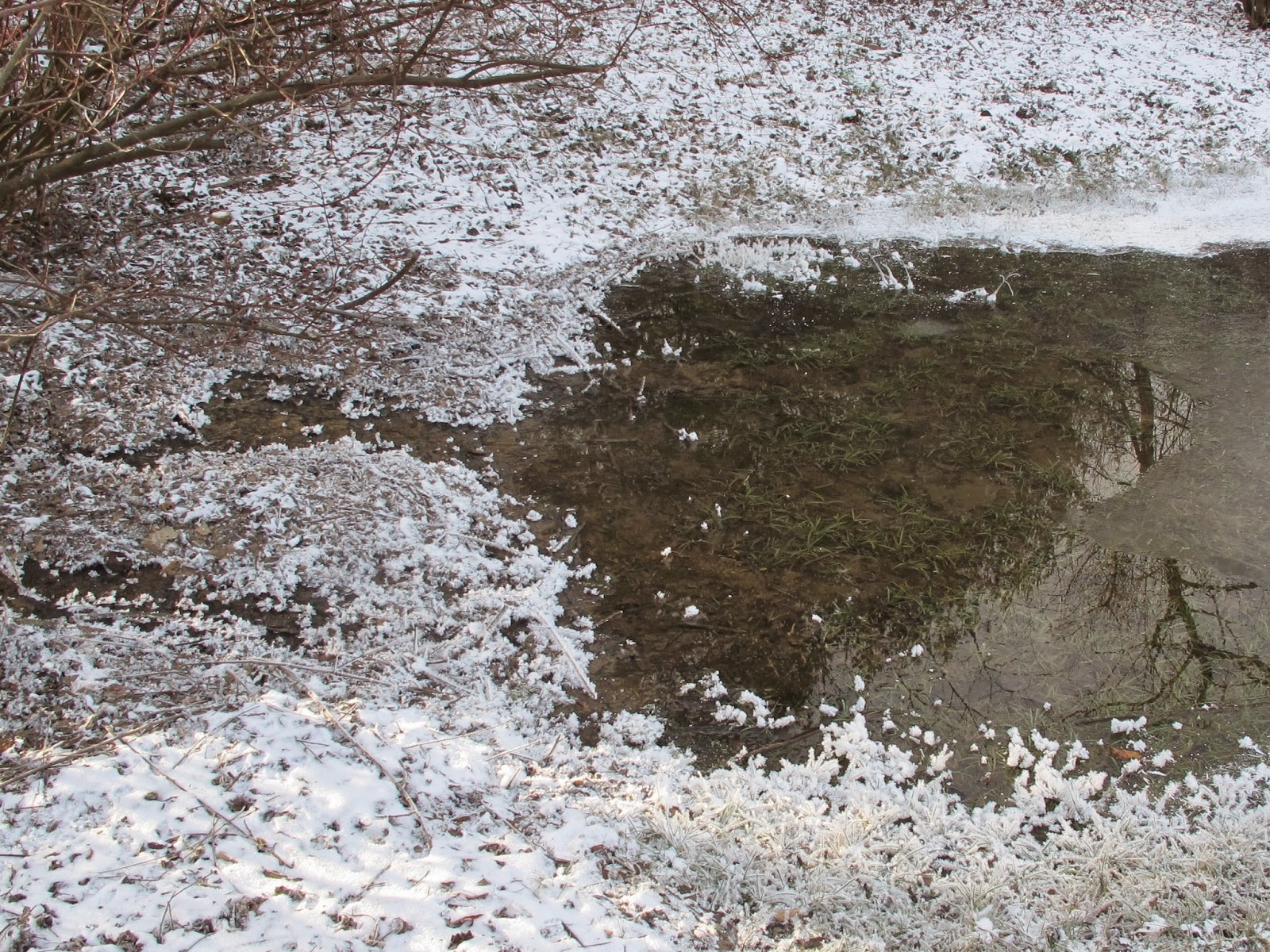
Cold weather caps the pools with ice.  The established pool is fed by a single small spring, but that is enough to keep a bit of water unfrozen.

The spring keeps a small area of open water available to visiting wildlife


The same conditions occur in the pond, an artificial water body that was created long before I purchased the property. 

A strong seasonal spring produces a continuous stream of water entering the pond throughout the winter.

The warm water from the spring maintains a large area of open water.  Even through the coldest winters, this portion of the pond remains unfrozen.  When other water sources freeze over, birds flock here to drink and bathe.

Water from the spring also helps maintain adequate water for the survival of the breeding salamanders.  The view may be blocked by snow, but the salamanders are busy with courtship and egg laying activities beneath the ice.  I would never threaten the native prairies of Blue Jay Barrens with a water development project.  I’m just glad there are a few areas of undesirable vegetation available for conversion to open water.

Saturday, December 26, 2009

Toad Pond Site

Some of my planned projects will result in drastic changes to the landscape. Water flows from many points on the left side of this photo and concentrates at a point to the right. Just out of frame on the right is my combination vegetable and native plant garden. Runoff water used to flow through the center of the garden site, but I built a low diversion to carry the water around the garden. The diversion works perfectly and I’m able to have a very productive garden without excess water or erosion.

The diversion dike produced a short lived pool after each rain and the excess water flowed in this direction through a shallow channel. In preparation of one of my projects for next summer, I lowered the channel center line to eliminate the temporary pool.

The project I have planned for this site is the result of several interrelated observations. The first is the fact that encounters with American Toads, both breeding individuals in the temporary pond in front of the house and individuals found in the fields and woods, have declined dramatically during the last 20 years. The second is the reduction in encounters with the Eastern Hognose Snake, a species that prefers toads over any other prey. If a population of Hognose Snakes is to be maintained here, there must be toads. The plan is to build series of temporary pools that will (I’m not giving the toads an option) be used for toad breeding in the spring.

This site has several points in its favor for such a project. High up the slope are two wet weather springs that will act to keep the pools full for a few extra days between rains. The soils have a clay content high enough to slow seepage loss and maintain a pool during the wet time of the year. The higher moisture content of this site has helped to keep a thick sod of Fescue growing here, so I won’t be tearing up any native plants while building the pool. To maintain the temporary pool ecology, I will have to drain any water that remains into summer. This extra water can be used to irrigate the garden.

The wet weather springs sometimes keep water in this old tire track well into June. I’ll begin my pool construction here with a small pool of 15 or 20 square feet that can be kept full by the springs. The pools in series will gradually increase in size with the last having about 750 square feet of surface area. Actual earthmoving won’t begin until June or July, but there are other preliminary activities that I’ll be doing later this winter and spring.