Showing posts with label Rudbeckia fulgida. Show all posts

Thursday, September 6, 2012

Drier Prairie

My original plan was to post about the improved conditions on the prairies following the rains created by the remnants of Isaac that passed through over the Labor Day weekend.  Unfortunately, the total accumulation for the four day event came to one tenth of one inch of rain.  I’m beginning to think we live beneath a rain excluding bubble.  Within ten miles of us in any direction, the rainfall totals for that same period were between two and five inches.  So, the prairies are drier than ever and I’m left wondering by how much this year is going to beat our standing drought record.


Besides being abnormally short, the prairie grasses are having trouble remaining upright.  I’m sure they’ve drawn about all the moisture they can from the shallow soil.  By mid-day the grass is so wilted that it drapes itself across the ground like thin plastic ribbons.


The Reindeer Lichen turns to dust beneath my boots.  I avoid the areas with a predominantly lichen ground cover, but there’s enough lichen scattered through the grass to make a loud crunch every time I take a step.  Fortunately, the Reindeer Lichen regenerates quickly during the rainy season.  The crushed pieces travel with wind and water to establish lichen colonies in other suitable areas.  Even so, I prefer when the lichen is moist and springy.  Then you can travel through the tall grass in almost total silence.


At this time of year the grass should be taller and greener.  I shouldn’t have such a clear view of the ant mounds in September.


A new brood of Allegheny Mound Ants has hatched and the spent cocoons have been discarded atop the mound.   That event is typically followed by new excavation and a fresh exterior being added to the mound.  By the time winter arrives, the mounds are contoured so that rainfall and snow melt flow right off.  There is some new material being brought to the surface, but it’s so dry it can’t be used for any sort of mound repairs.  The winter mounds may look a bit shabby if we don’t get some rain soon.


This slope should be covered with eight foot tall Big Bluestem, but maximum height now is closer to 30 inches.  A few super short Orange Coneflowers and Western Sunflowers stand tall among the dwarfed grass.


Western Sunflower on this site usually sends up a divided flower stalk that produces anywhere from three to nine blooms.  The few plants that bloomed this year were able to produce just a single flower.  These plants do most of their expansion by vegetative means, so the loss of a seed crop is not a disaster.  It’s the birds that will lose on this deal.  Western Sunflower seeds are a favorite of many bird species and this is just one more source of food that will not be available this coming winter.


Friday, August 31, 2012

Orange Coneflower

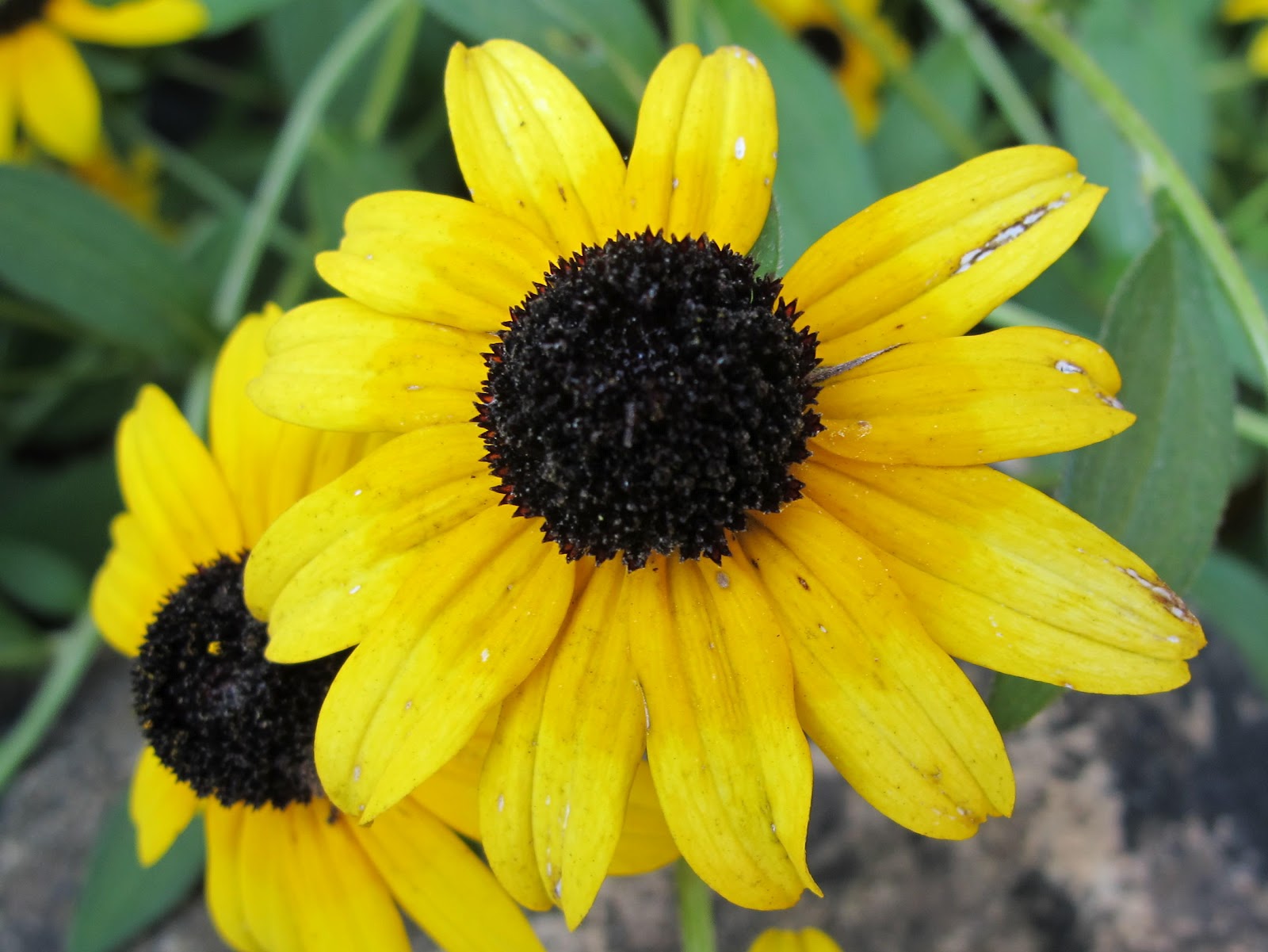
One plant that doesn’t seem much bothered by the drought is Orange Coneflower, Rudbeckia fulgida.  It may appear to be a bit worn, but that’s its normal condition at this stage.

The fertile flowers are found in the central disk.  The flowers mature in succession, beginning with the outer edge and moving toward the center of the disk.  As blooming progresses, the disk expands upward until the center sits well above the yellow rays.

Orange Coneflowers tend to grow in wetter conditions such as are found at the base of slopes or in natural drains through the field.  They also tolerate dry conditions.  I think these two characteristics account for the plant’s vigor during this year’s unusual weather conditions.

Orange Coneflowers are hardy perennials.  Flower stalks will die over winter.  Next year’s growth will come from basal rosettes that form from short stolons produced by the flowering plant.  These basal rosettes typically remain green through the winter and will develop rapidly as soon as it warms in the spring.

Several insect species find the Orange Coneflower of interest.  An unidentified moth larva boring up the center of the stalk produces this dusty material.  The timing of this activity doesn’t seem to affect the ability of the plant to complete flowering and produce viable seed.  Over half of the plants typically contain one or more larvae.

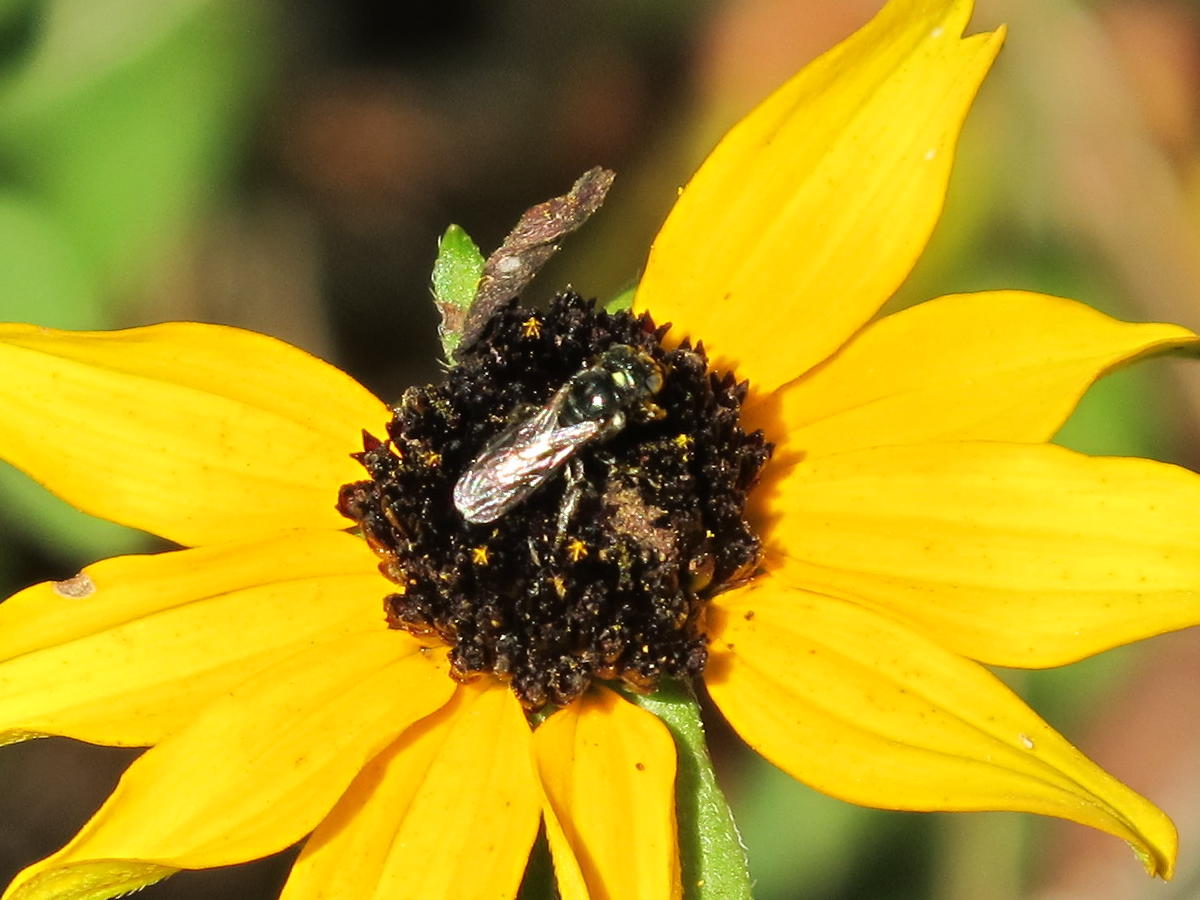
Small bees are the most numerous of the flower visitors.

A few Soldier Beetles are around, but I’m seeing fewer than normal for this time of year.

This neat little fly spent quite some time moving from flower to flower.  This is a member of the Tachinid Fly family, the larvae of which develop inside an insect host that ultimately does not survive the encounter.  Most in that family are big, hairy brutes.  This fellow is a species of Cylindromyia, a genus of wasp mimics.  I don’t see these guys very often and enjoyed observing this one for the few minutes it was around.

There appears to be some type of larva feeding down among the disk flowers and leaving a mass of excrement to mask its passage.  I dug into several of the affected flowers and found nothing but an empty tunnel.  One thing noticeably absent from the flower heads was Crab Spiders.  I can usually find dozens of these small yellow spiders perched on the flowers.  Here is one more regularly common animal species that has failed to appear this year.

Sunday, August 8, 2010

Flowers and Insects

Summer is a time of flowers and insects. Everywhere you look there’s an abundance of life. The entrance to the trail is flanked by nine foot tall Ironweeds and Wingstem. The plants lean in to the open area created by the trail and crowd the pedestrians.

A cicada buzzes away among the Ironweed blooms. I think Ironweed is one of the most spectacular of the summer blooms. I was once in a field with someone who asked me how to get rid of Ironweed so they could grow wildflowers. I just bent down one of the Ironweed stalks and stuck the flower head in their face.

Many of the Wingstem flowers are too high to see. I’ve seen blooming Wingstem range in height from one foot up to ten feet depending on the soil and growing conditions. When I first saw tiny Wingstems, I thought I was looking at a different species. It increases the chances of species survival when species growth pattern can adjust to its environmental conditions.

When Wingstem grows alongside other flowering plants, many of the pollinating insects tend to pass it by. The plants always produce an abundance of seed, despite these low insect visitation rates. This bloom is definitely not for people who like symmetry in their flowers. The flowers of the central disk always seem to open in a lopsided manner and the rays are usually unevenly sized and randomly scattered around the disk.

A couple of weeks ago I was wondering where the Robber Flies were. Now their numbers have surpassed even last year’s abundance. This individual decided to use my pant leg as a perch while it consumed this small fly. It didn’t seem much disturbed by my walking around and stayed with me for quite a while as I photographed flowers.

This pair is busy making more Robber Fly food. These look like Picture-winged Flies, but they could be a type of Fruit Fly. The differences between these two groups are in wing vein patterns and other small characters that can’t be seen in the photo.

Orange Coneflower, Rudbeckia fulgida, is sometimes referred to as Brown-eyed Susan. This is one of my favorites. It’s an extremely hardy perennial that spreads easily by seed. The blooming season runs through the summer and up until heavy frost. Orange Coneflower is a favorite of many species of insects and always has something interesting crawling around on its flowers or leaves. I’ve scattered a lot of this seed around the field and now have an abundance of this plant.